A practical guide to 2026 supply chain AI trends—agents, control towers, digital twins, and automation—focused on real execution and ROI.
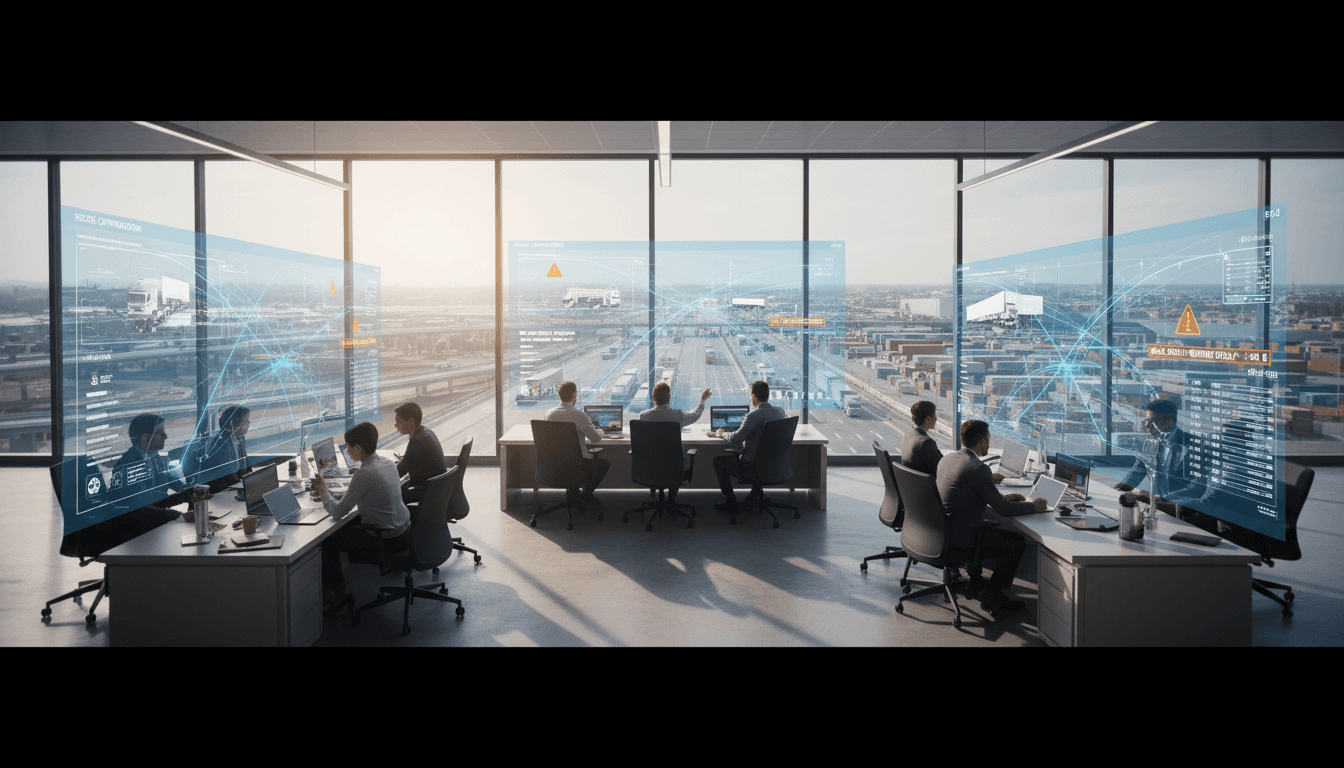
2026 Supply Chain AI Trends for Logistics Leaders
Most supply chain tech budgets don’t fail because the tools are bad. They fail because the tools don’t run the operation—they sit next to it.
That’s the big shift heading into 2026: AI in transportation and logistics is becoming part of day-to-day execution. Not a dashboard. Not a pilot. Not a “feature” tucked inside a platform nobody trusts. Teams are buying technology that shortens decision cycles, reduces exceptions, and makes networks more predictable—especially in the messy weeks we’re in right now (holiday peak, weather volatility, and carrier capacity whiplash).
Below is a practical roadmap for the 10 supply chain technology trends that matter most in 2026, framed for transportation, warehousing, and planning teams who need outcomes: fewer service misses, lower cost-to-serve, and faster recovery when things break.
AI becomes the operating layer (not a bolt-on)
Answer first: In 2026, the winning AI deployments will sit inside TMS, WMS, and planning workflows—where decisions actually happen—so teams can act in minutes, not meetings.
In 2025, a lot of “AI” meant summarizing notes, drafting emails, or producing forecasts that still required a human to translate them into execution. Useful, but not transformational. The operational shift is embedding AI into the steps that create cost and service outcomes:
- A TMS that proposes alternates when a lane fails and creates the tender-ready plan.
- A WMS that dynamically resequences work based on congestion, labor availability, and cut-off times.
- A procurement workflow that surfaces supplier risk signals early enough to change allocations.
Here’s what I’ve found separates strong operational AI from expensive experiments:
- It knows the constraint set. Dock hours, order priority rules, carrier contracts, appointment capacity—AI that ignores these is just “smart-looking noise.”
- It’s tied to a measurable decision. Example: “reduce missed OTIF due to late tenders” or “reduce dwell time in yard.”
- It closes the loop. Recommendations should flow into execution (tender, wave release, appointment changes), with logging so teams can learn what worked.
If you’re building a 2026 roadmap, prioritize AI where you already have repeatable operational decisions—and enough data to evaluate whether the AI helps.
Multi-agent systems: bounded autonomy is the safe path
Answer first: Multi-agent systems will move into production in 2026, but the smart play is “recommendation authority” before “commit authority.”
Agentic AI is getting real traction in supply chain because logistics is full of negotiation problems: inventory balancing, carrier bid responses, yard moves, appointment changes. A multi-agent system can propose actions at speed—sometimes faster than a human team can even assemble the right context.
The risk is also obvious: if agents are allowed to commit changes freely, they can create service failures at scale.
A practical 2026 pattern looks like this:
- Agents recommend reallocations, mode shifts, or carrier alternates.
- Humans approve any decision that crosses cost or service thresholds.
- Agents auto-commit only within pre-approved guardrails (for example: “rebook within same carrier if delay > 6 hours and cost delta < 2%”).
Where this matters most for the AI in transportation & logistics series: multi-agent systems are a strong fit for load matching, carrier bidding, appointment management, and short-cycle inventory repositioning—especially when the operation already has clear policies.
Graph-based reasoning: how AI stops missing the “network effect”
Answer first: Graph-based reasoning is the most practical way to make AI understand supply chain dependencies—so it can explain cascading impacts instead of guessing.
Classic analytics treat supply chain data like tables. Supply chains don’t behave like tables. They behave like networks.
Graph-based reasoning (including graph-enabled retrieval for AI assistants) helps answer questions planners ask every day:
- “If this port slows down, which SKUs are exposed and which customers take the hit first?”
- “If supplier A slips by 10 days, which plants lose components, and what substitutions exist?”
- “Which lanes have regulatory or documentation constraints that make alternates non-viable?”
In control towers and planning tools, graph reasoning becomes the bridge between “visibility” and “action.” It’s also a quiet cure for one of the most common AI failures in logistics: an accurate prediction paired with an unusable recommendation because the model didn’t understand dependencies.
Warehouse automation shifts from hardware hype to orchestration
Answer first: 2026 will reward warehouses that treat automation as systems engineering—fleet orchestration, uptime, and integration—not robotics as a showcase.
The AMR wave taught a blunt lesson: buying robots is easy; running a mixed environment is hard.
Facilities that got real returns typically focused on:
- Orchestration over devices: Coordinating people, AMRs, sortation, and replenishment so work doesn’t bottleneck.
- Uptime and maintainability: “Cool features” don’t matter when a fleet can’t sustain peak.
- Integration discipline: WMS/WES/WCS alignment, event timing, exception handling, and clean master data.
If your 2026 goal includes warehouse automation, the best next steps usually aren’t “more robots.” They’re:
- Reducing exception rates (bad barcodes, missing dimensions, incomplete slotting rules)
- Tuning release logic (waves, waveless, zone strategies) to match real labor patterns
- Adding AI-driven task sequencing that respects congestion and travel paths
This is where AI shows up as real productivity: not replacing labor, but turning variability into flow.
Transportation APIs replace EDI where time matters
Answer first: EDI won’t disappear in 2026, but APIs will become the default for high-value, time-sensitive transportation workflows.
EDI still runs a lot of freight. The issue is latency and fidelity. When operations need near-real-time status, accurate ETAs, and fast onboarding, APIs win.
The practical split is already forming:
- APIs for predictive ETA feeds, exception detection, cross-border documentation, and premium lanes
- EDI as the fallback for long-tail carriers and low-velocity integrations
For AI-driven logistics optimization, the API shift matters because AI needs granular event data. If the only status you get is “shipped” and “delivered,” you can’t optimize dwell, appointment compliance, or dynamic rerouting.
Energy becomes a planning constraint (especially for fleets and DCs)
Answer first: In 2026, routing, scheduling, and facility planning will treat energy like a capacity variable—because electrification changes how you plan.
Electrification is forcing logistics teams to plan around:
- Charging availability and reliability
- Peak pricing and demand charges
- DC energy constraints (especially if automation and charging load stack)
This changes the optimization math. The “shortest route” may not be the “best route” if it strands equipment away from charging capacity. The “fastest schedule” may be the most expensive if it triggers peak energy costs.
If you operate private fleets, regional delivery, or high-throughput DCs, 2026 is the year to ask:
- Do we have energy-aware routing capabilities (not just mileage-based routing)?
- Can we model charging schedules as part of dispatch and dock planning?
- Are we measuring energy resilience the way we measure throughput?
Sustainability shifts from reporting to execution
Answer first: Emissions dashboards are table stakes; 2026 is about embedding sustainability into routing, mode choice, and carrier selection.
In 2025, a lot of companies focused on measuring Scope 3 emissions better. That’s necessary—but it doesn’t reduce emissions by itself.
Operational sustainability looks like:
- Lane-level emissions scoring that influences procurement and carrier awards
- Mode diversification (rail, intermodal, consolidated linehaul) where service allows
- Packaging decisions tied to cube utilization and damage rates (not just material)
The strongest programs treat sustainability as a cost-to-serve variable. Because that’s what it becomes in the real world: carbon penalties, customer requirements, and energy volatility all land in the same operational equation.
Digital twins become daily tools, not annual projects
Answer first: Digital twins in 2026 will be “always-on” scenario engines tied to real operational data—used for weekly decisions, not once-a-year redesigns.
Digital twins have a reputation problem because many implementations were static: a model built for a one-time study that drifted away from reality.
The 2026 version is different:
- The twin is fed by near-real-time operational data (throughput, dwell, labor, carrier performance).
- Teams run scenarios continuously: “What if we re-slot top 200 SKUs?” “What if we shift volume to DC2 for two weeks?”
- Planning and execution get closer: the twin isn’t just analysis—it informs how you respond.
For transportation and logistics leaders, the biggest payoff is faster scenario generation when disruption hits: storms, labor constraints, port congestion, or supplier slips.
Control towers become action centers
Answer first: A control tower that only shows visibility is incomplete; 2026 control towers will route work, trigger workflows, and propose multi-scenario actions.
Visibility used to be the goal. Now it’s the baseline.
What teams want is:
- Alerts prioritized by operational impact (not just “late shipment”)
- Recommended corrective actions tied to specific owners
- Workflow automation that pushes changes into TMS/WMS/procurement
A simple rule I like: If an alert can’t answer “who does what next,” it’s not an alert—it’s a notification.
This is also where AI copilots can help, if they’re grounded in policy:
- “If order is premium + customer is top-tier, propose expedite options under $X.”
- “If appointment miss risk > Y%, propose reschedule windows and notify consignee.”
Risk modeling becomes routine planning
Answer first: In 2026, risk scoring will be embedded into replenishment, routing, and network decisions—because disruption is no longer occasional.
Supply chain teams are done with annual risk reviews that sit in slide decks. The next step is operational risk modeling:
- Disruption likelihood and severity scores by lane, supplier, and facility
- Early anomaly detection (carrier instability, cyber signals, weather severity trends)
- Risk-aware inventory policies (where to buffer, how much, and for which SKUs)
People often ask, “What risk model should we start with?” Start with the one that changes a decision you already make:
- Replenishment: risk-adjusted safety stock for top-margin SKUs
- Transportation: lane risk scoring that influences carrier mix
- Network: resilience scenarios that quantify service impact and recovery time
When risk becomes a design parameter, you stop being surprised by the same failures.
A practical 2026 roadmap (what to do first)
Answer first: The fastest path to ROI is sequencing: fix the data-to-action pipeline first, then scale AI and automation.
If you’re planning 2026 investments, here’s a sequencing that works in the real world:
- Instrument execution: APIs/events, clean status milestones, consistent master data.
- Tighten orchestration: WMS/WES/WCS alignment, exception handling, workflow ownership.
- Deploy operational AI: copilots and models tied to specific decisions (routing alternates, task sequencing, appointment changes).
- Add bounded agents: start with recommendations + guardrails.
- Operationalize twins + risk: use them weekly, not annually.
“AI only creates value in logistics when it changes what happens on the floor or on the road.”
That’s the through-line across all ten trends.
Where this fits in the AI in Transportation & Logistics series
This series is about practical AI: routing optimization, warehouse automation, supply chain forecasting, and last-mile delivery performance. The 2026 trends point to the same stance across each domain: execution wins. Teams that connect prediction to action—via APIs, orchestration, control-tower workflows, and risk-aware planning—will pull away.
If you’re deciding what to prioritize before Q1 planning cycles close, focus on one question: Which operational decision would we like to make 10× faster, with fewer errors, every day? Then build backward from that decision into data, systems, and AI.