Rivian’s AI assistant hints at the next in-car UX: personalized trip planning, charging intelligence, and media experiences built on real-time context.
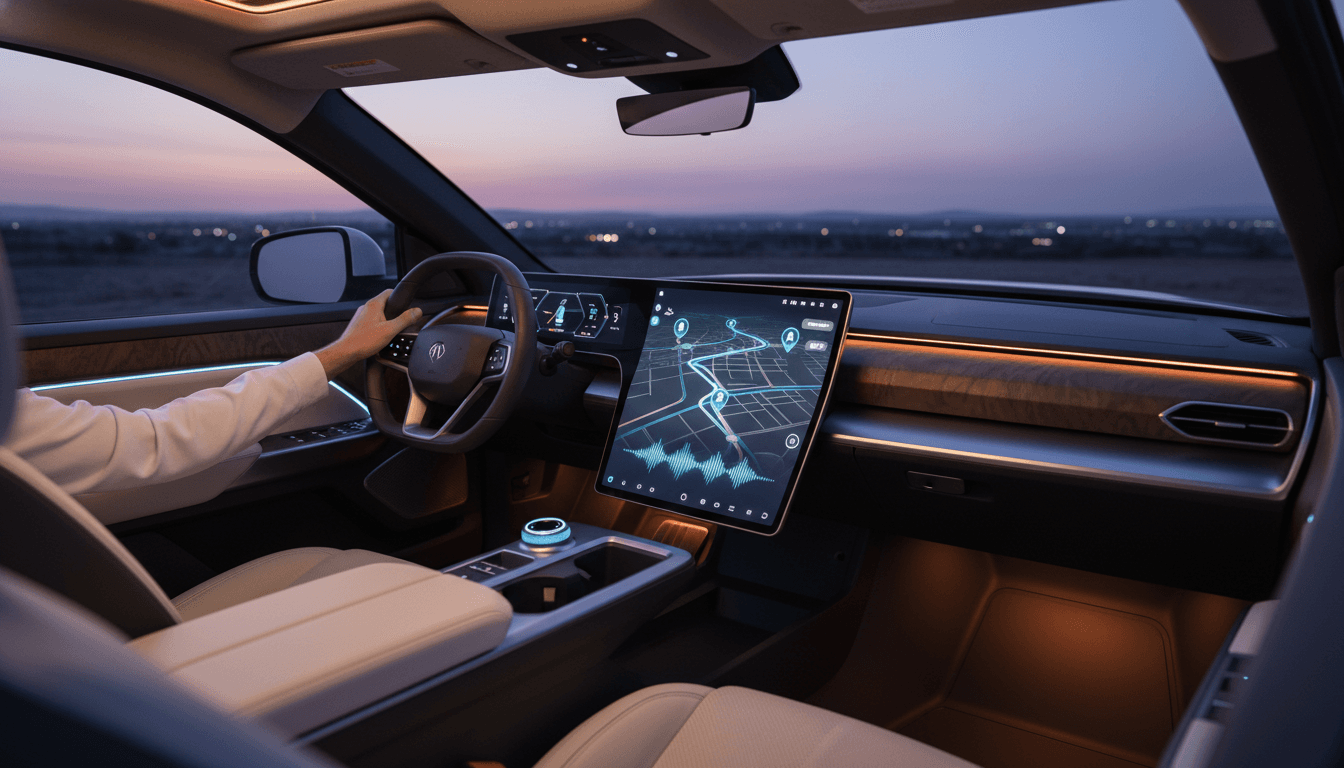
Rivian’s AI Assistant: What It Means for In-Car UX
A modern vehicle already runs on software. What’s changing fast—especially heading into late 2025 product cycles—is how people interact with that software. Rivian building its own AI assistant isn’t a cute feature add-on; it’s a signal that the car’s interface is becoming a real-time decision layer across navigation, charging, safety, and entertainment.
For teams working in AI in Transportation & Logistics, this matters beyond consumer convenience. The same personalization mechanics that power media recommendations are moving into mobility: context, intent, and prediction. If your business touches fleets, last-mile delivery, routing, or connected vehicle platforms, Rivian’s move is a preview of where user expectations are going.
Snippet-worthy stance: The next competitive edge in EVs won’t be another screen—it’ll be an assistant that understands your trip, your constraints, and your preferences, then acts on them.
Why EV makers want their own AI assistant (not someone else’s)
Answer first: Automakers build in-house AI assistants to control the user experience, protect proprietary vehicle data, and integrate deeply with vehicle functions that third-party assistants can’t safely manage.
Voice assistants are easy to demo and hard to ship well. The reason is simple: in a vehicle, “helpful” can become “dangerous” if it’s wrong or slow. If Rivian is investing in its own assistant, it’s because the assistant needs to be tied into systems that aren’t generic—battery management, route planning with charging, driver profiles, climate controls, off-road modes, towing settings, and more.
There’s also a strategic layer. If your car becomes the main interface for services—charging networks, subscriptions, audio content, driver coaching—then whoever owns the assistant owns the “front door.” That’s the same dynamic streaming platforms learned: recommendation and personalization aren’t side features; they’re distribution.
The data advantage: vehicles generate context media can’t
Media platforms personalize from clicks and watch time. Vehicles personalize from a richer stream:
- Location + route intent (commute vs. road trip vs. delivery run)
- Battery state of charge and predicted consumption
- Driver behavior (aggressive acceleration, braking patterns)
- Cabin preferences (temperature, seat, audio levels)
- Time constraints (arrival windows, charging dwell time)
This is why “AI assistant” in an EV is closer to an operations coordinator than a chatbot.
Safety and liability force tighter integration
When an assistant can change driving-critical settings, OEMs can’t rely on a general-purpose model with ambiguous behavior. Expect Rivian (and peers) to emphasize:
- Command confirmation for safety-critical actions
- Clear fallback behaviors when uncertain
- On-device processing for latency and reliability
- Strong permissioning (who can do what, when)
What Rivian’s AI assistant could realistically do well
Answer first: The highest-value wins will be trip intelligence, charging optimization, and context-aware cabin controls—because they reduce friction and reduce operational cost.
The RSS summary notes Rivian will likely share more details around its AI & Autonomy Day. Until specifics land, we can still be practical about what works in vehicles today and what typically disappoints.
Trip planning that behaves like logistics, not a map
Most navigation still treats EV charging as a static constraint. A strong in-car AI assistant should treat a trip like a logistics problem:
- Choose an optimal route based on distance, elevation, temperature, and traffic
- Plan charging stops based on stall availability and charging curves
- Adjust the plan continuously when conditions change
For consumer drivers this feels like “it just handled the road trip.” For fleets, it’s the same mental model as AI route optimization and dynamic routing—except the assistant is explaining decisions in plain language.
What I’d want to hear Rivian confirm: the assistant can re-plan charging with a bias toward minimizing total trip time (drive + charge), not just minimizing number of stops.
Charging optimization that understands real intent
A useful assistant doesn’t just say “charge now.” It knows whether you:
- Need to arrive fast (minimize dwell time)
- Need to arrive with buffer (maximize arrival state of charge)
- Prefer cheaper energy (time-of-use pricing where applicable)
- Want predictable stops (reliability over optimization)
This is where AI-powered personalization comes in. The assistant should learn your pattern without making you build rules.
Cabin and media controls that feel like a streaming app
Rivian’s move is a clean bridge into AI in Media & Entertainment. In-car media is increasingly a primary use case, especially during charging sessions. The assistant can bring “recommendation system” thinking to the cabin:
- Start the podcast you usually play on Friday commutes
- Suggest a playlist based on trip length and noise level
- Shift audio focus during navigation prompts automatically
- Switch profiles when it recognizes a driver (with explicit consent)
The win isn’t novelty. The win is fewer taps and less distraction.
Maintenance and diagnostics as a conversational layer
For logistics operators, the unsexy stuff is where the ROI lives. An assistant that can interpret vehicle health signals can reduce downtime:
- Explain a warning in plain language
- Estimate urgency (“safe to finish today’s route” vs. “stop soon”)
- Schedule service windows based on upcoming routes
That’s directly aligned with predictive maintenance and fleet management trends.
The logistics angle: assistants are becoming dispatchers
Answer first: In fleets, an AI assistant can act as a lightweight dispatcher—coordinating routes, charging, and driver preferences to reduce delays and missed ETAs.
This post sits in the “AI in Transportation & Logistics” series, so here’s the practical connection: consumer EV features often become enterprise expectations within 12–24 months. If drivers get used to an assistant that handles charging stops intelligently, they’ll expect fleet vehicles to do the same.
Where an EV AI assistant maps to logistics workflows
Think of these as the fleet equivalents of “play my music”:
- Route + charging co-optimization: meet delivery windows while minimizing total time
- Driver coaching: reduce harsh braking and improve efficiency (battery range is logistics capacity)
- Automated checklists: vehicle readiness before shift start
- Exception handling: explain delays, propose alternate stops, notify ops systems
The biggest hidden benefit: fewer calls between drivers and dispatch. The assistant becomes the first line of support.
KPIs that actually matter (and how to measure them)
If you’re evaluating an assistant for fleet or logistics use, measure outcomes—not demos.
- On-time arrival rate (before/after)
- Average charging dwell time per route
- Energy cost per mile (or per delivery)
- Driver distraction events (proxy via interactions while moving)
- Unplanned downtime hours
A good assistant should move at least two of these without making another worse.
What most companies get wrong about in-car assistants
Answer first: They optimize for conversation quality instead of task completion, reliability, and trust—then users abandon it after a week.
Chatty is not helpful when you’re driving. The best assistants in vehicles behave more like high-trust UI automation than a person.
Reliability beats personality
Drivers forgive bland. They don’t forgive wrong.
A practical bar for an in-car assistant:
- It should complete common tasks in one command
- It should ask clarifying questions only when necessary
- It should confirm irreversible actions
- It should work in tunnels, garages, and low-signal areas (at least for core functions)
If Rivian is building its own, this is where it can differentiate: tightly scoped actions, high success rates, and vehicle-native context.
The privacy line is a product decision, not a legal one
When assistants learn preferences, the obvious question is: where does the data live?
The approach that wins trust in 2026:
- On-device processing for sensitive commands when possible
- Transparent controls for data retention
- Clear separation between driver profiles (especially for shared vehicles)
Fleet operators will demand this even more, because driver monitoring and data policies are contractual and regulated in many contexts.
Model choice matters less than orchestration
People fixate on which foundation model is used. The real product is orchestration:
- Intent detection
- Tool calling into vehicle functions
- State management (what’s happening in the trip)
- Guardrails and permissions
- UI handoff (voice + screen + steering wheel controls)
That orchestration is the same pattern we see in media apps: recommendations are only as good as the catalog metadata, playback rules, and UX.
“People also ask” about Rivian’s AI assistant
Answer first: Most questions come down to autonomy vs. assistant features, data privacy, and whether it works without a perfect internet connection.
Is an AI assistant the same thing as self-driving?
No. An AI assistant is primarily an interface and decision support layer. Autonomy is perception + planning + control of the vehicle. They can share components, but they’re not the same product.
Will it work offline?
It should for core commands. If an assistant can’t handle basics like climate, audio, and navigation entry during poor connectivity, users won’t trust it. The best designs split tasks: on-device for frequent commands; cloud for heavier reasoning.
Does this affect entertainment and personalization?
Yes—and that’s the bigger story for the AI in Media & Entertainment crowd. The car is becoming a personalized media environment that also happens to move. Recommendations, profiles, and context-aware playback will become standard.
What should fleet teams do now?
Start with a requirements sheet that’s outcome-based:
- Top 10 driver tasks (what they actually do daily)
- Constraints (safety, privacy, offline, multi-driver)
- KPIs tied to cost and reliability
- Integration needs (dispatch, telematics, scheduling)
Then evaluate assistants like you’d evaluate logistics software: reliability, observability, and measurable impact.
Where this goes next for AI in transportation (and why media should care)
Rivian building an AI assistant is a reminder that personalization is spreading to every interface people rely on—cars, warehouses, dispatch consoles, even charging stations. The same core idea keeps showing up: predict what the user needs next, then reduce friction without reducing control.
For transportation and logistics leaders, the near-term opportunity is straightforward: treat assistants as part of your connected vehicle strategy, not a UX garnish. If your drivers spend less time fiddling with screens and more time hitting ETAs, you’ve improved safety and throughput at the same time.
For media and entertainment teams, the car is turning into a new kind of living room—one that knows context (trip length, time, who’s in the car) better than any TV ever could. That context will shape what gets recommended, what gets licensed, and how subscriptions get bundled.
Rivian’s AI & Autonomy Day may fill in the technical details, but the direction is already clear: assistants are becoming the operating system for mobility. When your vehicle can explain its choices—and make better ones—the entire experience changes. What would your product look like if it had that same level of context and intent?