Cold chain e-commerce isn’t a holiday niche anymore. Learn how AI improves packaging, forecasting, routing, and last-mile delivery to cut spoilage and refunds.
AI for Cold Chain E-commerce: Fewer Spoilage Surprises
A decade ago, “cold chain e-commerce” mostly meant a holiday steak box or a fruit basket that showed up in a thick foam cooler. Now it’s Tuesday. It’s meal kits, specialty seafood, regional bakeries shipping nationwide, and pharmacies pushing temperature-sensitive therapies to patients’ doors. The gift box didn’t disappear—it got outgrown.
And here’s the uncomfortable truth most teams learn the hard way: you can’t scale perishable delivery with the same playbook you used for shelf-stable parcel. The moment your product can spoil, melt, or become noncompliant, every handoff becomes a risk event. That’s why temperature-controlled shipping is still a brutally hard business, even as consumers have gotten comfortable ordering food online and expecting it to arrive “perfect.”
This post is part of our AI in Transportation & Logistics series, and I’m going to take a clear stance: AI is now the most practical way to make cold chain e-commerce reliable at scale—because it’s the only approach that can manage thousands of micro-decisions per day across packaging, fulfillment, carriers, and last mile.
Cold chain e-commerce grew up—and the bar got higher
Cold chain e-commerce has shifted from seasonal novelty to year-round demand, and that changes what “good operations” looks like.
The original model was straightforward: a limited catalog, predictable peak windows, and packaging designed for a small set of lanes. Today’s reality is a sprawling ecosystem of direct-to-consumer food, specialty goods, and perishable products. Marketplaces have also broadened the field by letting small brands sell nationally without building their own logistics infrastructure.
That growth comes with a new expectation: the customer doesn’t care that cold chain is hard. They care that the ice packs are still doing their job when the box hits the porch.
A big reason this market expanded post-pandemic is behavioral: more people got comfortable ordering food online. Operators also improved the economics—better packaging choices, smarter fulfillment workflows, more carrier options, and tighter feedback loops through e-commerce reviews.
But “more mature” doesn’t mean “easy.” It means the industry learned what breaks first.
The real product is trust, not the food
In temperature-controlled delivery, the product is perishable—but the brand damage from a failure can be permanent. Reviews and rapid customer feedback create instant consequences. One bad delivery can cost you the customer, the refund, the reship, and the reputation.
A simple line I use with teams: Cold chain quality is a performance metric customers measure with their senses.
If you’re scaling, you need systems that reduce the probability of failure, not heroic last-minute fixes.
Why cold chain is still thin-margin (and why “just ship faster” isn’t a strategy)
Cold chain e-commerce stays thin-margin because you’re paying for speed, insulation, and risk—at the same time.
Compared to ambient parcel, you’re dealing with:
- Packaging cost (insulation, gel packs/dry ice, absorbents, liners, right-sized cartons)
- Higher pick/pack complexity (time out of refrigeration, staging discipline, pack-out rules)
- Carrier constraints (service cutoffs, limited weekend coverage in some areas, exceptions handling)
- Failure cost (spoilage, refunds, reships, chargebacks, customer service)
- Weather volatility (heat waves, freeze events, storms that stall networks)
Most companies get this wrong by over-focusing on transit time alone. Faster shipping helps, sure, but it’s not the whole job. The real goal is to deliver within a validated “thermal budget.” That budget is the combination of time, ambient temperature exposure, and packaging performance.
Packaging is a data problem pretending to be a materials problem
Teams often treat packaging as a one-time design decision—pick a box, pick gel packs, call it done. That works for a narrow catalog and predictable lanes. It breaks when:
- you add more SKUs with different thermal sensitivity
- you expand geography
- carrier performance varies by ZIP and day of week
- weather swings (hello, December peak plus regional storms)
The right packaging decision is conditional. It depends on lane, season, cutoff time, carrier service, and delivery-day exposure risk. That’s exactly the type of multi-variable decision AI is good at.
Where AI delivers real value in cold chain logistics
AI helps cold chain e-commerce by turning messy operational signals into decisions you can execute consistently.
To be useful (and not “AI theater”), models need three things: clean operational data, fast feedback loops, and authority to trigger actions—like upgrading service levels, changing pack-out rules, or rerouting orders.
1) AI-based demand forecasting that respects perishability
Cold chain demand forecasting isn’t just “how many orders are coming.” It’s:
- how many orders by ship day (not order day)
- by temperature band (frozen vs chilled vs ambient add-ons)
- by destination region (lane mix drives packaging and carrier choice)
- by promised delivery date (holiday surges create hard deadlines)
A practical AI forecasting approach uses:
- historical order patterns (including promo calendars)
- marketing signals (email sends, paid spend ramps)
- carrier capacity/constraint signals
- weather forecasts tied to delivery geographies
The output shouldn’t be a pretty chart. It should be operational triggers:
- “Pre-build 1,200 frozen kits for two-day zones.”
- “Add a second pack line from 2–10 pm for Wednesday ship.”
- “Shift inventory forward to the Northeast node for pre-holiday volume.”
When forecasts are lane-aware, you stop guessing on labor and packaging—and you reduce waste.
2) Warehouse automation + AI quality controls for pack-out consistency
The cold chain version of “pick accuracy” includes time and temperature exposure. If chilled items sit staged too long, you can do everything else right and still fail.
AI supports warehouse execution in three concrete ways:
- Slotting optimization: Place fast-moving cold items to reduce travel time and door-open time.
- Pack-out decisioning: Recommend insulation type, gel pack count, or dry ice weight based on lane/weather/service.
- Exception detection: Flag orders that violate rules (wrong liner, missing coolant, too much dwell time) before they leave.
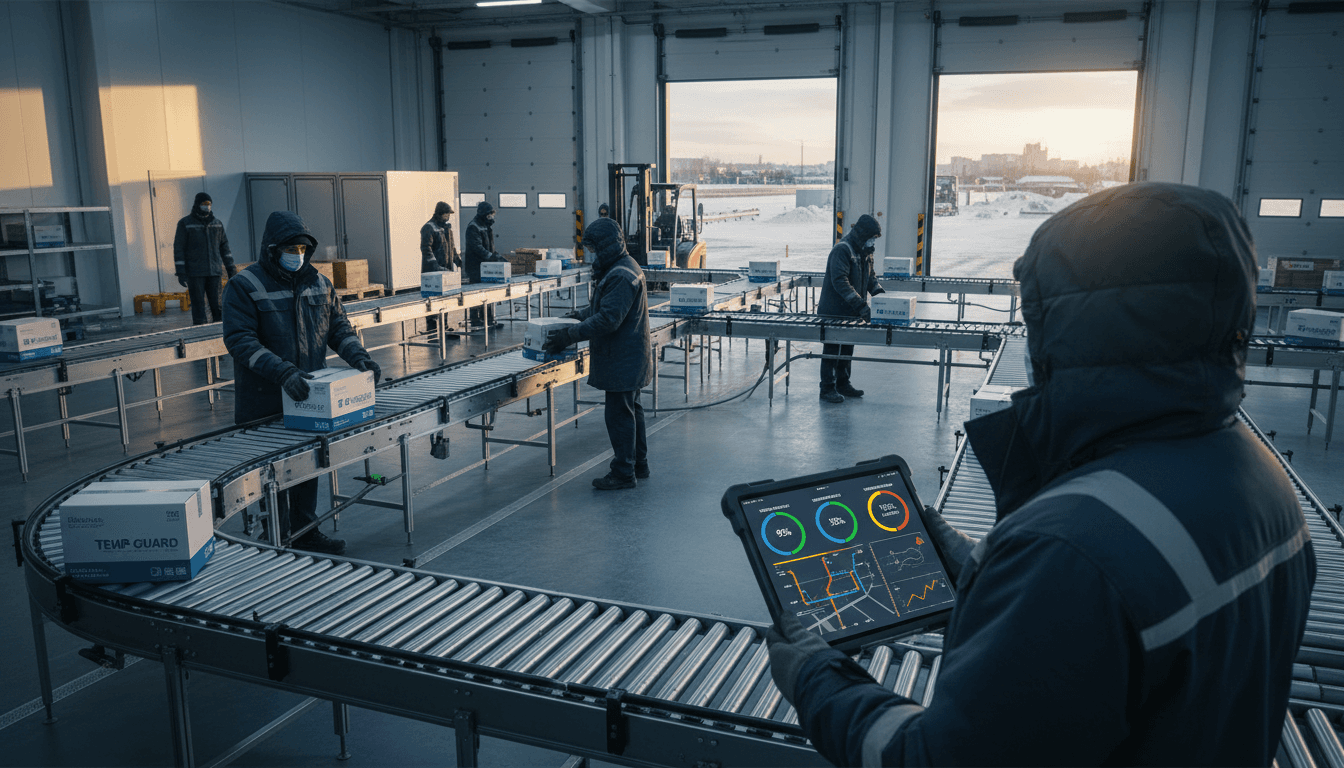
If you’re already investing in automation (conveyance, sortation, pick-to-light), pairing it with AI rules and computer vision checks is how you protect margins. Automation moves faster; AI keeps it correct.
3) Routing and carrier selection that adapts daily (not quarterly)
Cold chain teams usually set carrier rules and revisit them quarterly. That cadence is too slow.
AI-driven logistics planning can choose carriers and service levels based on daily realities:
- lane-level on-time performance
- cutoff times and tender acceptance
- exception rates (missorts, weather delays, damage)
- weekend/holiday coverage
- total landed cost (including predicted spoilage risk)
This is where “cheapest label” thinking quietly kills you. A slightly cheaper service that increases failure probability is not cheaper. If your model prices in refund/reship probability, decisions get clearer.
A strong system will also diversify intelligently across national and regional carriers—especially where regional networks offer better consistency or later cutoffs.
4) Last-mile delivery prediction: reduce porch-time risk
The final mile is often the least controlled part of the chain. It’s also where the customer judges you.
AI can reduce last-mile risk by:
- predicting delivery-day delays by ZIP code and day-of-week
- suggesting “ship hold” or “ship earlier” logic for high-risk windows
- offering dynamic delivery promises (don’t overpromise; be precise)
- triggering proactive customer communications when risk rises
This matters a lot in late December. One extra day in a stalled network can turn a premium product into a refund.
A practical AI blueprint for cold chain e-commerce teams
You don’t need a moonshot. You need a tight loop: predict → decide → execute → learn.
Here’s a blueprint I’ve found works for shippers, 3PLs, and marketplaces.
Step 1: Define “failure” in measurable terms
Start with numbers your finance and CX teams already feel:
- refund rate
- reship rate
- spoilage complaints per 1,000 orders
- on-time delivery rate by promised date
- damage rate
- customer lifetime value drop after a cold chain complaint
Then segment by lane, carrier, ship day, and SKU group. Cold chain problems are rarely uniform.
Step 2: Build a lane-level thermal risk score
Your “thermal risk score” should combine:
- forecasted ambient temps along the lane
- expected transit time distribution (not a single average)
- carrier exception probability
- delivery-day exposure risk (weekend, holidays, apartments, rural)
- packaging configuration
That score becomes the brain behind actions like upgrading service, adding coolant, or changing ship day.
Step 3: Start with one high-impact model
If you’re choosing where to begin, pick one:
- Packaging optimization model (highest direct cost impact)
- Carrier/service selection model (highest failure risk impact)
- Demand and labor forecasting model (highest operational stability impact)
Don’t start with all three unless your data discipline is already strong.
Step 4: Close the loop with returns and customer feedback
E-commerce has an advantage traditional retail doesn’t: fast feedback. Use it.
Connect post-delivery signals back into your model training:
- customer complaint categories (“thawed,” “warm,” “leaking,” “damaged”)
- delivery timestamp vs expected
- weather anomalies
- packaging configuration used
Cold chain AI gets better when it learns from near-misses, not just disasters.
Common questions teams ask (and the straight answers)
“Do we need IoT temperature sensors in every box?”
No. Box-level sensors are useful for clinical-grade shipments or high-value products, but they’re rarely cost-effective for every consumer order. Most brands get better ROI from lane-level risk models plus strong pack-out controls, then selectively instrumenting high-risk lanes.
“Will AI replace our cold chain operators?”
It shouldn’t. The best setups treat AI as a dispatcher of decisions and humans as owners of exceptions. Cold chain requires judgment; AI reduces the volume of judgment calls.
“How do we justify the spend?”
Tie it to avoidable costs:
- fewer refunds and reships
- lower packaging overuse (less “just in case” coolant)
- fewer expedite upgrades caused by late decisions
- higher repeat purchase rate from improved delivery quality
If you can’t measure those today, that’s your first project.
What to do before next peak season hits
Cold chain e-commerce didn’t just outgrow the gift box—it outgrew gut-feel operations. The winners in 2026 won’t be the companies with the flashiest brand photos. They’ll be the ones that treat temperature-controlled shipping as a decision science across packaging, fulfillment, routing, and last-mile delivery.
If you’re building your roadmap in Q1, aim for one outcome: fewer spoilage surprises during peak weeks. Put AI where it belongs—on the decisions that happen thousands of times per day and quietly determine whether your product arrives perfect or arrives as a refund.
If you had to pick one cold chain decision to automate with AI in the next 90 days—pack-out, carrier selection, or ship-day planning—which one would reduce your failure rate the fastest?