Amazon Air Cargo’s money-back guarantee signals a shift toward time-definite air freight powered by AI, visibility, and network control. See what to do next.
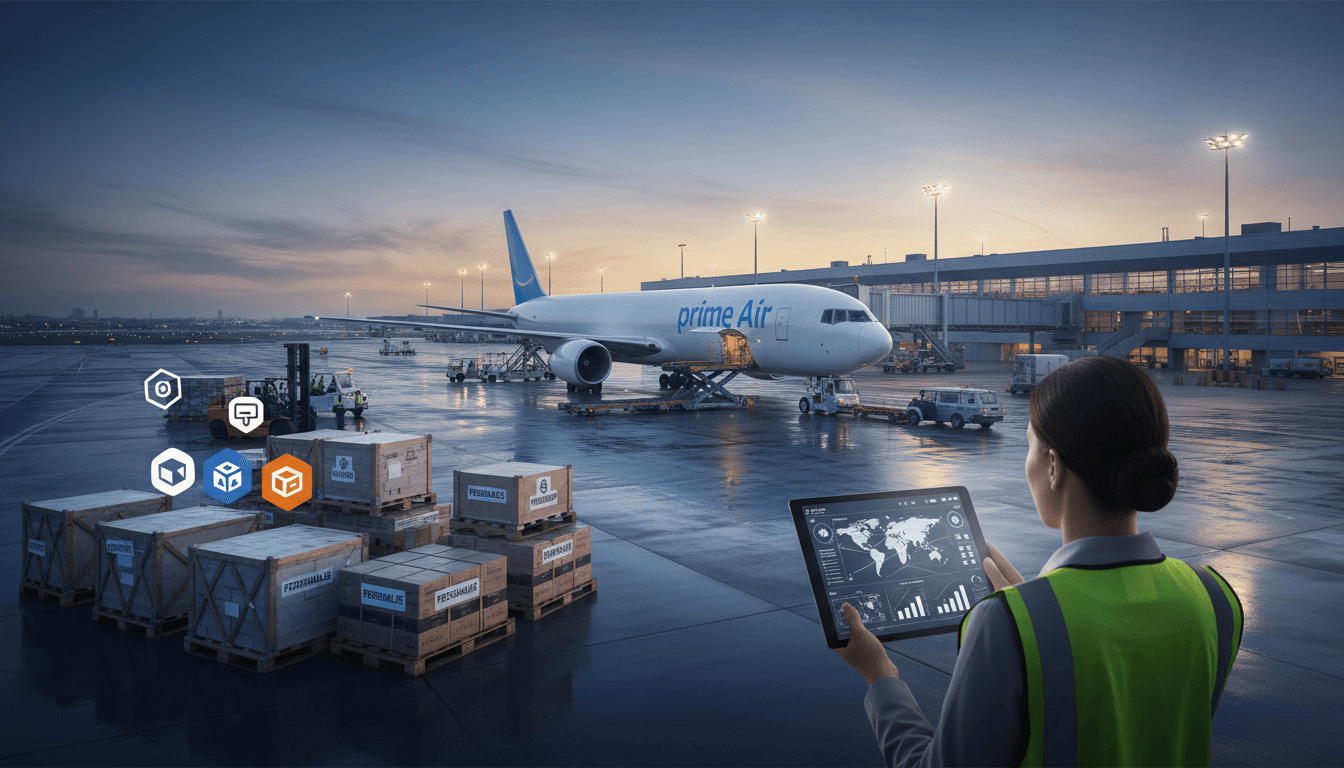
Amazon Air Cargo’s On‑Time Guarantee: What It Means
A money-back guarantee in air cargo is a big deal. Not because refunds are new in business, but because air freight usually has too many handoffs (and too many “not my fault” moments) for anyone to promise punctual delivery with real financial consequences.
Amazon is now doing exactly that for new U.S. and Puerto Rico customers of Amazon Air Cargo: if a shipment arrives more than two hours late due to a service failure, Amazon will refund shipping fees up to $10,000 per flight. That’s not a small marketing tweak. It’s a signal that Amazon believes its network control, data, and AI-driven logistics tooling are strong enough to put cash behind on-time performance.
This post is part of our AI in Transportation & Logistics series, and I’m taking a clear stance: the guarantee is interesting, but the real story is the platform behind it—how Amazon is packaging capacity, visibility, and predictive operations into something that looks less like “air cargo” and more like a managed, tech-forward service.
A money-back guarantee is really a network-control statement
Amazon’s guarantee matters because traditional air cargo rarely has end-to-end control. That’s why time-definite commitments have historically been the domain of integrators (think express carriers) that own—or tightly orchestrate—pickup, linehaul, sort, and delivery.
Amazon is betting it can behave like an integrator even while using a hybrid model (Amazon manages the network and relies on contract carriers to operate aircraft). The company runs an air network of 100+ cargo jets serving 65+ destinations, built to feed Prime’s next-day and two-day promises. Now it’s selling excess capacity to third-party shippers in a more formal way.
Here’s the punchline: a guarantee is only credible when the operator can measure, predict, and intervene in real time.
Why guarantees are rare in wholesale air freight
Wholesale air freight has variability baked in:
- Multiple parties touch the shipment (forwarder, airline, handler, trucker, warehouse)
- Delays compound across handoffs
- Data is often fragmented (different systems, formats, visibility gaps)
So when Amazon adds a guarantee, it’s essentially claiming: “We can reduce variability enough to price and manage the risk.” That’s not bravado. That’s systems.
A guarantee isn’t a customer perk. It’s proof the operator believes its exception-management is better than everyone else’s.
Amazon is turning air cargo into a platform—AWS style
Amazon has a habit of taking internal capabilities and selling them externally. AWS is the famous example. Amazon Air Cargo is following the same playbook: build for yourself, then monetize what you built.
The parallel matters for logistics leaders because it changes what you should look for when evaluating carriers and forwarders. It’s not only about lanes, rates, and capacity anymore. It’s about:
- Digital booking and self-serve workflows
- Visibility and proactive alerts
- Forecasting and predictive ETAs
- Network-level optimization that reacts quickly when disruption hits
Amazon has explicitly described working with AWS on “integrated, cloud-based supply chain solutions,” including agentic AI concepts for optimizing routes and identifying opportunities.
The portal upgrade is the quiet headline
Amazon moved from manual/offline booking to a digital console—its Supply Chain by Amazon dashboard—where shippers can:
- Get instant rate quotes and capacity availability
- Make immediate reservations
- Monitor shipments in real time
- Handle billing, payments, and support in one place
This sounds basic until you’ve lived through air freight booking emails, PDF rate sheets, and status updates that arrive after the shipment does. Reducing workflow friction isn’t cosmetic—it’s how you increase velocity while lowering error rates.
If you want a simple way to interpret the portal shift: Amazon is trying to make air cargo behave like software.
AI in transportation shows up as fewer surprises (not more dashboards)
Most companies get AI wrong in logistics because they treat it like a reporting layer. The value is operational: fewer missed connections, fewer rebooks, fewer late arrivals, fewer angry customer emails.
Amazon’s on-time guarantee only makes business sense if its underlying systems can do three things reliably:
- Predict where the network is likely to break (capacity pinch points, weather knock-ons, hub congestion)
- Decide what to do (reroute, re-time, re-allocate capacity, change ground legs)
- Execute quickly across modes (air plus ground network options)
That’s where AI-driven route optimization and forecasting earn their keep.
What “agentic AI” implies in freight operations
“Agentic AI” is becoming shorthand for systems that don’t just recommend actions—they can take actions within guardrails. In air cargo operations, that could look like:
- Automatically proposing alternates when a flight is at risk (same-day, next-day, different hub)
- Holding downstream linehaul or line sort windows when inbound ETAs shift
- Allocating capacity to preserve service commitments for high-priority shipments
No one should assume this is fully automated end-to-end today. But the direction is clear: the network that wins is the one that resolves exceptions fastest.
The KPI that matters: “time-to-recovery”
On-time performance is the output. The competitive advantage is how quickly you recover when disruption happens.
If your current air freight process requires four emails and two phone calls to rebook a shipment, your “AI strategy” is irrelevant. A modern logistics platform focuses on:
- exception detection in minutes (not hours)
- consistent decision rules
- rapid re-planning across many route combinations
Amazon explicitly points to dynamic technology and “millions of route combinations” to make real-time adjustments. That’s exactly the kind of network-level optionality you need to back a guarantee.
What this means for shippers and freight forwarders (practically)
Amazon’s growth in third-party air cargo is also a market signal: more shippers want integrator-like reliability without integrator-only pricing. And more forwarders will need to decide whether to treat Amazon as a competitor, a carrier, or a capacity partner.
The service already supports different buying motions:
- ad hoc tendering
- block space agreements
- full aircraft charters
And it’s not theoretical. Amazon Air Cargo is being used in flows like:
- e-commerce shipments from China to the U.S. via Honolulu
- Miami–Bogotá with northbound perishables/commodities
- belly cargo handoffs at Honolulu for onward distribution to dozens of U.S. cities
Should you switch because of the guarantee?
Not automatically. The guarantee is a useful forcing function, but you should evaluate service architecture, not slogans.
Use this checklist when comparing an air cargo option that claims high reliability:
- Eligibility and exclusions: What counts as a “service failure”? What doesn’t?
- Lane performance history: Ask for on-time data by lane and day-of-week patterns.
- Recovery playbook: What happens at T+30 minutes delay risk? Who acts? How?
- Visibility quality: Are scan events consistent? Do ETAs update meaningfully?
- Ground network integration: Can they reroute through different hubs and still deliver?
If the provider can’t answer (3) clearly, the guarantee is likely more marketing than operations.
How forwarders can use Amazon without losing the customer relationship
Forwarders that treat Amazon like “just another airline” will struggle. The forwarders that win will package Amazon capacity inside a stronger service wrapper:
- consolidation and deconsolidation services
- customs brokerage coordination
- packaging and compliance for perishables/high-value goods
- multi-carrier orchestration when Amazon isn’t the best option on a given day
Your differentiation becomes network design + control tower execution, not simply buying space.
The bigger trend: logistics is turning into productized infrastructure
The most important shift isn’t Amazon offering air capacity. It’s the productization of logistics into something more standardized, measurable, and software-operated.
Here’s what I expect we’ll see more of in 2026 planning cycles:
- Service-level commitments expanding beyond parcel into B2B air freight
- More self-serve freight procurement (quote → book → pay → track)
- AI-powered forecasting baked into transportation management workflows
- Competition moving from rate sheets to network reliability + exception handling
And yes, this will raise the bar for everyone—integrators, airlines, and forwarders alike.
Amazon’s guarantee applies to new customers and has specific terms, but the strategic move is broader: train the market to demand time-definite air freight as a default expectation.
What to do next if on-time delivery is a top priority
If you’re a shipper moving high-value, time-sensitive freight (pharma adjuncts, perishables, critical repair parts, premium e-commerce), treat this moment as a prompt to tighten your own playbook.
Start here:
- Define “late” in business terms, not carrier terms (lost sale, spoilage risk, SLA penalty).
- Segment shipments by service need (true time-definite vs “fast but flexible”).
- Instrument your data: if you can’t measure door-to-door variance, you can’t manage it.
- Pilot with one lane, one SKU family, one operating team—then scale what works.
If you’re building an AI in transportation roadmap, keep it grounded: prioritize forecasting accuracy, exception automation, and route optimization that reduces delays you can actually control.
The real question to ask going into 2026 budgeting: when your next disruption hits—weather, capacity, a hub slowdown—how many minutes until your system proposes a fix, and how many more until it’s executed?