AI scheduling helps prevent disruption chaos like crew hotel rebooking backlogs. Learn how predictive analytics and real-time allocation reduce exceptions fast.
AI Scheduling for Disruptions: Lessons from FedEx
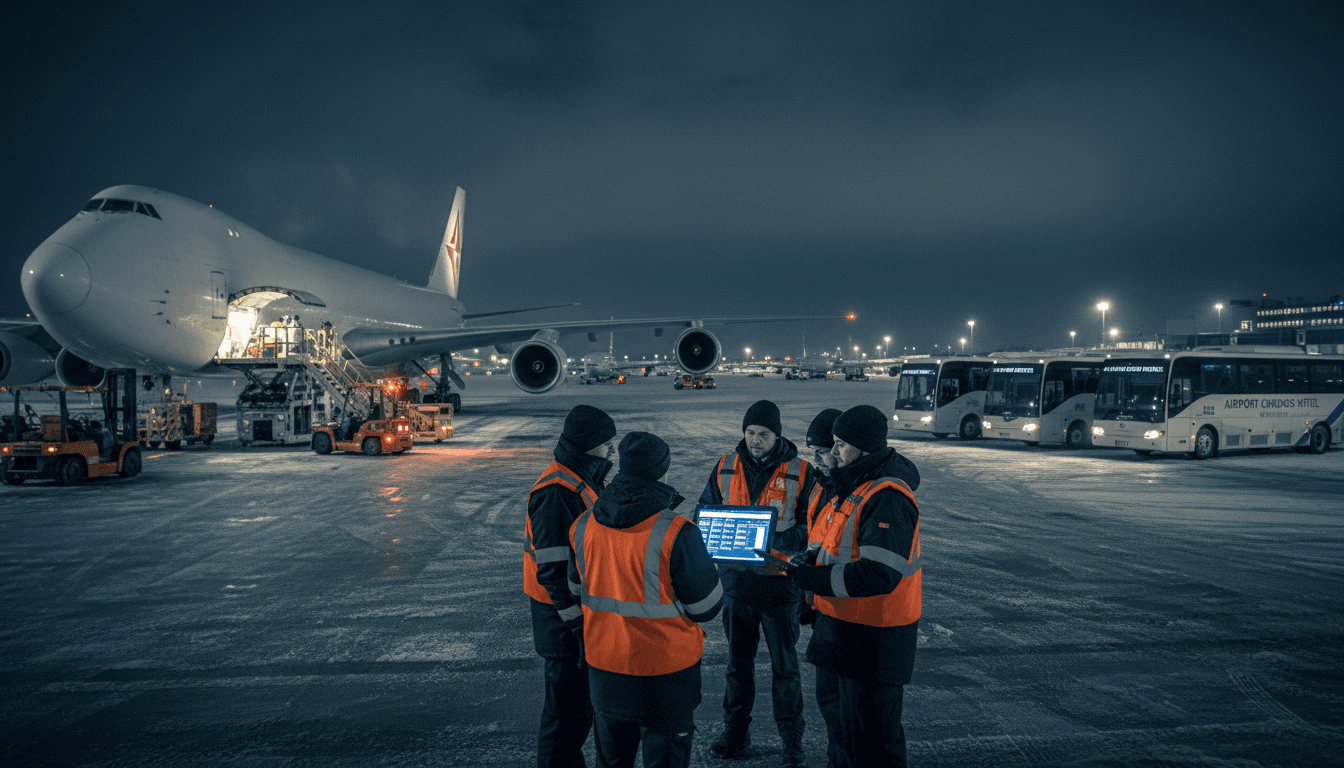
A single safety directive can ripple through an entire air network in hours. In FedEx’s case, the FAA-ordered MD-11 freighter grounding removed 28 aircraft from service right as peak shipping demand was cresting. The headline problem wasn’t only capacity—it was something far less glamorous and far more telling: pilots landing after long-haul flights without confirmed hotel rooms or ground transportation.
That detail matters because it’s the kind of “small” operational failure that quietly drives bigger ones: fatigue risk, longer recovery times, missed departure windows, cascading reassignments, and a morale hit that shows up later as absenteeism and attrition. If you run transportation or logistics operations, you’ve seen versions of this. The reality? The network doesn’t break at the big nodes first. It breaks at the seams—handoffs, exceptions, and the last 5% of coordination that still relies on frantic manual work.
This post is part of our AI in Transportation & Logistics series, and I’m going to be blunt: if your disruption playbook still depends on humans “catching up” after schedule shocks, you’re paying a tax—every peak season, every weather event, every unplanned maintenance outage. There’s a better way to approach this: AI-driven predictive scheduling and real-time resource allocation that treats crew services, transportation, and lodging as first-class operational constraints—not afterthoughts.
What the FedEx hotel backlog really reveals
The core issue isn’t hotel booking. The issue is exception management at scale.
When the MD-11s were grounded, FedEx had to reconfigure flying using other aircraft types, activate spares, consolidate flights, and revise pairings. Those changes didn’t just shift departure times; they likely changed:
- Layover cities and hotel properties
- Arrival times (and late-night check-in windows)
- Crew duty/rest legality windows
- Ground transportation pickup timing
- Contracted room blocks and negotiated rates
Now add volume. During peak season, reservations are normally made weeks (sometimes months) in advance. But the operational reality described in the source is different: thousands of trips being revised within the operating month. That’s a classic mismatch between a steady-state process and a shock-driven system.
The hidden cost: rest becomes an operational variable
When pilots arrive and spend an extra hour sorting lodging and transportation, that’s not “inconvenience.” It’s rest time lost.
In air cargo networks, lost rest becomes:
- Higher fatigue call-out risk
- More reserve utilization
- More last-minute reassignments
- More downstream schedule volatility
It also creates an emotional cost: crews feel the company isn’t protecting them, especially internationally. That trust gap becomes a performance gap.
Why manual processes fail under schedule churn
Most companies get this wrong: they invest heavily in flight ops optimization but treat crew logistics (hotels, transport, rebookings) like a back-office admin function.
Under disruption, the work explodes:
- Schedule changes generate new lodging and transport needs
- Automated systems invalidate prior reservations (“kicked out of the system”)
- Staff must rebook across multiple vendors and policies
- Crews arrive before updates settle
If your “system” is primarily ticket queues, phone calls, and one-off exceptions, it will collapse under surge conditions. Not because your people aren’t capable—because humans don’t scale linearly when exceptions compound.
The real operational lesson: disruptions are predictable—even when the event isn’t
You can’t predict every grounding or crash investigation timeline. You can predict what happens next inside your network.
The consistent pattern is:
- Capacity shock → network re-optimization
- Re-optimization → crew pairing volatility
- Pairing volatility → travel and lodging rebooking surge
- Rebooking surge → service desk overload
- Overload → missed confirmations and last-minute self-help
That chain is stable across airlines, parcel carriers, and even rail and trucking (swap “hotel” for “driver layover,” “equipment staging,” or “yard appointment”).
Peak season makes the margin for error tiny
Mid-December operations have less slack. Hotels fill faster, late arrivals have fewer options, and last-minute changes cost more. That’s why operational strain shows up first in the “small stuff.” It’s also why AI-driven logistics planning pays off most during peak season: it creates slack artificially through smarter allocation.
Where AI scheduling fits: treat crew services like a capacity constraint
AI scheduling in logistics works best when it’s not bolted on. The key is modeling crew services as constraints and resources, just like aircraft, pilots, gates, sort capacity, or linehaul trailers.
Here’s what that looks like in practice.
1) Predictive exception forecasting (before the queue explodes)
Answer first: Use predictive analytics to forecast where and when rebookings will spike, then staff and pre-position inventory accordingly.
A disruption triggers measurable signals: flight swaps, new routings, extended duty days, increased reserve use. An AI model can translate those into a forecast of:
- Expected hotel rebooking volume by station
- Expected ground transport changes by arrival wave
- Probability of same-day changes for each pairing
That forecast lets you do something operations teams rarely get to do: act early.
Practical moves AI supports:
- Temporarily increase staffing before hold times spike
- Pre-allocate additional room blocks in likely diversion/layover cities
- Shift bookings to alternate suppliers when primary inventory tightens
2) Real-time resource allocation for lodging and transport
Answer first: AI can continuously reassign lodging and transport options based on live schedule updates, inventory, and policy—without waiting for humans to “catch up.”
A modern allocation engine can optimize across:
- Hotel availability and distance-to-airport
- Check-in constraints and late-arrival policies
- Contracted rates and allowable caps
- Crew rest windows and next-day show times
- Safety rules (e.g., vetted providers, location constraints)
This is especially useful when pairings change repeatedly. Instead of invalidating a booking and pushing work to a desk, the engine re-solves and confirms alternatives.
3) Automated “reservation integrity” checks
Answer first: Build systems that detect when bookings were dropped, unconfirmed, or out-of-policy—then fix them automatically.
The source described a failure mode many logistics teams recognize: when internal systems change assignments, downstream reservations get kicked out.
AI isn’t magic here; the win is orchestration:
- Monitor booking states in near real time
- Flag missing confirmations within minutes
- Auto-rebook based on rules and preferences
- Escalate only genuinely hard cases to humans
This reduces the worst outcome: crew arriving with nothing.
4) Crew-facing communication that reduces anxiety and wasted time
Answer first: Give crews a single, reliable channel (mobile-first) showing confirmed lodging and transportation, with self-serve fallback built in.
A union official noted pilots didn’t have text-based support. Whether or not that’s universal, the broader point stands: phone calls are a bottleneck.
A strong disruption-ready design includes:
- Push notifications when bookings change
- One-tap access to hotel confirmation and pickup instructions
- “I’ve arrived” check-in triggers for rides
- Guardrails for self-booking that keep receipts and policy compliant
This isn’t just convenience. It’s risk control.
A practical playbook: how to implement AI disruption scheduling (without boiling the ocean)
You don’t need a multi-year transformation to reduce disruption pain. Here’s a staged approach I’ve found works in transportation and logistics environments where systems are complex and change is expensive.
Phase 1: Instrument the exceptions (2–6 weeks)
Goal: Make disruption measurable.
- Define exception categories: dropped booking, unconfirmed hotel, late transport, out-of-policy rate, arrival-without-room
- Capture timestamps: when pairing changed, when booking was invalidated, when rebooked
- Measure “time-to-confirm” and “arrive-without-confirmation rate”
If you can’t quantify it, you can’t fix it.
Phase 2: Add reservation integrity automation (6–12 weeks)
Goal: Stop the bleeding.
- Monitor booking status continuously
- Auto-retry confirmations
- Auto-rebook from approved alternates when thresholds hit
- Escalate only edge cases to human agents
This phase usually delivers fast ROI because it directly reduces manual workload and failure rates.
Phase 3: Predictive staffing and inventory positioning (1–2 quarters)
Goal: Get ahead of peak season.
- Forecast booking surge by station and day
- Dynamically staff service desks
- Pre-buy or pre-block rooms where disruption probability is high
Phase 4: Optimization across network constraints (2–4 quarters)
Goal: Optimize, not just automate.
- Jointly optimize pairings and crew services constraints
- Incorporate cost, rest, safety, and reliability metrics
- Continuously learn from outcomes
What leaders should measure: reliability metrics that actually change behavior
If you want AI scheduling to improve operations, measure the outcomes your teams feel.
Here are metrics that map directly to the FedEx-style failure mode:
- Arrival-without-confirmed-room rate (% of layovers missing confirmed lodging on arrival)
- Time-to-rest (minutes from block-in to hotel check-in)
- Rebooking backlog age (how long requests sit unconfirmed)
- Exception touch time (minutes of human handling per exception)
- Fatigue-related disruptions (call-outs, reserve burn, last-minute cancellations)
One snippet-worthy truth: If “time-to-rest” gets worse, everything else gets worse next.
What to do next if your operation looks uncomfortably familiar
The FedEx story is a high-profile example, but the pattern is everywhere in transportation and logistics: disruption creates schedule churn, churn creates exception volume, and exception volume overwhelms teams built for steady-state operations.
If you’re heading into 2026 peak planning, don’t treat disruption readiness as an ops-only problem. Treat it as a systems problem. AI scheduling and predictive analytics won’t prevent aircraft groundings or surprise outages—but they can prevent the second-order failure where people arrive with no plan and the network pays for it all week.
If you want a starting point, audit your last major disruption and answer one question honestly: how many exceptions were solved by design, and how many were solved by heroics?