Maersk and Hapag-Lloyd dropped Baltimore from key trans-Atlantic loops. Here’s what it teaches about AI routing, port risk, and faster network decisions.
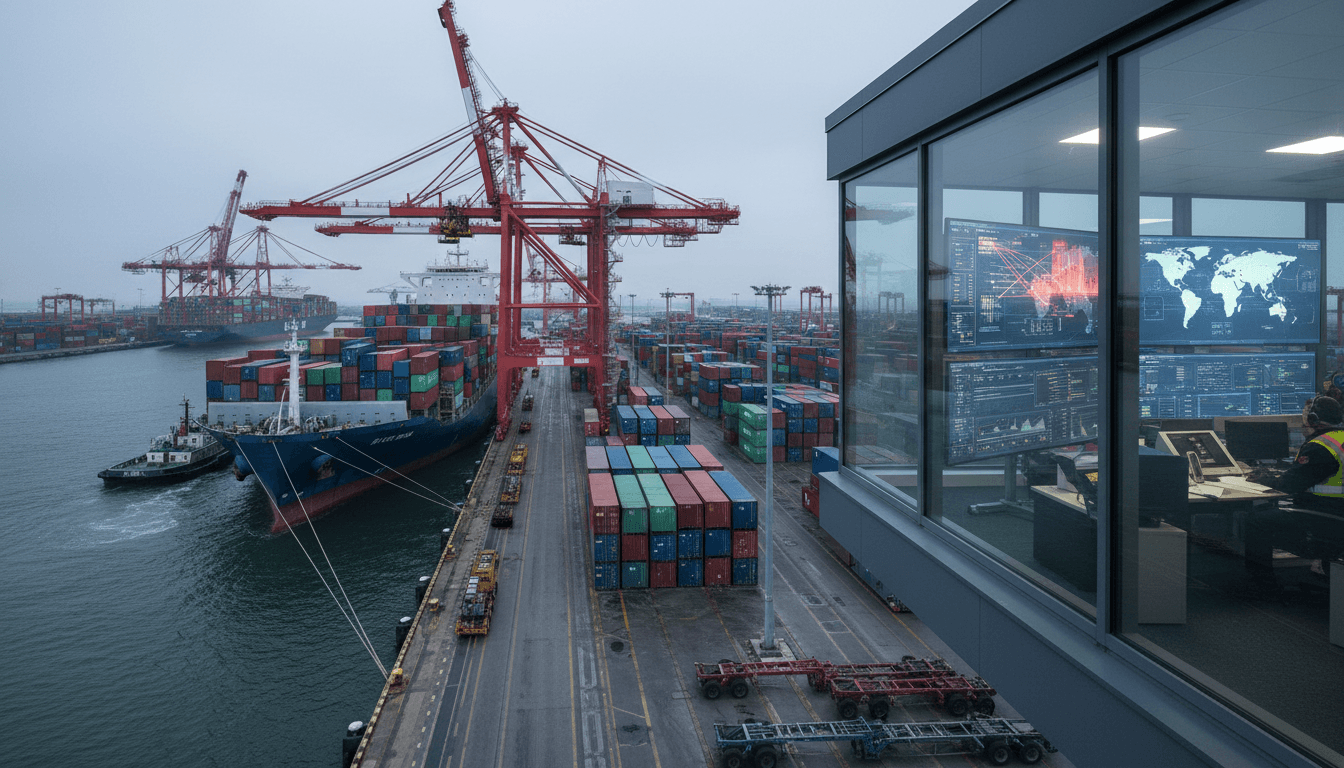
AI Port Routing Lessons From Maersk’s East Coast Shift
Baltimore didn’t lose a weekly trans-Atlantic container call because anyone “forgot” about it. It lost it because time started costing more than loyalty.
Maersk and Hapag-Lloyd are removing Baltimore from parts of their North Europe–North America rotations and shifting capacity toward nearby ports—most notably Philadelphia on Maersk’s TA3 service—while also adjusting other strings (including an added call at Saint John in Canada on TA2). The operational reasons are blunt: the long tail of disruption after the Francis Scott Key Bridge collapse, and the simple math of schedule recovery when one port adds days of transit.
If you’re a shipper, 3PL, forwarder, or port operator, this is more than a headline. It’s a clean case study for the AI in Transportation & Logistics playbook: network design has become a continuous optimization problem, and the winners will be the teams that can model trade-offs fast—before service changes hit the water.
What happened (and why it matters to your supply chain)
Answer first: Maersk and Hapag-Lloyd are omitting Baltimore from key trans-Atlantic services to improve schedule reliability, replacing it with nearby calls that reduce transit complexity and recover time.
Maersk’s update puts Philadelphia into the TA3 rotation (with a new rotation that includes major North Europe ports and U.S. East Coast calls such as Newark and Norfolk), starting with an early January sailing. Hapag-Lloyd also signaled Baltimore omissions on services for “schedule recovery.” Translation: when on-time performance slips, carriers prune network nodes that create disproportionate delay.
Baltimore’s challenge isn’t just one event—it’s compounding friction:
- The region is still dealing with the extended recovery timeline from the 2024 Key Bridge collapse.
- Calling Baltimore requires navigating deep into the Chesapeake Bay—about 150 miles of channel—plus multiple pilot requirements.
- Compared to alternatives like Norfolk or Philadelphia, that extra distance and operational complexity translates into days that carriers can’t afford when they’re trying to stabilize weekly strings.
This matters because many logistics organizations still treat port selection as a static procurement choice. Carriers don’t. They treat it as a dynamic variable.
The hidden cost of “one more port call”
Answer first: The cost of a port call isn’t just port fees—it’s schedule risk, buffer time, and downstream disruption that multiplies across an entire service string.
A container vessel string is a chain of promises: cutoffs, ETAs, berth windows, rail connections, dray appointments, labor plans, chassis availability. When a single call adds multiple days (or adds variability you can’t hedge), carriers often respond the same way airlines do when a hub gets messy: simplify the route.
Schedule reliability beats marginal volume
For years, many networks tolerated “inefficient” calls because the volume justified it, or because service patterns were stable. But the past few years—pandemic aftershocks, labor constraints, rerouting pressure, and infrastructure surprises—trained carriers and shippers to pay a premium for predictability.
When the article notes Baltimore’s container throughput fell sharply after the bridge collapse (from a record 1.26 million TEUs in 2023 to an estimated 741,215 TEUs), it signals something important: even strong ports can become fragile when a single constraint persists long enough.
Baltimore’s ro-ro strength doesn’t automatically protect containers
Baltimore remains a major ro-ro gateway, with vehicle volumes representing more than half of cargo in some reporting, including roughly 750,000 cars and light trucks in 2024. That’s a different operating and commercial profile than weekly trans-Atlantic container loops.
Here’s the uncomfortable point: being strategically important to one cargo type doesn’t immunize you in another. AI-based network planning can make that distinction explicit by modeling profitability and reliability by service, not by port reputation.
Where AI decision support changes the outcome
Answer first: AI doesn’t prevent bridge collapses or channel constraints—but it does help logistics teams quantify options faster, predict downstream impacts, and execute mitigations before service changes become painful.
Most teams still manage network shifts with a mix of experience, spreadsheets, and late-breaking emails from carriers. That’s workable—until it isn’t. The Maersk/Hapag-Lloyd adjustment is exactly the kind of scenario where AI-driven decision support systems shine.
1) Predictive risk scoring for port and corridor fragility
An effective AI model for ocean network risk doesn’t need to be mystical. It needs to continuously ingest signals and produce a ranked view of fragility.
Signals that matter in cases like this:
- Infrastructure status (bridge rebuild milestones, channel restrictions)
- Pilot and berth availability patterns
- Port productivity proxies (berth time variance, dwell time trends)
- Intermodal constraints (rail service frequency, terminal congestion)
- Weather seasonality risk (winter nor’easters, fog patterns)
The output should be something a planner can act on: “Baltimore schedule variance risk is rising; expected ETA uncertainty +1.8 days next 6 weeks.” That’s a planning tool, not a science project.
2) AI-based routing and service-level trade-off modeling
When a carrier swaps Baltimore for Philadelphia, shippers immediately face second-order questions:
- Do we keep the same carrier and adjust inland dray/rail?
- Do we re-bid to a service that still calls our preferred port?
- What happens to total landed cost if the port is closer—but rail is worse?
AI routing models can compare scenarios using real constraints:
- Transit time distributions (not just averages)
- Cutoff and free-time impacts on demurrage/detention exposure
- Dray mileage, chassis pools, appointment lead times
- Rail dwell and service frequency
The goal is clarity: which option produces the best on-time-in-full probability at the lowest risk-adjusted cost?
3) Forecasting volume shifts to avoid “surprise” congestion
Philadelphia picking up incremental mainline calls sounds great—until too many shippers re-route at once.
This is where AI forecasting is practical. If you can forecast demand shifts by lane (North Europe → Mid-Atlantic, for example), you can prepare for the predictable problems:
- Gate congestion and appointment scarcity
- Warehouse receiving spikes (especially in post-holiday restocking)
- Dray capacity whiplash
December into January is a planning choke point: budgets reset, retail replenishment ramps, and weather adds variability. The teams that model variance—not just volume—avoid the “why are we paying so much for dray this month?” meeting.
A practical playbook for shippers and 3PLs (next 30 days)
Answer first: Treat this like a controlled re-optimization sprint: map impacted SKUs and lanes, quantify alternatives, then execute with clear service-level targets.
Here’s what works when a port call disappears or rotates:
Step 1: Identify exposure by lane, customer, and service
Don’t start with “all Baltimore freight.” Start with a precise cut:
- Bookings tied to the impacted service strings
- Customers with strict OTIF requirements
- SKUs with high storage cost, seasonal sensitivity, or contract penalties
This is where I’ve found many teams get it wrong: they treat everything as equal, then over-correct.
Step 2: Build three scenarios (and force the math)
Create three options and quantify them:
- Stay with the carrier; accept new port (e.g., shift to Philadelphia)
- Switch service/carrier to keep port (if available)
- Split strategy (time-sensitive freight on one, cost-sensitive on another)
For each, compare:
- Median transit time and 90th percentile transit time
- Expected dray + rail cost
- Demurrage/detention risk (based on dwell trends)
- Customer delivery variance
If you’re using AI decision support, this is the moment to operationalize it: run scenario sims weekly, not once.
Step 3: Re-plan inland moves (rail, dray, and appointments)
A port change is an inland change.
- Re-confirm rail ramps and cutoff compatibility
- Validate dray capacity at the receiving metro
- Pre-book appointments where possible
- Adjust safety stock for lanes with increased variance
Even a “closer” port can create longer end-to-end transit if the inland handoff is weaker.
Step 4: Communicate like you mean it
Operational communication beats heroic expediting.
Provide internal stakeholders with:
- New standard transit windows n- Exception thresholds (what triggers an escalation)
- Customer messaging templates for ETA variability
When teams do this well, service changes become manageable instead of chaotic.
What ports and terminal operators should learn from this
Answer first: Ports that win new calls keep them by proving reliability—measured in variance reduction, not marketing.
Philadelphia gaining a mainline call is an opportunity, but also a test. Carriers are pruning complexity. They’ll do it again if a replacement call starts adding unpredictability.
Ports and terminal operators can respond with an AI-forward posture:
- Predict berth clashes using historical vessel arrival variance and real-time AIS patterns
- Optimize yard planning to reduce re-handles and peak gate queues
- Forecast labor and equipment needs based on inbound stowage profiles
- Share visibility with dray partners to reduce appointment churn
The ports that treat schedule reliability as a product—measured daily—become “sticky” in carrier networks.
The real lesson: network design is now continuous
Baltimore’s omission from certain trans-Atlantic services is a reminder that ocean routing is a living system. Carriers will adjust rotations to protect schedule integrity, and shippers will be forced to adapt whether they planned for it or not.
AI in transportation and logistics isn’t about flashy dashboards. It’s about making the next decision faster than disruption spreads: port selection, routing, capacity planning, and inventory positioning—all under uncertainty.
If you’re still running these changes on instinct and static lane guides, you’ll keep paying for avoidable variance. If you’re building an AI decision support layer—scenario modeling, predictive risk, and network optimization—you’ll start treating these headlines as inputs, not emergencies.
What would change in your operation if you could see the next port rotation risk four weeks earlier—and quantify the cost of every alternative in minutes?