Build an AI-native supply chain that predicts disruptions early using context-aware orchestration, faster partner onboarding, and guardrailed automation.
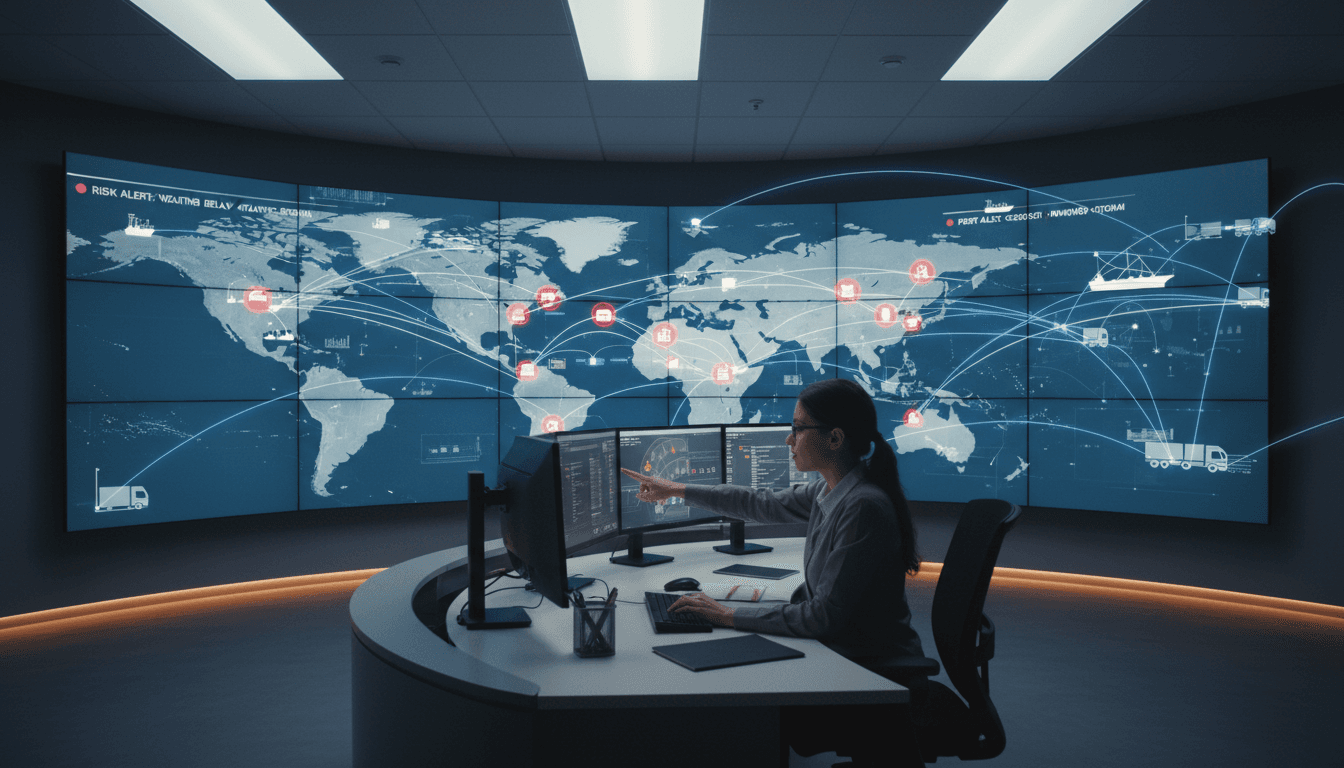
AI-Native Supply Chains: Predict Disruptions Early
Supply chain disruptions rose 38% over the past year. That number matters less as a headline and more as a reminder that “react faster” isn’t a strategy anymore—it’s a treadmill.
If you’re running transportation, logistics, procurement, or operations, you’ve probably felt the same friction: you’ve got automation in pockets, integrations held together with custom mappings, and a pile of exception alerts that mostly tell you about problems after they’ve already cost you money. The shift happening now is bigger than adding another bot or dashboard. It’s moving toward an AI-native supply chain—one designed to predict what’s about to go wrong, not just document what already did.
Cleo’s recent direction with Cleo Integration Cloud is a good lens for this broader trend in the “AI in Transportation & Logistics” series: predictive logistics plus context-aware orchestration is becoming the control plane for resilient networks.
Why predictive logistics beats “better alerts”
Predictive logistics is about one thing: shortening the time between weak signal and operational action. Traditional systems wait for confirmation failures, missed pickups, late tenders, or ASN mismatches, then escalate. That’s not intelligence. That’s bookkeeping.
Here’s the practical difference:
- Reactive operations: “Carrier missed appointment at 10:00. Expedite?”
- Predictive operations: “Based on yard dwell trend + linehaul ETA variance + weather + this carrier’s historical late probability, the appointment miss risk is 72%. Offer earlier slot or reassign now.”
That second version is what companies mean when they say they want a supply chain that “thinks ahead.” It’s not magic. It’s probability, context, and orchestration.
What’s actually changing in 2025 (and why it’s accelerating)
A few forces are pushing predictive systems from “nice-to-have” to “operational requirement”:
- More disruption types, more often (cyber, geopolitics, extreme weather, labor instability).
- Tighter tolerance for service failure in retail and manufacturing networks—penalties show up fast.
- Data availability is improving (telematics, ELD, yard systems, e-commerce order streams), but it’s fragmented.
- Automation without coordination creates new failure modes. You can automate a broken process and just break things faster.
My take: most teams don’t need “more AI models” first. They need a better decision surface—a place where events, partner messages, transportation status, and inventory reality meet.
Context-aware orchestration: the supply chain’s missing control plane
Context-aware orchestration is the idea that integrations shouldn’t just pass messages; they should understand the situation those messages represent. Cleo frames context as two dimensions: historical insight (what tends to happen) plus forward-looking intelligence (what’s likely next).
That’s the right framing. If you’re trying to build supply chain resilience, you need both:
- Historical insight to learn patterns (which supplier ASN formats are error-prone, which lanes swing on Friday tendering, which DCs spike dwell during promo weeks).
- Forward-looking intelligence to anticipate the next few days (late inbound → missed labor plan → outbound cutoffs → service failures).
The orchestration layer isn’t “another system”—it’s the glue with intent
Most logistics stacks already have:
- TMS for planning/execution
- WMS for inventory and labor
- ERP for orders/financials
- Visibility tools for tracking
- EDI/API gateways for partner connectivity
What they often don’t have is a shared layer that:
- Normalizes events across systems and partners
- Assigns meaning (late vs. risky-late vs. acceptable-late)
- Triggers the right workflow (rebook, reroute, notify, hold release, adjust appointment)
- Measures outcomes so the system improves
This is where AI fits naturally: not as a “chatbot for logistics,” but as a model that scores risk, classifies exceptions, recommends actions, and gradually earns the right to automate.
A useful one-liner for leadership: Orchestration is where AI becomes operational—not just analytical.
No-code trading partner onboarding: the fastest ROI you can get from AI
Trading partner onboarding is where many logistics digitization projects go to die—slow mappings, endless testing cycles, brittle EDI rules, and tribal knowledge locked in one engineer’s head.
Cleo’s approach—using AI to infer schemas/mappings from sample documents and existing integrations—speaks to a bigger industry truth: onboarding speed is a competitive advantage.
What “AI-assisted onboarding” should look like in practice
A practical, high-value onboarding flow tends to include:
- Partner profile generation
- Identify partner identifiers, document types, required fields, and common variants.
- Document ingestion and schema inference
- Parse examples (EDI, JSON, CSV, PDF-to-structured where appropriate).
- Mapping suggestions with confidence scores
- “Field X maps to Y with 0.91 confidence; needs validation.”
- Test harness + synthetic scenarios
- Simulate edge cases (partial shipment, backorder, split tender, appointment reschedule).
- Observability from day one
- Track failures by type (missing field, format drift, timing drift, duplicates).
If you’re leading a 3PL, shipper transportation team, or integration group, this is often the simplest path to measurable impact. Faster onboarding means faster network expansion, faster supplier enablement, and fewer “we can’t support that partner until next quarter” conversations.
A realistic expectation to set internally
AI won’t eliminate testing. It changes what you spend time on.
- Old world: humans do the mapping and guess at edge cases.
- New world: AI proposes the mapping; humans focus on validation, exception design, and performance tuning.
That’s a better use of expensive talent.
Real-time relationship management: scorecards that don’t start fights
Scorecards are everywhere, but they often create defensive behavior—especially when one party controls penalties (retail is the obvious example). The interesting promise in Cleo’s direction is shared visibility: performance and risk signals in a common environment.
When both sides see the same indicators, you can move from blame to prevention:
- Supplier sees fill-rate risk early and can propose substitutions.
- Carrier sees appointment risk and can request re-slotting.
- Shipper sees confirmation delays and can shift volumes before service fails.
What to score if you want resilience (not just compliance)
If you’re building partner scorecards, prioritize metrics that predict failure rather than merely punish it:
- Confirmation latency (time to accept tender / confirm PO)
- Document quality drift (rate of format changes, missing fields, duplicate messages)
- ETA variance by lane/carrier/site
- Dwell time (yard, port, cross-dock)
- Exception closure time (how quickly issues resolve once flagged)
A stance I’ll defend: Scorecards should trigger joint workflows, not quarterly arguments. If your scorecard doesn’t connect to an action path, it’s reporting theater.
Autonomous decision-making: phase it, or you’ll get burned
Cleo’s SVP Dave Brunswick makes a point that’s easy to ignore when budgets are on the line: autonomy needs to be earned. Start with automated error resolution, then move toward autonomy once the models “settle” and you’ve proved governance.
That’s exactly right. The biggest failures I’ve seen in logistics AI programs come from skipping two steps:
- Clear decision rights (what the system can decide, what requires approval)
- Feedback loops (did the action work, and did we measure it?)
A practical maturity model for AI-native logistics
Here’s a phased approach that works in real operations:
- Visibility + clean event streams
- Centralize transportation and warehouse events, normalize partner messages.
- Decision support (human-in-the-loop)
- Risk scoring, recommended rebooks, suggested appointment changes.
- Guardrailed automation
- Auto-resolve known errors, auto-notify partners, auto-create cases with structured context.
- Partial autonomy
- System executes low-risk actions within thresholds (e.g., reroute within approved carriers/cost bands).
- Adaptive autonomy
- System adjusts thresholds based on performance and seasonality, with audit trails.
The goal isn’t to remove people. It’s to stop wasting people on preventable exceptions.
How to start building an AI-native supply chain in Q1 2026
December planning always comes with a familiar trap: teams approve “AI initiatives” that are really just experiments without operational hooks. If you want leads, savings, and resilience (not demos), start with a narrow slice that touches execution.
A 30-60-90 day plan that doesn’t rely on miracles
First 30 days: pick one disruption you can predict
- Late inbound to a specific DC
- Tender rejection spikes on a lane cluster
- ASN mismatch rates for a top supplier group
Define:
- The event signals you already have
- The action you want to trigger
- The KPI that proves value (cost, service, labor stability)
By day 60: implement context-aware orchestration for that slice
- Normalize events (TMS/WMS/EDI/API)
- Add risk scoring or rules + model assist
- Route exceptions into one workflow with ownership
By day 90: automate one safe action Examples:
- Auto-request appointment reschedule when risk exceeds threshold
- Auto-create an alternate routing suggestion for planner approval
- Auto-notify supplier with a structured “what’s wrong” payload
If you can’t name the action the system will take, you’re not building predictive logistics—you’re building a prettier report.
Where this fits in the AI in Transportation & Logistics series
Across routing optimization, warehouse automation, and last-mile delivery, the common thread is the same: AI works when it’s connected to decisions and execution systems. Cleo’s vision highlights the integration layer as the missing piece—where context-aware orchestration turns raw events into coordinated action.
The companies that win the next cycle won’t be the ones with the most dashboards. They’ll be the ones that can confidently say: “We saw it coming, and the network adjusted before customers noticed.”
If you’re evaluating what an AI-native supply chain should look like in your operation, start with one question: Which disruption costs you the most money—and how many hours earlier could you afford to know it’s coming?