AI logistics is winning by fixing road-to-rail handoffs. Glīd’s Startup Battlefield 2025 story shows how autonomy and operations AI can ease congestion.
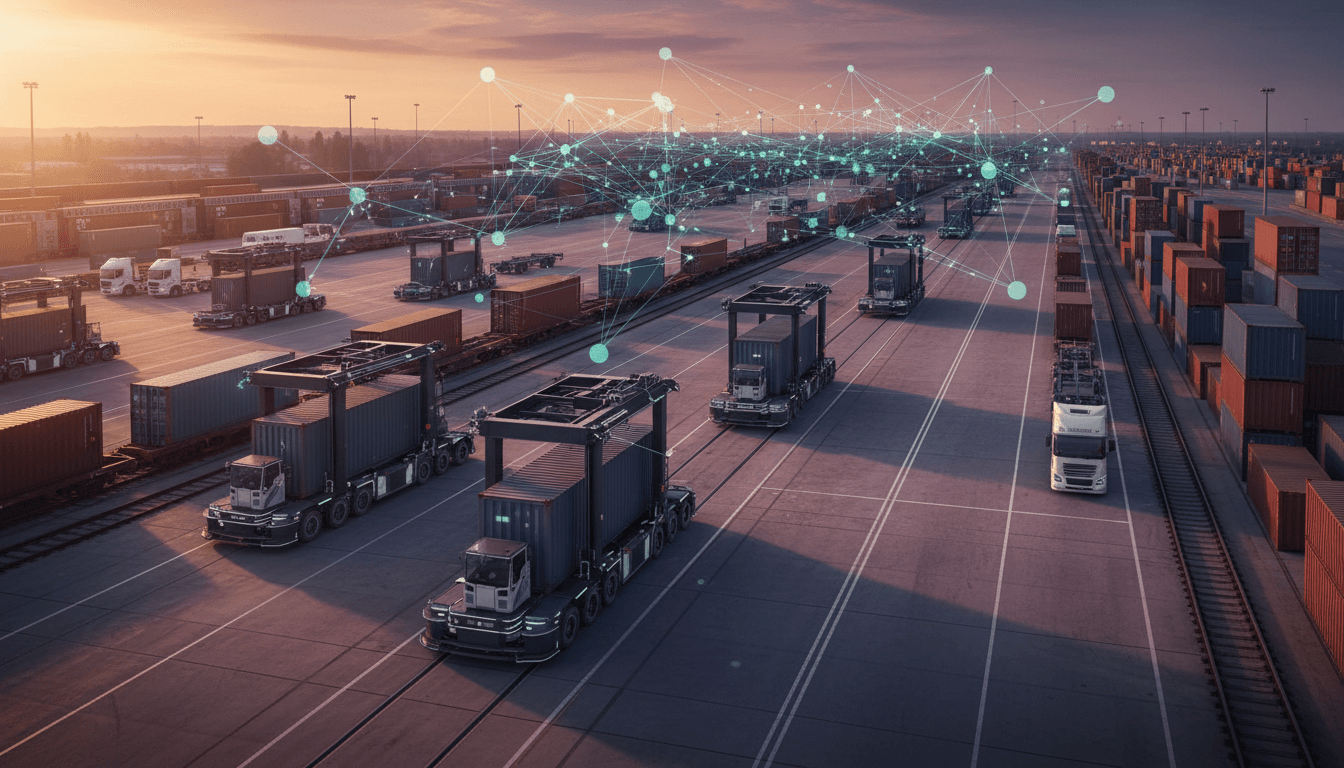
AI Logistics Wins: Glīd’s Rail-to-Road Autonomy
Port congestion makes headlines, but the quieter choke point is closer to home: trucks crawling in city traffic while rail capacity sits unused a few miles away. That mismatch—overloaded roads, underutilized rail—is where AI-powered logistics can actually earn its keep.
Glīd, led by founder and CEO Kevin Damoa (a veteran with a military logistics background), just won Startup Battlefield 2025 by pitching an autonomous approach that connects road and rail in a practical way. The interesting part isn’t the trophy. It’s the playbook: choose a real infrastructure constraint, apply autonomy where it’s controllable, and build commercial momentum early—Glīd reportedly has $70M in early customer commitments.
This post sits in our AI in Transportation & Logistics series, where the theme is consistent: AI is most valuable when it reduces operational friction, not when it adds “innovation theater.” Glīd’s story is a clean case study in that.
The real problem: roads are saturated, rail is underused
Answer first: Logistics doesn’t need more dashboards; it needs capacity rebalancing—moving freight onto the modes that can handle it, without breaking delivery timelines.
Most logistics networks are optimized locally. A shipper might optimize line-haul trucking. A port might optimize yard moves. A rail operator might optimize dwell time. But the handoff points—where freight shifts modes—are where time and cost balloon.
Here’s what that looks like operationally:
- Drayage bottlenecks: Short-haul trucking between terminals, warehouses, and rail yards is expensive, driver-constrained, and traffic-sensitive.
- Rail friction: Rail can be cost-effective and lower-emission for longer distances, but onboarding freight into rail often adds scheduling uncertainty.
- Infrastructure inertia: You can’t rebuild highways quickly, and rail expansions take years. Near-term gains come from using what already exists—better.
AI in transportation and logistics succeeds when it attacks these seams: mode shifts, yard moves, scheduling uncertainty, and the human coordination load that comes with them.
Why a military logistics mindset fits AI supply chain automation
Answer first: Military logistics is obsessed with reliability under constraints—the same requirement modern supply chains have, especially when labor, time windows, and infrastructure are tight.
Kevin Damoa’s veteran perspective matters here because military logistics culture tends to emphasize:
- Clear objectives over perfect plans: You don’t need an elegant model if it can’t survive real-world variance.
- Redundancy and contingency: A plan that fails when one node is delayed isn’t a plan.
- Operational discipline: Checklists, pre-mortems, and post-mortems aren’t “process overhead”; they’re how you avoid repeating expensive mistakes.
I’ve found that many AI logistics projects fail not because the models are weak, but because the operating system around the model is missing: who trusts it, who overrides it, what happens when sensors fail, how exceptions are handled, and how you prove safety.
That’s also why the “AI in media & entertainment” conversation is relevant here: the common thread is automation you can trust. Whether you’re scheduling shoots or scheduling shipments, AI must be accountable, explainable enough for operators, and integrated into day-to-day workflows.
Glīd’s core idea: autonomous logistics that bridges road and rail
Answer first: Glīd is betting that autonomy can make rail intermodal more usable by solving the first/last-mile interface—the messy zone where delays usually stack up.
From the RSS summary, Glīd’s pitch centers on an autonomous solution bridging congested roads and underutilized rail. The most credible autonomy plays in logistics share three traits:
- They operate in constrained environments first (yards, terminals, dedicated corridors), not instantly everywhere.
- They optimize repeatable routes, where mapping, safety validation, and exception handling can be engineered.
- They focus on measurable KPIs like turn time, dwell time, and cost per move.
Where autonomy creates value fastest
Autonomous logistics isn’t one thing—it’s a stack of capabilities. The wins tend to show up in this order:
- Yard and terminal moves: Lower speeds, defined geofences, fewer edge cases.
- Predictive dispatch and slotting: AI routing and scheduling that reduces empty miles and missed appointments.
- Automated mode transfer coordination: Timing drayage moves to rail availability (and vice versa) so containers don’t sit.
If Glīd is serious about bridging road and rail, the big lever is reducing uncertainty at the transfer point. The moment you can reliably say “this container will be at rail by X, loaded by Y, and delivered by Z,” rail becomes easier to choose.
The AI pieces that usually sit underneath
Glīd hasn’t published a full technical breakdown in the RSS summary, but an AI-driven intermodal autonomy system typically includes:
- Perception + localization: Sensor fusion (camera/radar/lidar where applicable) and high-confidence positioning.
- Planning and control: Safe motion planning under constraints (speed limits, right-of-way rules, obstacle handling).
- Operations AI: ETA prediction, exception detection, dynamic scheduling, and fleet utilization optimization.
- Human-in-the-loop tooling: Remote assist for rare edge cases and operator workflows for approvals.
The crucial design choice: don’t measure success by autonomy percentage. Measure it by freight outcomes—turn time, reliability, cost per container move, and service-level compliance.
Winning Startup Battlefield 2025: what investors and customers rewarded
Answer first: Startup competitions reward clarity: a painful problem, a credible wedge, proof of demand, and a team that can execute in regulated, physical environments.
Startup Battlefield-style wins aren’t about the flashiest demo. They’re about whether the company has a believable path from pilot to scaled operations.
From the RSS summary, three signals likely landed:
1) A problem that’s bigger than one customer
Infrastructure bottlenecks aren’t niche. If you can ease road congestion and increase rail utilization, you’re speaking to shippers, rail operators, terminals, and municipalities in the same sentence.
2) Early commercial traction: $70M customer commitments
The number that jumps off the page is $70M in early customer commitments. Commitments aren’t the same as recognized revenue, but they do indicate something investors care about even more than a demo: budget has been allocated.
If you’re building AI supply chain automation, this is the bar you should internalize:
- A signed pilot is nice.
- A pilot with clear expansion criteria is better.
- Commitments tied to outcomes (cost per move, throughput, service levels) are what scale.
3) A mission-driven culture that fits hard ops
Glīd’s founder also highlighted mindfulness and mission-driven culture. In software-only startups, culture is often discussed like a perk. In autonomy and logistics, culture is safety and uptime.
A mission-driven culture is practical when:
- Operators feel empowered to stop the line when something looks unsafe.
- Teams run blameless incident reviews and fix root causes fast.
- People don’t burn out in a 24/7 operational environment.
Practical lessons for AI logistics teams (and buyers) in 2026 planning
Answer first: The teams that win in AI logistics are the ones that productize operations—data, safety, workflows, and commercialization—at the same time.
If you’re building or buying AI for transportation and logistics, here’s what Glīd’s story suggests you should do next.
For founders: pick a wedge where the environment is controllable
Autonomy in open-world urban driving is a long road. Autonomy in a defined logistics corridor is a business.
A strong wedge has:
- Repetitive routes
- Clear operational ownership (who controls the space)
- A painful KPI you can improve inside 90–180 days
For operators: demand “reliability math,” not autonomy hype
When vendors pitch autonomy, push for the metrics that matter to your network:
- On-time performance by lane and time window
- Turn time at yard/terminal
- Exception rate and average resolution time
- Cost per loaded move vs. baseline
- Safety incidents and near-miss reporting process
One of my favorite buyer questions is simple: “Show me the week where everything went wrong and how the system behaved.” If the answer is vague, you’re buying a demo.
For product teams: build the exception workflow before the model is perfect
The highest-leverage feature in operational AI is often not the model—it’s the way exceptions are handled.
Build:
- Detection: Identify when the plan is breaking (delays, blocked routes, equipment faults).
- Triage: Classify urgency and assign ownership.
- Resolution: Provide recommended actions and a clear audit trail.
- Learning loop: Feed outcomes back into scheduling and planning.
This is where AI becomes operational, not experimental.
People Also Ask: AI and autonomous logistics basics
Does AI logistics automation replace human dispatchers?
No—at least not in any serious, scaled deployment. AI reduces manual coordination and improves consistency, but humans still handle escalation, customer communication, and unusual constraints. The win is dispatchers managing by exception, not drowning in routine.
Why connect trucking and rail instead of focusing on one mode?
Because the network is only as strong as its handoffs. If the road-to-rail transfer is unreliable, shippers stick with trucking even when rail has available capacity. Improving that interface increases usable capacity without waiting years for new infrastructure.
What’s the biggest risk in autonomous freight operations?
Operational risk beats technical risk more often than people expect. Integration with yard processes, safety governance, maintenance, and union/regulatory realities can determine success even if the autonomy stack performs well.
Where this fits in the AI in Transportation & Logistics series
AI in transportation and logistics isn’t about flashy autonomy demos; it’s about throughput, reliability, and cost per move. Glīd’s rise—from military logistics thinking to Startup Battlefield 2025 champion—highlights a pattern we keep seeing: the startups that win are the ones that treat infrastructure constraints as product requirements.
If you’re planning 2026 pilots, take a hard look at your network’s transfer points: ports to yards, yards to rail, rail to distribution centers. That’s where AI routing, autonomous operations, and predictive scheduling can create immediate capacity.
Want the practical next step? Map your top three congestion nodes and attach a number to each—minutes of dwell time, missed appointments, and empty miles. Then ask: Which of these can be solved with automation in a constrained environment first? The answer is usually where the ROI is hiding.