AI fleet diagnostics reduces downtime by shrinking uncertainty. Learn how predictive maintenance, code data, and better triage protect uptime and margins.
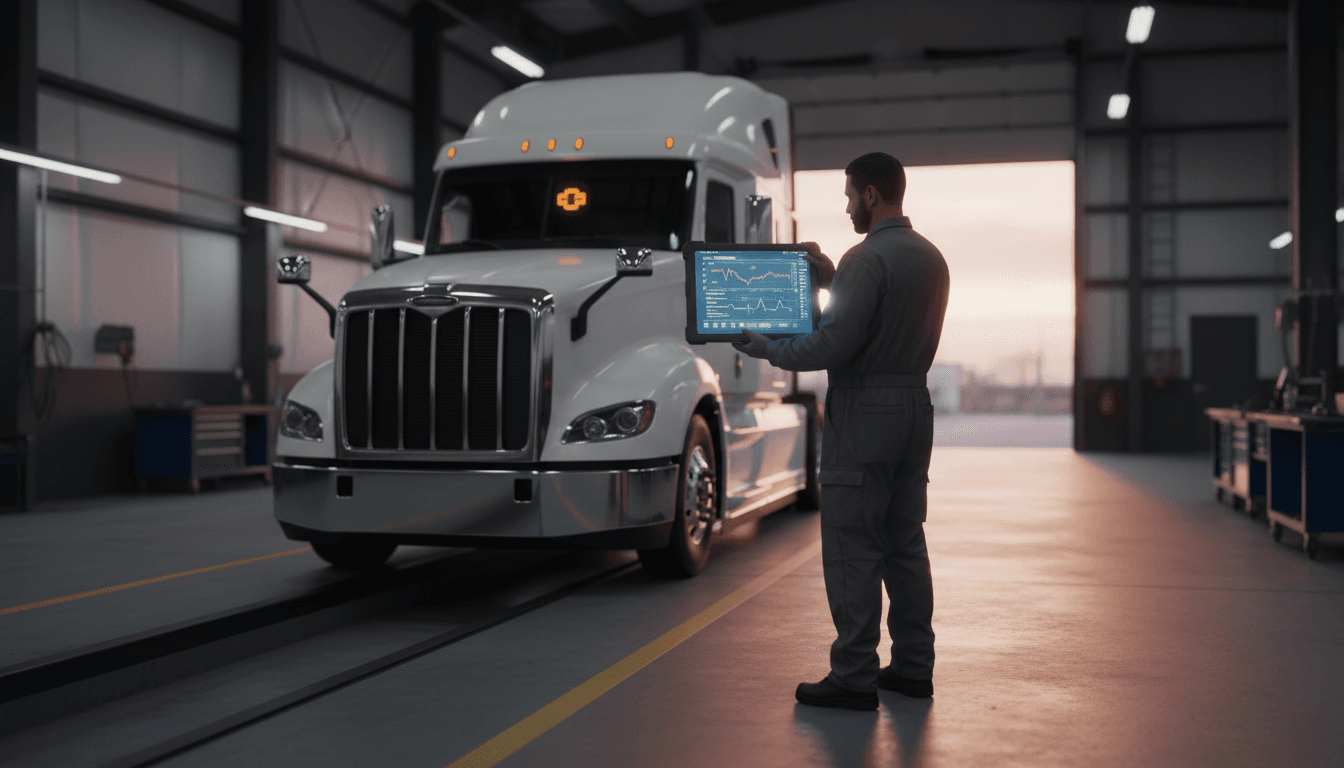
AI Fleet Diagnostics: Cut Downtime by Knowing First
A single dashboard light can turn a profitable day into a cash leak. Not because the part is expensive—but because nobody knows what’s actually wrong yet.
That “waiting-to-find-out” window is where trucking operations bleed: missed appointments, repowers, detention, angry customers, and a shop bill that grows by the hour while a tech plays whack-a-mole with fault codes. The most expensive part of a breakdown is often uncertainty.
This post is part of our AI in Transportation & Logistics series, where we focus on practical ways AI improves utilization across assets, routes, and maintenance workflows. Here, the theme is straightforward: AI-driven diagnostics and predictive maintenance shrink the uncertainty window, turning breakdowns into planned work and protecting uptime.
The real cost of breakdowns is uncertainty, not parts
Breakdowns get expensive fastest when you don’t have an answer. A sensor, a clogged filter, or a minor wiring issue can trigger fault codes that look catastrophic on the dash. If you can’t quickly separate “safe to limp” from “shut it down now,” you’re forced into worst-case decisions.
That’s why the story behind Diesel Laptops resonates with owner-operators and small fleets. Tyler Robertson watched the same cycle repeat in dealership service lanes: trucks arrive with a warning light, drivers wait for triage, and the meter runs—often before anyone confirms root cause.
The “parts cannon” problem shows up everywhere
Shops and fleets don’t waste money because they enjoy it. They waste money because the diagnostic process can degrade into guessing:
- A fault code points to a subsystem, not always the root cause
- Tech time gets consumed proving what isn’t wrong
- Parts get replaced “just to rule it out”
That’s the parts cannon in action—replacing likely suspects until the symptom disappears. It works sometimes, but it’s a brutal way to run maintenance in a margin-tight market.
Why this matters more in 2026 than it did in 2016
The industry has layered complexity on top of complexity: aftertreatment, multiplex wiring, more sensors, and stricter emissions logic. A truck can derate for reasons that are operationally minor but systemically ambiguous.
Add today’s realities—technician shortages, shop backlogs, and tighter customer service expectations—and uncertainty becomes a direct threat to asset utilization.
Downtime is a data problem before it’s a wrench problem.
Owning diagnostics changes the repair conversation
When you can read fault codes and live data yourself, you control the first hour of the event. That hour is the difference between a planned stop and an emergency.
Tools like a plug-in decoder paired with a phone (like the Diesel Decoder concept discussed in the interview) aren’t about turning drivers into master techs. They’re about giving operators enough clarity to make better decisions—fast.
What “situational awareness” looks like in the real world
At minimum, an operator who owns diagnostics can:
- Read and clear fault codes (when appropriate)
- View live engine data (temps, pressures, sensor readings)
- Confirm whether a regen is needed and whether it’s safe to perform
- Exit derate to limp to a shop (where permitted and safe)
- Follow guided troubleshooting steps
- Identify correct part numbers, including aftermarket options
That list doesn’t replace a qualified technician. It replaces the costly gap between “something’s wrong” and “here’s what we’re dealing with.”
Shops aren’t the villain—but the clock is
Most shops aren’t out to overcharge. The tougher truth is more frustrating: many shops are under-resourced, under-trained on certain platforms, or missing OEM-specific information. Even dealers can struggle when diagnostic pathways are locked behind paywalls or fragmented toolchains.
Owning diagnostics changes the dynamic in three practical ways:
- Better intake: You arrive with codes, freeze-frame data, and symptoms documented.
- Better questions: You can ask, “What tests confirm this is the root cause?”
- Faster authorization: You approve the right job sooner because you understand the failure mode.
In lead-generation terms (and in operational terms), this is the shift from reactive maintenance to data-driven maintenance decision-making.
Aftertreatment issues: why misdiagnosis is so common
Aftertreatment is where symptoms show up—even when the cause is upstream. That’s why DPF and regen complaints can become financial sinkholes.
A common pattern:
- A truck throws DPF-related codes
- The operator replaces DPF-related components
- The codes return
- Weeks later, the root cause is found (often unrelated): oil consumption, boost leak, injector issue, EGR fault, or a sensor/connector problem
The interview highlights a real-world example: a driver chased DPF problems for weeks, only to discover an upstream oil leak was the actual cause. The DPF system wasn’t “the problem.” It was the messenger.
Two hard truths about emissions systems
- Deleting emissions systems is illegal. It also creates downstream risk: compliance exposure, resale issues, and unpredictable performance.
- Understanding emissions logic is profitable. The operator who can interpret soot load, regen history, and temperature behavior avoids unnecessary replacements.
For fleets, this is where training pays back. For small carriers, it’s where a decoder plus basic education prevents the “replace everything” spiral.
How AI-driven predictive maintenance reduces downtime
AI reduces downtime by turning unknown failures into known risks with timelines. That’s the core operational benefit.
In the interview, Diesel Laptops describes monitoring transit fleets in real time using AI plus human technicians. That hybrid model is the near-term reality across transportation and logistics: AI flags patterns, humans validate and decide.
What AI actually does in fleet diagnostics (practically)
AI is most useful when it’s doing one of these jobs:
- Early anomaly detection: spotting sensor values drifting out of normal ranges (coolant temp trends, DPF pressure deltas, fuel rail behavior)
- Failure pattern matching: comparing code combinations + live data against historical fixes
- Maintenance prioritization: ranking which issues can wait and which will cause derate soon
- Workflow automation: opening a work order with the right context, parts list, and test steps
Here’s a snippet-worthy way to say it:
Predictive maintenance isn’t about perfect forecasts. It’s about fewer surprises and shorter repair cycles.
The constraint: VIN-specific data and OEM lock-in
AI can’t diagnose what it can’t see. Many of the best repair pathways, component IDs, calibrations, and platform-specific procedures are still gated by OEM ecosystems.
That creates a strategic divide:
- Fleets that invest in data access and knowledge bases get compounding gains
- Fleets that treat diagnostics as “the shop’s job” keep paying for uncertainty
For the broader AI in transportation and logistics trendline, this is the same story we see in routing, warehouse operations, and forecasting: the winners own clean data and operational context.
A practical playbook for small fleets (1–25 trucks)
You don’t need an enterprise program to get the benefits of AI fleet maintenance. You need a few disciplined habits and a simple stack.
Step 1: Standardize what drivers capture during a fault event
Make it repeatable. When a fault occurs, drivers should capture:
- Active codes + inactive codes
- Engine hours and mileage
- Ambient temp and operating conditions (pulling grade, idling, stop-and-go)
- Screenshot of key live data relevant to the system (aftertreatment temps/pressure, coolant temp, battery voltage)
- A short symptom note (loss of power, smoke, regen frequency)
This is the raw material AI and technicians need.
Step 2: Decide your “limp / park / tow” rules in advance
Uncertainty causes expensive overreactions. Set simple rules with your maintenance lead or trusted shop, such as:
- Park immediately for oil pressure warnings, severe overheating, or braking faults
- Limp to a shop for specific derate levels if temps/pressures remain within safe ranges
- Tow only when the risk of secondary damage is high
The point is consistency.
Step 3: Build a lightweight predictive maintenance loop
Even without a full telematics platform, you can do this:
- Track top 10 recurring codes by unit
- Track unplanned downtime hours per unit per month
- Track time-to-diagnosis (first alert → confirmed root cause)
- Review monthly and pick one failure mode to eliminate
You’ll be shocked how quickly patterns show up.
Step 4: Use AI where it fits: triage, not miracles
AI works best as a triage assistant:
- “These codes usually pair with these root causes.”
- “This live data looks abnormal compared to baseline.”
- “This unit is trending toward derate within X miles.”
If a vendor promises “full autonomous diagnosis” without deep data access, be skeptical. In fleet maintenance, confidence scoring matters more than flashy claims.
People also ask: quick answers operators need
Can AI prevent truck breakdowns completely?
No. It prevents a portion by detecting trends early and by shortening diagnosis time. The biggest win is fewer surprise derates and fewer “no fault found” shop visits.
Is a code reader enough for fleet maintenance?
For a one-truck operation, a code reader plus good process can pay for itself fast. For a growing fleet, you’ll want code + live data + history + workflow (work orders, parts, and vendor performance).
What’s the fastest way to reduce downtime in trucking?
Measure and reduce time-to-diagnosis. Faster diagnosis leads to faster repair decisions, smarter parts ordering, and fewer unnecessary tows.
Where fleet diagnostics is heading next
2026 will reward fleets that treat maintenance as an information system. The direction is clear: more connected assets, more real-time monitoring, more AI-supported troubleshooting, and more pressure to keep utilization high.
If you run transportation operations, here’s the stance I’ll defend: waiting for someone else to tell you what’s wrong is an avoidable cost center. Own your diagnostics, tighten your fault-event process, and then add AI where it reduces decision time.
If you’re exploring AI in transportation and logistics, start here: pick one lane—AI fleet diagnostics—and make your first goal brutally specific.
- Cut unplanned downtime hours by 10–20% next quarter
- Reduce time-to-diagnosis by one business day
- Eliminate your top recurring aftertreatment failure pattern
What would your operation look like if every fault event came with a clear severity level, likely root causes, and a recommended next action—within minutes, not days?