AI crew rebooking prevents hotel and transport bottlenecks during air cargo disruptions. Learn a practical AI playbook for peak-season resilience.
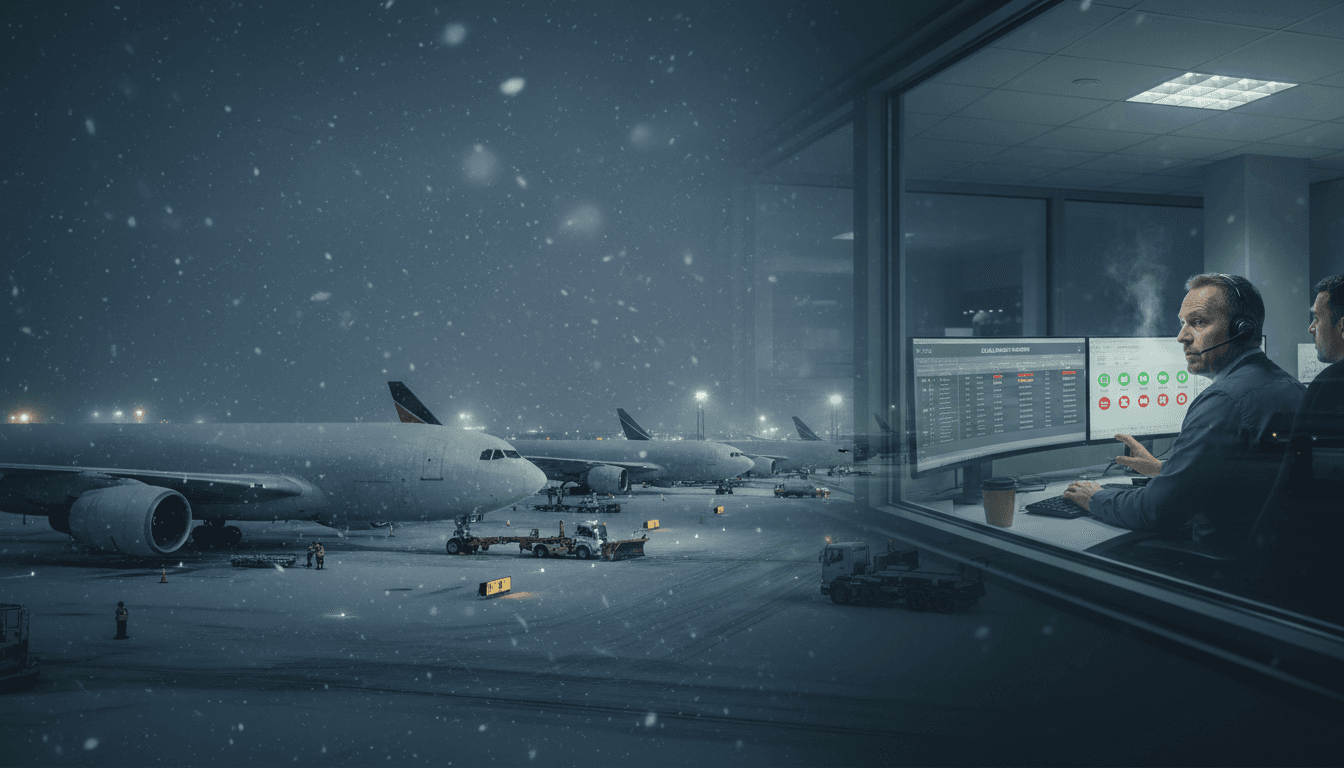
AI Fixes Crew Rebooking When Air Cargo Gets Disrupted
FedEx didn’t lose parcels first when the MD-11 freighter fleet was grounded this peak season. It lost something more fragile: time and certainty for its crews. When dozens of widebody aircraft come out of a network in November and December, schedules don’t just change—they churn. Pairings get rewritten, layovers move, duty times shift, and thousands of hotel and ground-transport reservations need to be rebooked at speed.
That’s where the story gets interesting for anyone leading operations in transportation and logistics. The headline problem sounds mundane—hotel rooms and rides—but it’s actually a perfect case study in real-time logistics optimization. If your operation can’t reliably place a pilot in a bed after a 12-hour leg, the same process gaps will show up in drayage dispatch, yard management, linehaul relays, or cross-dock appointment control.
This post is part of our “AI in Transportation & Logistics” series, and I’m going to take a stance: crew services (lodging + transport) should be treated as a first-class node in the logistics network, not as back-office admin. Once you treat it that way, AI becomes an obvious fit.
What the FedEx MD-11 grounding reveals about “hidden logistics”
Answer first: The MD-11 grounding exposed how quickly a tightly staffed, manually rebooked support function can become a network bottleneck.
According to the reported situation, mandatory inspections grounded a large portion of MD-11 capacity during the busiest shipping stretch of the year. FedEx compensated with contingency actions—activating spare aircraft, consolidating flights, upgauging to larger aircraft, deferring non-urgent maintenance, and using contract lift. That’s what a mature operator does.
But the second-order effect hit the Flight Services Desk: thousands of trips revised inside the operating month, which is the worst possible moment to be fighting for hotel inventory in major hubs.
Three details from the case matter for operators beyond aviation:
- Schedule churn breaks downstream reservations. When an internal system changes a pairing, lodging can get “kicked out” of the workflow. That’s a systems problem, not a people problem.
- Peak season amplifies every exception. In December, hotels sell out, airport-area properties price up, and ground transport availability becomes uneven. Your margin for error disappears.
- Crew rest is an operational constraint, not a perk. If crews spend an extra hour sorting rooms and rides, that’s fatigue risk, productivity loss, and a trust hit—all at once.
If you’re in trucking or ocean, substitute “pilot” with “driver,” “crew rest” with “HOS compliance,” and “hotel” with “safe parking + lodging.” The pattern holds.
Why manual rebooking collapses under disruption
Answer first: Manual rebooking fails because it’s a many-to-many matching problem (people, places, times, constraints) that changes every minute.
Rebooking at scale isn’t “call a hotel.” It’s a dynamic allocation problem:
- Thousands of travelers (crews) with different qualification constraints and duty-time limits
- Multiple layover cities with variable inventory
- Hotel contracts with rate caps, blackout dates, and cancellation rules
- Ground transport capacity that fluctuates by hour
- A schedule that keeps updating due to maintenance, weather, delays, or ATC
Humans are good at judgment calls, but they’re bad at continuously solving a live optimization puzzle. That’s why teams appear “overwhelmed” during major disruptions even when they’re competent and working hard.
The common failure modes (you’ve probably seen them)
Answer first: Most breakdowns come from poor exception handling and weak system-to-system handoffs.
Typical failure modes look like this:
- Reservation orphaning: itinerary changes cancel or invalidate hotel bookings without re-creating them.
- Queue congestion: agents handle requests FIFO, but the real priority is driven by report times, duty limits, and city inventory.
- No predictive escalation: the desk learns about a shortage when the crew lands.
- Single-channel support: phone-only support creates hold-time friction precisely when crews need rest.
- No inventory intelligence: booking happens without forecasting which cities will go “tight” tonight.
This is where AI earns its keep—not by replacing humans, but by keeping the system from generating preventable exceptions.
What AI-driven crew logistics looks like (and why it works)
Answer first: AI improves crew rebooking by forecasting disruption impact, prioritizing re-accommodation, and automatically securing inventory before crews arrive.
Think of this as resource allocation across a network, the same way modern logistics teams apply AI to routing, capacity planning, and ETA prediction.
Here’s a practical architecture that maps well to air cargo, but also to rail crew management or long-haul trucking relays.
1) Predictive disruption modeling: “Where will the mess land?”
Answer first: The fastest win is forecasting which layover cities will face shortages 6–24 hours ahead.
Inputs an AI model can use:
- Real-time schedule changes and tail swaps
- Delay propagation risk (weather, hub congestion patterns, maintenance events)
- Hotel inventory signals (contract utilization, historical sell-out rates by weekday)
- Ground transport availability patterns (airport pickup dwell times, local events)
Output:
- A heat map of at-risk layovers (e.g., “Memphis tonight: high risk; Anchorage tomorrow: medium risk”).
Once you can predict where the bottleneck will occur, you can pre-stage solutions instead of apologizing after landing.
2) Constraint-based optimization: the “right” booking, not the “first” booking
Answer first: Rebooking is a constrained optimization problem; AI can solve it faster and more consistently than manual triage.
Constraints typically include:
- Legal rest windows and duty limits
- Crew pairing integrity (keep crews together when required)
- Contracted hotel rate caps and distance-from-airport limits
- Safety constraints (approved properties/areas)
- Cancellation penalties and rebooking costs
A good system doesn’t just book rooms—it chooses the lowest-risk feasible plan:
- Keep the crew closest to the airport when report times are early
- Use secondary properties when inventory tightens
- Avoid repeated cancellations that trigger penalties
- Balance cost against downstream delay risk
That last point matters: saving $60 on a room can cost you an aircraft departure.
3) Automated re-accommodation workflows with human override
Answer first: Automation should handle the routine 80% and route the tricky 20% to specialists.
A workable model:
- AI agent detects itinerary change → checks if current hotel/transport remains valid
- If invalid → proposes top 3 rebooking options with cost + risk score
- Auto-books within policy for low-risk cases
- Escalates exceptions (sold-out city, international visa issues, medical needs) to a human desk
This is exactly how mature logistics automation works in other domains: straight-through processing with exception management.
4) Multi-channel crew support that reduces fatigue friction
Answer first: Text-based support and self-serve options reduce hold times and protect rest.
Even without fancy AI, giving crews a secure channel to receive:
- hotel confirmation
- pickup time + vehicle details
- a one-tap “I’m delayed” update
…cuts the “one more hour awake” problem dramatically.
With AI, you can add:
- a conversational assistant that retrieves confirmations, reissues vouchers, and files “no-room” incidents
- proactive alerts when bookings change
The goal is simple: crew lands → transport is ready → room exists → rest happens.
The KPI operators should track (because “people are annoyed” is too late)
Answer first: If you can’t measure crew rebooking performance in real time, you can’t manage it during disruption.
Here are metrics that actually drive operational outcomes:
- Reservation completion SLA: % of layovers with confirmed hotel + transport before arrival (e.g., 95%+)
- Time-to-confirm after schedule change: median minutes from pairing update to new confirmation
- Hold time / contact rate: average time crews spend waiting for support; number of contacts per trip
- Exception rate by station: which hubs generate the most orphaned reservations
- Downstream impact: fatigue calls, missed report times, preventable delays linked to accommodation issues
If you’re running a broader logistics network, mirror these KPIs:
- “% loads with appointment confirmed before driver arrival”
- “minutes from ETA change to dock reschedule”
- “exceptions per facility per day”
Same playbook. Different assets.
A practical rollout plan (30/60/90 days)
Answer first: You don’t need a multi-year transformation; you need fast containment, then smarter automation.
First 30 days: stop the bleeding
- Build a single source of truth for pairings/itineraries and bookings (even if it’s a simple integration layer)
- Add automatic “orphan detection”: alert when a pairing changes and lodging drops
- Implement a priority queue based on report time + rest constraints, not FIFO
Days 31–60: add prediction + inventory strategy
- Forecast high-risk stations nightly (sell-out probability)
- Pre-negotiate overflow properties in top disruption cities
- Introduce “protect bookings” rules (don’t cancel unless replacement is secured)
Days 61–90: automate the routine cases
- Launch straight-through booking for low-risk changes
- Add multi-channel support (secure messaging)
- Create an exception playbook with structured categories (sold out, unsafe area, international)
I’ve found that teams get the most value when they start by reducing avoidable exceptions, not by chasing a perfect AI model.
What to do if you’re not an airline (and why you should still care)
Answer first: Crew logistics is a template for every “supporting” workflow that quietly determines service reliability.
The FedEx case is aviation-specific, but the lesson is cross-industry: your operation is only as resilient as its least-instrumented workflow.
In trucking, this shows up as:
- drivers stuck without safe parking when plans change
- last-minute hotel booking chaos during weather events
- dispatchers burning hours on calls instead of managing capacity
In ocean and rail, it shows up as:
- crew callouts cascading through schedules
- missed connections because ground legs weren’t reallocated quickly
- terminals overwhelmed because appointment changes didn’t propagate
AI in transportation and logistics works best when you apply it to the “boring” parts that are actually high-frequency, high-variance.
Where this goes next for AI in Transportation & Logistics
The MD-11 grounding story is a reminder that disruption doesn’t ask permission. It hits when volumes are high, inventory is tight, and everyone’s already stretched.
AI-driven crew rebooking is one of the clearest, fastest ROI opportunities in logistics optimization because the outcome is measurable: more confirmed reservations before arrival, fewer fatigue-driven issues, fewer preventable delays, and less desk overload.
If you’re building resilience for 2026 peak season, the question isn’t whether disruptions will happen. It’s whether your operation will treat crew accommodation and support as a real node in the network—instrumented, optimized, and automated—or as an afterthought that collapses under pressure.
If your rebooking process can’t keep up with a grounded fleet, it won’t keep up with your next big disruption either.
Want to pressure-test your own “hidden logistics” workflows—crew, driver support, appointment rebooking, detention prevention—and see where AI automation fits first?