Wheeled mobile manipulators bring real logistics ROI by reducing touches and exceptions. See where they fit, what to demand, and how AI ties it together.
Wheeled Mobile Manipulators: Logistics ROI Now
December is when warehouse and delivery networks feel every rough edge in the operation: peak volumes, compressed cutoffs, seasonal labor gaps, and a steady stream of “exceptions” that don’t fit automation’s neat assumptions. The hard truth is that most warehouses have automated movement (AMRs, conveyors) but still depend on humans for the last 10 feet of work—picking, placing, staging, loading, and resolving the weird stuff.
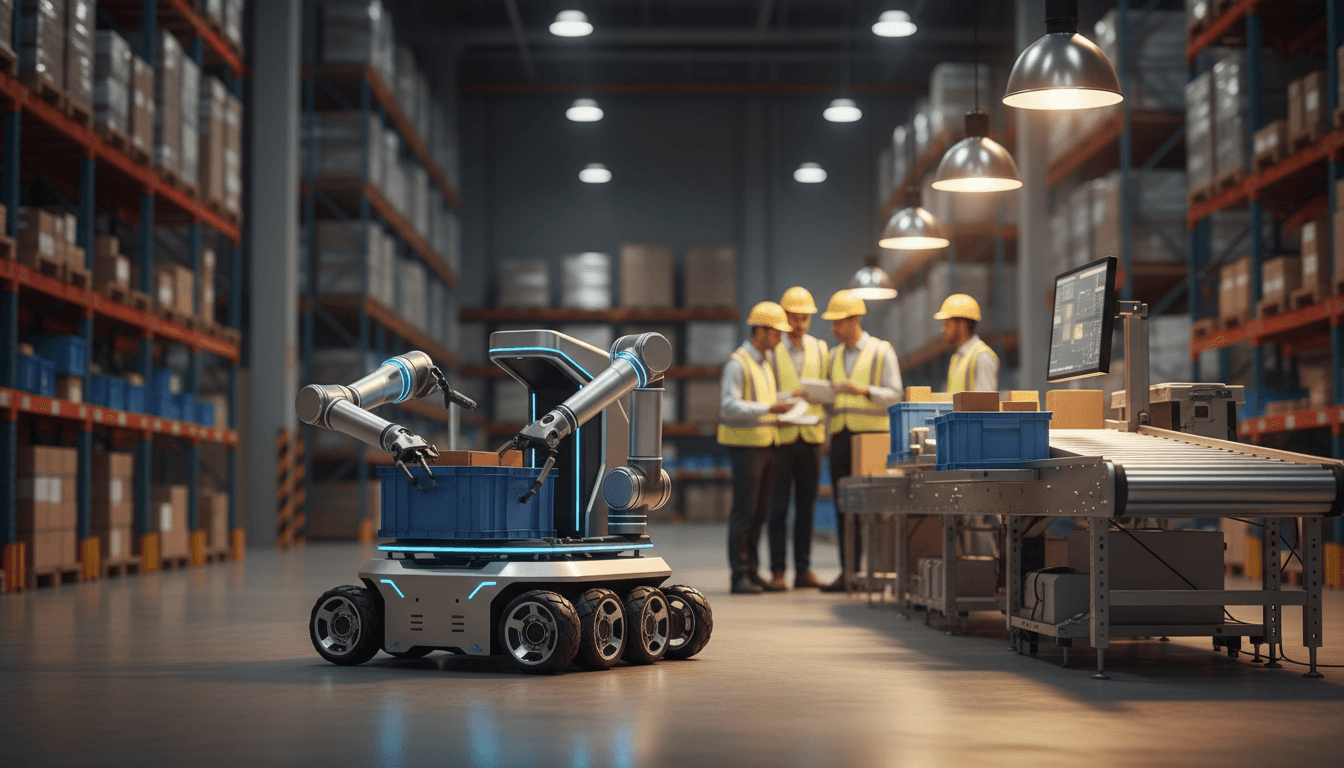
That’s why wheeled mobile manipulators—AMRs with arms—are getting practical attention. Richtech Robotics’ new Dex is a good example of where the category is headed: two arms on a stable wheeled base, designed for uptime, payload, and real deployments. If you’re leading transportation and logistics automation, the interesting part isn’t the “humanoid” look. It’s the operational math: how many touches can you remove, how many exceptions can you absorb, and how quickly can you redeploy the same robot to the next workflow?
Below is how to think about wheeled mobile manipulators in an AI-powered logistics stack—what they’re good at, where they struggle, and what you should demand before you sign a purchase order.
Why wheels are winning in mobile manipulation
Answer first: Wheels win because logistics buyers pay for reliability and runtime, not novelty.
Legged robots are impressive, but in most warehouses and back-of-house environments, the floor is flat, the paths are known, and the real problem is manipulating objects—not stepping over rubble. A wheeled base simplifies the physics: fewer moving parts, less energy spent on balance, and more battery available for actual work.
Richtech’s Dex highlights the point with an explicit design choice: wheels over legs to extend operational runtime. For logistics teams, that choice matters because uptime is the product. A robot that needs frequent charging, babysitting, or resets isn’t automation; it’s a new kind of work.
A second reason wheels win: safety and predictability. Stable platforms are easier to certify, easier to risk-assess, and easier to operate around people. In busy peak-season flows, that matters more than the robot’s ability to climb a step.
The market signal: wheeled “humanoid-like” robots dominate
A useful data point from the source material: Grand View Research estimates wheeled humanoid-like robots represent 65% of the current $1.6B market. You don’t need to debate the precise segmentation to see the message: buyers are prioritizing form factors that fit existing facilities.
Logistics is conservative for a reason. You can’t “move fast and break things” when the thing you break is throughput.
The real shift: from moving totes to doing work
Answer first: The biggest leap isn’t navigation; it’s closing the gap between transport and manipulation.
AMRs already move inventory around many warehouses. The sticking point is all the moments where inventory must be:
- Picked from a shelf/bin
- Oriented correctly
- Placed into a tote/cart
- Staged to a lane
- Handed off to packing
- Loaded into a roll cage
- Reworked when labels/dimensions don’t match
Those are manipulation problems, not navigation problems.
A wheeled mobile manipulator turns a “move item from A to B” system into a “complete the task” system. That’s a big difference. It’s also why the category is so appealing for transportation and logistics: fewer handoffs means fewer errors, and fewer errors means fewer costly downstream events—missorts, damages, late departures, and customer-service recoveries.
Where Dex fits: dual-arm capability and on-robot AI
Richtech’s Dex is positioned as a two-armed mobile robot designed for industrial deployment. In practice, dual arms matter when tasks require stabilizing an item with one hand while manipulating with the other—think opening a tote lid, holding a carton while scanning, or handling awkward packaging.
The other key element in the source: Dex integrates an edge AI processor (NVIDIA Jetson Thor) and uses lidar-based SLAM navigation, plus simulation workflows (via Isaac Sim) for training.
Here’s the logistics takeaway: the robot can’t depend on perfect connectivity. Edge decisioning is the difference between a robot that pauses when Wi‑Fi drops and one that keeps working.
How AI and mobile manipulators connect to warehouse optimization
Answer first: Mobile manipulators pay off when they’re connected to forecasting, inventory data, and work orchestration, not when they’re treated like isolated gadgets.
In our “AI in Robotics & Automation” series, the pattern is consistent: hardware gets attention, but software integration determines ROI. A mobile manipulator is most valuable when it becomes a physical endpoint of your AI planning layer.
Bridge point 1: Forecasting → staffing → robotic task allocation
Most ops teams already forecast volume and labor needs. The next step is using those forecasts to pre-plan robotic coverage:
- Assign mobile manipulators to high-variance zones during peak (gift sets, mixed SKUs, fragile goods)
- Shift robots to replenishment and staging during off-peak
- Use “exception probability” scores to decide where robots should be stationed before issues occur
That last point is underrated. If your AI forecasting flags that a set of SKUs historically causes packing exceptions (missing inserts, barcode confusion), you can pre-position a manipulator to handle the rework loop.
Bridge point 2: Inventory accuracy → autonomous exception handling
Robots generate structured observations: barcode reads, dimension/weight checks, photo evidence, location confirmations.
When that data feeds your WMS/OMS, it improves inventory accuracy. When inventory accuracy improves, forecasting improves. It’s a loop.
Mobile manipulators matter because they can both observe and act:
- Identify a mismatch (wrong SKU in bin)
- Pull the unit
- Place it into a quarantine tote
- Trigger an audit workflow
That’s the difference between “AI that tells you there’s a problem” and “AI that resolves it.”
Bridge point 3: Task execution that maps to logistics KPIs
If you’re evaluating Dex-like platforms, tie every use case to a KPI you already defend:
- Touches per order
- Picks per labor hour
- Exception rate
- Damage rate
- Trailer departure adherence
- Cycle time from pick to pack
If a vendor can’t map a manipulation workflow to one of these, you’re looking at a demo, not a deployment.
Practical use cases for wheeled mobile manipulators in logistics
Answer first: The best near-term use cases are structured, repetitive, high-touch tasks with clear start/stop conditions.
Here are realistic workflows where wheeled mobile manipulators fit well—especially in mixed human/robot environments.
1) Goods-to-person support: tote handling and station servicing
Many facilities already do goods-to-person picking. Mobile manipulators can reduce station downtime by:
- Swapping empty/full totes
- Removing dunnage and placing it in a designated bin
- Handing items to the operator in the correct orientation
This is “boring” work. That’s why it pays.
2) Pack-out and kitting in high-mix operations
Seasonal kitting is a December staple. A manipulator can:
- Pick components from labeled bins
- Assemble kits in a tote
- Verify via vision checks
- Stage completed kits for sealing
The value is consistency and fatigue reduction. Kitting errors are expensive and brand-damaging.
3) Cross-dock micro-rework: relabeling, scan confirmation, sort recovery
In transportation hubs, exceptions happen fast. A mobile manipulator can perform:
- Scan-and-confirm on suspect parcels
- Relabel placement (depending on end-effector capability)
- Divert to a recovery lane
Even if the robot only handles 30–40% of exceptions, that’s meaningful because exceptions consume disproportionate labor.
4) Last-mile preparation: cart building and route staging
For last-mile delivery, staging is often manual and rushed:
- Build route carts
- Sequence stops
- Confirm high-value items are present
A mobile manipulator connected to routing data can stage by priority (first stops on top/front), then confirm with scans and photos.
What to demand before you deploy (so you don’t buy shelfware)
Answer first: Insist on proof around runtime, recovery behavior, integration, and service model.
I’ve found that many robotics programs fail for predictable reasons: unclear ownership, messy data interfaces, and unrealistic assumptions about “autonomy.” Here’s a deployment checklist tailored to wheeled mobile manipulators.
Technical acceptance criteria (non-negotiables)
- Runtime under your duty cycle: not a lab number. Measure it with real payload, real routes, and real stops.
- Recovery playbooks: what happens when it drops an item, encounters a blocked aisle, or can’t localize?
- Manipulation success rate: define it per task (e.g., successful grasp-and-place within 2 attempts).
- Safety envelope clarity: how speed, proximity, and force limits change around humans.
- Edge-first operation: it must continue core tasks even with degraded connectivity.
Integration criteria (where ROI lives)
- WMS/WES integration for work dispatch and confirmation
- Inventory updates and exception codes
- Teleoperation hooks for “human assist” events
- Data logging for continuous improvement (images, attempts, failure reasons)
Business model criteria: RaaS vs purchase
Richtech emphasizes robot-as-a-service (RaaS) with optional direct sales. For logistics, I’m generally pro-RaaS when the process is still evolving, because you want:
- Faster iteration
- Clear uptime commitments
- Support bundled into the cost
If the workflow is stable and you have strong internal maintenance capability, purchase can work. But don’t pretend you’re buying “a robot.” You’re buying a program.
The underappreciated prize: data as a logistics asset
Answer first: The long-term value of mobile manipulators is the operational dataset they create—especially in the U.S. market.
Richtech’s leadership is explicit about moving toward data as a service (DaaS) as deployments scale. That direction is smart. Physical AI systems need real-world edge cases: occlusions, reflective packaging, crushed cartons, mislabeled items, messy staging areas.
For transportation and logistics operators, this creates a strategic option:
- Use robot data to improve pick accuracy and reduce claims
- Use robot observations to validate vendor compliance (labels, packaging)
- Use failure-mode analytics to redesign slotting and packaging standards
One-liner worth remembering: If you don’t capture the data from physical work, you’ll keep paying to relearn the same lessons every peak season.
What this means for AI in Transportation & Logistics
Wheeled mobile manipulators are the practical path to “physical AI” in operations because they align with how facilities are built today. They don’t need perfect infrastructure, but they do need tight integration with your planning and execution systems.
If you’re thinking about 2026 readiness, the question isn’t “Should we get humanoids?” The better question is: Which 2–3 high-touch workflows can we automate end-to-end, and what data do we need to keep improving them?
If you want help scoping a pilot—use case selection, KPI baselines, vendor evaluation, and integration requirements—reach out. A good pilot doesn’t prove the robot can move and grab. It proves your operation can absorb automation and get measurably better month over month.
Where would a wheeled mobile manipulator remove the most touches in your network: pack-out, exception handling, or route staging?