Wearable human activity recognition helps care robots understand movement context in real time. Learn how hierarchical fuzzy models boost robustness and trust.
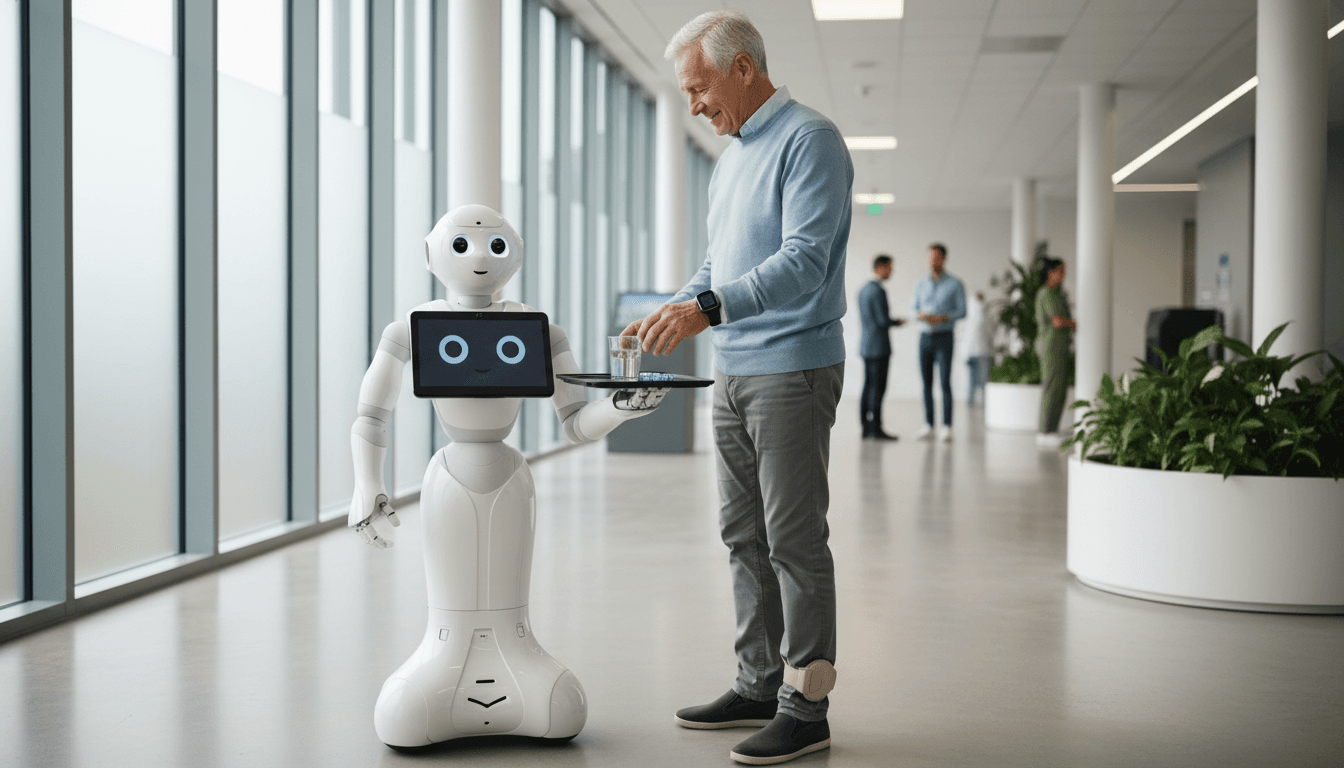
Wearable HAR: The Missing Sense for Care Robots
Robots in hospitals and senior living facilities don’t fail because they can’t move. They fail because they can’t read the room.
A service robot can navigate a hallway flawlessly and still make the wrong call if it can’t tell whether a person is resting, walking unsteadily, reaching for support, or recovering from a near-fall. That’s why human activity recognition (HAR) using wearable sensors is quietly becoming one of the most practical “perception upgrades” for robotics in healthcare and assisted living.
Zahra Ghorrati, a PhD researcher at Purdue University, is working on exactly this problem: scalable, adaptive deep learning frameworks for wearable-based HAR that hold up outside pristine lab datasets. Her approach—mixing hierarchical modeling with fuzzy logic—hits a sweet spot robotics teams should care about: robustness, interpretability, and low compute.
Why wearable human activity recognition matters for robotics
Wearable HAR matters because it turns noisy body motion data into actionable context robots can use to assist, alert, or stand down.
Robotics has spent decades improving external perception: cameras, LiDAR, depth sensors, and environmental mapping. But in healthcare and elder care, some of the most important signals are person-centric:
- Is the patient getting up too quickly?
- Are they shuffling (possible fatigue or dizziness)?
- Did they transition from sitting to standing and then stop moving (risk event)?
- Are they performing rehab exercises with correct cadence?
Video can answer some of these questions, but it creates deployment friction—privacy concerns, occlusions, fixed coverage areas, lighting constraints, and “camera anxiety” in private spaces. Wearables flip the trade-off:
- Portable and continuous: you get monitoring during daily routines, not just in camera zones.
- Privacy-respecting by default: motion and physiological signals instead of identifiable video.
- Robot-ready signals: time-stamped data streams that can drive triggers and policies.
In the AI in Robotics & Automation series, we often talk about autonomy as “perception → decision → action.” Wearables strengthen the first step: perception of the human, not just the environment.
The hard part: wearable sensor data is messy (and robots suffer when models are brittle)
The core challenge Ghorrati highlights is simple: real-world wearable data is noisy, inconsistent, and uncertain.
If you’ve built anything with IMUs (accelerometer/gyroscope) in the wild, you’ve seen the failure modes:
- Placement variability: wrist vs pocket vs ankle changes the signal signature.
- Orientation drift: users don’t wear devices “correctly” 24/7.
- Motion artifacts: grabbing a rail, leaning on a walker, carrying groceries.
- Device differences: sampling rate, sensitivity, firmware filtering.
Robotics teams feel this pain twice:
- False positives create alarm fatigue (nurses and caregivers stop trusting the system).
- False negatives create safety risk (missed fall precursors, missed distress signals).
So the goal isn’t “higher benchmark accuracy.” The goal is stable performance under shifting conditions, with outputs that are understandable enough to support safety cases and clinical workflows.
A practical idea: hierarchical models that recognize simple actions first
A hierarchical HAR model works because it matches how activities are composed in real life.
Ghorrati’s research uses a hierarchical recognition approach: detect simpler activities at early levels, then classify more complex activities at higher levels. In robotics terms, this is a perception pipeline that answers questions in the right order.
Why hierarchy helps care robots
In a care setting, a robot (or an automation system) often needs a fast, coarse decision before it needs a precise label.
Example:
- Early level: “Is the person stationary or moving?”
- Next: “If moving, is it walking, turning, or transitioning posture?”
- Higher: “Does this walking pattern look impaired?” or “Is this a rehab exercise set?”
This matters because time-to-detection is a safety feature. If the system can quickly recognize a transition (sit-to-stand) and detect instability, it can:
- slow a nearby robot to reduce collision risk,
- trigger a check-in prompt,
- alert staff if risk thresholds are exceeded.
Hierarchy also makes integration cleaner: robots can consume intermediate states (like “transitioning posture”) even if the final label isn’t certain yet.
The overlooked ingredient: fuzzy logic for uncertainty you can explain
Fuzzy logic improves wearable human activity recognition because it represents uncertainty explicitly—and that makes the system easier to trust.
Ghorrati integrates fuzzy logic principles into deep learning, so the model can reason in degrees rather than hard, brittle boundaries. That’s not academic flair; it’s directly aligned with how healthcare decisions are made.
What “fuzzy” buys you in deployment
Most HAR systems act like a judge: one label, final answer. Fuzzy systems act more like a clinician: “I’m 0.7 confident it’s walking, 0.2 it’s standing, 0.1 it’s something else.”
For robotics and automation, those confidence degrees can drive safer behavior:
- Policy gating: Only trigger an escalation if confidence stays above a threshold for N seconds.
- Graceful fallback: If uncertainty spikes, switch the robot to a conservative mode (slow speed, increased distance).
- Human-readable explanations: “Detected transition + high variability + low stability” is more defensible than “Model says fall risk.”
Here’s the stance I’ll take: if your HAR system can’t explain uncertainty, it shouldn’t be allowed to trigger high-stakes actions (like emergency alerts or autonomous physical assistance).
Real-time matters: low compute is a feature, not an optimization
Wearable HAR for robotics succeeds when it runs reliably on-device or at the edge.
Ghorrati emphasizes simplicity and low computational cost—important because many deployments can’t assume always-on connectivity or cloud inference. In healthcare environments, outages happen, Wi‑Fi dead zones exist, and privacy policies often restrict raw data uploads.
A practical architecture for robotics teams
A common pattern that works well:
- On-device wearable inference for basic activity states and uncertainty scores.
- Edge aggregator (room hub or nursing station gateway) fusing signals from multiple wearables and the robot’s onboard sensors.
- Robot behavior layer consuming only events and probabilities (not raw streams).
That design keeps bandwidth low, reduces privacy exposure, and makes the robot’s decision system more stable.
From wearables to robots: how HAR becomes contextual awareness
Wearable HAR isn’t just “classify movement.” It becomes a context engine for service robots.
Example 1: fall prevention workflows
A fall prevention pipeline can be more than post-fall detection:
- Detect sit-to-stand transition
- Track gait variability over 10–30 seconds
- Flag instability pattern
- Trigger robot check-in (“Do you need support?”)
- If no response + continued instability, alert staff
Even without adding new hardware to the robot, wearables provide an early warning layer that robots can act on.
Example 2: rehab and adherence monitoring
Many clinics struggle to monitor home rehab adherence. A wearable HAR model can:
- recognize exercise type,
- detect repetition count and cadence,
- estimate form consistency via signal patterns,
- provide a summary a care robot can communicate or coach against.
Robots become more useful when they can base coaching on measured behavior, not self-reported compliance.
Example 3: multi-occupant environments
Vision-only robots struggle in shared rooms: occlusion and ambiguity are constant. A wearable signal tied to an individual identity reduces confusion:
- “Patient A is standing; Patient B is sleeping.”
- Robot can prioritize interactions and reduce disturbances.
This is one of the strongest arguments for wearables in elder care robotics: they’re identity-preserving without being identity-revealing.
What to evaluate before you deploy wearable HAR in automation
If you’re considering wearable human activity recognition as part of a robotics or automation product, evaluate it like a safety system, not a demo.
Deployment checklist (the stuff that breaks pilots)
-
Sensor placement robustness
- Test wrist vs pocket vs belt.
- Test dominant vs non-dominant hand.
-
Domain shift tolerance
- Train on Dataset A, test on Dataset B.
- Then test on your facility data.
-
Latency and duty cycle
- Define maximum acceptable detection delay (e.g., 500 ms vs 5 s).
- Confirm battery life targets under continuous inference.
-
Interpretability artifacts
- Can you produce a human-readable reason code?
- Can clinicians/caregivers understand what triggered an alert?
-
Uncertainty handling
- What does the system do when confidence is low?
- Does the robot default to safer behavior?
-
Integration surface area
- Prefer event-based APIs:
activity_state,confidence,change_point,stability_score.
- Prefer event-based APIs:
If you only do one thing: build an “uncertainty-first” interface. Robots shouldn’t consume labels; they should consume labels plus confidence and trend.
Where the research is heading (and why robotics should care)
Ghorrati’s stated next step—improving scalability, adaptability, efficiency, and interpretability—aligns with what real deployments demand.
Even more interesting is her expansion from HAR into general time series classification, including physiological signals and sound classification. For robotics, that points toward a richer perception stack:
- IMU-based motion context (activity)
- physiological context (stress, fatigue proxies)
- acoustic context (coughing, distress calls, equipment alarms)
Put those together and a care robot stops being a rolling tablet. It becomes a system that can prioritize help, reduce unnecessary interruptions, and coordinate with staff using evidence.
“Robots don’t need perfect understanding. They need reliable signals, calibrated uncertainty, and behaviors that degrade safely.”
Where to start if you want wearable HAR in your robotics roadmap
If you’re building in healthcare, senior living, hospitality, or any human-facing automation, wearable HAR is one of the fastest ways to improve contextual awareness without installing more cameras.
A realistic pilot plan I’ve seen work:
- Start with 3–5 activity classes that map to clear actions (resting, walking, sit-to-stand, lying down, “unknown”).
- Add uncertainty thresholds and time smoothing before you add more classes.
- Integrate with robot behavior constraints (speed, proximity, interaction timing).
- Expand to facility-specific events (walker use, bathroom visits, rehab sessions).
If you want leads from this work—meaning you want it to turn into a product—focus on one question: what decision does this enable that wasn’t safely possible before? That’s where ROI lives.
Robotics in 2026 isn’t just about better grippers and better maps. It’s about better human understanding. Wearable-based human activity recognition is one of the most practical ways to get there.
What’s the first workflow in your operation that would improve if a robot could reliably tell the difference between “walking normally” and “walking at risk” in real time?