Ultrasound-driven bubble muscles enable wireless soft robot actuation. See why AI control makes them practical for healthcare, logistics, and automation.
Ultrasound Bubble Muscles for AI Soft Robots
A lot of robotics roadmaps obsess over the “brain” (AI perception and planning) and treat the “body” (actuation) like a solved problem. Most teams learn the hard way that it isn’t. If your robot can’t generate the right motion at the right time—quietly, safely, and in a tight space—no amount of autonomy makes it useful.
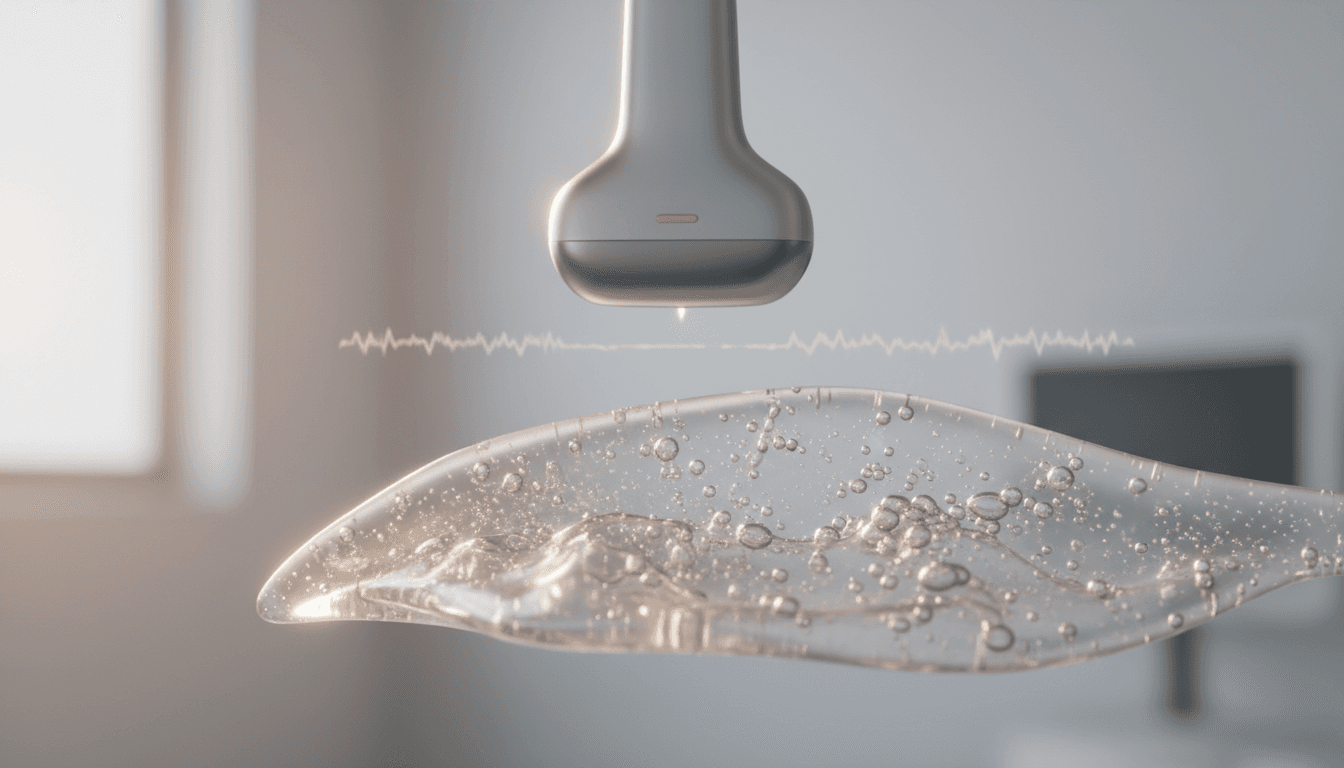
That’s why ultrasound-powered “bubble muscles” are worth paying attention to. In late 2025, researchers demonstrated a soft, biocompatible gel packed with microscopic bubbles that moves when hit with ultrasound—no wires, no onboard pumps, no batteries. For AI in robotics & automation, this isn’t a materials curiosity. It’s a new actuation pathway that makes different robot designs feasible, especially in healthcare and confined industrial environments.
What ultrasound bubble muscles actually change
Ultrasound bubble muscles change the integration equation: you can put the actuator where you need motion, and put the power/control hardware somewhere else.
Traditional actuation forces uncomfortable trade-offs:
- Electric motors deliver force and precision, but they’re rigid, gear-heavy, and create pinch hazards.
- Pneumatics/hydraulics are strong, but the tubing, valves, and compressors add bulk and maintenance.
- Thermal/chemical soft actuators can be elegant, but often respond too slowly or waste energy.
Bubble muscles are different because the energy delivery is external and wireless. The material contracts, bends, grips, or undulates when ultrasound excites embedded microbubbles. The key practical implication is simple:
If you can get ultrasound to the target, you can move the target—without dragging a tether of wires or hoses through your robot.
In medicine, that’s huge. In industrial automation, it’s quietly disruptive for robots that must operate inside sealed housings, wet environments, or contamination-controlled spaces.
How bubble muscles work (and why “programmable” matters)
The core mechanism is acoustic resonance. Thousands of microscopic bubbles are embedded in a soft gel in patterned arrays. When ultrasound is applied, bubbles oscillate and the surrounding gel deforms.
Frequency-addressable actuation
The clever part is selectivity. Different bubble sizes respond to different ultrasound frequencies, so a single external ultrasound source can activate specific regions by changing frequency. In demonstrations, researchers used actuation frequencies in the 1–100 kilohertz range.
That creates a form of “hardware addressing” in the material itself:
- Bubble population A responds at frequency A → region bends.
- Bubble population B responds at frequency B → different region twists.
- Combine frequencies → compound motions like undulation or gripping.
For AI-driven robotics, this is more than a neat trick. It’s an actuation interface that looks like a control problem AI is good at: mapping sensor feedback to a set of excitation frequencies and amplitudes.
Why this pairs naturally with AI control
Soft robots are notoriously hard to control because their bodies have near-infinite degrees of freedom. Precise analytical models tend to break.
Bubble muscles push you toward a practical architecture:
- Sense: ultrasound imaging and/or embedded strain/pressure sensing
- Infer: estimate deformation state (often via learned models)
- Actuate: choose ultrasound frequency/amplitude patterns
- Correct: close the loop fast
This is where modern robotics teams already have strong muscle memory: model predictive control with learned dynamics, reinforcement learning for manipulation policies, and adaptive control under uncertainty.
What the prototypes prove (and what they don’t)
The 2025 demonstrations hit three things robotics buyers care about: dexterity, safe contact, and operation in real tissue.
Gentle gripping without the usual complexity
One prototype gripper closed around live zebrafish larvae without harming them. That’s not a factory use case—but it’s a strong signal about compliance and controllable contact force.
In logistics and manufacturing, this maps to:
- handling fragile goods (produce, glass vials, soft packaging)
- variable-shape items (bags, pouches)
- mixed SKU environments where rigid grippers struggle
The difference is not “soft grippers exist.” They do. The difference is actuation without onboard pneumatics.
Locomotion in constrained, wet environments
A stingray-shaped soft robot with fins containing three bubble sizes swam under ultrasound actuation. It even moved within pig stomach tissue (ex vivo). That’s a direct nod to future:
- GI inspection and targeted therapy devices
- minimally invasive surgical tools that need smooth bending
- mobile sensors in wet, confined industrial systems
Tissue adhesion and implant-like behavior
A patch of bubble-patterned gel adhered to a pig heart surface and stayed in place for over an hour while flexing under ultrasound.
From an AI automation angle, the interesting part is the workflow this implies:
- Place a soft device/patch
- Track position with ultrasound imaging
- Actuate on demand for dosing, pumping, or mechanical stimulation
That starts to look like “smart implants” where the AI layer schedules actuation based on sensed physiology.
The limits are real
Two constraints matter if you’re thinking about deploying this technology:
- In vivo performance isn’t proven yet. Ex vivo tissue is a start, but living bodies introduce motion, perfusion, immune response, and complex acoustics.
- Bubble stability: prolonged actuation can cause bubbles to expand and the system destabilizes after roughly 30 minutes of continuous operation.
If you’re an automation buyer, treat bubble muscles as early-stage actuation tech with clear near-term pilots (especially for short-duty-cycle tasks) rather than plug-and-play actuators.
Ultrasound + imaging: a built-in operations advantage
A practical feature that’s easy to underestimate: the same microbubbles can be tracked with standard ultrasound imaging.
Better still, the actuation frequencies (1–100 kHz) are far below clinical ultrasound imaging frequencies (1–20 MHz), so the two functions don’t interfere.
Operationally, this matters because robotics deployments fail when you can’t answer three questions reliably:
- Where is the robot right now?
- What is it touching?
- Is it behaving as intended?
If actuation and visibility share a modality (ultrasound), you reduce sensing stack complexity. That’s good engineering and good risk management—especially in medical robotics, where verification and safety cases dominate schedules.
Where this fits in AI in Robotics & Automation (real deployment paths)
Bubble muscles won’t replace motors in six-axis arms. They’re a new option for robots that need soft motion under constraints. Here’s where I think they’ll land first.
1) Medical robotics: short, precise actions inside tissue
Best-fit early applications are tasks that need gentle force and limited duty cycles:
- targeted drug-delivery patches that open/close reservoirs
- implantable or insertable devices that unfurl and anchor
- tissue manipulation tools in minimally invasive procedures
AI’s role here is mostly closed-loop control and personalization:
- learn patient-specific acoustic propagation (bones scatter ultrasound)
- adapt excitation patterns to stabilize motion under fluid flow
- detect slippage and correct grip or adhesion
2) Logistics automation: soft grasping without pneumatics
Most warehouses don’t want compressed air everywhere. It’s noisy, maintenance-heavy, and often a retrofit headache.
If bubble muscles mature into manufacturable modules, they could enable:
- compact end-effectors for mixed-item picking
- grippers that are easy to wash down (food/pharma logistics)
- safer human-robot interaction at the gripper level
AI is already the differentiator in logistics (vision, grasp planning, exception handling). Better actuators raise the ceiling on what those AI systems can reliably pick.
3) Manufacturing: robots in sealed or hostile environments
Ultrasound actuation is attractive anywhere you want fewer penetrations through a barrier:
- sealed enclosures (cleanrooms, sterile isolators)
- wet or corrosive environments
- inspection robots inside pipes or tanks
The AI stack here is more about autonomy and navigation—bubble muscles would provide quiet, compliant motion where a motorized joint would be bulky or risky.
Implementation checklist for teams evaluating bubble-muscle R&D
If you’re leading robotics R&D and want to assess whether ultrasound-driven actuators are relevant, focus on these questions.
Acoustic access and attenuation
- Can you place an ultrasound transducer with line-of-sight (or acceptable path) to the actuator?
- What materials sit between source and actuator (bone, metal housings, fluid interfaces)?
- How much scattering/attenuation can your control loop tolerate?
Control architecture
- Do you have sensors (ultrasound imaging, strain gauges, vision) to close the loop?
- Can your controller handle multi-frequency excitation with fast updates?
- Will you use learned dynamics models to compensate for environment variability?
Duty cycle and reliability
- Is your application naturally intermittent (seconds/minutes) rather than continuous?
- What’s your acceptable performance drift over time?
- Do you need a “refresh” mechanism for bubble stability or material fatigue?
Regulatory and safety (especially in healthcare)
- What ultrasound exposure limits apply for your use case?
- How will you validate positioning and prevent unintended actuation?
- What failure mode is safest: loss of motion, loss of adhesion, or uncontrolled motion?
What to watch in 2026: the make-or-break milestones
Bubble muscles will move from lab headline to engineering platform if three things happen next:
- In vivo demonstrations with repeatable, controllable motion in live animals.
- Longer stable operation (beating the ~30-minute destabilization ceiling) or clear strategies for short-burst actuation.
- Manufacturing repeatability: consistent bubble size distributions, stable lattice patterns, and biocompatible encapsulation.
If you see progress on these, start taking ultrasound actuation seriously as a design input—not a future curiosity.
Soft robotics has always promised safer, more natural interaction. The missing piece has been actuation that’s both soft and deployable. Ultrasound bubble muscles are one of the first approaches that feels compatible with real-world constraints: fewer tethers, smaller devices, and a sensing modality that can double as a tracking system.
If your AI robotics roadmap includes medical tools, gentle manipulation, or robots that need to operate where wires and pumps are liabilities, this is a technology worth prototyping against. What would your robot look like if the “muscle” could be placed anywhere—and powered from outside?