Tiny magnetic flying robots show how AI control plus smart infrastructure can enable micro automation for inspection, manufacturing, and logistics.
Tiny Magnetic Flying Robots: AI Control for Micro Automation
A flying robot 9.4 mm wide and weighing 21 mg shouldn’t be able to do much. No battery. No onboard computer. No radio. And yet it can hover, climb, drift sideways, and hit small targets—because its “electronics” are effectively moved out of its body and into the environment.
That’s the real story behind UC Berkeley’s record-setting untethered micro flyer: it’s less a drone and more a system design pattern. Put actuation on the robot, put power and control in the infrastructure, then use AI to close the loop. If you work in manufacturing, warehousing, or high-mix automation, this matters because the same pattern is starting to show up everywhere: smarter environments enabling simpler robots.
In this installment of our AI in Robotics & Automation series, I’ll break down what this tiny magnetic robot actually proves, why “offloading electronics” is a practical idea (not a lab stunt), and where AI-driven control can turn micro-scale robotics into something operations teams can plan around.
What Berkeley’s micro flying robot proves (beyond the record)
This robot proves a blunt point: at micro scales, autonomy is often less about onboard compute and more about external control plus good models. When you shrink a robot under a centimeter, every milligram is expensive. Batteries, processors, sensors, and radios don’t just add weight—they add complexity, heat, and integration risk.
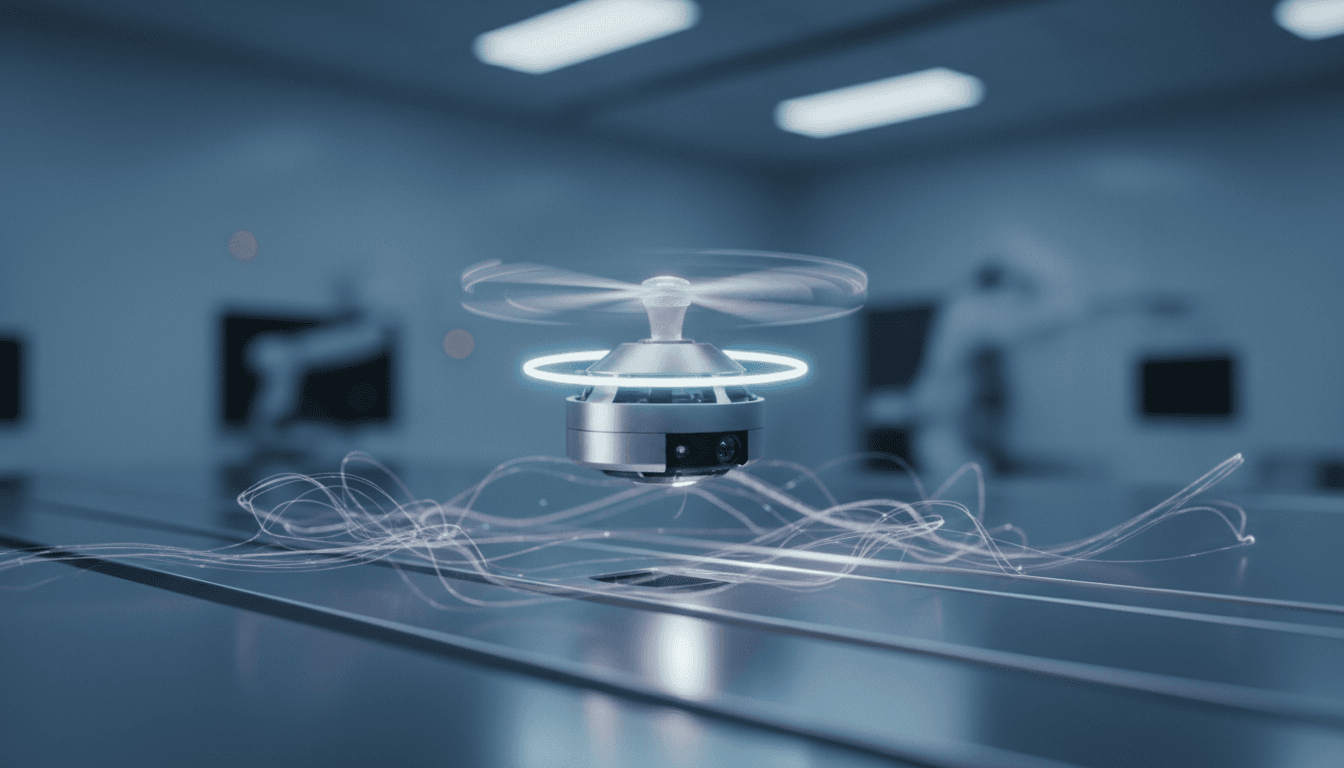
Berkeley’s robot keeps the body simple: a 3D-printed polymer structure with a four-bladed horizontal propeller and a stabilizing balance ring. The “motor” is basically two tiny neodymium magnets (each about 1 mm × 0.5 mm) mounted in a small vertical ring. An externally generated alternating magnetic field makes those magnets attract and repel, spinning the propeller and producing lift.
Two details are easy to miss but are critical for anyone thinking about automation systems:
- The robot is untethered, but not independent. The field source is the “power plant” and “controller.”
- Stability comes from mechanics, not compute. The balance ring adds rotational inertia, creating a gyroscopic stabilizing effect so the platform isn’t instantly unusable.
If you’re building robotics products, this is a reminder that mechanical design still does real work—often cheaper and more reliable than trying to solve everything in software.
How it moves: simple controls with surprising range
The motion primitives are straightforward:
- Up/down: Increase or decrease the magnetic field strength uniformly → propeller spins faster/slower → lift changes.
- Sideways motion: Create a spatial gradient in field strength across horizontal distance → the robot “drifts” toward the region that produces the desired net effect.
That’s not full 6-DoF flight control like a quadcopter. But it’s enough to demonstrate controlled hovering and translation—exactly what you’d want for micro-scale tasks like close-in inspection, navigating tight cavities, or interacting with small targets.
Offloading power and control: the “smart room, dumb robot” strategy
Here’s the thing about micro-robots: teams often assume the path to autonomy is shrinking electronics until they fit. Most companies get this wrong.
A more scalable strategy is distributed robotics:
- Robots are minimal: structure + actuator + maybe a few simple sensors.
- The environment provides energy: magnetic fields, light, RF, ultrasound, or structured airflow.
- Intelligence lives in the system: edge compute, cameras, magnetic field controllers, and coordination software.
This isn’t a compromise. It’s an engineering trade that can be superior in industrial settings.
Why it fits manufacturing and logistics better than you’d think
Factories already accept “instrumented spaces” when the ROI is clear:
- Vision cells with calibrated lighting and fixed cameras
- Safety scanners and light curtains
- RFID portals and antenna arrays
- Conveyors and tooling that constrain motion
Adding controlled magnetic field zones (or other energy fields) is conceptually similar: it’s infrastructure that creates predictable behavior. Once the environment is structured, the robot doesn’t need to be a self-contained miracle.
For logistics and manufacturing leaders, the big benefit is operational: maintenance shifts from thousands of complex robots to a smaller number of serviceable field generators and compute nodes. You trade distributed fragility for centralized reliability.
Where AI actually enters the picture (and why sensors are the next step)
The Berkeley team has already stated the next milestone: adding sensors so the robot can self-correct for disturbances like wind gusts. That’s the exact moment when AI becomes more than a headline.
At micro scales, disturbances dominate:
- Minor airflow becomes a major external force relative to mass
- Surface charges, vibrations, and turbulence matter
- Manufacturing tolerances in the propeller and ring show up as control errors
AI-based control helps because the system is hard to model perfectly, yet must be controlled precisely.
AI control loop: what a practical stack looks like
A realistic architecture for micro flyers in structured industrial environments looks like this:
- Sensing (external + onboard):
- External cameras for pose estimation
- Possibly a tiny IMU or magnetic sensor onboard
- State estimation:
- Sensor fusion (classical Kalman filtering still shines here)
- Learned correction terms for bias, drift, and non-linearities
- Control:
- Model predictive control for constraints (field strength limits, no-fly zones)
- Reinforcement learning for policy tuning after safety envelopes are defined
- Coordination:
- Swarm scheduling and collision avoidance
- Task allocation (which robot goes where, in what order)
If you’re evaluating “AI in robotics” vendors, this is a useful litmus test: do they talk about estimation, constraints, and failure modes—or only about autonomy demos? The former tends to ship.
Why magnetic actuation pairs well with AI
Magnetic propulsion/control is attractive for AI-driven automation because it’s:
- Fast to modulate: field strength changes can be controlled in real time
- Repeatable in a known volume: ideal for learning-based calibration
- Hardware-light on the robot: reduces payload pressure
That last point matters. AI benefits from more sensing and compute, but micro robots can’t carry it. So the AI shifts to the room, not the robot.
Micro-scale automation use cases: what’s plausible in the next 2–5 years
People jump straight to “robot pollinators” because it’s visual and memorable. I’m more interested in industrial use cases where structured environments and narrow tasks make adoption realistic.
1) Inspection inside hard-to-reach equipment
Micro flying robots can support inspection in places where rigid borescopes struggle:
- Narrow ducts, cavities, and vents
- Complex assemblies with line-of-sight occlusions
- Temporary access openings during maintenance shutdowns
The value isn’t that the robot is tiny. The value is that it can reposition itself without pushing against surfaces.
2) Micro-fulfillment and lab automation (small volumes, high constraints)
In pharma and life-science environments, workflows often happen in enclosures with strict boundaries and controlled airflow. A “smart enclosure” that can power and guide micro robots could help with:
- Moving tiny samples or disposable carriers
- Localized imaging checks
- Rapid scanning of barcodes/markers via external vision
This is where the “offloaded electronics” pattern shines: you don’t want batteries, heat, or radios near sensitive processes.
3) Assistance in electronics manufacturing and rework
Electronics assembly already relies on precision motion systems, but micro flyers could complement them for:
- Rapid visual verification in dense assemblies
- Accessing awkward angles without retooling
- Inspecting under overhangs and inside housings
I’m not claiming they’ll replace gantries or cobots. The better framing is: micro robots become mobile sensors inside instrumented cells.
4) Swarm mapping of constrained spaces
Once you can control one micro flyer reliably, the next step is many. AI scheduling and multi-agent control can turn a swarm into a parallel data collection tool:
- Map a confined space faster
- Cross-validate observations from multiple viewpoints
- Maintain performance despite single-unit failures
This matters for automation because redundancy is how you get reliability without overbuilding each unit.
The real constraints: what will slow this down
The robot is impressive, but production adoption will hinge on constraints that don’t show up in a short lab demo.
Field infrastructure and workspace design
Magnetic control requires hardware that shapes the field across a volume. That has implications for:
- Capital cost and installation
- Interference with nearby equipment
- Field uniformity and repeatability
The upside is that industrial environments already budget for specialized cells when the throughput and quality gains are clear.
Sensing and calibration at micro scale
If the robot relies on external vision, you’ll need:
- Calibration routines that survive thermal drift and vibration
- Robust tracking under occlusion
- Automatic re-identification when multiple robots overlap
AI helps here, but only if you engineer for it: consistent lighting, known surfaces, and good ground truth during commissioning.
Safety, containment, and recovery
A 21 mg robot won’t hurt a person, but it can still:
- Contaminate a clean process
- Get sucked into fans or filters
- Disappear into machinery
Practical systems need containment designs: capture surfaces, field-off “landing zones,” and recovery workflows.
What to do if you’re building or buying automation systems
If you’re exploring AI in robotics for manufacturing and logistics, treat micro-robotics like a system architecture option, not a novelty.
Here’s a pragmatic way to evaluate it:
- Look for tasks where the environment can be controlled. Enclosures, cells, and fixtures make micro robots feasible.
- Prioritize measurement and inspection first. Mobile sensing is a lower bar than manipulation.
- Design the infrastructure as the product. Field generation, sensing, compute, and calibration tooling will drive uptime.
- Demand failure-mode planning. Ask how the system detects loss of control, how it lands, and how it’s retrieved.
- Plan for phased autonomy. Start with externally guided motion; add onboard sensing only where it pays for itself.
One line I’ve found useful in internal reviews: “If the robot needs to be perfect, we’re doing it wrong.” Build the environment and the AI control stack so the system performs even when individual units vary.
Where this goes next for AI in robotics & automation
The most interesting part of this record-breaking tiny magnetic flying robot isn’t the size—it’s the implication: intelligent control doesn’t have to live on the robot. Offloaded power and computation are a direct path to micro-scale automation that factories can actually maintain.
As sensors get added and AI-driven stabilization improves, expect to see more “smart zones” in industrial settings: workcells that power and coordinate fleets of tiny devices for inspection, mapping, and specialized logistics inside constrained spaces.
If robots this small could work inside your process—inside your ducts, fixtures, housings, or enclosures—what would you automate first: inspection, traceability, or material movement?