Robust robot controllers can handle partial observability and model drift across many environments. Learn how HM-POMDPs and rfPG improve worst-case reliability.
Robust Robot Controllers for Uncertain, Noisy Worlds
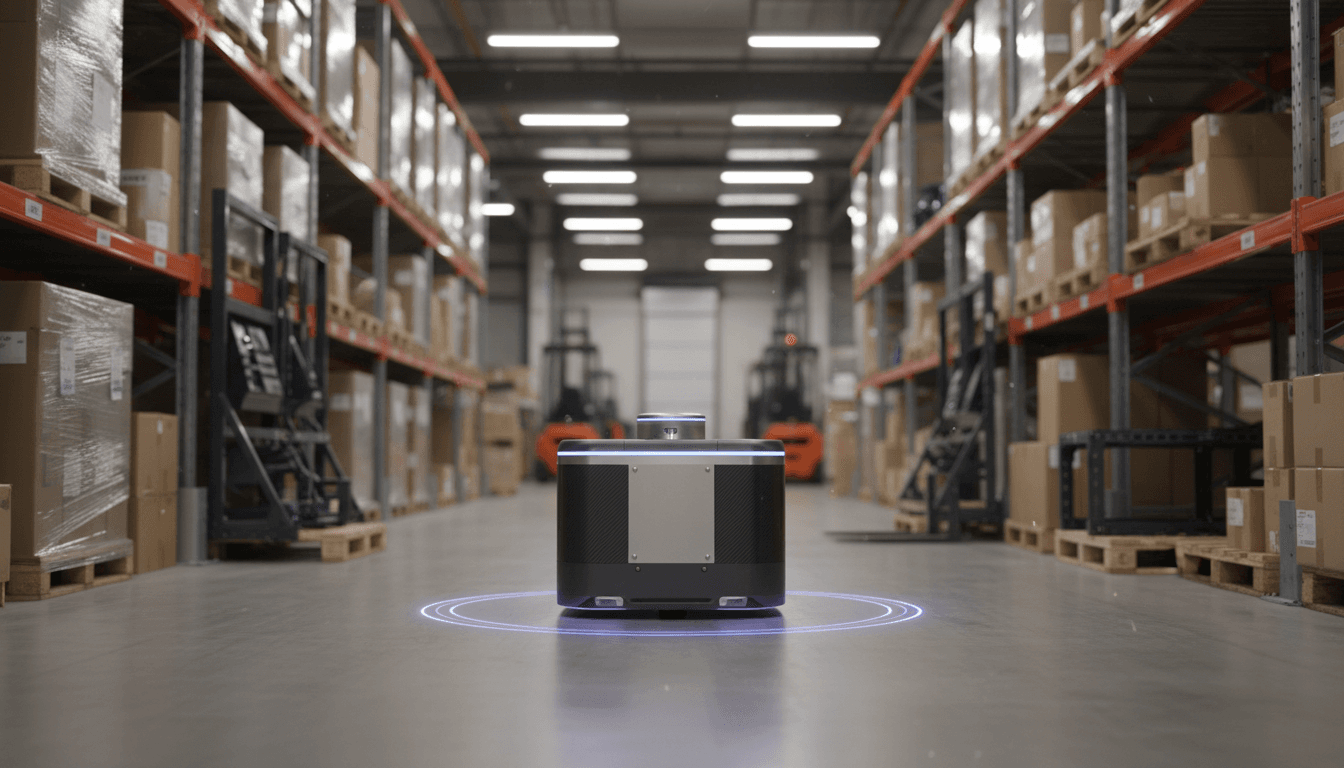
A warehouse robot that never makes a “bad” turn sounds great—until you change the layout, swap a sensor, or introduce a single unexpected obstacle. Then the robot that looked flawless in testing starts hesitating, taking unsafe shortcuts, or getting stuck in loops.
Most companies get this wrong: they treat uncertainty like a corner case. In real deployments—manufacturing cells, logistics aisles, hospitals after-hours—partial observability is the default. Cameras get occluded, LiDAR returns drop out, forklifts park in the “wrong” spot, and the robot’s internal model is always a little off.
This post in our AI in Robotics & Automation series explains a practical research direction that directly targets that pain: learning robust controllers that keep working across many partially observable environments, not just the one you trained on. The idea comes from recent work on hidden-model POMDPs and a learning method called robust finite-memory policy gradients (rfPG)—and it maps surprisingly well to the messy realities of automation.
Why robots fail in production: partial observability + model drift
Robots fail in production because they’re making decisions with incomplete information and a slightly wrong world model.
You can handle partial observability (imperfect sensing) and still fail if your environment model is too specific. Likewise, you can model the environment carefully and still fail because your sensors never reveal the full state. In practice, you get both:
- Occlusion and noise: pallets block a camera view; reflective wrap confuses depth sensors; wheel slip skews odometry.
- Process variation: “identical” workcells differ by a few centimeters; conveyor speed varies by vendor; lighting changes across shifts.
- Human and asset unpredictability: temporary staging in aisles; carts parked in new locations; doors sometimes open, sometimes closed.
Here’s the uncomfortable truth: a controller that’s optimal for one assumed model can be fragile under small perturbations. That fragility shows up as safety buffers that are too tight, oscillatory behavior near obstacles, or brittle task completion rates when conditions deviate.
POMDPs are useful—until you have many plausible worlds
A POMDP (partially observable Markov decision process) is a standard framework for decision-making under partial observability. The key point is simple:
In a POMDP, the agent acts based on observations, not the true state—so it needs memory to behave well.
In robotics, that “memory” might be implicit (a recurrent neural network) or explicit and structured.
Why finite-state controllers matter in automation
A lot of robotics teams default to big neural policies for anything involving partial observability. That can work, but in industrial automation you often need policies that are:
- Auditable: you can explain why it chose an action.
- Verifiable: you can test edge cases and certify constraints.
- Efficient: they run predictably on embedded hardware.
That’s where finite-state controllers (FSCs) are interesting. An FSC is a compact policy with a small internal memory state (think “mode” or “node”) that updates based on observations. It’s often easier to validate than a black-box policy, yet still captures history.
The missing piece: model uncertainty
Classic POMDPs assume a single environment model (transition and reward dynamics). But production systems rarely stay inside that box. You don’t have one POMDP—you have a family of them:
- the same warehouse with obstacles in different places
- the same AMR with slightly different wheel traction
- the same inspection task with varying sensor noise profiles
A controller trained on one model may not generalize to the rest. So the question becomes:
How do you learn a controller that performs reliably across many plausible POMDPs, not just one?
Hidden-model POMDPs: one policy, many environments
A hidden-model POMDP (HM-POMDP) captures model uncertainty by representing a set of POMDPs that share the same structure but differ in dynamics and/or rewards.
The key operational insight:
Your deployed environment is “hidden” among many candidates, and your controller must work well no matter which one is real.
That matches how automation actually gets deployed. You can think of each candidate model as:
- a different aisle-blockage configuration
- a different calibration state
- a different friction or payload regime
- a different sensor failure mode
Robust performance: designing for the worst case on purpose
In HM-POMDPs, robustness is measured by worst-case performance across models.
I’m strongly in favor of this framing for safety-critical automation. Why?
- Average-case performance is comforting in slides.
- Worst-case performance is what your ops team sees at 2 a.m. when conditions are weird.
If a controller maintains acceptable performance in the worst plausible environment, you’ve effectively bought a performance guarantee for deployment—especially important for service robotics and logistics where “unknown unknowns” are routine.
rfPG in plain language: find what breaks you, then fix it
The rfPG approach (robust finite-memory policy gradients) uses a clean loop:
- Robust policy evaluation: identify the model in the set where your current controller performs the worst.
- Policy improvement: update the controller using gradients computed on that worst-case model.
- Repeat until the worst case stops improving.
One-liner you can share with your team:
rfPG trains a controller by repeatedly asking, “Where do I fail most?” and then learning specifically to stop failing there.
That “pessimistic” focus is exactly what you want in automation.
Why this matters beyond theory
Two implementation details make this direction practical for robotics teams who care about guarantees:
- Finite-memory policies (FSCs): small, structured controllers can be easier to validate and deploy on constrained hardware.
- Verification-driven evaluation: instead of sampling a few scenarios, you can evaluate performance across huge sets of models by exploiting shared structure.
The underlying work demonstrates scaling to very large model sets (on the order of 100,000 variants) by using formal methods tooling to compute worst-case models efficiently.
For manufacturing and logistics, that suggests a different testing mentality: rather than writing thousands of brittle scenario scripts, you define a model family (layout variations, noise ranges, dynamics ranges) and train/evaluate against the entire family.
Real-world mapping: where robust controllers pay off first
Robust controllers aren’t an academic luxury. They’re a direct response to expensive deployment failure modes.
Manufacturing: retooling without re-training from scratch
Manufacturing cells change. Fixtures get swapped, cycle times shift, and tolerances drift.
A robust controller approach is a fit when:
- you have repeatable structure (same cell, same task) with bounded variation (small geometry changes, noise changes)
- downtime for re-training is costly
A practical pattern is to model “cell variants” as HM-POMDP candidates and train for worst-case throughput or constraint satisfaction.
Logistics and warehousing: layout drift and obstacle uncertainty
In peak season (and December is exactly when warehouses are under pressure), the environment changes daily:
- temporary staging appears
- aisles narrow
- human traffic increases
These are exactly the “rock moved somewhere else” conditions from the canonical example, just with higher stakes.
Robust finite-memory controllers can encode simple, reliable behaviors—like “if I’ve observed blockage patterns twice in a row, switch to a detour mode”—without requiring a massive neural policy.
Service robotics: partial observability is baked in
Hospitals, hotels, and campuses are full of occlusions and unmodeled dynamics (doors, elevators, people). The big win of HM-POMDP thinking is that it treats environment identity as hidden state and trains policies that don’t panic when the world doesn’t match yesterday.
What you can do this quarter: an implementation checklist
You don’t need to adopt HM-POMDPs end-to-end to get value from the mindset. Here’s what works in practice.
1) Build a “model set” instead of a single simulator
Define 20–200 environment variants you actually worry about:
- obstacle placements sampled from real heatmaps
- sensor noise profiles from logs (good day vs bad day)
- friction/payload regimes from operations data
Then treat performance as minimum across variants, not the mean.
2) Pick a memory budget on purpose
If you can solve a navigation uncertainty problem with two memory nodes in simulation (as shown in the research), that’s a hint: small memory can be enough.
Try a staged approach:
- start with 2–4 FSC nodes (interpretable)
- only expand memory if worst-case performance plateaus
This keeps policies understandable and easier to test.
3) Train against your worst-case, not your favorite case
Most teams tune on “golden path” scenarios because they’re stable. Flip it:
- identify the worst 5% of scenarios (collisions, timeouts, deadlocks)
- optimize for those
In rfPG terms, you’re approximating the “worst-case model” step with your own scenario mining pipeline.
4) Define robustness metrics your ops team cares about
Robust return is a research metric. In deployment, translate it into:
- worst-case task completion rate across variants
- worst-case time-to-complete (with a hard cap)
- constraint violations per 1,000 missions in the worst variant
If you can’t explain robustness to operations in one sentence, it won’t stick.
FAQ: the practical questions teams ask
“Is worst-case optimization too conservative?”
It can be—if your model set includes unrealistic extremes. The fix is governance, not abandoning robustness: define a credible uncertainty set based on logs, tolerances, and safety cases.
“Do we have to give up neural networks?”
No. I see FSCs and neural policies as complementary. FSCs are attractive for high-level decision logic and verifiability; neural nets can handle perception and continuous control. A common architecture is neural perception → discrete belief/observation features → FSC decision layer.
“Where does this fit in the AI in Robotics & Automation stack?”
Squarely in the middle: robust decision-making sits between perception and motion control. It’s the layer that prevents an AMR from doing something “locally reasonable” that becomes operationally unsafe under uncertainty.
Where robust finite-memory control is headed
The research results were demonstrated in simulated, discrete domains—exactly the kind of structured setting you see in high-level planning for factories and warehouses. The next step is extending these ideas to more continuous problems and richer policy classes while keeping the robustness and verification benefits.
If you’re responsible for robots that must operate through winter peak volumes, layout changes, and sensor headaches, robust controllers aren’t a “nice to have.” They’re the difference between a pilot that demos well and a fleet that stays reliable after the first month.
If you’re evaluating autonomy stacks right now, a useful question to ask vendors (or your internal team) is:
When the environment shifts within realistic bounds, do you optimize for the average run—or do you have a method to protect the worst case?
That answer will tell you a lot about how the system behaves when the world stops cooperating.