AI-powered dexterous grasping is closing the dexterity gap. See how RobustDexGrasp achieves 94.6% success on 512 objects—and what it means for automation.
Robot Hand Grasping That Works on Almost Any Object
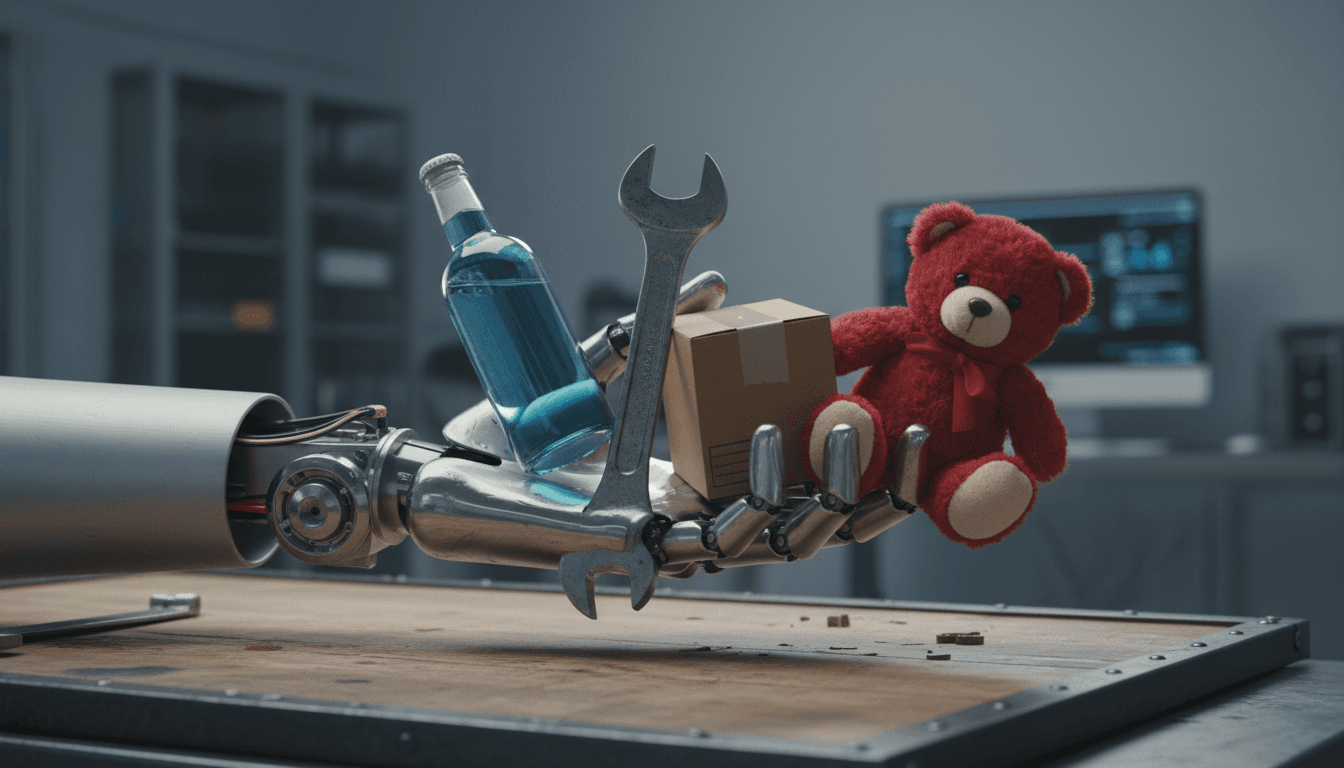
A dexterous robot hand that can pick up a transparent bottle, a heavy tool, or a squishy plush sounds like a flashy demo—until you look at the numbers. A recent research system called RobustDexGrasp reports a 94.6% real-world grasp success rate across 512 everyday objects, after being trained on just 35 simulated objects.
Most companies get this wrong: they treat “grasping” like a solved prerequisite, then wonder why pilot projects stall the moment the robot leaves a tidy lab cell. The reality is that reliable grasping is the gatekeeper for AI-enabled automation in warehouses, clinics, and flexible manufacturing. If the robot can’t consistently pick up what you actually use—odd shapes, glossy packaging, cluttered bins—everything downstream (tool use, assembly, kitting, sorting) becomes fragile.
This post is part of our AI in Robotics & Automation series, and it focuses on what RobustDexGrasp signals for the market: AI is starting to close the dexterity gap, and that changes what “automatable” means in 2026 planning cycles.
Why “dexterous grasping” is the real bottleneck
Dexterous grasping is hard because it combines high-dimensional control, messy perception, and nonstop correction. Two-finger grippers succeed by avoiding complexity: they standardize objects (fixtures, trays, consistent SKUs) and standardize approaches (pick from known poses). Dexterous hands do the opposite: they’re meant to handle variety.
A human hand has 20+ degrees of freedom, and that’s the point—tiny adjustments in finger placement and force let you recover from slips without thinking. For robots, those same freedoms create three practical blockers that show up in real deployments.
1) High-dimensional control explodes the search space
With many joints, the number of ways to fail multiplies:
- A thumb joint slightly off changes contact forces across the whole grasp.
- A “good” grasp at low speed becomes unstable when the arm accelerates.
- The right grip force depends on friction, mass, and whether the object is deformable.
Traditional controllers can do beautiful things when the object is known and the plan is precise. But in unstructured environments, the robot needs policies that choose actions under uncertainty and correct continuously.
2) Generalizing across shapes is the real test
A sphere invites an enveloping grasp. A marker wants a precision pinch. A mug handle begs for a hook-like strategy. Hard-coding grasp heuristics per category doesn’t scale—especially in logistics and service robotics where the long tail of objects is endless.
3) Monocular vision makes shape uncertain (and that’s normal)
Many real systems default to a single RGB camera because it’s affordable, easy to mount, and operationally robust. The tradeoff: depth ambiguity, occlusion, and reflective/transparent surfaces. If your business case depends on picking consumer-packaged goods, you already know the pain: glossy films, clear plastics, and odd reflections.
The takeaway: grasping isn’t a single module. It’s an integration problem across perception, control, and feedback.
What RobustDexGrasp does differently (and why it matters)
RobustDexGrasp is a framework designed to make dexterous grasping work with realistic sensing and real-world disturbances. The key ideas are less about a single clever trick and more about an architecture that respects how grasping actually happens: try, feel, adjust.
Teacher–student training: learn “ideal,” then learn “real”
RobustDexGrasp uses a two-stage reinforcement learning approach:
- Teacher policy trains in simulation with privileged information (full object shape and tactile sensing). It can explore aggressively and discover strong grasp strategies.
- Student policy learns to imitate and adapt using signals closer to what you can run in the field (single-view point cloud, noisy joint positions) and is trained to handle disturbances.
Why this is a big deal for AI in robotics: it’s a practical pattern for bridging the sim-to-real gap. In other words, the expensive part (exploration) happens where failures are cheap, and the deployable part learns to operate with the sensors you can actually afford and maintain.
Hand-centric representation: focus on “where are the surfaces near my fingers?”
A lot of manipulation pipelines get stuck chasing full 3D reconstruction. That can work, but it’s not always the best use of compute—or time.
RobustDexGrasp takes a more grounded approach: it builds a hand-centric “mental map” that answers one question:
Where are the object surfaces relative to my fingers right now?
This matters because grasping isn’t about knowing the entire object perfectly; it’s about securing stable contacts where your fingertips are going. In practice, this style of representation tends to:
- reduce dependence on perfect segmentation,
- tolerate missing geometry (occluded areas), and
- generalize better across shape families.
My take: this is closer to how automation teams want robots to behave—competent under partial information instead of brittle perfection.
Multi-modal perception: vision + proprioception + “reconstructed touch”
The system combines:
- vision (what the camera sees),
- proprioception (joint positions; the hand’s body awareness), and
- reconstructed touch sensation (an inferred sense of contact).
This combination reduces the “transparent object problem,” the “reflective packaging problem,” and the “occlusion in clutter problem.” In business terms, it increases the number of SKUs and environments where dexterous automation is plausible.
Results that matter for automation leaders
RobustDexGrasp reports three results that map cleanly to real operational requirements.
1) Generalization across real objects
- Training set: 35 simulated objects
- Test set: 512 real-world objects
- Success rate: 94.6%
Those objects include thin boxes, heavy tools, transparent bottles, and soft toys—exactly the types that expose brittleness in grasp planners that assume clean geometry.
2) Robustness under disturbance
The system maintained grasps under an external force equivalent to a 250g weight being applied to the object. That’s a meaningful threshold because many production failures don’t come from “bad initial grasps,” but from bumps, cable drag, bin collisions, and arm acceleration.
3) Real-time adaptation (closed-loop correction)
The most valuable behavior described is the ability to recover when an object slips or is bumped. This is where dexterous hands start to justify their complexity: they can correct without restarting the whole plan.
If you’re evaluating AI-enabled robotics for logistics or healthcare, this is the difference between:
- “It works when everything is perfect.”
- “It keeps working when the world behaves like the world.”
Where this lands in manufacturing, logistics, and healthcare
Dexterous robot hands become economically interesting when they reduce changeover and exception handling. Here are three high-value lanes where robust grasping changes the ROI math.
Manufacturing: flexible end-of-line and kitting without perfect fixturing
Most factories already automate the easy 80%: consistent parts, known locations, stable surfaces. The remaining 20%—mixed parts, variable packaging, last-minute changes—soaks up labor and delays.
A robust dexterous grasping stack can enable:
- kitting from mixed bins (less pre-sorting)
- packaging handling (bags, blister packs, deformable items)
- tool pickup and handoffs for semi-automated workstations
The practical win isn’t “human replacement.” It’s less engineering time per new part and fewer fixtures per line.
Logistics: picking in clutter and handling the long tail of SKUs
Warehouse automation hits a wall when:
- SKUs change weekly,
- bins are cluttered,
- packaging is reflective/transparent,
- and you can’t justify building a custom end effector per product category.
RobustDexGrasp-style approaches pair naturally with segmentation and tracking modules:
- Target pick in clutter: segment the requested item, then execute a robust grasp despite neighbor interference.
- Conveyor interaction: track motion, grasp on the fly, and correct during contact.
This is the direction the industry needs: general skills (grasp, place, regrasp, stabilize) composed by higher-level planners.
Healthcare and service robotics: gentle contact with higher stakes
In healthcare-adjacent environments, grasping is less about speed and more about:
- precision (small tools),
- gentleness (avoid crushing), and
- recovery behaviors (don’t drop).
Multi-modal sensing is especially relevant here. Vision alone is often unreliable around reflective instruments, translucent containers, and occlusions caused by people moving nearby.
If you’re building service robots, reliable grasping is what makes “helpful” mean something tangible: picking up dropped items, handling supplies, and manipulating everyday objects safely.
What to ask before you bet on dexterous grasping
If you’re scoping an intelligent automation pilot, the right questions are operational—not academic. Here’s a checklist I’ve found useful when teams evaluate dexterous robot hand grasping.
1) What does “success” mean for your process?
Define it as a number you can measure:
- grasp success rate across your top 100 SKUs
- maximum allowed drop rate per shift
- tolerance to disturbances (bumps, speed, bin contact)
- recovery time when a slip occurs
2) What sensing is realistic on your floor?
If your setup will be monocular for cost and simplicity, prioritize solutions designed for that constraint. Also ask whether the system uses proprioception and contact feedback in a meaningful way—those signals are often the difference between demos and deployments.
3) How fast do you need changeover?
The real ROI for AI in robotics is frequently time-to-adapt:
- New SKU introduced Monday—can you be stable by Friday?
- Can you avoid re-tuning grasp heuristics each time packaging changes?
4) Can it integrate with “brains” and “eyes” you already have?
In modern stacks, robust grasping is a skill plugged into a broader system:
- segmentation for object selection
- a planner (often a vision-language model) for task sequencing
- tracking for dynamic scenes
You don’t need one monolithic system. You need interfaces that don’t break.
What this means for the AI in Robotics & Automation roadmap
RobustDexGrasp is a strong signal that dexterous grasping is transitioning from research novelty to practical capability. A 94.6% success rate on 512 real objects isn’t “done,” but it’s far enough along that automation leaders should start planning for pilots that assume variety, not just repeatability.
For leads and builders, the opportunity is straightforward: if your operation has high mix, frequent exceptions, or manual handling that resists traditional grippers, AI-powered dexterous grasping is becoming a credible path to intelligent automation.
If you’re mapping your 2026 automation projects, ask yourself: where would your throughput jump if robots could grasp “nearly anything” without custom fixturing—and what would you redesign if that constraint disappeared?