Robot dancing isn’t a gimmick—it’s a public test of AI-driven balance, coordination, and sim-to-real transfer that matters for real automation.
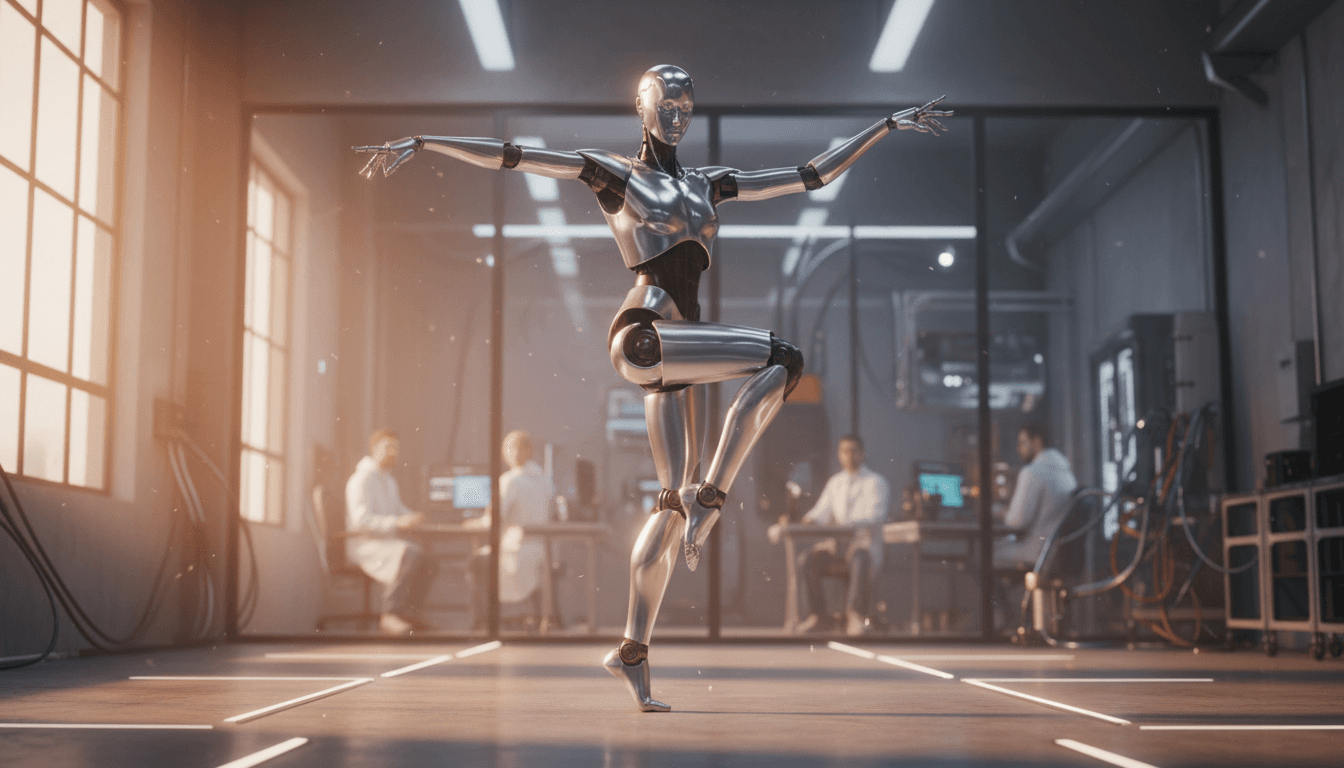
Robot Dancing Isn’t a Gimmick—It’s a Mobility Test
Robot dance videos rack up millions of views because they’re fun. But that’s not why serious robotics teams keep building them.
A humanoid that can dance on purpose—with timing, balance, and recovery when something goes slightly wrong—is demonstrating the exact capabilities that decide whether it can work safely around people. In the AI in Robotics & Automation world, “dancing robots” are basically a public demo of hard technical milestones: whole-body control, robust locomotion, sim-to-real transfer, and human-robot interaction.
The headlines tend to focus on the spectacle (Tesla Optimus doing ballet steps, Boston Dynamics routines that still get called CGI, Unitree’s athletic stunts). The more useful story is what those moves imply for factories, warehouses, hospitals, and service work—especially as we head into 2026 and more companies are actively piloting humanoids and mobile manipulators in real environments.
Dancing is a stress test for real-world robot mobility
Dance is one of the fastest ways to expose whether a robot’s “mobility stack” is real or staged.
In industrial automation, robots succeed by repeating a known motion in a controlled cell. Humanoid robots and general-purpose service robots don’t get that luxury. They have to move through human spaces, handle varied objects, and stay stable on imperfect floors. A dance routine compresses many of those requirements into a short clip.
What robot dancing actually measures
When you see a humanoid dance, you’re seeing a bundle of measurable competencies:
- Dynamic balance: Maintaining stability while the center of mass shifts quickly.
- Foot placement accuracy: Consistent ground contact under changing loads.
- Whole-body coordination: Arms, torso, head, and legs moving without destabilizing each other.
- Timing and trajectory tracking: Hitting positions on-beat is essentially high-frequency control.
- Disturbance recovery: Micro-slips, actuator lag, and sensor noise are always present; good controllers correct without “panic steps.”
Here’s the blunt take: a robot that can dance reliably is much closer to carrying a tote, pushing a cart, opening a heavy door, or helping a person transfer from bed to wheelchair than a robot that can only walk slowly on a lab floor.
Why this matters to automation buyers
If you’re evaluating robotics for operations—not just watching demos—dance capability is a proxy. It hints at whether the platform can:
- Operate outside safety cages (or with reduced guarding)
- Handle variability (different loads, floor friction, obstacles)
- Maintain uptime (fewer falls, fewer resets, fewer broken end-effectors)
A graceful routine doesn’t guarantee production readiness, but it’s not empty entertainment either. It’s a mobility benchmark the public can understand.
From hydraulics and scripts to AI-driven control
Robots have been “dancing” for decades via scripted motion and mechanical choreography—think classic animatronics. What changed is the control approach.
Older dance robots were closer to puppets: impressive, but bounded by preplanned trajectories and careful staging. Modern humanoids increasingly rely on AI for motion policy learning and on high-fidelity simulation to develop skills faster than physical iteration allows.
The capability jump people are reacting to
The public reaction—equal parts delight and discomfort—tracks a real technical shift: humanoids are starting to move with human-like fluidity, not just human-like shape.
That fluidity comes from a stack that often includes:
- Reinforcement learning (RL) for locomotion and whole-body behaviors
- Physics engines to train skills in simulation
- Domain randomization to make policies robust to real-world differences (friction, mass, latency)
- Proprioception (joint encoders, torque sensing), plus IMUs for orientation and acceleration
- Vision + state estimation to keep motion stable as the world changes
When a team claims a skill is “learned in simulation and transferred to the real robot,” the core business implication is speed: faster iteration means faster deployment of new tasks, and potentially lower cost per new capability.
“Zero-shot” sim-to-real is the real headline
The short Tesla Optimus dance clips that triggered so much discussion weren’t interesting because of the choreography. They were interesting because the team described zero-shot transfer—learning in simulation and performing in the real world without lengthy per-skill tuning.
In practical automation terms, that’s the dream:
- Train once in sim
- Deploy across multiple identical robots
- Update policies like software
We’re not fully there yet. But we are closer than most companies’ procurement checklists assume.
The hidden reason dancing robots keep going viral: trust and legibility
Humans judge robots with our instincts, not our spec sheets.
A robot that moves awkwardly or unpredictably triggers a safety reaction, even if it’s technically “safe.” A robot that moves smoothly and legibly—clear intention, stable gait, controlled stops—feels safer to stand next to.
Dance amplifies this because it’s movement designed for people to interpret.
Expressive motion is a safety feature, not just a UI feature
Here’s a stance I’ll defend: expressive motion is part of the safety stack for robots working near humans.
Not functional safety in the certified sense (that still requires torque limits, safe stop, monitored speed, validated control modes, etc.), but behavioral safety: the everyday comfort that determines whether people accept the robot in their space.
In service environments—retail, hospitality, elder care—adoption lives or dies on that comfort.
Practical examples of “dance-adjacent” motion traits that matter:
- Signaling intent: turning the torso before stepping, pausing before reaching across a person
- Readable speed changes: gradual acceleration/deceleration
- Comfortable interpersonal distance: maintaining predictable spacing while walking alongside someone
A dance routine is an exaggerated demonstration of the same core idea: if the robot can control its body well enough to look intentional, people relax.
Why anthropomorphism cuts both ways
Humanoid form factors make it easy to anthropomorphize robots—for better and for worse. Some viewers feel joy; others feel a visceral “nope.”
For companies deploying robots, that means one thing: you can’t ignore perception. You have to design for it.
- In a factory, you may want motion that looks more “machine-like” and less uncanny.
- In a hospital, you may want gentle, predictable motion that reads as considerate.
Dance videos are where these reactions show up first, loudly, and at scale.
Beyond entertainment: where dance-grade motion shows up in industry
Dance skills translate into industrial value when the underlying capability improves throughput, reduces falls, and expands the set of feasible tasks.
Logistics and warehouses: dynamic walking while carrying
Warehouses aren’t just about walking; they’re about walking with load and interacting with humans.
Dance-grade control supports:
- Carrying irregular items while maintaining balance
- Turning in place in narrow aisles without clipping racks
- Recovering from slips on dust, tape, or small floor debris
If you’ve ever watched a robot “sort of” walk and then freeze, you’ve seen how quickly small instability becomes an operational bottleneck.
Manufacturing: flexible tending and re-tasking
Most manufacturers don’t need a robot that can moonwalk. They need a robot that can:
- step around a cart someone left in the wrong spot
- lean safely into a machine envelope
- pick and place with stable footing
- keep cycle time while the environment changes
Dance-focused R&D tends to improve exactly those traits: whole-body stability, coordination, and repeatability under motion.
Healthcare and service work: safe, gentle physical interaction
Healthcare robotics puts a premium on controlled motion—no sudden jerks, no surprise reaches, no unstable stance.
Dance capability correlates with:
- smooth joint trajectories (comfort)
- better balance margins (safety)
- more accurate body pose control (predictability)
That matters for tasks like fetching items, opening doors, moving carts, or assisting staff—especially during winter respiratory season surges when staffing strain is real and any help that reduces walking and fetching adds up.
How to evaluate “dancing robot” claims as a buyer
Demos are marketing. Still, you can extract real signal if you know what to look for.
Ask these five questions about the motion
- Is it tethered or supported? If there are safety cables, it’s not disqualifying, but it changes what you’re actually seeing.
- Is it teleoperated? Teleop can be valuable, but it’s different from autonomy. Ask what’s autonomous vs puppeted.
- How repeatable is the routine? One great take isn’t the same as 50 consecutive runs.
- What’s the failure mode? Does it freeze, fall, or recover gracefully?
- What changes break it? Different shoes/feet, different floor, different payload, different lighting.
What “production-ready mobility” looks like
If you’re considering humanoids or mobile manipulators for automation pilots in 2026, the markers that matter more than flashy choreography are:
- Low fall rate over long runs
- Fast recovery after minor disturbances
- Consistent foot contact and stable turning
- Safe interaction behaviors near people
- Tooling integration (hands/end-effectors that work for your items)
Dance is the teaser trailer. These are the feature-length requirements.
Where robot dancing goes next (and why it will get weirder)
We’re heading toward a new phase: robots that aren’t just executing choreographed sequences, but responding to music—or the environment—without explicit programming.
When a robot can hear a beat, perceive its own pose, and generate motion in real time while staying stable, you’re looking at the same building blocks needed for general-purpose task execution:
- perception → state estimation → policy → control
It will get weirder because it will look more alive. That’s the cost of building robots that can operate in the messy world we designed for humans.
From the perspective of this AI in Robotics & Automation series, dancing isn’t a detour. It’s a visible milestone on the road to robots that can work a full shift in human environments.
If you’re exploring robotics for your operation, the practical next step is simple: treat movement quality as a core KPI (right alongside payload and speed) and pressure-test vendors on repeatability, recovery, and real-world variance.
The real question isn’t whether robots should dance. It’s whether your automation strategy is ready for robots that can move like they mean it.