RL² meta-reinforcement learning trains systems to adapt fast. See how it applies to robotics and SaaS automation in the U.S. and what to do next.
RL² Meta-Reinforcement Learning for Faster Robot Training
Most automation teams are solving the wrong problem.
When a robot or an AI-driven workflow “learns too slowly,” the instinct is to hunt for a better reinforcement learning (RL) algorithm. But the more stubborn bottleneck in real deployments—especially across U.S. tech and SaaS—is the cost of trials: real-world robot actions that wear hardware, time-consuming simulations that rack up compute bills, and customer-facing experiments you can’t afford to run for weeks.
That’s why a 2016 research idea still feels unusually practical in late 2025: RL² (“RL-squared”), a method that treats the learning algorithm itself as something a neural network can learn. The promise is simple to state and hard to pull off: slow, expensive training up front so systems can learn new tasks fast later.
In the AI in Robotics & Automation series, this is a foundational concept worth revisiting because it maps cleanly to what modern digital services need: agents that adapt quickly to new customers, new warehouses, new product SKUs, and new edge cases—without months of retuning.
RL² in plain English: train the learner, not just the policy
RL² is meta-reinforcement learning: it trains a model to become a fast learner across tasks.
Traditional RL trains a policy for one task (or one environment family) by running many episodes, collecting rewards, and slowly adjusting weights. RL² adds a twist: it uses a recurrent neural network (RNN) whose hidden state acts like an internal memory. During deployment on a new task, the model updates its behavior not by changing weights, but by updating its activations (its internal state) as it experiences rewards.
Here’s the key design choice from the RL² paper: the RNN receives the same signals a classic RL algorithm would use:
- observations
- actions
- rewards
- “done” / termination flags
And crucially, it keeps its hidden state across multiple episodes within the same task. That means it can perform “fast learning” inside a task by remembering what worked and what didn’t.
A useful mental model: RL² turns “learning” into “inference with memory.” The weights store long-term knowledge from many tasks; the hidden state stores short-term knowledge about the current task.
Why this matters for robotics and automation
Robotics and industrial automation rarely involve one static task. Even in a “repeatable” warehouse, day-to-day variation is the rule:
- different lighting and floor reflectivity for vision systems
- shifting inventory layout
- seasonal order patterns (hello, holiday peak)
- new packaging types and pallet sizes
A system that can adapt in a handful of episodes rather than thousands is the difference between a pilot and a product.
What RL² actually showed (and why it was a big deal)
RL² demonstrated that a learned RL procedure can compete with human-designed algorithms on small problems and still scale to high-dimensional inputs.
The OpenAI write-up describes two categories of experiments:
Bandits and small MDPs: matching classic algorithms
RL² was trained on randomly generated:
- multi-armed bandits (choose among options with unknown reward rates)
- finite Markov Decision Processes (MDPs)
After training, RL² performed on new tasks close to algorithms that come with optimality guarantees (for those problem classes). That’s notable because RL² wasn’t hard-coded with exploration bonuses or confidence intervals; it learned behaviors that look like intelligent exploration because that’s what paid off across many training tasks.
Vision-based navigation: not just a toy result
RL² was also tested on vision-based navigation, showing it could handle high-dimensional sensory input. For robotics teams, that’s the line you care about: the concept isn’t limited to tiny tabular problems.
My opinion: the enduring value of RL² isn’t that you should copy the 2016 setup verbatim. It’s that it made “learning-to-learn with RL signals” feel like an engineering pattern rather than a philosophical idea.
The business translation: fast adaptation is the real ROI
For U.S. SaaS and digital service providers, RL² points to a practical strategy: invest in broad training so customer-specific adaptation becomes cheap.
If you’re building AI into a digital service, you’re usually facing one of two painful realities:
- Every customer environment is different, so you keep fine-tuning or writing special-case logic.
- The environment changes over time, so performance decays unless you continuously retrain.
RL² reframes the goal: don’t just train a policy; train an adaptive procedure.
Where this shows up in real products
Even if you never call it “RL²,” the pattern is everywhere in automation:
- Customer support automation: routing, escalation, and resolution strategies adapt to a new product line or policy change based on reward-like signals (CSAT, resolution time, refunds avoided).
- Warehouse robotics: pick-path planning adapts to new aisle constraints or congestion patterns.
- Industrial process control: controllers adapt to drift in sensors, raw material variation, or equipment aging.
- Fraud and risk workflows: strategies adapt as adversaries shift tactics.
The common requirement is the same: learn quickly from a small amount of fresh experience.
Why “slow RL to get fast RL” fits 2025 constraints
Compute is abundant, but high-quality interaction data is still scarce and expensive.
In late 2025, teams can rent serious training infrastructure, but they still struggle to get:
- safe real-world robot trials
- realistic simulations (and calibrated sim-to-real transfer)
- trustworthy reward signals that don’t incentivize nonsense behavior
RL²’s logic matches these constraints:
- Spend your expensive budget once: train across many tasks (slow)
- Save time per deployment: adapt rapidly on the new task (fast)
For U.S. startups trying to scale automation, that’s a familiar playbook: front-load R&D so onboarding the next customer is mostly configuration, not reinvention.
A concrete example: robotics deployments across sites
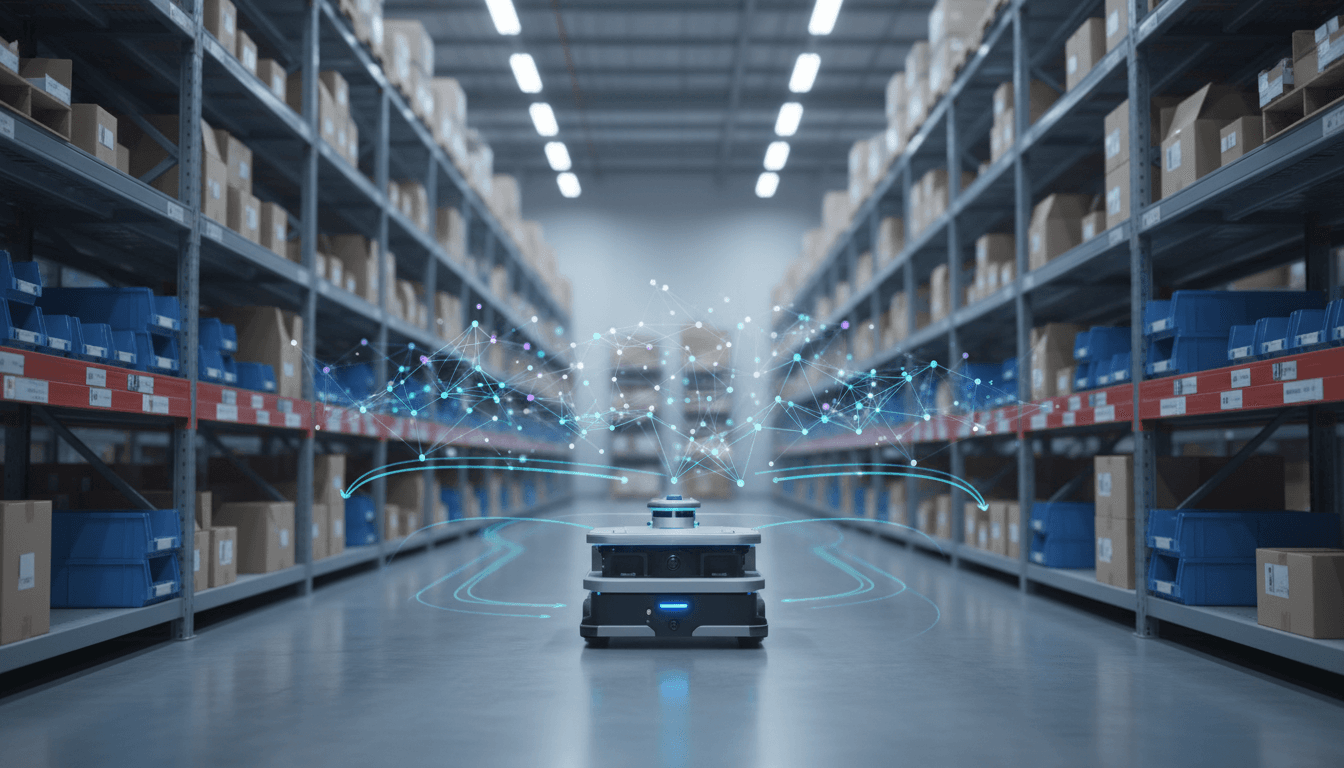
Consider a mobile robot deployed across 30 distribution centers.
- Traditional approach: treat each site as a new environment; collect lots of site-specific data; retrain.
- RL²-style approach: train on a wide distribution of “site variations” (layout, lighting, obstacle types) so that when the robot enters site #31, it adapts in a few rollouts.
Even a modest reduction in per-site tuning effort can change unit economics.
How to apply the RL² idea without rebuilding your stack
You can adopt the RL² mindset incrementally: design your system so it can update behavior from recent context, not just offline retraining.
Here are practical implementation patterns that mirror RL², even if you’re not using an RNN trained exactly like the paper:
1) Treat adaptation as a first-class product feature
If you want fast adaptation, you need to instrument for it. That means:
- logging state, action, outcome (even in non-robotic digital workflows)
- defining reward signals that reflect real business value
- versioning policies and rollbacks like you would any critical service
A good rule: if you can’t explain what “success” is numerically, RL will optimize the wrong thing.
2) Use memory to replace repeated retraining
RL² uses an RNN hidden state as memory. In modern systems, “memory” might be:
- a recurrent policy
- a transformer with a context window of recent episodes
- a learned state estimator
- a hybrid approach: a planner with a learned world model plus recent trajectory summaries
The core requirement is the same: the agent needs a mechanism to condition on recent outcomes.
3) Train on task distributions, not single tasks
If you’re only training in one environment, you’re not doing meta-RL—you’re doing regular RL.
Practical ways to create a task distribution:
- randomize simulation parameters (domain randomization)
- vary goal locations, obstacles, order mixes, and failure modes
- include “nasty” edge cases on purpose (sensor dropouts, delayed rewards)
This is where many robotics programs stall: they train on the happy path and then wonder why adaptation fails when reality gets messy.
4) Put guardrails around exploration
Fast learning often requires exploration. In robotics and customer-facing automation, uncontrolled exploration is unacceptable.
What works in practice:
- constrained action spaces (never exceed safe torque/speed; never take irreversible customer actions)
- human-in-the-loop escalation for uncertain cases
- offline evaluation and shadow mode before full rollout
- reward shaping that penalizes unsafe or costly behaviors
If you want leads from enterprise buyers, this is the point they care about most: “How do we keep it safe?”
Common questions teams ask about RL² (and direct answers)
Is RL² the same as few-shot learning?
Not exactly. Few-shot learning usually refers to supervised adaptation from a few labeled examples. RL² is few-shot adaptation from interaction—the system learns by acting, observing rewards, and updating its internal state.
Does RL² eliminate the need for fine-tuning?
No. It changes where adaptation happens. Instead of weight updates for every new environment, a lot of adaptation can happen in the model’s internal state during execution. You may still fine-tune periodically, especially when the task distribution shifts.
What’s the catch?
The hard parts are:
- building a training distribution that truly represents deployment conditions
- defining reward signals that don’t create perverse incentives
- managing safety and evaluation when the agent is allowed to explore
The upside is worth it when you deploy the same system many times across varying environments.
Where RL² fits in the AI in Robotics & Automation story
Robotics and automation are moving from “programmed behavior” to “adaptive services.” RL² is an early, influential blueprint for that shift: a system that carries general competence in its weights and picks up local specifics quickly.
For U.S. technology and SaaS companies, that’s also a scaling strategy. The vendors winning deployments aren’t the ones with the fanciest demo—they’re the ones who can roll out to the next site, the next customer, or the next workflow change with minimal rework.
If you’re building AI-powered automation and you want a north star, use this one: optimize for adaptation speed, not just peak benchmark performance.
What would your product look like if it could learn a customer’s environment in a day instead of a quarter?