Rivian’s AI assistant arrives in early 2026 and targets every existing EV. Here’s what it signals for in-car entertainment, personalization, and automation.
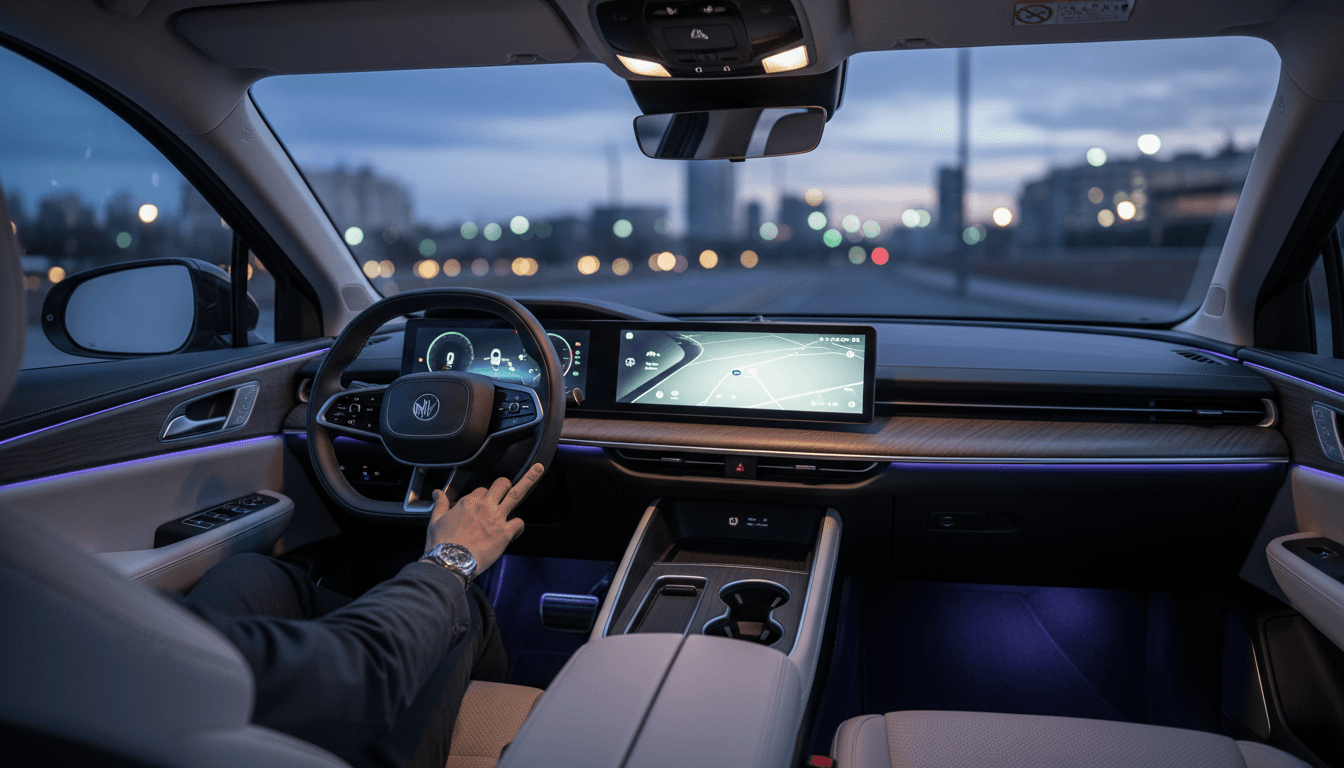
Rivian’s AI Assistant: The Car Becomes Your Media Hub
Rivian says an AI assistant is coming to its EVs in early 2026—and the detail that should make every automaker (and every streaming platform) pay attention is this: it’s expected to roll out to every existing Rivian EV, not just newer models.
Most companies treat in-car voice as a checklist feature: “It can change the temperature and set a destination.” Drivers tolerate it, then go back to their phones. Rivian’s planned approach signals something bigger: the vehicle as a software-updatable, AI-driven interface that can learn preferences and orchestrate experiences—navigation, comfort, messaging, and yes, media and entertainment—with less friction.
This post is part of our AI in Robotics & Automation series, and that context matters. A modern EV is a rolling robot: sensor-rich, always-on (when permitted), and deeply dependent on automation to feel effortless. An AI assistant isn’t just a nicer voice UI. It’s a control layer for automated systems, personalization, and in-cabin experiences that look a lot like the recommendation engines you already know from streaming.
Why Rivian’s “roll out to every EV” detail matters
The key point: shipping AI to the existing fleet turns the assistant into a scalable product, not a showroom gimmick. When an AI capability updates across years of vehicles, it changes how value is created—and who captures it.
For consumers, it means the car you already own can improve meaningfully without a trade-in. For Rivian, it means:
- Long-term engagement: more interactions per week, more surface area for software features.
- Faster iteration: deploy, measure, refine—like a mobile app, not a traditional car feature.
- A platform mindset: the assistant becomes a persistent interface for future services.
From a robotics and automation lens, this is the “fleet learning” playbook. Not autonomous driving exactly, but the same philosophy: software-defined behavior at scale.
Fleet updates are the new competitive moat
In late 2025, consumers have seen years of overpromised “smart” features that didn’t age well. The winners are proving a simple rule: the car must get better after you buy it.
A fleet-wide AI assistant rollout raises the bar. If Rivian executes, drivers won’t compare it to “car voice commands.” They’ll compare it to the responsiveness and personalization they get from consumer AI assistants and media apps.
The real shift: your car becomes an entertainment operating system
The direct answer: an in-car AI assistant is a personalization engine wearing a voice interface. If it’s done right, it doesn’t just play music—it understands intent, context, and routines to shape the whole cabin experience.
Cars already have big screens and premium audio. What’s missing is a natural “director” for the experience—one that can coordinate apps, settings, and passengers.
From “play a song” to “run the vibe”
Media and entertainment is where AI assistants can feel instantly useful because the success metric is human: Did it pick something I actually wanted? Good assistants learn patterns such as:
- Morning commutes: short-form news or a specific podcast
- Friday evening drives: high-energy playlists, warmer cabin lighting
- Road trips: family-friendly audio, proactive charging stops
A well-designed in-vehicle assistant should be able to handle requests like:
- “Queue my usual commute podcast and keep it kid-safe until school drop-off.”
- “We’re heading to the mountains—download something for spotty coverage.”
- “Turn the cabin into ‘quiet mode’ and only read urgent messages.”
That’s not a “voice command list.” That’s an orchestration layer.
Recommendation engines move from phone screens to physical spaces
Streaming platforms perfected personalization by optimizing around watch time and skips. In a car, the signals are different—and richer:
- Time of day, day of week
- Trip duration and destination type (work vs. leisure)
- Passenger presence (driver only vs. family)
- Noise levels (rain, road noise, open windows)
When those signals are used responsibly, the assistant can feel less like a gadget and more like a thoughtful concierge.
A practical way to think about it: the car becomes a context-aware media device, and the assistant is the remote control you never have to look for.
AI assistants in EVs are automation products (not just chatbots)
Here’s the stance: if Rivian’s assistant is just conversational, it’ll disappoint. The real value comes when the assistant reliably triggers automation across vehicle systems—climate, seating, routing, charging, communications, and media.
In the AI in Robotics & Automation world, “intelligence” only counts if it translates into repeatable actions with high reliability. That’s why assistant design in vehicles is harder than on a phone: mistakes can be distracting, annoying, or unsafe.
What “good” looks like in the car
A strong in-vehicle AI assistant needs three traits:
- Low-latency basics: instant response for common tasks (temperature, defrost, volume).
- Context awareness: it should infer what you mean from situation, not force perfect phrasing.
- Graceful failure: when uncertain, it asks a short clarifying question or offers two options.
If you’re building or buying AI assistants for any automated environment—cars, warehouses, hospitals—this pattern repeats: reliable task completion beats clever conversation.
Safety and distraction: the non-negotiable constraint
Voice is often sold as “hands-free,” but “hands-free” isn’t “attention-free.” The assistant must reduce cognitive load.
That implies design rules such as:
- Short confirmations (“Done.” “On it.”)
- Minimal back-and-forth while driving
- Clear privacy controls and visible mic indicators
- Conservative behavior for anything that affects driving focus
Entertainment is the sweet spot because it’s high value and comparatively low risk—making it a strong entry point for better assistants.
What this means for media, entertainment, and brand partnerships
The direct answer: cars are becoming the next major distribution surface for personalized media, and AI assistants will decide what gets played, suggested, or pinned as a default.
That should change how media teams think about “platform strategy.” A driver won’t browse five apps at 70 mph. They’ll ask the assistant.
The new fight is for “default outcomes”
When an assistant mediates consumption, whoever wins the “default” behaviors wins engagement:
- Default news brief source
- Default podcast queue
- Default music profile by driver
- Default settings for “family mode”
For media companies, this is a familiar problem (app store rankings, smart TV home screens), but sharper: voice collapses choice into one answer.
Personalization is about identities, not accounts
Vehicles often have multiple drivers and passengers. That pushes systems toward:
- Multi-profile recognition (driver profile switching)
- Shared sessions (“play something everyone likes”)
- Context-based filtering (explicit content rules, time-based preferences)
If Rivian deploys a strong assistant fleet-wide, it can standardize these expectations. Competitors will be pressured to match.
How to prepare: a practical checklist for teams building in-car AI experiences
If you’re in automotive UX, media partnerships, or AI product, here are concrete moves that tend to separate successful assistants from “nice demos.”
1) Design for the top 20 intents—then obsess over accuracy
Most usage clusters around a small set of actions:
- Navigation: home/work, charging stops, ETA sharing
- Comfort: temperature, seat heat, defrost
- Communications: call, text readout, quick replies
- Media: play, pause, next, “something like this”
Get those right with fast execution and minimal dialogue. Everything else is secondary.
2) Build personalization that users can understand
Black-box personalization feels creepy in a car. The assistant should be able to explain itself simply:
- “I played your Friday playlist because it’s 6 pm and you usually listen to it on the way home.”
Also provide controls:
- “Don’t suggest this again.”
- “Use this for commute only.”
- “Turn off learning.”
3) Treat privacy as a product feature
Cars are intimate spaces. People talk, argue, sing, and share personal info. A trustworthy assistant needs:
- Clear data controls per profile
- Local processing where feasible for sensitive commands
- Transparent retention policies (even if summarized in plain language)
If users don’t trust the microphone, they won’t use the assistant—period.
4) Make it resilient to real-world conditions
Road noise, accents, kids talking, intermittent connectivity—these are the norm.
Practical resilience features include:
- Offline-capable core commands
- Smart retries (“I lost connection—do you want me to continue with cached media?”)
- Noise-adaptive speech recognition
People also ask: what should we watch for as Rivian’s launch approaches?
Will it reach older vehicles equally? Fleet-wide rollout is the promise, but performance can vary by hardware generation. Watch for how Rivian handles feature parity and expectations.
Is it focused on entertainment or vehicle control? The best assistants do both, but the product strategy often reveals itself in what’s fastest and most reliable on day one.
Does it integrate with third-party media deeply? “Open Spotify” is basic. The interesting part is cross-app recommendations, multi-profile handling, and continuity (start at home, continue in the car).
How transparent is personalization? Opt-outs, explanation, and simple preference editing will decide whether people call it helpful or invasive.
Where this fits in the bigger AI in Robotics & Automation story
Rivian’s early-2026 AI assistant plan is a reminder that automation isn’t confined to factories and warehouses. The same principles—context-aware decisioning, natural interfaces, and software that improves over time—are turning consumer devices into robots in disguise.
If you work in media and entertainment, this is your nudge: in-car is no longer a “screen strategy.” It’s an AI-mediated attention strategy, and the assistant becomes the gatekeeper.
If you’re building products in this space, the next step is simple: map your user journeys around intent, not apps. The winners will be the teams that make the assistant feel boringly reliable—because that’s what people come back to.
What do you want your customers to say a year after an AI assistant ships: “It’s neat,” or “I can’t drive without it now”?