Reinforcement learning environments help AI agents learn real utility workflows—grid optimization, BESS dispatch, and maintenance automation—safely before production.
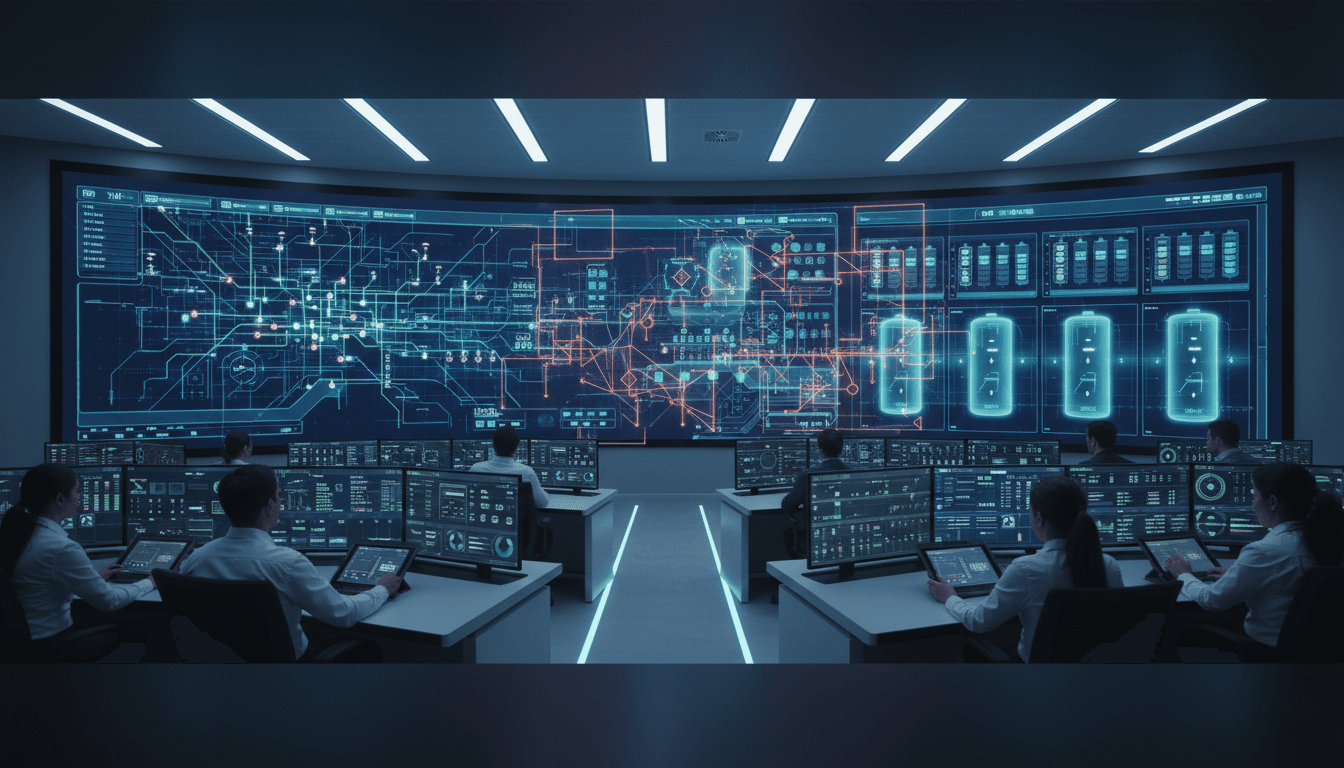
Reinforcement Learning Environments for Smarter Grids
The biggest constraint on enterprise AI in 2025 isn’t model size. It’s practice time.
Energy and utilities teams feel this acutely. You can train a large language model (LLM) to explain a protection scheme or summarize an outage report, but getting an AI agent to operate safely inside messy, real workflows—SCADA alarms, shifting constraints, half-complete asset data, human approvals, vendor portals, and “tribal knowledge” in PDFs—is a different job.
That’s where reinforcement learning (RL) environments come in. Think of them as the training grounds where agentic AI learns to take actions, recover from mistakes, and improve over repeated runs—before it touches production systems. In the AI in Robotics & Automation series, this is the missing link between “AI that talks” and “AI that does.” And for utilities chasing reliability, efficiency, and faster response times, it’s also a practical path to deployment.
Why energy AI can’t scale on data alone
If your AI initiative is stuck, it’s rarely because you don’t have enough data. It’s because your highest-value work isn’t a static prediction problem.
Demand forecasting, equipment health scoring, and price prediction still matter. But the real operational payoff is increasingly in closed-loop decisions:
- Which switching plan minimizes customer impact and respects constraints?
- How should a battery dispatch controller respond to a sudden frequency event?
- What’s the safest set of actions to restore service given partial telemetry?
- Which maintenance tasks should be scheduled first when crews are constrained?
These aren’t “label a dataset and train a model” problems. They’re sequential decision-making problems—more like robotics than analytics.
Here’s the blunt truth: most energy workflows are too complex, too regulated, and too high-stakes to “learn on the job” in production. So the AI needs a place to learn that isn’t production.
RL environments, explained like you’d explain it to an ops leader
An RL environment is a simulation (or controlled sandbox) where an agent repeatedly:
- Observes the current state (telemetry, constraints, task context)
- Acts (dispatch, reconfigure, create a work order, request approval)
- Gets feedback via a reward signal (stability improved, outage reduced, rule violated, cost increased)
- Updates behavior to do better next time
The key shift is that training becomes interactive. The agent isn’t only predicting the next token (like in a chat). It’s learning what happens when it takes actions, especially when things go wrong.
A useful way to frame it: data teaches an AI what the world looks like; environments teach it what the world does when you push on it.
In energy, that “what happens next” is everything.
Where LLMs fit: from “assistant” to “operator”
LLMs can already draft switching steps, summarize events, and generate code. Put the same model inside an environment where it can:
- query asset models
- run a power flow
- validate protection constraints
- submit a plan for approval
- execute in a sandboxed EMS/DERMS
- diagnose failures and retry
…and it stops being a passive assistant. It becomes an agent—a software robot operating a workflow.
This is exactly the “robotics & automation” connection: the agent is effectively doing knowledge work the way a robot does physical work—sense → decide → act → learn.
Three high-impact RL environment use cases in utilities
Utilities don’t need sci-fi agents that run the whole grid. They need narrow, high-confidence autonomy in places where teams are overloaded and consequences are expensive.
1) Grid optimization that can handle real constraints
Answer first: RL environments make grid optimization deployable because they teach agents to respect constraints, not just optimize a math objective.
Traditional optimization works well when constraints are clean and complete. But real networks have:
- incomplete topology changes (temporary jumpers, field changes)
- device availability uncertainty
- constraints that live in human heads (or old procedures)
- exceptions that require approvals
An RL environment can simulate:
- voltage and thermal limits
- N-1 contingency checks
- switching constraints and lockouts
- feeder reconfiguration options
- DER and storage behavior
Then the reward function can be shaped around operational goals, for example:
- + reduce customer minutes interrupted (CMI)
- + maintain voltage within target band
- + reduce losses and congestion
- − any protection violation or unsafe switching
- − excessive switching operations (wear-and-tear)
The result isn’t just “a better plan.” It’s an agent that learns which plans are actually feasible under utility rules.
2) Autonomous dispatch for batteries and DER
Answer first: RL environments are well-suited to DER and BESS dispatch because the control problem is dynamic, uncertain, and multi-objective.
Battery energy storage systems often stack value streams: frequency response, peak shaving, congestion relief, arbitrage, resilience. The “best” action changes minute to minute.
In an RL environment, you can train an agent to respond to:
- rapid frequency excursions
- solar ramps and forecast error
- feeder constraints
- market signals or tariff rules
- state-of-charge limits and degradation cost
A practical stance: if you’re serious about storage ROI, you should treat degradation as a first-class cost. An environment lets you encode that directly—rewarding actions that hit grid objectives without abusive cycling.
3) Predictive maintenance that turns into scheduling and action
Answer first: The value isn’t predicting failures—it’s choosing the next best maintenance action under constraints.
Many utilities have condition scores and anomaly detectors. Fewer can consistently convert them into:
- prioritized work orders
- crew assignments
- parts staging
- outage planning
- coordination with vegetation management
An RL environment can model the maintenance “game”:
- limited crews and truck rolls
- travel time and access restrictions
- weather windows (especially in winter storm season)
- regulatory inspection intervals
- risk and consequence models (critical loads, hospitals)
Train an agent on years of historical scenarios (and synthetic stress tests), and you get something more useful than “Asset X looks risky.” You get a system that can propose:
- what to do next
- who should do it
- when it should happen
- what the risk trade-off is if you defer
That’s robotics-style automation applied to field operations.
What should an “energy-grade” RL environment include?
You don’t need a perfect digital twin to start, but you do need the right failure modes.
The minimum viable environment (that still teaches useful behavior)
To train an agent that behaves well in production, your environment should include:
- Messy interfaces: ticketing tools, asset systems, schematics, and the reality of missing fields
- Realistic delays: telemetry latency, approval queues, and work execution time
- Rules and guardrails: operating procedures, safety constraints, and permission checks
- Stochastic events: equipment failure, weather-driven load variation, comms dropouts
- Evaluation harness: objective scoring across reliability, safety, cost, and time
If you only simulate the “happy path,” you’ll train an agent that collapses the first time it meets a real substation morning.
Watch-outs: reward hacking and brittle policies
RL is powerful, but it’s not magic. Two common failure patterns show up fast:
- Reward hacking: the agent finds a way to “win” the reward without doing the right thing (classic example: meeting a target by suppressing alarms instead of fixing conditions).
- Brittleness under stress: agents that perform well in nominal cases but degrade sharply during storms, cyber events, or cascading outages.
The fix is disciplined environment design:
- add adversarial and edge-case scenarios
- penalize unsafe shortcuts explicitly
- validate on holdout “unknown unknown” scenario sets
- require explainable action traces for any recommended plan
A practical roadmap for utilities (90 days to first value)
Utilities often ask: “Do we need a massive simulation program to start?” No. You need a focused workflow and a training loop.
Phase 1: Pick one workflow where autonomy is realistic
Good first candidates:
- switching plan validation in a sandbox
- restoration decision support for a single feeder class
- battery dispatch policy for one constrained node
- maintenance scheduling for one asset family (reclosers, transformers)
The best workflow is one where:
- actions are well-defined
- success is measurable
- failure is containable in a test environment
Phase 2: Build the environment around your “operating truth”
Start with your real constraints:
- safety and switching rules
- equipment limits
- approval requirements
- reliability KPIs
Then simulate the interfaces the agent must use (even if crudely at first). In my experience, this is where most projects either get serious—or quietly die.
Phase 3: Train, test, and gate with hard criteria
Define “ship criteria” upfront:
- zero tolerance for unsafe actions
- bounded performance under stress scenarios
- audit logs that replay decisions step-by-step
- a clear human override and escalation path
And treat deployment like you would treat automation in a substation: staged, controlled, and instrumented.
Where this fits in AI in Robotics & Automation
Robotics isn’t only arms and autonomous vehicles. In utilities, the “robot” is often software: an agent that navigates systems, executes procedures, and coordinates action.
RL environments are the training floor where those software robots learn to operate reliably. Data teaches knowledge. Environments teach competence.
If you’re building AI for energy & utilities in 2026 planning cycles, I’d bet on this: the teams that invest in RL environments and evaluation harnesses will ship real automation. The teams that keep chasing “more data” will keep demoing chatbots.
The next step is straightforward: choose one operational workflow and sandbox it. If you can train an agent to handle the messy version of that workflow—timeouts, missing data, approvals, and all—you’re no longer experimenting. You’re building a deployable system.
What’s one grid or field workflow your team wishes could run on autopilot during the next major event?