Musculoskeletal robot dogs pair compliant “muscles” with AI control to boost mobility in messy environments. See where they fit in real automation deployments.
Musculoskeletal Robot Dogs: The Next Automation Bet
Most companies get quadruped robots backwards: they start with the body they can manufacture, then try to “AI their way” into agility.
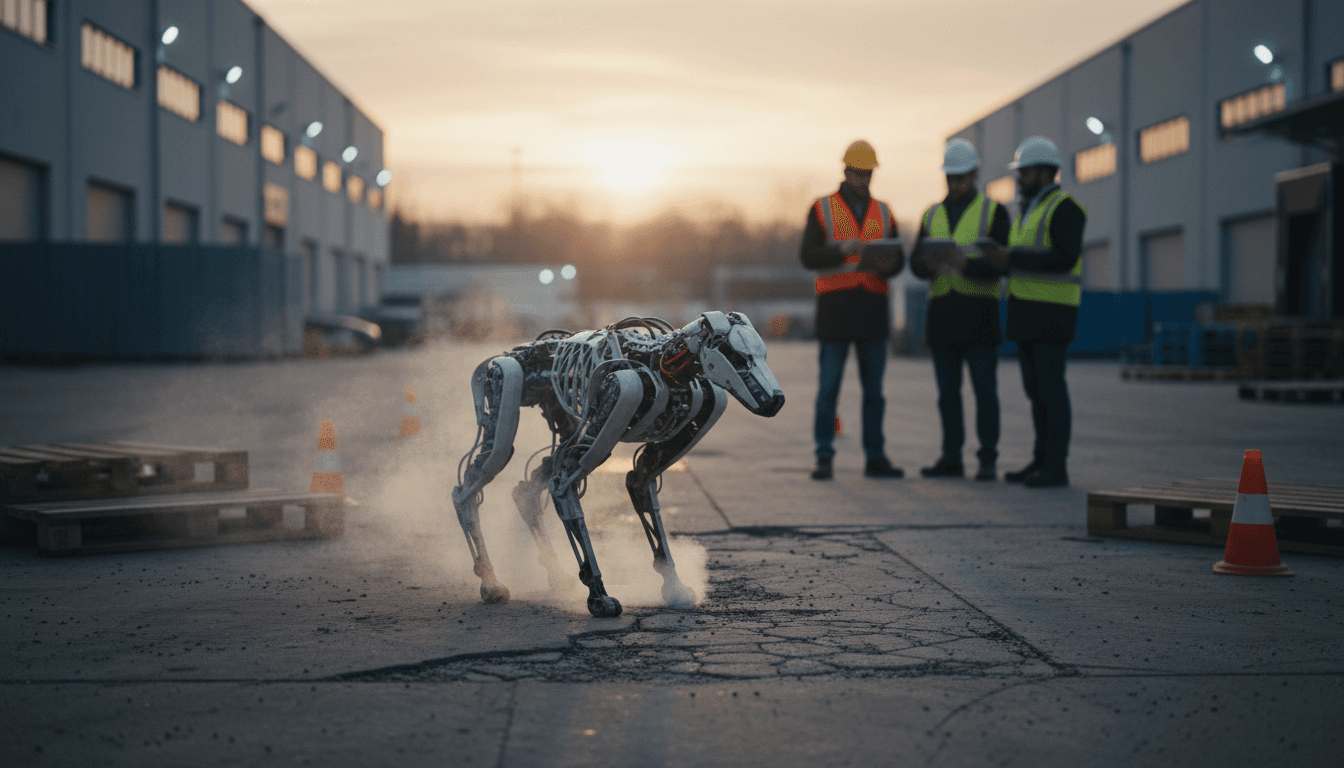
The musculoskeletal robot dog shown recently by Suzumori Endo Lab flips that. It starts with biology—thin McKibben artificial muscles and a flexible, hammock-like shoulder structure—and uses control and perception to take advantage of compliance instead of fighting it. That’s a meaningful shift for anyone serious about AI in robotics and automation, especially in environments where wheeled robots struggle: cluttered warehouses, mixed indoor/outdoor yards, mezzanines, disaster sites, and plant floors that never stay “mapped” for long.
This matters because mobility isn’t a demo problem anymore. It’s a throughput problem, a safety problem, and a maintenance problem. And musculoskeletal designs change the economics of all three.
Why “muscles” change what robot dogs can do
A musculoskeletal quadruped can absorb uncertainty mechanically, not just computationally. That reduces the burden on perception and planning, which is exactly where many real-world deployments get stuck.
Traditional quadrupeds are typically torque-controlled, electric-motor-driven machines with rigid transmissions. They can be extremely capable, but they often rely on high-rate control, accurate state estimation, and careful foot placement to avoid shocks, slips, and drivetrain stress.
A musculoskeletal approach introduces compliance by design:
- McKibben muscles (pneumatic artificial muscles) contract like biological muscle, naturally providing “give” under load.
- Tendon-like routing and muscle placement can create passive stabilization effects.
- A flexible shoulder structure can allow the body to adapt to terrain without requiring perfect planning.
The punchline: compliance makes some failure modes less catastrophic. Instead of “hit obstacle → slip → controller catches it (maybe),” you can get “hit obstacle → structure yields → controller corrects from a less extreme state.”
The real benefit: robustness per dollar of compute
Here’s a stance I’ll defend: adding compliance is often cheaper than adding compute and sensors when your goal is reliable field operation.
Compute helps, but it also brings:
- Higher power draw (shorter run time)
- More heat (thermal design and throttling issues)
- More integration complexity (latency, synchronization, software maintenance)
A robot body that’s inherently forgiving reduces the amount of “heroics” required from the AI stack.
AI’s role isn’t to “animate” the robot—it’s to manage complexity
AI in robotics works best when it’s supervising, adapting, and recovering—not micromanaging every millisecond. Musculoskeletal systems are messy: nonlinearities, hysteresis, actuator dynamics, and time delays are real.
That’s exactly where modern learning-based control and hybrid methods earn their keep:
- Learning residuals on top of physics models to handle unmodeled muscle dynamics
- Policy learning for foothold and gait adaptation when terrain changes quickly
- Vision-based locomotion to predict contact quality (wet floor, gravel, loose debris)
- Failure recovery behaviors (stumble recovery, partial foothold, self-righting)
In the RSS roundup, you can see the ecosystem forming around this idea of “AI for physical intelligence,” not just automation scripts:
- A self-contained edge vision system aimed at real-world perception on-robot
- Research robots executing agile flight paths using AI-based controllers
- Labs pushing generalization so robots can handle unseen objects and tasks
The common thread is practical: the world changes faster than your maps.
A useful way to think about the autonomy stack
If you’re building or buying mobile robots for automation, evaluate autonomy in three layers:
- Stability and locomotion control (milliseconds): staying upright, managing contacts
- Tactical behaviors (seconds): stepping over obstacles, choosing footholds, rerouting locally
- Task-level planning (minutes): deliver tote A to station B, patrol zone C, inspect asset D
Musculoskeletal designs can make layer 1 more forgiving. That frees AI effort for layers 2 and 3—the ones that actually create business value.
Where musculoskeletal quadrupeds make sense in automation
The best use cases are the ones where your facility can’t be “fixed” to suit robots. If you can flatten floors, add fiducials, ban clutter, and constrain humans—wheels win. If you can’t, legs start to look reasonable.
1) Yard logistics and outdoor industrial sites
Outdoor sites are full of mobility tax:
- Uneven ground, potholes, ramps
- Water, mud, snow (December reality)
- Unpredictable obstacles (hoses, pallets, debris)
Quadrupeds can handle transitions that defeat AMRs designed for pristine indoor floors. A musculoskeletal build adds shock tolerance and could reduce damage from missteps.
2) Inspection and patrol in mixed environments
Inspection routes in plants are rarely uniform. You get:
- Stairs and grated walkways
- Narrow passages
- Temporary barriers during maintenance
A robot dog that can safely traverse these while carrying sensors (thermal camera, gas detector, acoustic sensors) is a strong fit.
3) “Last 30 meters” inside warehouses
Many warehouses are deploying AMRs successfully—until the last segment:
- Tight aisles near packing
- Human congestion near docks
- Debris and wrap on the floor
A legged robot doesn’t need to replace AMRs. It can complement them for exception handling: the messy, high-variance areas that soak up labor.
4) Disaster response and safety operations
The RSS roundup mentions an AI-powered robotic dog concept for disaster zones, including multimodal models and visual memory.
Whether you’re in public safety or industrial EHS, the operational requirement is the same: go where humans shouldn’t, and come back with reliable information. Mobility that tolerates rubble and uncertain footing is the baseline.
The catch: muscles introduce infrastructure and control tradeoffs
Musculoskeletal robots aren’t “free performance.” They shift complexity. If you’re evaluating this direction, be clear-eyed about what changes.
Pneumatics and maintenance
McKibben muscles typically require compressed air and pneumatic control hardware. That can be a deal-breaker for some deployments.
Questions you should ask early:
- Where does compressed air come from (onboard compressor vs. tether vs. facility supply)?
- What’s the duty cycle and expected runtime?
- How do you detect leaks and degradation?
- What’s the service procedure and mean time to repair?
In many factories, compressed air is abundant but expensive and often leaky. If you already fight air quality issues, a pneumatic quadruped may increase your maintenance load.
Precision vs. compliance
Compliance helps with robustness, but it can complicate precision foot placement or manipulation.
That doesn’t mean musculoskeletal robots can’t do precise work—it means you’ll rely more on sensing and estimation to achieve repeatable outcomes.
The practical approach I’ve seen work: pair compliant locomotion with rigid or semi-rigid tool interfaces (sensor booms, docking mechanisms, standardized payload mounts).
What buyers should demand before deploying robot dogs
If you’re trying to drive leads into real deployments, the fastest way is to stop selling “cool mobility” and start selling measurable reliability. Here’s a deployment checklist that separates pilots from programs.
Operational metrics (non-negotiable)
- Mean time between intervention (MTBI): how often a human must rescue or reset the robot
- Route completion rate: percent of missions completed without manual help
- Slip/stumble recovery success rate: measured on representative surfaces
- Runtime under load: including sensors, compute, comms, and worst-case temperatures
- Ingress protection and cleaning procedure: dust, water spray, disinfectants
Autonomy requirements that actually matter
- Graceful degradation: what happens when a camera is occluded or a foot sensor fails
- Human-aware navigation: predictable behavior around people (stopping distance, yielding)
- Remote ops workflow: one operator supervising multiple robots with good telemetry
Integration reality
- APIs for your work orders and CMMS/EAM systems (inspection findings must become tickets)
- Data governance (video and sensor data retention, access control)
- Fleet update strategy (software changes without breaking validated behavior)
If a vendor can’t talk in these terms, they’re selling a demo.
The bigger trend in the AI in Robotics & Automation series
Robotics is converging on “systems that learn” rather than “systems that are programmed.” You can see it across the videos highlighted in the RSS source:
- Natural language turning into physical objects through generative design + robotic assembly
- Tendril-inspired grippers that handle fragile and heavy items without crushing them
- Wearable robots improving donning/doffing so real users can operate them daily
- Autonomy teams emphasizing demonstrable safety as a design principle
Musculoskeletal quadrupeds sit right in the middle of this trend: they’re hard to model perfectly, so the winners will combine good mechanical priors with AI that adapts and recovers.
The reality? It’s simpler than you think: hardware choices decide how much intelligence you’ll need. If the body is brittle, the AI must be perfect. If the body is forgiving, the AI can be practical.
A compliant body is a form of embedded intelligence—one that doesn’t crash, doesn’t need a software update, and doesn’t care about lighting.
What to do next if you’re considering quadrupeds for automation
If you’re exploring robot dogs—musculoskeletal or not—start with a scoped, high-value workflow.
- Pick a route with real friction (stairs, thresholds, outdoor segments, clutter) and quantify current labor time.
- Define success as MTBI and completion rate, not “it walked around.”
- Run surface and season tests (wet floors, winter grit, cold battery performance).
- Design the handoff into your operations systems so inspection outputs become actions.
If you want help selecting a platform, defining pilot metrics, or mapping autonomy requirements to an ROI case, we can walk through your facility constraints and recommend a deployment plan that won’t collapse under real usage.
The next question worth asking isn’t whether robot dogs can walk. It’s whether your automation program is ready to manage robots that learn, adapt, and occasionally fail—without stopping the operation.