Musculoskeletal robot dogs show how AI locomotion and compliant hardware can improve automation in logistics, inspection, and service environments.
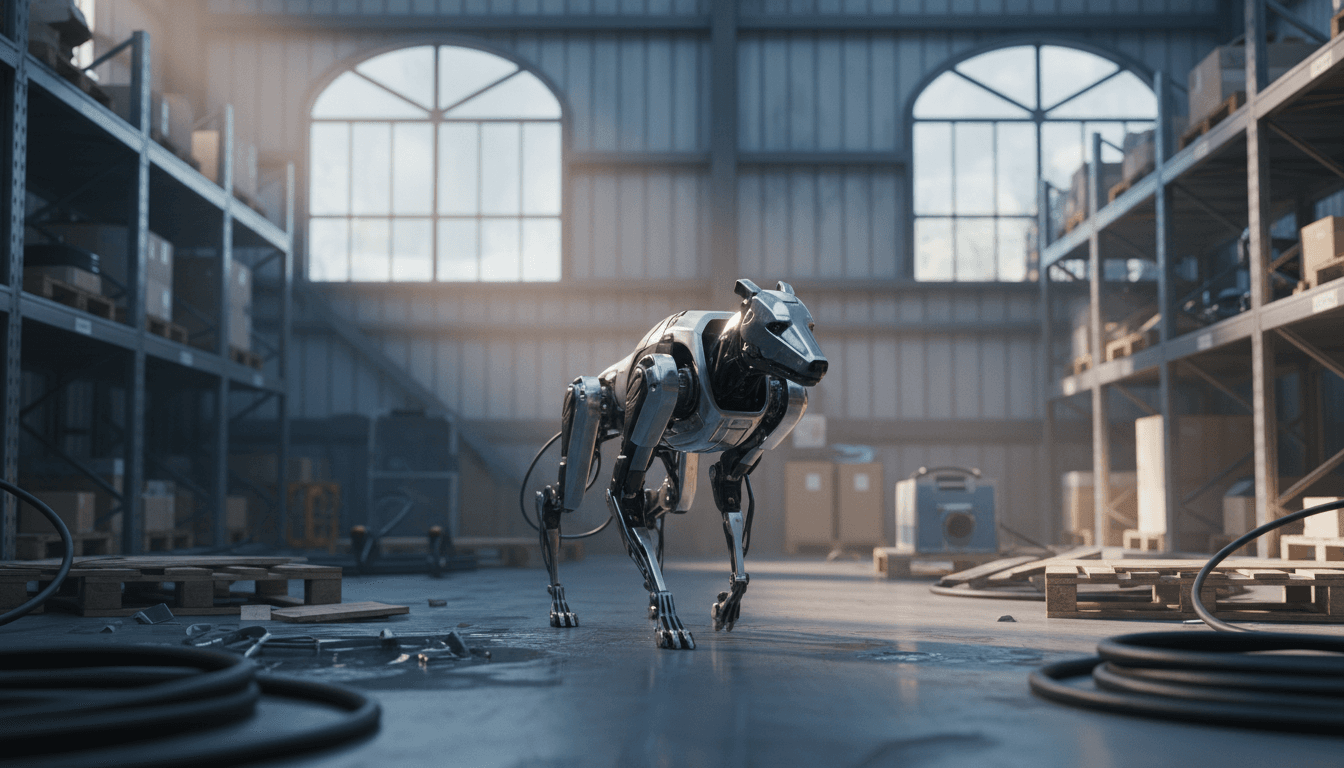
Muscle-Driven Robot Dogs: AI Locomotion for Industry
A lot of industrial robots are strong, fast, and reliable—right up until the environment stops being “industrial.” Toss in a wet floor, a loose cable tray, a temporary ramp, or a cluttered aisle during peak season, and the same systems that look flawless in demos start needing guardrails, fences, and constant babysitting.
That’s why musculoskeletal robot dogs are more than a cool lab video. A quadruped built with muscle-like actuators (rather than purely rigid motors and gearboxes) is a clear signal of where AI in robotics and automation is heading: toward machines that don’t just follow trajectories, but adapt their bodies to the real world.
A recent showcase from Suzumori Endo Lab (Science Tokyo) highlights a dog-like musculoskeletal quadruped that uses thin McKibben artificial muscles and a flexible, hammock-like shoulder structure. It’s research-first, but the implications are practical: compliance, shock tolerance, and more natural movement—all of which translate into fewer “robot-stops” on the factory floor.
Why musculoskeletal robot dogs matter for automation
Musculoskeletal quadrupeds matter because they address a stubborn truth: many automation failures are mechanical-contact problems, not AI problems. The robot “knows” what to do, but the body can’t do it safely when the world doesn’t match the model.
Traditional rigid actuation is efficient and controllable, but it transmits impacts into the drivetrain, struggles with unexpected contact, and often needs conservative motion to stay safe. Muscles—biological or artificial—behave differently:
- They naturally absorb shocks
- They support variable stiffness (soft when you want safety, stiff when you want precision)
- They make contact-rich locomotion (stairs, gravel, thresholds) less brittle
Here’s the stance I’ll take: industrial robotics needs more “good-enough adaptation” and fewer perfect models. Musculoskeletal design is one of the cleanest hardware paths to get there.
The “hammock shoulder” is a big deal
Dog shoulders aren’t built like four identical hinges. They have complex compliance that helps with stride efficiency and stability. Mimicking that hammock-like shoulder structure isn’t about making a robot look like a dog. It’s about exploring a structure that:
- reduces peak loads during foot strike
- helps the body recover from slips
- enables a wider range of gaits without constant re-tuning
In an industrial setting, that can mean fewer falls, less drivetrain damage, and better uptime.
AI is what turns muscle into useful motion
Muscle-like actuation alone doesn’t solve locomotion. If anything, it makes control harder. You’re no longer commanding “motor position to 0.2 degrees.” You’re dealing with nonlinear force dynamics, hysteresis, and time-varying stiffness.
This is exactly where modern AI techniques earn their keep.
What “AI locomotion” really means in 2025
When vendors say “AI-powered quadruped,” it can mean anything from basic perception to full policy learning. For industrial buyers, the useful stack usually looks like this:
- Perception and state estimation
- Visual-inertial odometry, depth sensing, slip detection
- Terrain-aware footstep planning
- Choosing stable footholds, adjusting stride length and cadence
- Low-level whole-body control
- Balancing, compliance control, disturbance rejection
- Learning-based adaptation
- Policies that adjust to floor changes, payloads, wear, or unexpected pushes
Musculoskeletal systems push even more responsibility into layers (3) and (4). They benefit from learning controllers that can map sensor inputs to force patterns without relying on perfect analytical models.
Why variable compliance changes the safety conversation
Most teams try to “software” their way into safety: slower motion, bigger clearance margins, more cages. But compliance gives you physical safety properties.
A musculoskeletal quadruped can be tuned to:
- stay soft around people or fragile assets
- become stiffer when stabilizing under load
- absorb impacts instead of amplifying them
That’s valuable for service robotics, warehouse automation, and facility inspection—especially in mixed human-robot spaces.
From lab quadrupeds to factories: where robot dogs actually fit
Quadrupeds won’t replace AMRs for simple point-to-point transport on flat floors. Wheels remain cheaper, faster, and easier to maintain.
Quadrupeds win when the facility has one or more of these realities:
- frequent layout changes
- thresholds, steps, grates, or outdoor segments
- tight spaces where turning radius matters
- inspection routes that include stairs or ladders (yes, some do)
- the need to carry sensors into places humans shouldn’t go
Practical industrial use cases (that justify the cost)
1. Plant and facility inspection (especially winter 2025 realities)
December is a good reminder that “floor conditions” aren’t stable. Snowmelt, condensation, and grit track into loading bays and mechanical rooms. A compliant quadruped with strong perception can handle:
- thermal and visual inspection rounds
- valve and gauge checks
- leak detection sensor payloads
- patrols in partially outdoor facilities
2. Logistics and distribution center exception handling
Peak season brings clutter, temporary pallets, and last-minute reconfiguration. A quadruped isn’t there to do the whole job; it’s there to handle the messy edge cases:
- checking blocked aisles
- delivering small urgent items through congested zones
- escorting maintenance techs with tools/sensors
3. Safety-first response in hazardous or unstable environments
One of the videos highlighted an AI-powered robotic dog aimed at disaster response with multimodal models and visual memory. That same concept—robot as a mobile scout that can see, remember, and report—translates to industrial incidents:
- chemical spills
- smoke events
- structural concerns
- areas with poor air quality
The value proposition is simple: reduce human exposure while improving situational awareness.
What to evaluate before deploying quadrupeds in automation
Most companies get this wrong by shopping based on top speed, battery life, or “cool factor.” Those specs matter, but they don’t decide whether you’ll get value in production.
Here’s what I’ve found is more predictive.
1. Can it recover from failure states?
Ask for evidence of:
- slip recovery on wet floors
- self-righting or safe shutdown behavior
- gait adaptation with partial sensor occlusion
A quadruped that walks beautifully until it doesn’t isn’t an automation asset—it’s a demo.
2. What’s the AI/perception stack maturity?
Look for:
- robust depth perception in low light
- on-device (edge) compute for latency-sensitive behaviors
- logging and replay tools for incident analysis
Edge AI matters because locomotion decisions often need to happen in tens of milliseconds. Cloud dependence is a red flag for real-time stability.
3. How will it integrate with your operations?
In industrial robotics and automation, integration is the tax you always pay. Plan for:
- fleet management (even if you start with one robot)
- mission scheduling tied to maintenance workflows
- alert routing into the tools your team already uses
If integration isn’t part of the plan, pilots stall and “the robot becomes a toy.”
4. Maintenance model: actuators, air, seals, and wear
Muscle-based systems (like McKibben actuators) raise real questions:
- What’s the replacement interval?
- How sensitive is performance to wear or leaks?
- What does calibration look like after component swap?
The pitch for musculoskeletal robots is resilience and compliance—but only if the maintenance story is realistic.
The bigger trend: robots that build, sense, and reason together
The musculoskeletal robot dog is one thread in a wider shift across the AI in Robotics & Automation landscape.
In the same week of robotics news, we’re seeing:
- speech-to-object systems that turn natural language into physical assemblies via generative AI and robotic construction
- edge vision platforms bundling sensing + compute + 3D perception
- controllers that enable insect-scale robots to fly agile trajectories
- robotics labs pushing generalization: robots that can handle unseen objects autonomously
One line connects these: automation is moving from scripted motion to adaptive behavior. Musculoskeletal design is the hardware counterpart to that shift. It gives learning-based control something forgiving to work with.
Where musculoskeletal quadrupeds go next (and what you should do now)
Musculoskeletal quadrupeds are heading toward a practical middle ground: not as delicate research prototypes, and not as rigid industrial machines, but as adaptive platforms that can work in semi-structured environments with fewer constraints.
If you’re exploring intelligent automation for 2026 planning, I’d focus on three next steps:
- Identify “mobility pain” zones in your operation (stairs, outdoor segments, wet areas, inspection routes).
- Run a pilot with success metrics that match operations, not marketing (missed inspections, response time, incident exposure reduction, downtime prevented).
- Plan for AI monitoring from day one: logs, drift detection, and post-incident replay are what turns field learning into reliability.
Quadruped robots in logistics and service environments won’t win because they look like dogs. They’ll win because they keep moving when the floor stops being perfect—and because AI can finally take advantage of bodies designed for real contact with the world.
If your automation strategy assumes ideal conditions, it’s not a strategy—it’s a bet. The smarter move is building for the mess.