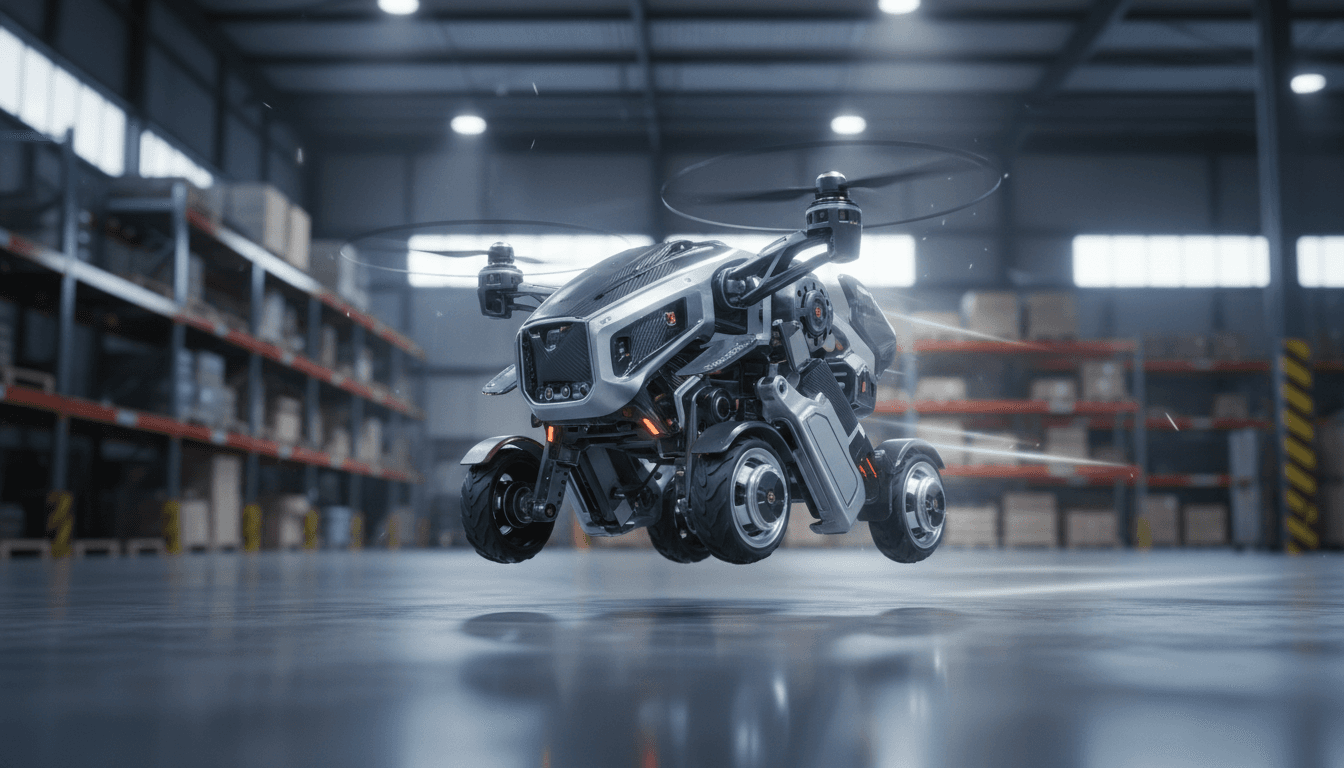
AI-powered morphing drones can fly, transform mid-air, land, and roll—reducing platform handoffs in logistics, inspection, and rescue.
Morphing Drones: Fly, Land, Then Roll With AI
A quadcopter that can change its body in mid-air isn’t a party trick—it’s a direct answer to a messy operational problem: the world isn’t built for robots.
Warehouses have narrow aisles and door thresholds. Disaster zones have broken staircases, rebar, and dust-filled interiors. Industrial sites have both open yards (great for flight) and cramped corridors (bad for flight). Most companies deal with this by buying two platforms—an aerial drone and a ground robot—then suffering through separate training, maintenance, spares, software stacks, and operator workflows.
Caltech’s ATMO bot (as described in the RSS summary) points to a simpler operational model: one transformable robot that flies to reach the area fast, then morphs to land and move on wheels. The real story, though, isn’t the hinges or the wheels. It’s the autonomy. AI is what makes mid-air transformation safe, repeatable, and useful in real-world conditions.
Why morphing drones matter (and why most teams still hesitate)
Answer first: Morphing drones matter because they reduce the “mode mismatch” that breaks real deployments—when a robot’s best navigation mode changes every 20 meters.
Aerial robots are unbeatable for:
- Rapid access over clutter and obstacles
- Wide-area inspection and mapping
- Getting eyes on a scene before people enter
But flight becomes a liability when:
- You need persistent close-range work (battery drains fast)
- You’re indoors or near sensitive equipment
- Rotor wash kicks up dust or disturbs lightweight parts
- The space is tight and GPS-denied
Wheeled robots are great for:
- Long-duration patrols and repeatable routes
- Stable sensing (better for close inspection and manipulation)
- Safe navigation near people and equipment
But wheels struggle when:
- You need to cross gaps, rubble, or stairs
- You must reach elevated targets quickly
- The environment changes and routes get blocked
Most teams hesitate because transformable robots historically failed at one of three points:
- Mechanical complexity (more joints, more failure modes)
- Control complexity (transition dynamics are hard)
- Field robustness (dust, vibration, impacts, wind)
ATMO’s key promise is tackling the second and third issues by performing the transition in the air—the hardest moment to control, but also the moment where better autonomy pays off most.
The hard part isn’t morphing—it’s doing it mid-air reliably
Answer first: Mid-air transformation is difficult because it changes a drone’s aerodynamics, inertia, and control authority while it’s already fighting wind, turbulence, and sensor noise.
When a quadcopter morphs, several things can shift at once:
- Center of mass moves (your controller’s assumptions break)
- Moment of inertia changes (how fast you can rotate changes)
- Drag profile changes (wind affects you differently)
- Motor loading changes (thrust-to-weight margin shifts)
Even if the robot is only “kind of” unstable for half a second, that’s enough to:
- Clip a wall indoors
- Bounce on landing and flip
- Break a prop, which ends the mission
What AI contributes to a mid-air transition
AI isn’t magic; it’s a toolkit. For a morphing aerial-ground robot, it typically shows up in four places:
-
State estimation that survives weird dynamics
Classical filters assume your system model is roughly stable. During morphing, the model is changing. Learning-enhanced state estimation can help maintain stable attitude and velocity estimates during the transition. -
Adaptive control policies
Instead of one controller tuned for “pure drone,” you need controllers that handle multiple configurations plus the in-between state. Learning-based controllers (often trained in simulation with domain randomization) can learn policies that remain stable as the platform’s parameters shift. -
Landing-site evaluation
If the robot is going to land and roll, it needs to pick a surface that won’t trap the wheels, tip the chassis, or ingest debris. Vision models can classify terrain and estimate slope/roughness fast enough to make practical decisions. -
Fault detection and graceful fallback
Mid-air morphing needs a “no drama” safety plan. AI-driven anomaly detection can flag actuator lag, a stuck joint, or unexpected oscillations and revert to a safer configuration or abort the landing.
A useful one-liner for decision-makers: A transformable robot is only as good as its transition—AI turns that transition from a stunt into a repeatable workflow.
Where fly-to-roll robots pay off in automation
Answer first: The best use cases are the ones that require fast access and long-duration local work—especially in GPS-denied or cluttered spaces.
Logistics and warehouse operations
Warehouses are a study in tradeoffs: flight for speed, wheels for endurance and safety.
A practical pattern looks like this:
- Fly to a distant zone or upper rack area for quick situational awareness
- Land to perform aisle-level scanning, barcode/label verification, or inventory confirmation
- Roll to charging points or between scan targets without constant rotor noise
This matters in late Q4 and peak season operations (yes, even in December): facilities are reconfigured often, temporary storage appears, and human traffic increases. Robots that can adapt their mode can keep up with layout changes without forcing perfectly “robot-friendly” infrastructure.
Industrial inspection and maintenance
Industrial sites have open outdoor areas (pipes, tanks, yards) and interior spaces (corridors, tight platforms). A fly-to-roll robot can:
- Fly over fenced areas or around blocked access roads
- Land for close inspection where stable, low-vibration sensing improves data quality
- Roll to follow a pipe run or perimeter route repeatedly
If you care about inspection consistency, wheels help. If you care about reaching hard-to-access spots quickly, flight helps. The value is having both without swapping platforms.
Search-and-rescue and disaster response
Disaster environments punish single-mode robots.
- Drones can reach the scene fast and map it.
- Ground robots can persist inside for longer.
A morphing robot can fly over a collapsed entry, land near a safe threshold, then roll into an interior void—reducing the need for multiple deployments and handoffs.
The autonomy stack you actually need (not the one in slide decks)
Answer first: To make a transformable robot useful, you need an autonomy stack that treats “configuration” as a first-class variable—planned, sensed, and controlled.
Here’s a practical breakdown I’ve found works when teams move from demos to deployments.
Perception: terrain, clearance, and contact-aware sensing
Transformable robots need perception beyond obstacle avoidance:
- Landing suitability: slope, debris, loose gravel, slick floors
- Clearance checks: will the new wheelbase fit after morphing?
- Contact detection: wheel slip, bump events, curb thresholds
If your perception only answers “is there an obstacle,” you’ll still fail on “is this surface worth landing on.”
Planning: “when to morph” is a planning problem
A common mistake is treating morphing as a manual operator command. In scalable automation, the robot should decide:
- Morph now to conserve battery?
- Stay in flight because the floor is cluttered?
- Roll because the corridor is narrow and people are present?
This becomes a cost function across energy, risk, time, and task success probability. You don’t need perfect global optimization; you need consistent, explainable decisions.
Control: multi-model or learning-based switching done safely
The controller needs:
- Stable flight control
- Stable ground locomotion control
- A controlled transition policy
The transition policy is the differentiator. It should include explicit safety conditions:
- Minimum altitude buffer
- Maximum wind estimate
- Allowed roll/pitch bounds
- Abort criteria if joint positions lag
Operations: fleet integration and maintenance reality
If you want leads (and real deployments), this is where the conversation gets serious.
For morphing robots, operational readiness includes:
- Predictive maintenance on joints/servos (cycle counting, temperature, current draw)
- Spare strategy (actuators and props fail differently)
- Operator training that focuses on exceptions and overrides
- Digital twin simulation to test new transition policies before field rollout
What to ask before you pilot a morphing robot
Answer first: Evaluate transformable robots on transition success rate, terrain robustness, and operational overhead—not just flight time or top speed.
Use these questions to pressure-test a vendor or internal prototype:
- Transition reliability: What’s the observed transition success rate over 1,000 cycles? What fails first?
- Degraded-mode behavior: If one morph actuator sticks, can it still land safely? Can it still roll?
- Indoor navigation: Does it handle GPS-denied spaces with dust, reflective floors, and low texture?
- Terrain envelope: What floor conditions are allowed for landing—gravel, grates, ramps, wet concrete?
- Energy model: How does the system decide when to roll vs fly to maximize mission time?
- Safety model: What’s the human proximity behavior—slow zones, rotor disable policies, audible alerts?
- Data products: What do you get out—maps, defect flags, inventory counts—and how do you integrate them?
If you can’t get crisp answers, the robot is likely still a lab project.
People also ask: practical questions about fly-to-roll robots
Is a morphing drone safer indoors than a normal drone?
It can be—if it lands and disables rotors for close work. The safety improvement comes from minimizing flight time near people and equipment, not from the morphing itself.
Does adding wheels make flight performance worse?
Usually yes. Wheels add mass and drag. That’s why the autonomy layer matters: the robot should fly only when flight is the best option, then roll when it isn’t.
Why transform mid-air instead of landing first?
Transforming mid-air can reduce bounce-and-tip risks during touchdown by letting the robot approach in a configuration optimized for landing stability. It also helps when the “landing” surface is cluttered and you need to commit quickly.
What ATMO signals for the “AI in Robotics & Automation” roadmap
Transformable robots like ATMO are a strong sign that robotics is shifting from single-purpose machines toward adaptive systems that treat the environment as variable and messy.
In this “AI in Robotics & Automation” series, I keep coming back to the same point: automation wins when it reduces handoffs. A fly-to-roll robot reduces handoffs between platforms, between teams, and between software stacks. That’s not a research curiosity—that’s how you lower operational friction.
If you’re exploring robotics for logistics, manufacturing, or search-and-rescue, the next step is straightforward: map your workflows and find the transitions where robots currently fail (doorways, thresholds, stairs, tight corridors, mixed indoor/outdoor routes). Those are the spots where AI-enabled adaptability—including mid-air morphing—can justify itself fast.
A year from now, the interesting question won’t be “Can it morph?” It’ll be: Can your autonomy stack choose the right mode at the right time, for the right reason, every single shift?