Layer depalletizing breaks when pallets get messy. See how AI-ready tooling like NūMove’s can cut exceptions and raise throughput in warehouses.
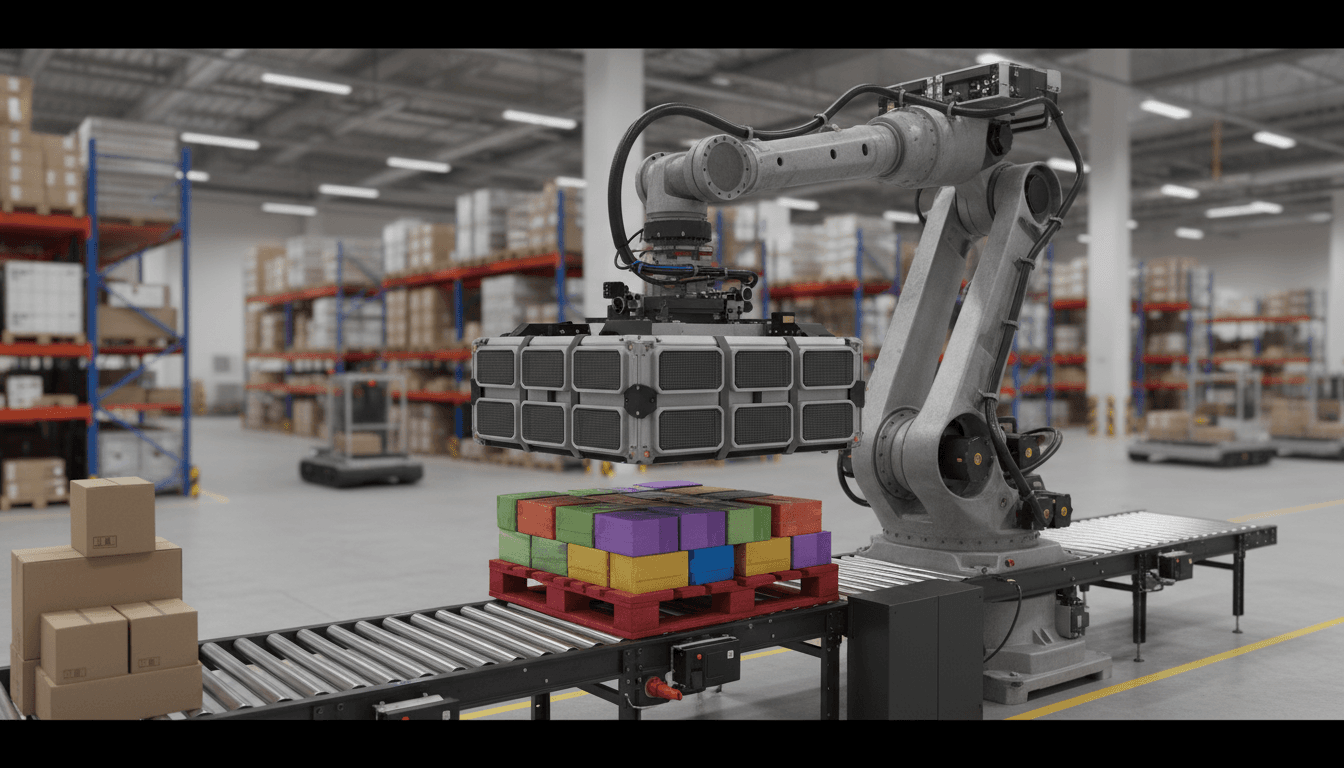
AI-Ready Layer Depalletizing for Faster Warehouses
Peak season exposes a simple truth: depalletizing is still one of the easiest places for a warehouse to lose throughput. When pallets arrive “perfect,” automation looks effortless. When they arrive mixed, wrapped differently, leaning, or with inconsistent case sizes, even good robots can stall—or require so much babysitting that the ROI collapses.
That’s why NūMove Robotics & Vision’s newly introduced layer depalletizing tool matters. According to the RSS release summary, the tool is designed for high-throughput logistics and can depalletize both single-SKU and rainbow pallets. If you’re building an automation roadmap for 2026, the headline isn’t just “new end-of-arm tooling.” It’s this: the end-effector is now a strategic AI integration point—where mechanical compliance, sensing, and software intelligence meet.
In this installment of our AI in Robotics & Automation series, I’ll unpack what layer picking automation really requires, why the gripper/tooling often decides success, and how to connect a modern depalletizing tool with AI vision and controls so your robot performs like a systems solution—not a demo.
Why layer depalletizing is the throughput bottleneck
Layer depalletizing is hard because pallets are messy in the real world. The depalletizing robot isn’t just lifting boxes; it’s coping with variation in pallet build quality, packaging, and inbound handling.
Most companies get this wrong by treating depalletizing as a simple pick-and-place task. It’s not. It’s a perception + manipulation problem happening at production speed.
What makes rainbow pallets uniquely painful
Rainbow pallets (mixed SKUs and mixed case dimensions on one pallet) add complexity that single-SKU operations don’t face:
- Different case heights across the same layer, which breaks assumptions about a flat plane
- Inconsistent friction and compliance between cartons (glossy shrink wrap vs. matte corrugate)
- Unpredictable center of mass when picking multi-case groupings
- Label clutter and graphics that can confuse traditional rule-based vision
A tool that claims to handle both single-SKU and rainbow pallets is essentially promising adaptability. And adaptability is exactly where AI (and good mechanical design) earns its keep.
The cost of “almost working” depalletizing
When depalletizing automation is fragile, the hidden costs show up fast:
- Line starvation downstream (conveyors, sortation, case erecting, replenishment)
- Extra labor assigned to “robot tending”
- Lower OEE than planned because recovery routines take too long
- Safety and damage risk when operators frequently enter the cell
If your operation is seasonal (December is the obvious stress test), reliability beats hero throughput. A slightly slower cell that runs hands-off usually wins.
What NūMove’s new layer depalletizing tool signals
A modern depalletizing tool isn’t just a gripper—it’s a performance multiplier. The RSS summary describes NūMove’s new end-of-arm tool as an improved layer depalletizing solution engineered for high-throughput environments and able to depalletize single-SKU and rainbow pallets.
Even without full specs, we can infer what “improved adaptability and performance” typically means in this category: better tolerance to variation, faster cycle recovery, and fewer exceptions.
What “adaptability” usually looks like in EOAT
When vendors talk about adaptability in layer picking automation, look for design choices like:
- Compliance (mechanical or pneumatic) to accommodate slight height differences
- Zoning (multiple suction zones or segmented contact areas) so the tool can pick partial layers or uneven patterns
- Better sealing on porous cartons or uneven surfaces
- Integrated sensing (vacuum pressure feedback, flow monitoring, proximity) to detect a weak pick before the robot moves
If NūMove has meaningfully improved the tool versus prior models, the practical outcome should be fewer “mystery drops,” fewer manual restarts, and more consistent cycle times across varied inbound pallets.
Layer depalletizing isn’t only about suction vs. forks
A lot of teams over-index on the tool type (vacuum, forks, clamps, hybrid). The more useful framing is:
The best depalletizing tool is the one that can detect a bad pick early and recover quickly—without calling a human.
That’s where EOAT design and AI-ready software integration start to look like a single product decision, not two separate ones.
Where AI fits: making depalletizing robust, not just automated
AI improves depalletizing when it reduces exceptions and speeds up recovery. If you already have a capable layer depalletizing tool, AI can turn it into a system that handles variation with less engineering effort.
AI vision for layer detection, not just box detection
Traditional vision often relies on tidy assumptions: clean edges, consistent lighting, clear layer boundaries. Real inbound pallets don’t cooperate.
AI vision (especially modern deep-learning-based segmentation) can help with:
- Layer boundary identification even when cartons vary, are deformed, or have busy graphics
- 3D pose estimation when the pallet is slightly skewed
- Confidence scoring (how likely is this pick plan to succeed?)
- Dynamic pick strategy (full layer vs. partial layer vs. “stabilize first”)
This matters because the robot should choose the pick style that matches risk. A “perfect” full-layer pick is great—until it isn’t.
AI-driven strategy selection: full layers, partials, or singles
A high-throughput cell shouldn’t commit to full-layer picks if pallet quality is poor. AI can help classify inbound pallets and select a strategy:
- Full-layer picks when cases are uniform and stable
- Partial-layer picks when the top surface is uneven or mixed
- Single-case picks when stability is questionable or cartons are damaged
A tool capable of both single-SKU and rainbow pallet depalletizing pairs naturally with this strategy selection approach.
Closed-loop control using EOAT feedback
Here’s the underused opportunity: your EOAT already generates valuable signals.
If the end-of-arm tool can report vacuum pressure curves, zone activation status, or contact sensor data, you can build closed-loop behaviors:
- Abort lift if pressure drops below threshold within the first 150–300 ms
- Re-seat the tool with a micro-adjust (2–5 mm) before committing
- Switch from full-layer to partial-layer routine when multiple zones fail
That’s not “AI for the sake of AI.” That’s how you remove operator interventions.
A practical checklist: what to evaluate before buying layer picking automation
You’ll get better results by evaluating the whole depalletizing stack, not just the robot. If you’re assessing tools like NūMove’s new layer depalletizing tool, use a checklist that reflects how depalletizing fails in reality.
Mechanical and tooling questions (EOAT)
- What’s the maximum and minimum layer footprint it can handle?
- Can it handle porous cartons and glossy wrap?
- Does it support zoned picking for partial layers or mixed patterns?
- How does it detect and respond to incomplete picks?
- What are the wear parts, and what’s the expected maintenance interval?
Vision and AI questions
- Does the system handle rainbow pallets without hand-tuned rules per SKU?
- What’s the plan for model updates when packaging changes?
- Can it output a confidence score per pick?
- How does it handle occlusions (wrap glare, labels, damaged corners)?
Controls, integration, and uptime questions
- What happens when the robot encounters an exception—does it recover automatically?
- How long does a typical recovery take (seconds matter)?
- Can operators clear faults with a simple guided flow (HMI), without engineering support?
- Is cell performance tracked with reason codes (drop, vacuum fail, vision low confidence, slip detected)?
If you can’t get crisp answers, expect hidden commissioning time.
Example deployment: turning mixed inbound pallets into predictable flow
A realistic target for layer depalletizing automation is consistent outbound flow, not perfect inbound handling. Here’s a scenario I’ve seen play out in many distribution environments.
Scenario: inbound mixed pallets feeding a sortation or replenishment line
- Inbound pallets arrive with mixed SKUs and inconsistent wrap quality.
- Downstream needs steady case feed at a set rate.
A strong design pairs:
- Layer depalletizing tool capable of handling mixed layers and partial picks
- AI vision to interpret the top layer and plan the safest pick
- Conveyance buffering so the robot can briefly slow down without starving the line
The win isn’t that the robot never hesitates. The win is that the system absorbs variability.
A depalletizing cell that “only” hits 85% of theoretical speed but runs 12 hours without a human entering the cage is more profitable than a faster cell that needs constant rescues.
What this means for 2026 automation roadmaps
EOAT innovation is becoming the limiting factor—and the differentiator—in warehouse robotics. Robots have been accurate and fast for years. The hard part is gripping messy reality.
NūMove’s announcement is a reminder that layer picking automation is advancing on two fronts:
- Smarter, more adaptable tools that can tolerate variation
- AI-enabled perception and decision-making that chooses the right action before failure happens
If you’re planning deployments after the holiday surge, now is a good time to audit where your process breaks: inbound quality, perception, tooling, exception handling, or downstream buffering. Most sites blame “the robot.” The robot is rarely the real problem.
Next steps: how to make your depalletizing project lead-worthy
If you’re considering a layer depalletizing tool like NūMove’s, treat this as a systems design exercise. Start with your inbound reality, not a clean demo pallet.
- Capture photos and stats for a representative week: % rainbow pallets, wrap types, damage rate, common case sizes.
- Define your exception budget: how many manual interventions per shift is acceptable?
- Run a pilot with success criteria tied to uptime and recovery time, not just picks per hour.
If you want a second set of eyes on your layer depalletizing automation plan—tooling selection, AI vision approach, exception handling, or cell KPIs—I can help you frame the requirements so vendors quote the same problem.
Where do you see the most pain today: mixed pallets, damaged cartons, inconsistent wrap, or operator intervention time?