IROS 2025 signals where AI robotics is headed next. Here’s what the agenda means for healthcare, logistics, and automation planning in 2026.
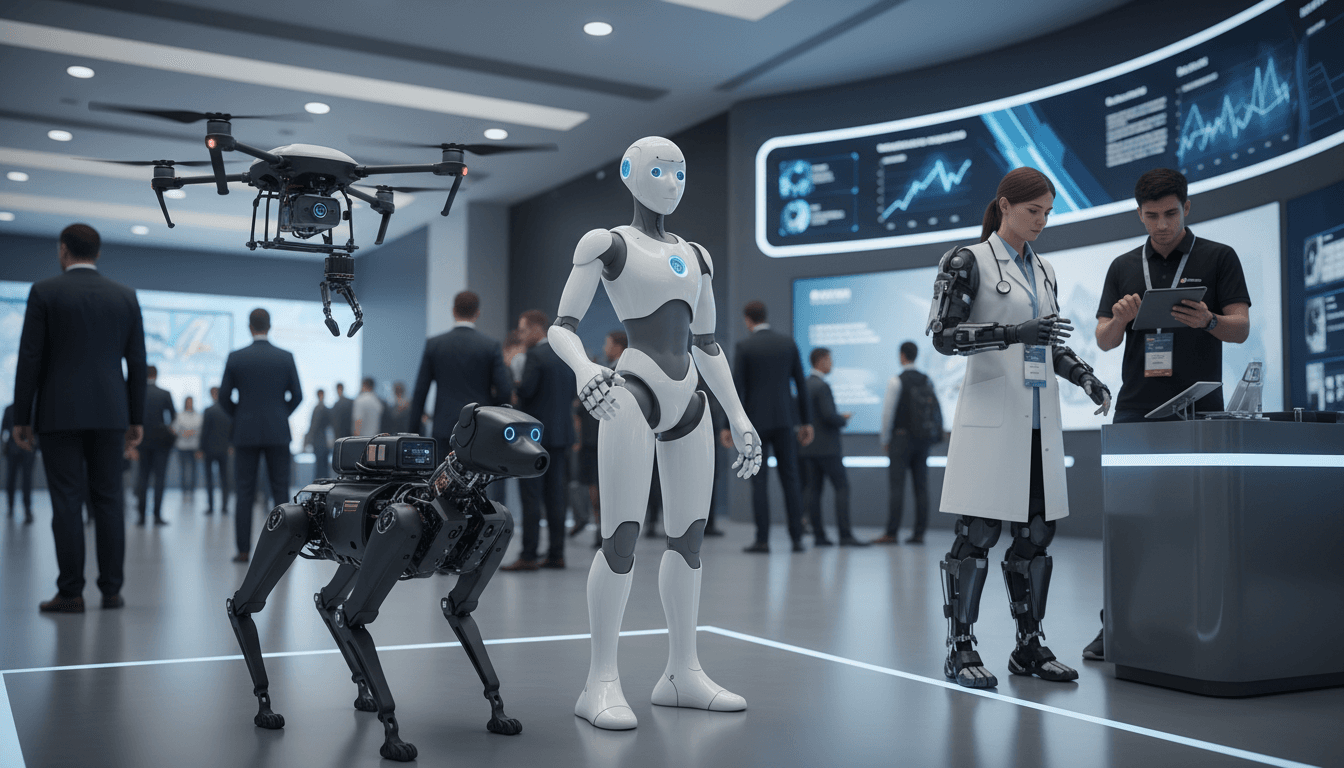
IROS 2025: AI Robotics Trends You Can Use in 2026
A lot of teams still treat robotics like an integration problem: pick a robot, bolt on sensors, write some code, then hope it behaves in the real world. IROS 2025 made something clear: that mental model is getting expensive. The next wave of value in robotics and automation is coming from systems that can adapt—to new environments, new tasks, and messy human workflows.
IROS 2025 (held 19–25 October in Hangzhou) wasn’t just “more papers and demos.” The program signaled where practical AI in robotics is heading next: humanoids and legged mobility leaving the lab, aerial manipulation that actually works in the wild, touch and proprioception becoming first-class data streams, and healthcare robots shifting from novelty to workflow tooling.
If you’re building or buying automation—especially in healthcare, logistics, field operations, and human augmentation—this is what you should take from the agenda. Not theory. Decisions.
The headline trend: robots are being built for open-world work
Answer first: IROS 2025’s program focuses on robots that can operate outside controlled environments, which means your automation roadmap should prioritize robustness, learning, and safety over brittle task scripts.
The plenaries alone show the arc:
- Real-world mobility is becoming normal, not exceptional (humanoids and quadrupeds moving from demos to deployments).
- Autonomous aerial manipulation is expanding robots from “inspection eyes” to “hands in the air.”
- Bridging physical robots and AGI-style agents is pushing robotics teams to rethink interfaces, memory, and task abstraction.
Here’s the practical shift: ROI in robotics is moving from “one cell, one task” to “one platform, many tasks.” The organizations that win in 2026–2027 will be the ones that invest early in:
- Data pipelines (teleop logs, near-miss events, contact/tactile data)
- Evaluation harnesses (repeatable real-world tests, not just sim success)
- Safety and explainability (because pilots expand only when risk is legible)
That theme shows up across keynotes in robot learning, mechanisms and controls, field robotics, and humanoid systems.
Humanoids and legged robots: the hype is real—but the bottleneck is operations
Answer first: Humanoids won’t replace “most human workers” soon, but they will replace specific high-variance tasks where mobility and reach matter—if you treat deployment like a product, not a demo.
The agenda’s humanoid and mobility emphasis (including the midweek debate on workforce replacement) reflects a market reality: companies are buying pilots, but most stall at scale.
What’s actually deployable in 2026
From what I’ve seen in real deployments, the “near-term win” tasks share three traits: repetitive intent, variable geometry, and human-adjacent constraints.
Examples that map well to humanoids/quadrupeds when integrated well:
- Logistics yards and warehouses: mixed terrain, stairs/ramps, frequent layout changes
- Facilities and infrastructure: inspection plus light manipulation (turning valves, opening panels)
- Manufacturing support roles: kitting, line-side delivery, and rework assistance
But here’s the stance: most companies get humanoid pilots wrong by starting with the robot. Start with the operating model.
A deployment checklist that avoids “pilot purgatory”
If you’re evaluating humanoid or legged platforms, ask for these before you ask for a demo:
- Uptime plan: parts availability, MTTR targets, swap modules, on-site vs remote support
- Recovery behaviors: what the robot does after a slip, drop, bad grasp, or partial failure
- Workcell boundaries: where it can’t go, what it can’t touch, and how it signals uncertainty
- Safety case: not just E-stop—procedures, training, logging, incident response
A line I keep coming back to: “If you can’t explain how the robot fails, you can’t scale it.”
Aerial manipulation is moving from ‘cool video’ to ‘useful tool’
Answer first: Autonomous aerial manipulation matters because it expands automation into places ground robots can’t reach, reducing downtime and human risk in inspections, repairs, and emergency response.
Aerial robots historically topped out at inspection and mapping. The IROS 2025 focus on physically intelligent robots in flight points to a bigger opportunity: maintenance and intervention.
Where it pays off fastest
- Energy and utilities: contact inspection, sensor placement, minor adjustments
- Industrial sites: remote “first touch” during shutdowns or alarms
- Disaster response: clearing light obstructions, delivering tools, situational setup
The real constraint: contact + uncertainty
The hard part isn’t flying. It’s controlled contact with unknown surfaces under wind, vibration, and partial observability. That’s why you’re seeing more attention on:
- Robust multi-agent reinforcement learning (for coordination and safety)
- Adaptive inference in transformers (to run perception/control under compute limits)
- Learning from demonstrations (because collecting “crash data” is a bad strategy)
If your organization is planning aerial robotics, the smartest move is to standardize the payload and interaction primitives—for example, a small set of end-effector tools and force/torque limits—so models can generalize.
Healthcare and human augmentation: AI is finally aligning with workflows
Answer first: The most valuable medical and assistive robots in 2026 will be the ones that reduce clinician workload and improve repeatability—not the ones that “look autonomous.”
IROS 2025’s heavy emphasis on rehabilitation, wearable robots, surgical robotics, and multimodal human–machine interaction matches what buyers are demanding: practical automation that fits clinical realities.
Why healthcare robotics adoption is accelerating
Healthcare systems are under pressure from staffing shortages, aging populations, and rising procedure volumes. Robots that can deliver measurable time savings and consistent outcomes have a clear path to procurement.
Concrete use cases that keep winning budget approvals:
- Rehab exoskeletons and wearable robots that personalize therapy intensity and track progress
- Surgical assistance that stabilizes, positions, or improves precision in constrained spaces
- Hospital logistics robots that move supplies and reduce nurse walking time
A useful rule: autonomy should be “bounded”
In clinics, fully autonomous behavior is often the wrong goal. What works is:
- Constraint-aware assistance: the robot does the safe, repeatable part
- Human-in-the-loop control: clinicians keep authority over exceptions
- Explainable decisions: why a recommendation changed, why a motion was rejected
If you’re selling into healthcare, bake this into your messaging: “We automate the repeatable steps, and we make exceptions easy.” That’s what decision-makers want.
Soft robotics, touch, and proprioception: the next data advantage
Answer first: The teams that master tactile sensing and soft robot proprioception will build automation that handles variability—fragile items, deformable materials, and human contact—without constant reprogramming.
Soft robotics isn’t just a materials story; it’s a data story. When robots can “feel” and infer state from compliant bodies, they can handle tasks that defeat rigid grippers.
Practical automation wins from soft + sensing
- E-commerce and 3PL handling: deformable packaging, mixed SKUs, variable placement
- Food and pharma: gentle handling, contamination-aware contact strategies
- Assistive devices: comfort, alignment, safe interaction forces
The IROS 2025 focus on digitizing touch, sensor design for soft proprioception, and even self-healing materials points to a near-term differentiator: reliability in contact-rich tasks.
A lot of automation fails in the same moment: first contact. Touch closes that gap.
What to do if you’re building a robotic application now
If you want a roadmap that’s realistic for 2026 deployments:
- Instrument contact early: add tactile/force sensing even if your first model doesn’t “use it well” yet.
- Log interaction episodes: not just success/failure—include slip events, near-misses, and recoveries.
- Train policies with recovery, not perfection: the best robot isn’t the one that never fails; it’s the one that fails safely and recovers quickly.
This is where AI in robotics stops being a buzzword and becomes a compounding advantage.
AI robot learning is growing up: safety, transparency, and compute matter
Answer first: The direction of AI in robotics is clear: models must be safe, interpretable when needed, and efficient enough to run on real hardware with tight latency.
Robot learning sessions at IROS 2025 put emphasis on:
- Uncertainty-aware decision making (because real environments don’t label edge cases for you)
- Explainable and interpretable methods (because operators and regulators demand it)
- Adaptive inference (because your robot can’t wait 300 ms for a big model)
“Open world” is the default now
Field robotics keynotes highlighted the challenge many teams underestimate: distribution shift. The warehouse changes. The crop field changes. Lighting changes. Humans behave differently each shift.
So if you’re planning an AI-powered automation project, set success criteria that reflect reality:
- Performance under novel conditions, not just validation sets
- Latency under load (peak hours, worst lighting, busy wireless)
- Safe degradation modes (what happens when confidence drops)
A snippet-worthy truth: A robot that asks for help at the right time is more autonomous than one that guesses.
What to watch next—and how to turn conference signals into leads
Answer first: Use IROS 2025 themes to sharpen your 2026 automation plan: pick one “platform bet,” one “data bet,” and one “safety bet,” then run a 90-day pilot designed for scale.
If your goal is business impact (and not just technical novelty), anchor on three bets:
- Platform bet: humanoid/legged mobility, aerial manipulation, or mobile manipulation—choose the one aligned to your environment.
- Data bet: tactile/contact logs, teleop demonstrations, or multi-agent coordination data—choose what will compound.
- Safety bet: explainability, formal constraints, or operational procedures—choose what will satisfy internal risk owners.
A 90-day pilot plan that doesn’t waste time
- Weeks 1–2: define success metrics in operational terms (throughput, error rate, downtime, staff time saved)
- Weeks 3–6: deploy in a bounded area with strong logging and human override
- Weeks 7–10: expand variability (more SKUs, more routes, more human interaction)
- Weeks 11–13: document failure modes, recovery times, and training requirements
If you can produce a one-page “failure and recovery report” after 90 days, you’re ahead of most teams.
Robotics leaders don’t need more inspiration. They need fewer surprises.
The question worth ending on is simple: Where in your operation would a robot that can adapt—rather than just repeat—create the first compounding advantage in 2026?