iRobot’s bankruptcy is a warning for AI robotics. Learn what it reveals about consumer hardware, industrial automation, and sustainable robotics business models.
iRobot’s Bankruptcy: What Robotics Leaders Must Learn
iRobot didn’t lose because people stopped wanting robot vacuums. It lost because consumer robotics is a brutal place to fund long-horizon AI—and the rules have only gotten harsher in 2025.
After iRobot filed for bankruptcy on December 16, 2025, cofounder and former CEO Colin Angle said the outcome didn’t surprise him. In his view, the failed Amazon acquisition wasn’t just a missed exit—it was the moment the company’s ability to compete became structurally constrained. Whether you agree with his take on regulators or not, the underlying business lesson lands hard: if your robotics company depends on low-margin consumer hardware to bankroll advanced autonomy, you’re fighting uphill.
This post is part of our AI in Robotics & Automation series, where we focus on what actually scales in real deployments. iRobot’s story is a cautionary tale—but also a roadmap for what to do differently if you’re building AI-driven robotics for manufacturing, logistics, and industrial automation.
Why iRobot’s fall matters beyond robot vacuums
iRobot’s bankruptcy isn’t “just” a consumer electronics story. It’s a stress test of the modern robotics business model.
For years, Roomba was the rare robotics success: a real robot, in real homes, at real scale. But scale alone doesn’t guarantee durable advantage—especially when:
- Hardware becomes commoditized (fast)
- Distribution channels favor price competition (always)
- AI capability becomes the differentiator (and AI is expensive)
Angle pointed out that by the early 2020s iRobot no longer dominated, citing Europe at ~12% market share and declining. At the same time, Chinese robotics companies—often supported by policy, financing, and manufacturing ecosystems—could invest 2–3x more in R&D than iRobot.
This matters because robotics is one of the most capital-intensive ways to “do AI.” You’re not just training models; you’re paying for sensors, actuators, safety testing, field failures, returns, firmware maintenance, and supply chain volatility.
Consumer markets rarely reward that cost structure. Industrial markets often do.
The hard truth: consumer robotics punishes “good enough” AI
Robot vacuums look simple until you try to make them reliably autonomous in messy homes. The product has to handle:
- dynamic obstacles (kids, pets, cords)
- variable lighting and reflective surfaces
- maps that go stale as furniture moves
- user expectations that feel closer to appliances than software
The problem is that consumers don’t pay proportionally for better autonomy. A vacuum that’s 80% good is “fine,” and many buyers will happily choose the cheaper one.
That creates a trap:
The consumer robotics trap
- Your costs rise as you chase better perception, navigation, and edge AI.
- Your pricing power falls as competitors flood the market with similar-looking hardware.
- Your differentiation compresses because improvements are hard to explain on a retail shelf.
This is why so many consumer robotics companies end up stuck between “appliance economics” and “deep tech burn rates.” iRobot lived that tension for years.
The Amazon deal collapse: the strategic oxygen got cut off
Angle’s argument is blunt: once Amazon’s $1.7B acquisition was blocked, iRobot couldn’t fund the next phase of competition. The company laid off roughly a third of staff, paused R&D, and entered a long glide path.
Here’s the point worth extracting if you’re running a robotics company:
Robotics strategy can’t rely on a single liquidity event to finance core innovation.
Maybe you’re not planning to be acquired. Fine. The same principle applies.
If your long-term autonomy roadmap requires a capital infusion at a specific moment—and you don’t control that moment—your technical plan is fragile.
This is where industrial and logistics robotics look different. Many industrial buyers don’t just purchase a robot; they purchase:
- uptime guarantees
- integration
- fleet monitoring
- service contracts
- workflow outcomes (throughput, pick rate, defect reduction)
Those revenue structures can support sustained AI development without betting the company on an exit timeline.
The bigger shift: where AI robotics value is actually compounding
The strongest AI economics in robotics show up when learning compounds across repeated tasks.
Why manufacturing and logistics are better AI businesses
In industrial automation, you can often standardize:
- environments (lighting, lanes, racks, line layout)
- workflows (pick, place, palletize, inspect)
- success metrics (cycle time, error rate, OEE)
That means your models improve faster, failures are easier to reproduce, and deployment patterns repeat. You get fleet learning that actually matters.
A practical way to think about it:
- A robot vacuum encounters an almost infinite variety of “one-off” home conditions.
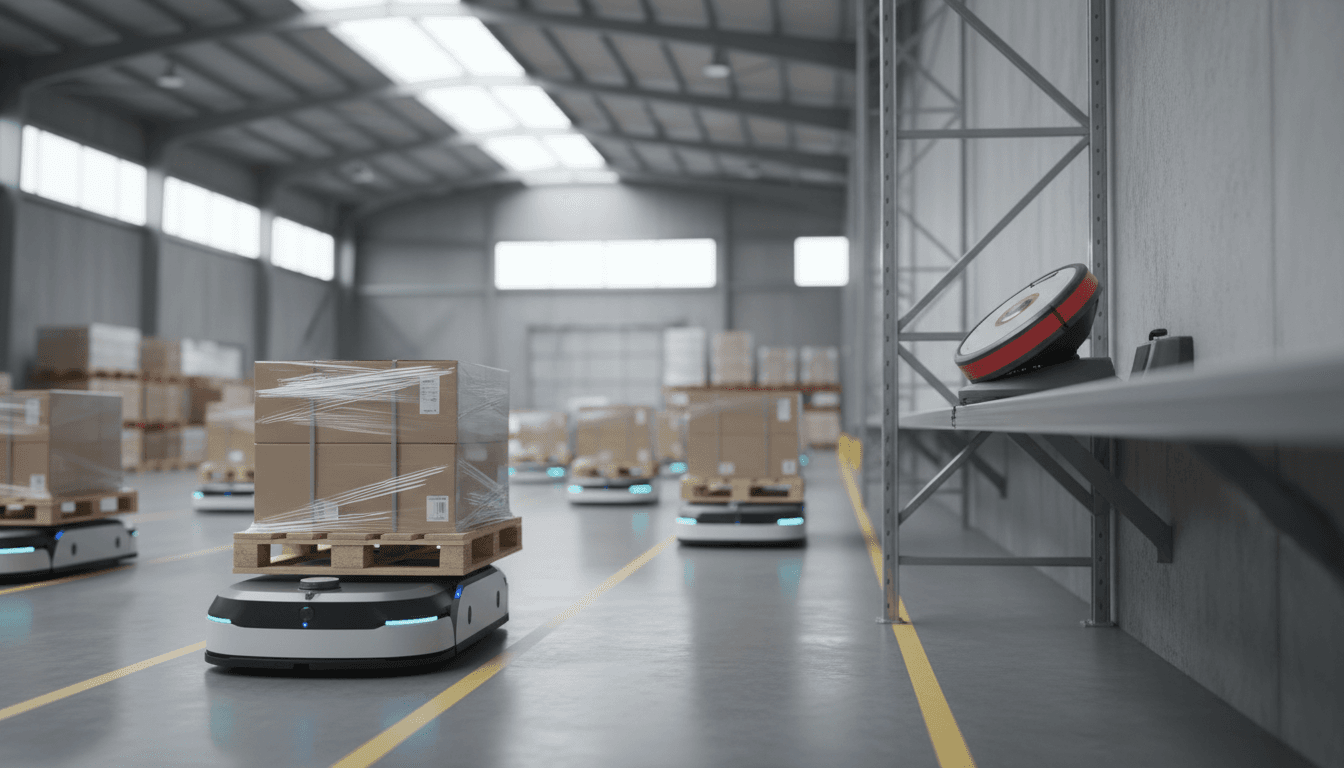
- A warehouse AMR or a palletizing cell sees the same categories of conditions thousands of times per week.
If you want AI to pay off, you want repetition.
Embodied AI needs a business model, not just a demo
Embodied AI is getting better quickly, but the winning companies are aligning it to operational ROI. In logistics and manufacturing, you can tie autonomy to:
- labor reduction in specific lanes
- reduced rework and scrap
- higher throughput without expanding footprint
- safer handling of heavy, hot, or hazardous goods
Those are outcomes that procurement can justify and renew.
The uncomfortable data lesson: ownership, privacy, and trust
iRobot’s bankruptcy also creates a consumer-facing reminder that robot data is business leverage.
Angle noted iRobot invested heavily in privacy and security during his tenure, but after the asset handover to its manufacturing partner, priorities may change. For robotics leaders—especially in industrial settings—the takeaway is clear:
Data governance is part of product design, not a legal afterthought.
In factories and warehouses, the data is even more sensitive:
- facility layouts and material flows
- production rates
- inventory movement
- worker safety telemetry
- quality inspection images
If customers think you’ll mishandle it—or they can’t control it—your sales cycle slows down or stops.
What to do differently (especially for automation vendors)
- Make data retention and deletion policies explicit in contracts.
- Offer on-prem or customer-controlled storage for sensitive telemetry.
- Separate “necessary for operations” data from “nice for product improvement” data.
- Build a credible security story: patch cadence, vulnerability disclosure, device identity, encryption.
Trust is a moat. You can’t bolt it on later.
What robotics founders and product leaders should do next
iRobot’s story is a warning, but it’s also a checklist for building something more durable.
1) Stop treating hardware as the business
Hardware is the entry ticket. The business is the system around it:
- commissioning
- integration
- workflow design
- uptime and service
- continuous improvement via software
If your margins depend on one-time hardware sales, you’re exposed.
2) Pick markets where AI performance is paid for
If the buyer can’t quantify the value of better autonomy, you’ll struggle to fund it.
Industrial robotics, warehouse automation, and inspection are better aligned because improvements translate into measurable outcomes: seconds saved, defects prevented, incidents avoided.
3) Design for fleet operations from day one
In 2025, “we’ll add fleet management later” is a costly mistake.
Build for:
- remote monitoring and diagnostics
- staged rollouts and feature flags
- safe over-the-air updates
- reproducible incident replay
- clear KPIs per site and per robot
This is where AI in robotics becomes operationally real.
4) Don’t confuse R&D spend with innovation speed
Angle’s point about competitors investing 2–3x more matters, but spending alone doesn’t win.
Speed comes from:
- shipping into repeatable environments
- closing the loop between failures and training data
- strong simulation-to-reality workflows
- disciplined product constraints
I’ve found that teams “win” faster when they deliberately narrow the operating envelope, dominate it, then expand. Broad promises early often turn into endless edge cases.
The lesson I don’t want the industry to miss
iRobot proved that consumer robots can reach massive adoption. The tragedy is that massive adoption didn’t translate into a sustainable innovation engine once the market commoditized and capital got tight.
For the AI in Robotics & Automation space, the forward path is clearer than it was a decade ago: build where automation budgets exist, where AI improvements compound, and where value is measured in operational outcomes—not shelf appeal.
If you’re evaluating where to place your next robotics bet—product, partnership, or platform—ask yourself: are you building an appliance, or are you building an automation system that can keep learning, keep improving, and keep getting renewed?