Hybrid manufacturing plus AI orchestration builds agile defense factories that surge, adapt, and reduce supply chain risk. Learn the playbook for 2025 readiness.
Agile Defense Factories: Hybrid Manufacturing + AI
A single factory line that can’t flex is a national security liability. That’s not theory—it's what you see when demand spikes, parts go long-lead, and a program discovers (too late) that one “miracle process” can’t carry production at scale.
Hybrid manufacturing—the practice of combining additive manufacturing, machining, forming, welding, casting, inspection, and automation into one coordinated system—is the grown-up answer to the last decade of 3D-printing hype. The real story in 2025 isn’t “print everything.” It’s build an agile factory that can switch products fast, scale output, and survive disruptions.
This post sits in our AI in Robotics & Automation series for a reason: the hardware matters, but AI-driven orchestration is what turns a mixed set of machines into a weapon-system-ready production engine.
Hybrid manufacturing is a defense readiness strategy, not a process trend
Hybrid manufacturing is how you get high mix and high volume without betting the mission on a single method. In defense terms, it’s the factory equivalent of combined arms: each capability covers the others’ weaknesses.
Additive manufacturing is still valuable—especially for complex internal geometries, rapid prototyping, and low-volume spares. But the moment you try to make additive the whole plan, you run into familiar constraints: machine time, material qualification, post-processing, inspection throughput, and workforce bottlenecks.
Hybrid manufacturing fixes the strategic problem: it spreads production across multiple pathways.
- If printing capacity is saturated, machining and forming can absorb load.
- If a casting supplier slips, additive can bridge early production or create tooling inserts.
- If one line is disrupted, the product can be re-routed through alternate value streams.
Here’s the stance I think defense leaders should take: a factory that can’t reconfigure is as risky as a supply chain with only one supplier.
What an “agile factory” actually looks like
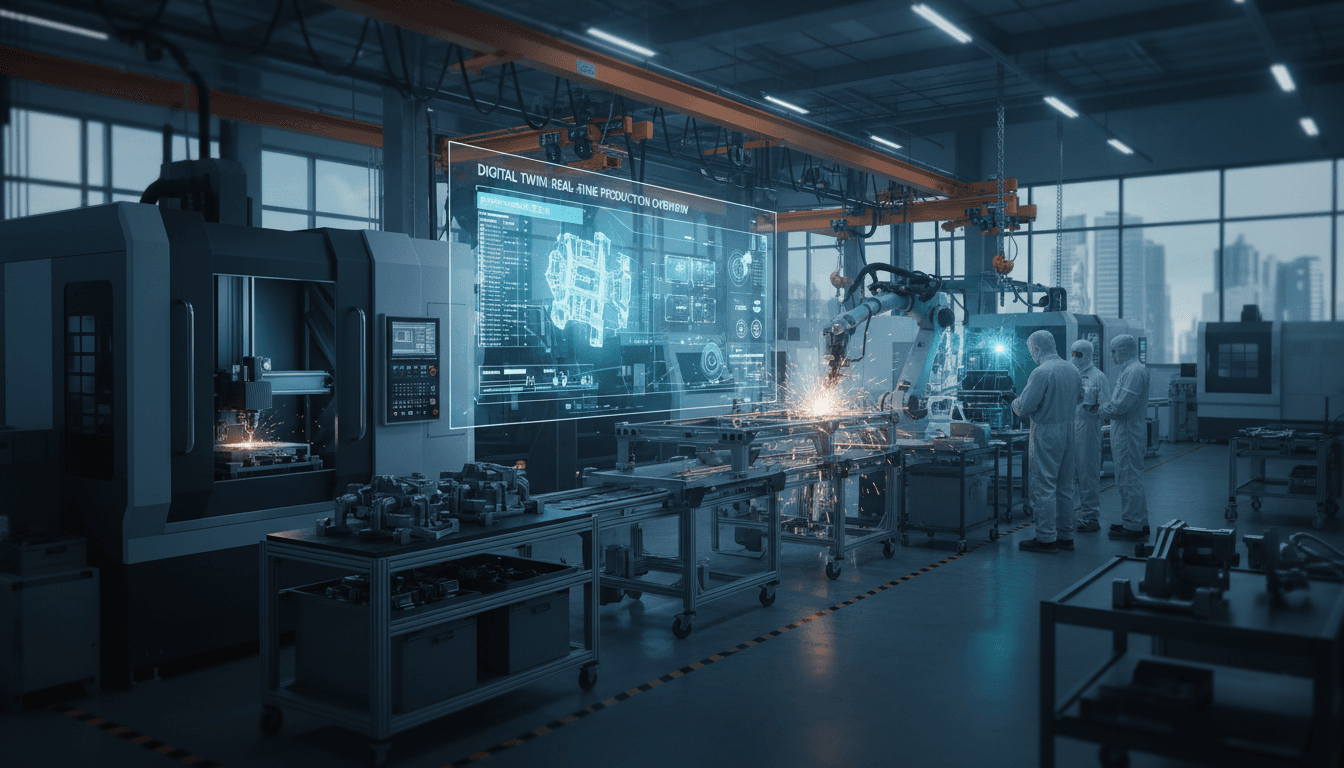
An agile factory isn’t just “we have robots.” It’s a coordinated environment where:
- Additive produces the geometry only additive is good at (internal channels, lattice structures, conformal cooling, weight reduction)
- High-speed machining handles precision surfaces and interfaces
- Robotic welding and automated joining build repeatable structures fast
- Sheet forming and incremental forming produce large skins and enclosures with fewer dedicated dies
- Automated inspection (vision systems, scanning, in-process metrology) keeps quality from becoming the bottleneck
The difference-maker is integration—a digital thread that routes work, manages configurations, and ties design intent to production reality.
AI is the hidden engine of agile manufacturing
Agile factories don’t work because someone “decides to be agile.” They work because software coordinates the chaos.
In defense production, variability is constant: engineering changes, supplier substitutions, lot-to-lot material variation, shifting priorities, and the occasional urgent operational need. AI helps by turning the factory into a decision system instead of a static pipeline.
AI-driven orchestration: the scheduling problem that actually matters
Most manufacturers already schedule work. The defense challenge is that schedules break—often daily.
AI-enabled scheduling and orchestration platforms can continuously optimize:
- Machine assignment (print vs machine vs form)
- Queue prioritization (urgent orders vs planned builds)
- Tooling availability and changeover minimization
- Workforce constraints (certified welders, metrology techs, programmers)
- Inspection capacity (the common hidden limiter)
A practical definition you can quote: AI in hybrid manufacturing is the system that decides “what gets built where, when, and with which constraints,” then adapts when reality changes.
AI quality control reduces rework and speeds certification
Defense manufacturing lives and dies on quality evidence. The faster you can detect deviation, the less you scrap—and the easier it is to defend airworthiness or mission-assurance decisions.
In hybrid lines, AI can support:
- In-process anomaly detection (melt pool monitoring, spindle vibration, weld bead analysis)
- Automated visual inspection for surface defects and assembly verification
- Predictive maintenance that prevents drift and out-of-tolerance runs
- Statistical process control that flags when “normal variation” becomes risk
This matters because hybrid manufacturing adds handoffs (print → machine → heat treat → inspect → assemble). AI reduces the probability that a defect hides in the seams between steps.
Why “print everything” fails—and what hybrid does better
Betting on additive alone creates three failure modes that show up in defense programs.
1) Throughput collapses when demand spikes
3D printers are expensive, and build time is unforgiving. When you need surge capacity, you can’t magically compress physics.
Hybrid manufacturing creates parallelism:
- Print the complex core while machining the outer housing
- Form brackets while additive produces specialized inserts
- Run inspection and finishing in parallel instead of as a single downstream gate
The operational result is simple: you start producing sooner, then scale using conventional processes when volume demands it.
2) Cost overruns hide inside “one-process purity”
Printing an entire component because you can is rarely cost-optimal. The smarter pattern is additive where it creates unique value, and conventional methods where they’re cheaper and faster.
A common hybrid tactic:
- Additive produces an internal flow path or conformal feature set
- Conventional manufacturing produces the external structure and critical interfaces
- Assembly integrates both into a final part that meets performance and cost targets
This isn’t a compromise. It’s disciplined engineering.
3) Single points of failure multiply risk
Defense acquisition already emphasizes diversification at the supplier and system level. Factories should follow the same logic.
A hybrid line reduces risk by ensuring that no single machine type is the only path to delivery. That’s resilience you can quantify in program planning: more alternate routings, more substitute processes, fewer “line down equals mission down” scenarios.
The national security payoff: resilient supply chains and faster fielding
Agile, hybrid factories map directly to defense priorities: readiness, sustainment, surge, and deterrence.
Supply chain vulnerability is now a design constraint
In 2025, programs can’t treat supply chain as an afterthought. Long lead items, fragile sub-tiers, and geopolitical risk show up as schedule slips and operational gaps.
Hybrid manufacturing helps because it supports:
- Alternate sourcing strategies (different processes, different suppliers)
- Localization of critical production for sensitive parts
- Faster substitution when a material or supplier becomes unavailable
The key connection to AI: AI-driven supply chain management becomes far more powerful when the factory itself has multiple feasible production pathways. Data only helps if you have options.
Agile factories support autonomous systems and cyber infrastructure
Defense modernization is pushing hard on autonomy, sensing, and secure networks. Those systems need:
- Rapid iteration cycles (prototype → test → revise)
- Short refresh windows for electronics enclosures, mounts, and thermal hardware
- Sustainment capacity for fielded fleets
Hybrid manufacturing is a natural fit, especially when robotics and automation handle repeatable operations while engineers focus on design changes and qualification.
A blunt observation: autonomous systems are only as available as the factories that repair them.
How to implement hybrid manufacturing in defense programs (a practical playbook)
Hybrid manufacturing succeeds when it’s planned as a system. Here’s what works in practice.
Step 1: Identify “hybrid-eligible” parts using a simple filter
Start with parts that hit at least two of these conditions:
- Complex internal geometry or weight constraints (good additive candidate)
- Tight interface tolerances (good machining candidate)
- High joining content (good robotic welding candidate)
- Demand uncertainty (needs flexible scaling)
- Supply chain fragility (needs alternate routings)
This avoids wasting time trying to hybridize everything.
Step 2: Build the digital thread before you scale machines
Most teams buy equipment first and integrate later. That’s backwards.
Prioritize:
- Configuration control from CAD to build files to inspection plans
- Traceability for materials, machine parameters, and operators
- A manufacturing execution system that can route work dynamically
- Data pipelines that make quality evidence easy to retrieve
If your quality data is trapped in PDFs and tribal knowledge, your “agile factory” will slow down the moment a certifying authority asks questions.
Step 3: Treat inspection as a first-class production constraint
Inspection is where good intentions go to die.
Plan capacity for:
- Non-destructive evaluation
- Automated scanning and metrology
- In-process inspection that reduces end-of-line surprises
A useful rule of thumb: if you double production tools without doubling inspection throughput, you didn’t double production.
Step 4: Train for hybrid roles, not single-process jobs
Defense already invests in welders, machinists, and additive technicians. Agile factories need something slightly different: cross-functional teams that understand handoffs.
Examples of hybrid-ready roles:
- Manufacturing engineers who can choose between additive vs machining vs forming based on cost and schedule
- Quality engineers who can correlate in-process signals across machines
- Robot programmers who understand fixturing, metrology, and changeovers
The workforce strategy should match the technology strategy: diversified, resilient, and adaptable.
What leaders should measure: four metrics that predict readiness
Hybrid manufacturing isn’t a slogan; it’s measurable. Track these four metrics at the program and factory level:
- Quality yield: first-pass yield across the full hybrid route, not just each cell
- Unit cost at rate: cost curve as volume increases (does hybrid enable cheaper scaling?)
- Throughput time: order-to-ship, including inspection and post-processing
- Routing resilience: number of viable alternate pathways for critical parts
Snippet-worthy truth: A resilient factory is one where losing a machine slows output—not stops it.
Where this fits in AI in Robotics & Automation
Robotics and automation are doing more than reducing labor. In defense production, they’re enabling repeatable, auditable operations—the kind that support certification, sustainment, and rapid configuration changes.
AI sits on top of that robotic base layer and answers the bigger question: how do we keep producing when priorities shift, parts change, or suppliers fail?
If you’re building an “AI factory” roadmap for defense, hybrid manufacturing is the most pragmatic place to start because it forces integration: design, production, quality, and logistics must finally talk to each other.
Next steps: turn hybrid manufacturing into a readiness advantage
Hybrid manufacturing is becoming a national security imperative because it converts industrial capacity into operational flexibility. The countries that can adapt production fastest will field capability faster, sustain it longer, and absorb shocks better.
If you’re responsible for modernization, sustainment, or advanced manufacturing strategy, your next step is straightforward: pick a small set of high-impact parts, build a hybrid route, wire up the data, and prove throughput with quality evidence. Then scale.
What would change in your program if you could surge output in weeks by rerouting work across additive, machining, forming, and robotic joining—without rewriting the whole production plan?