Humanoid robots for household chores are entering home alpha tests in 2025. Here’s what it means for AI robotics—and for service automation ROI.
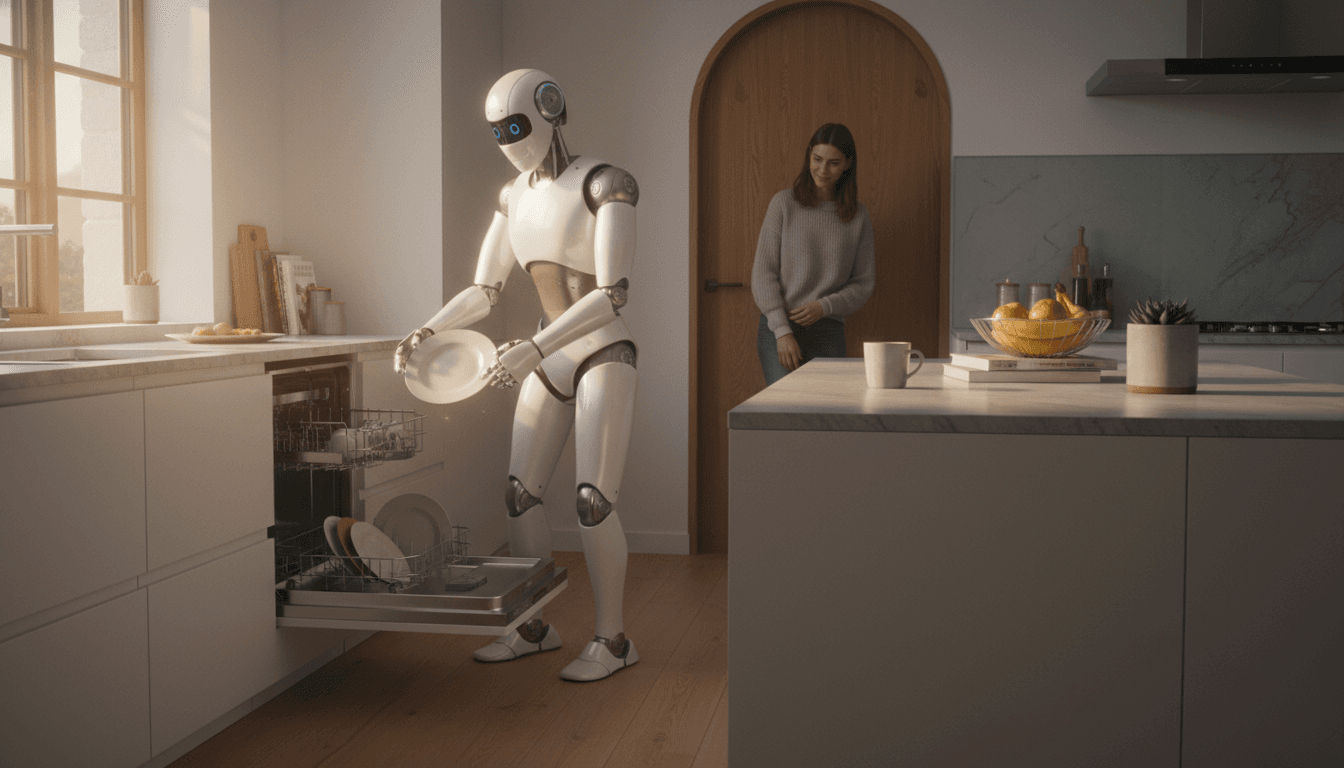
Humanoid Robots for Household Chores: 2025 Reality
A home humanoid robot that actually does chores has been the punchline for decades. Yet in 2025, that joke is getting less funny—fast.
Figure’s CEO Brett Adcock says the company plans to begin alpha testing humanoid robots in homes sometime in 2025, which is reportedly two years ahead of their earlier timeline. Even with just that short RSS summary, the signal is clear: the pace of AI-powered robotics isn’t gradual anymore. It’s compressed.
For anyone building or buying automation—whether you’re in service operations, healthcare, logistics, or robotics product development—this matters because the home is the hardest “factory” on Earth. If a humanoid can handle unpredictable kitchens, cluttered bedrooms, and human expectations, the same AI and hardware stack can scale into industries that have been waiting for flexible automation.
Why home alpha tests are a bigger deal than they sound
Home alpha testing is a stress test for AI robotics, not a marketing stunt. A household isn’t a controlled environment, and that’s exactly why it’s valuable.
Factories and warehouses are structured: clear aisles, standardized bins, consistent lighting, predictable tasks. Homes are the opposite. The reality is messy: toys on the floor, glossy countertops, pets moving through the scene, objects that vary wildly in shape and fragility, and humans who change their mind mid-task.
If Figure is pushing into domestic alpha testing in 2025, they’re betting their humanoid robots can do three hard things at once:
- Perceive: recognize objects in clutter and understand scene context.
- Plan: break a vague goal (“clean the kitchen”) into safe, executable steps.
- Act: manipulate a wide range of objects with enough precision not to break things.
That combination—perception + planning + manipulation—is the core of AI in robotics & automation. It’s also the bottleneck that has kept general-purpose robots stuck in demos.
The home is the ultimate “unstructured environment” benchmark
Humanoid robots for household chores can’t rely on perfect setups. They need competence across:
- Variable object geometry (plastic bags, cutlery, towels, chargers)
- Occlusions (items behind others, under chairs, inside cabinets)
- Human safety (moving around people, understanding personal space)
- Task switching (pause mopping to open a door; resume without getting lost)
- Common-sense constraints (don’t place wet dishes in a drawer; don’t mix chemicals)
A credible home alpha program suggests the AI stack is moving from “single-skill robot” toward “multi-skill generalist robot.” That’s the direction the market has been waiting for.
What’s actually enabling humanoid robots to do chores in 2025
The enabling factor isn’t one breakthrough part. It’s the combination of robotics hardware and robotics AI finally maturing together.
Here’s what’s doing the heavy lifting behind the scenes.
Robotics AI is shifting from scripts to policies
Traditional robot deployments often depend on brittle logic: if-this-then-that rules, pre-mapped spaces, carefully positioned objects. That approach breaks down immediately in a home.
The newer approach uses learned control policies that generalize across variation. Practically, that means:
- Vision models identify objects and surfaces even when lighting and clutter change.
- Task planners convert natural goals into sequences of actions.
- Control systems adjust grip, force, and motion on the fly.
A useful way to phrase it:
A chore-capable humanoid isn’t “programmed to clean.” It’s trained to handle the physical world.
The real milestone: reliable manipulation, not walking
People fixate on bipedal walking because it’s dramatic. For household chores, hands matter more than legs.
Chores are manipulation-heavy: picking up laundry, opening cabinets, loading dishwashers, wiping surfaces, moving items without knocking others over. So the meaningful milestone is repeatable, safe dexterity—especially for objects that deform (cloth) or vary (random packaging).
If Figure is serious about home alpha testing, watch for progress indicators like:
- Picking and placing fragile items (glassware) without slips
- Folding or handling towels without tangling
- Opening doors/drawers across different handles
- Carrying items while navigating tight spaces
The “data flywheel” advantage is real—and uncomfortable
Home robots generate messy, high-value data: long-horizon tasks, diverse objects, varied failure modes. That’s precisely the dataset you need to build robust household automation.
But it also creates a dividing line between companies that can:
- collect real-world interaction data at scale
- learn from it quickly
- ship model updates safely
…and those that can’t. If Figure reaches domestic alpha testing broadly, their lead could compound.
What household chores teach us about service automation
A home humanoid robot is a service worker in miniature. The same capabilities translate directly into service industries where tasks are physical, varied, and labor-constrained.
Healthcare: assisting, not replacing
The near-term value in healthcare isn’t “robot nurses.” It’s targeted support for repetitive, time-consuming tasks that burn out staff.
Examples of humanoid-appropriate tasks (once safety and reliability are proven):
- Restocking supplies room-to-room
- Transporting linens and meals
- Fetch-and-carry assistance for non-clinical items
- Cleaning and prep tasks in controlled zones
The home is a proving ground for human-robot interaction: navigating around people, responding to interruptions, and operating safely in shared spaces. That’s exactly the social and safety bar healthcare requires.
Logistics and warehouses: the bridge to flexible picking
Warehouses already automate conveyance well; the pain point is still manipulation—especially in edge cases.
A humanoid trained for household chores is trained for:
- irregular objects
- mixed bins
- partial occlusions
- varied grasp points
That maps cleanly onto piece picking, returns processing, kitting, and small-batch fulfillment.
Hospitality and facilities: the obvious fit
Hotels, senior living, and large facilities are basically “scaled households” with clearer SOPs.
Humanoid robots for household chores could evolve into:
- room reset support (trash removal, towel replenishment)
- after-hours floor and surface cleaning with fewer handoffs
- supply runs between storage areas and work zones
And unlike many automation projects, the ROI story is often immediate: staffing shortages, high turnover, and lots of repeatable tasks.
The hard truths: why most home robots will still disappoint
A 2025 alpha test doesn’t mean a 2025 mass-market product. Alpha is where the problems show up—loudly.
Here’s what I expect to separate “cool demo” from “useful worker” for domestic humanoid robots.
Reliability targets are brutal in the home
A robot vacuum can fail gracefully; a humanoid carrying a glass can’t.
For household chores, acceptable performance looks like:
- Low error rates over long sequences (dozens to hundreds of steps)
- Recovery behaviors (detect a slip, regrasp, try a different approach)
- Human-readable intent (you should understand what it’s about to do)
If you’re evaluating vendors, ask about mean time between interventions—how often a human has to step in. That metric matters more than a highlight reel.
Safety and trust are product features, not compliance checkboxes
Domestic environments include kids, pets, and unpredictable movement. Safe behavior isn’t just collision avoidance.
A trustworthy home humanoid needs:
- speed and force limits that adapt by context
- conservative behavior around faces/hands
- fail-safe stopping and “freeze” modes
- clear ways for humans to override and redirect
The companies that treat safety as a UX problem—not just a legal one—will win adoption.
Cost will be the gating factor for mainstream households
Even if the technology works, price determines the market. For many homes, a humanoid has to compete with a mix of:
- low-cost appliances
- occasional cleaning services
- human time (the default option)
The earliest viable market may not be everyday consumers. It may be premium pilots, assisted living, and facility operations where labor savings are easiest to quantify.
If you’re building an automation roadmap, here’s what to do next
If Figure (and others) truly bring humanoid robots into home alpha testing in 2025, you don’t need to “wait and see.” You need a plan. This is the phase where smart teams get ahead.
1) Identify “humanoid-shaped” tasks in your operation
Humanoids aren’t for high-speed, ultra-repetitive work—that’s what fixed automation is for. Humanoids shine when tasks are:
- physically varied (different objects each time)
- in spaces designed for humans
- interrupted frequently
- hard to standardize
Write down 10 tasks that fit those criteria. That list becomes your pilot shortlist.
2) Define success with operational metrics, not demos
Before any pilot, pick 3–5 metrics you’ll track. Examples:
- interventions per hour
- task completion time distribution (median + worst-case)
- incident rate (near misses count)
- uptime and maintenance time
- training time to add a new task
These numbers force clarity. They also make it easier to justify expansion—or to kill the pilot quickly.
3) Prepare your environment like you would for a human
The best robot deployments often start with small environment changes:
- consistent storage locations
- clearer labeling
- reducing clutter in high-traffic areas
- standardizing a few “robot-friendly” tools (bins, caddies, handles)
It’s not glamorous, but it’s effective. And it improves human efficiency too.
4) Treat data governance as a first-class requirement
Domestic robots raise the stakes on privacy and security. In business settings, that becomes:
- policies on video/audio retention
- on-device vs cloud processing choices
- access controls for logs and teleoperation
- incident response plans for physical systems
If you’re pursuing service automation, get legal, IT, and operations aligned early.
Where this fits in the AI in Robotics & Automation series
This series is about a simple idea: AI makes robots adaptable, and adaptability is what turns automation from a one-off system into a scalable capability.
Humanoid robots for household chores are a public-facing milestone because everyone understands the benchmark. If a robot can tidy a chaotic kitchen, it can probably handle a lot of “unstructured” work in healthcare, logistics, and facilities.
Figure’s 2025 home alpha testing plan is a reminder that timelines are compressing. If you’re responsible for automation strategy, the right response isn’t hype—or dismissal. It’s preparation: pick the right tasks, define metrics, and design pilots that produce real operational learning.
The next question is the one that will decide who benefits first: when a general-purpose robot becomes “good enough,” which industry has the clearest path from pilot to scale?