Neo Gamma hints at a near-term future of humanoid service robots. Learn what matters for ROI, safety, and deploying AI automation beyond factories.
Humanoid Home Robots: What Neo Gamma Signals for 2026
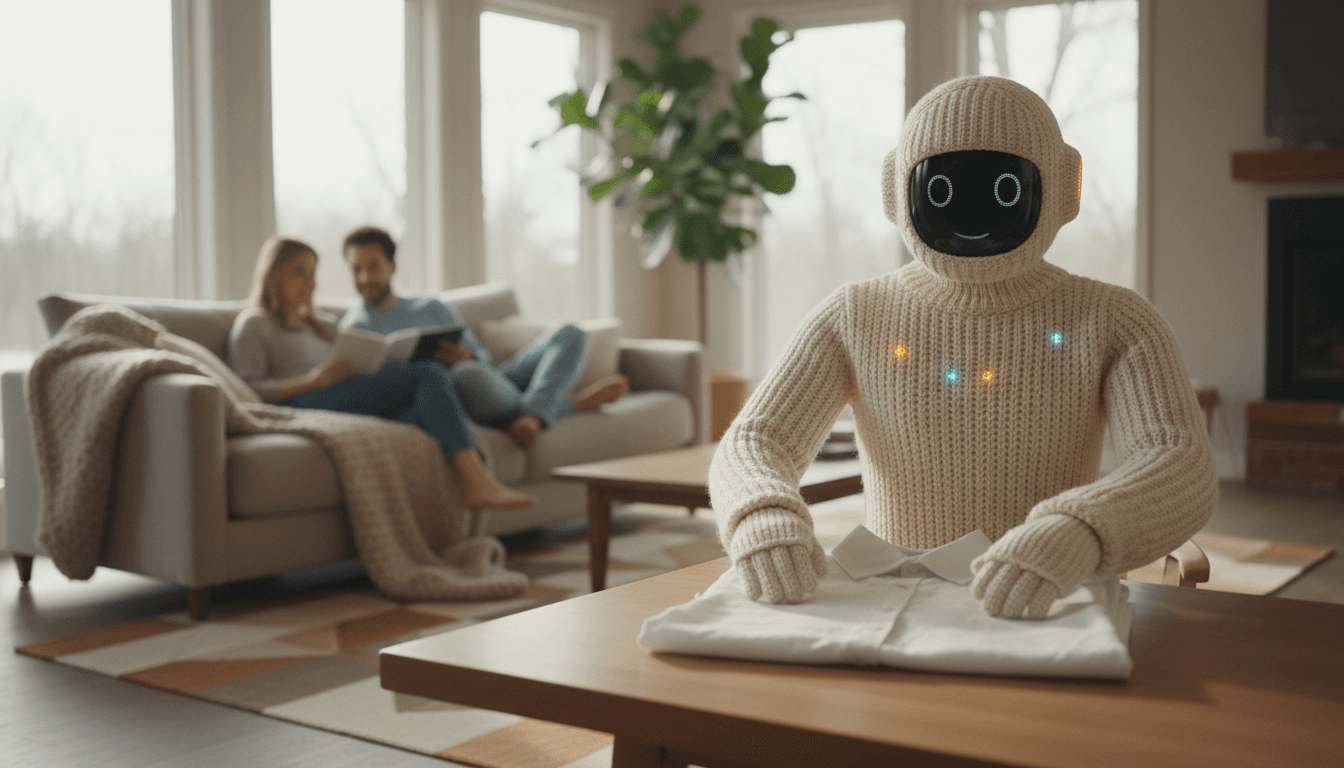
A 37‑second promo video shouldn’t be able to stir up serious business questions. But 1X’s Neo Gamma does exactly that—partly because it folds laundry and serves coffee, and partly because it looks like it wants you to notice.
Most people watching the clip fixate on the “sad helper” vibe. I think that’s a distraction. The bigger story is that humanoid robots are finally being packaged as service automation, not science fair projects. If you work in robotics, facilities, healthcare, hospitality, or any service operation with chronic labor gaps, Neo Gamma is a clear signal: the interface is changing from apps and kiosks to embodied AI.
This post is part of our AI in Robotics & Automation series, where we track how AI is pushing robots out of fenced-off industrial cells and into messy, human spaces. Neo Gamma is a case study in what matters next: reliability, safety, data, human trust, and the economics of “a full-time AI employee.”
Neo Gamma isn’t a gadget—it's service automation in a new place
Neo Gamma matters because it reframes domestic chores as a service workflow—and that same workflow logic transfers directly to hospitality and care settings. Think of “home chores” as micro-fulfillment tasks: pick up items, move them safely, handle fragile objects, navigate unpredictability, and interact naturally with people.
In the video and supporting materials, Neo Gamma is positioned to:
- Prepare and serve (coffee service is basically a hospitality demo)
- Clean and tidy (housekeeping fundamentals)
- Handle laundry (sorting, loading, transferring—highly repeatable)
- Act as a voice companion (LLM-based interaction)
If you strip away the cozy earth tones, what you’re seeing is a general-purpose service robot being trained for the hardest environment possible: a real home.
The real leap: robots moving from “controlled spaces” to “lived-in spaces”
Factories succeed with robots because the environment is engineered for automation. Homes are the opposite. Objects vary. Floors aren’t consistent. People and pets change the plan constantly.
So when a humanoid robot is being pushed toward domestic use, it’s not only about consumer convenience. It’s a stress test for service robotics autonomy.
Here’s the stance I’ll take: the home is the proving ground, but service industries will be the first big payoff. Hotels, senior living communities, and hospitals can standardize parts of the environment just enough to get ROI earlier than the average household.
The “sad robot” marketing works because humans don’t treat humanoids like appliances
People anthropomorphize bodies, not circuits. That’s why a Roomba can bonk into furniture for years without anyone feeling guilty, while a humanoid quietly folding clothes triggers moral unease.
Neo Gamma’s design choices are doing two jobs at once:
- Safety engineering: a soft, knit exterior reduces injury risk and makes physical proximity more acceptable.
- Trust engineering: a warm, non-industrial look lowers perceived threat and increases willingness to let it operate nearby.
1X leans into that. Neo Gamma is described as soft, unassuming, and “approachable.” It’s also reportedly quieter than its predecessor by 10 dB—a meaningful difference in perceived loudness for a shared living space. Quiet robots get used. Loud robots get turned off.
This matters for service businesses more than consumers
In service environments, “trust” isn’t a vibe. It’s an operational requirement.
- If residents in assisted living find a robot unsettling, adoption fails.
- If hotel guests feel surveilled or disturbed, satisfaction scores drop.
- If nurses don’t trust a robot’s movement near patients, it won’t be used.
Humanoid service robots will win or lose on these human factors as much as on manipulation benchmarks.
The AI stack behind Neo Gamma: what to pay attention to
Neo Gamma is described as using reinforcement learning (RL) from human motion capture to achieve a natural gait and stable sit/squat behaviors, operating at 100 Hz. Those details hint at a modern humanoid control stack: fast low-level control loops combined with learned policies.
Then there’s the interaction layer: an in-house large language model (LLM) for normal conversation.
RL for movement is table stakes; “robust manipulation” is the bottleneck
Walking gets headlines. Hands get ROI. Neo Gamma’s human-like hands are showcased because service tasks are manipulation-heavy:
- grasping different cup shapes
- opening doors and drawers
- picking up irregular items (clothes, towels)
- handling delicate objects without crushing or dropping
In service robotics, manipulation fails are expensive because they create rework. A dropped mug in a hotel hallway isn’t just a broken mug—it’s a safety incident and a brand hit.
The claim that Neo Gamma can manipulate “a variety of objects, even in unfamiliar environments” is exactly where buyers should press for proof:
- What’s the success rate per task?
- What’s the recovery behavior after a slip or mis-grasp?
- What safety constraints exist around people and pets?
LLMs don’t make robots safe; they make them usable
Here’s a simple, extractable truth: LLMs are the user interface for robots, not the safety system.
A conversational layer reduces training time for humans and increases task flexibility:
- “Bring the towels to room 214.”
- “Don’t go into the nursery while the baby’s sleeping.”
- “Avoid the dog—he’s anxious.”
But service operators should separate two capabilities:
- Language understanding (LLM, intent parsing)
- Action reliability (planning, perception, control, safety constraints)
If your vendor sells “chatty” as a substitute for “dependable,” you’re buying a demo.
From factory floors to living rooms: the service-robot playbook
The path to scalable humanoid robots looks a lot like the path industrial robots took—just with harder perception and tighter safety requirements.
Industrial automation matured through a few clear stages:
- One task, one station, high repeatability
- Multiple tasks, structured environment
- Flexible automation with vision and adaptive control
Humanoid service robots will follow a similar trajectory, and Neo Gamma is positioned between stages 2 and 3.
Where humanoid robots will actually land first (my bet)
If you’re looking for near-term deployments, watch for environments with:
- predictable layouts
- high labor churn
- physically repetitive tasks
- clear safety zones
- measurable service-level metrics
That points to:
- Hospital logistics: linen runs, supply transport, restocking
- Senior living: light room tidying, fetch-and-carry, monitoring check-ins
- Hotels: after-hours hallway delivery, back-of-house material movement
- Retail operations: shelf-ready transport, closing routines, basic cleanup
Homes are messy and emotionally loaded. Service facilities are messy too—but they can be managed.
The business case: treat a humanoid robot like a full-time employee
The right way to evaluate Neo Gamma-style robots is not “cool factor.” It’s cost per completed task and hours of reliable operation.
If you’re building a business case, start with a single workflow and quantify it.
A practical ROI checklist for service automation
Use this as a first-pass filter before you even ask about price:
- Task definition: Can you define the task outcome in one sentence?
- Frequency: Does it happen daily, ideally multiple times per day?
- Variance: How many edge cases show up per 100 runs?
- Recovery: What happens when the robot fails—does it retry safely?
- Human oversight: How many minutes of human time per hour of robot time?
- Safety and liability: What zones require slowdown, stop, or handoff?
- Data and privacy: What sensors record, what’s stored, and who can access it?
A “full-time AI employee” only pays off if supervision doesn’t eat the savings.
Reliability beats generality
Most companies get this wrong: they ask for a robot that can do everything.
The reality? You want a robot that can do three things extremely well, with clear handoffs when it can’t. That’s how service automation scales.
Neo Gamma’s demo tasks—serving, laundry, tidying—are smart picks because they’re common, repeatable, and easy to measure.
The hard questions Neo Gamma forces the industry to answer
Humanoid robots in human spaces create new expectations around ethics, privacy, and labor design—even if the robot isn’t “sentient.”
The source article leans into the discomfort of ignoring a humanoid helper. Whether you agree with the emotional framing or not, it highlights a real adoption dynamic: humans respond socially to social cues.
“Is it slavery?” isn’t the operational question—but it points to one
I’m not interested in arguing robot consciousness based on a marketing video. The operational issue is clearer:
- If customers feel uneasy, adoption slows.
- If staff treat robots poorly, the workplace gets weird fast.
Service businesses will need policies that sound simple but matter a lot:
- acceptable ways to command or correct the robot
- when the robot should refuse tasks (privacy zones, unsafe situations)
- how to explain robot behavior to guests/residents
Privacy is going to decide winners
A mobile humanoid robot in a home or care facility is a rolling sensor platform. Even if everything is processed locally, perception requires data.
If you’re evaluating vendors, ask for clear answers on:
- on-device vs cloud processing
- video/audio retention defaults
- user controls and audit logs
- how training data is sourced and consented
Robots that “learn in the home” can be great for autonomy. They can also be a compliance nightmare if handled casually.
What to do next if you’re exploring humanoid service robots
The fastest path to value is a pilot that’s narrow, measurable, and safe.
If you’re a service operator (healthcare, hospitality, facilities, retail), here’s what works in practice:
- Pick one workflow: e.g., “evening linen transport from laundry to closets.”
- Instrument it: time per run, number of runs, human touches, failure causes.
- Define success: 95% completion rate with <5 minutes human assistance per hour.
- Design the space: signage, docking, clear lanes, standardized bins.
- Train staff on handoffs: what they do when the robot can’t proceed.
This isn’t glamorous, but it’s how automation becomes boring—and “boring” is where ROI lives.
Neo Gamma is a reminder that the industry is shifting from prototypes to productization. The companies that win won’t be the ones with the flashiest demo. They’ll be the ones that can prove reliability, safety, privacy, and cost per task in real environments.
As we head into 2026, the question isn’t whether humanoid robots will enter service industries. It’s whether your organization will be ready to manage them like staff—measured, trained, supervised, and continuously improved—or treat them like a toy and get toy results.