Make human-robot interaction practical for healthcare, manufacturing, and logistics. Learn graph-based HRI, error recovery, and user-driven design.
Human-Robot Interaction That Works in Real Workplaces
Robots don’t fail in factories and hospitals because their motors are weak. They fail because the interaction is brittle.
I’ve seen teams spend months tuning navigation, perception, and grasping—then watch deployments stall when a robot can’t handle the social basics: a nurse stepping in front of it, a warehouse picker trying to pass, or two people giving conflicting instructions. That’s why the recent conversation with Professor Marynel Vázquez on human-robot interactions (HRI) and social robotics is worth your attention. Her work focuses on multi-party settings, social group dynamics, and modeling interactions as graphs—exactly the pieces that determine whether an automation program scales beyond a pilot.
For this AI in Robotics & Automation series, the point isn’t academic curiosity. It’s practical: if you’re building or buying robots for healthcare, manufacturing, or logistics, you need a clearer model of “social behavior” than a few canned polite phrases.
Social robotics is a deployment problem, not a demo problem
Answer first: Social robotics matters because most real workplaces are multi-human environments, and robots that can’t read group dynamics create friction, safety risk, and downtime.
In controlled demos, a robot interacts with one person at a time. In real deployments, it rarely does. Consider a hospital corridor at shift change, a production line during a quality hold, or a fulfillment center during peak season. The robot is negotiating space, attention, and authority—often with multiple people who have different goals.
Here’s the uncomfortable truth: many “HRI features” are bolted on late, treated like UI polish. But social behavior is part of the core autonomy stack. If the robot doesn’t know:
- Who is interacting with it (and who isn’t)
- Who is in a group (and how tightly)
- Who is influencing whom (a supervisor vs. a visitor)
- Whether it made an error (and how to recover without escalating)
…then it becomes a rolling source of micro-incidents: blocked aisles, awkward standoffs, escalations to human supervisors, and loss of trust.
Vázquez’s focus on social group dynamics—like spatial behavior and social influence—targets this exact gap between “robot works” and “robot works here.”
Where social friction shows up in industry
A few patterns appear again and again in real operations:
- Ambiguous right-of-way: People expect the robot to yield, but also expect it not to be indecisive.
- Multi-party instruction conflicts: Two workers give different commands; the robot needs a policy for authority.
- Invisible intent: If humans can’t predict what the robot will do next, they keep extra distance—or step in to “help,” creating new hazards.
- Error awkwardness: The robot bumps a cart lightly or blocks a door. If it doesn’t signal awareness and recovery, people remember the incident longer than they remember 1,000 normal trips.
If your automation roadmap includes mobile robots, collaborative arms, or service robots, social robotics isn’t optional. It’s the difference between operational acceptance and constant exceptions.
Modeling interactions as graphs: the missing bridge from perception to decisions
Answer first: Graph-based HRI models help robots reason about individuals, relationships, and groups at the same time—so decisions reflect the social scene, not just a set of detected humans.
Professor Vázquez emphasizes modeling interactions as graphs, which is a surprisingly practical idea. In plain terms, a graph lets the robot represent:
- Nodes: people, the robot, key objects (a medication cart, a pallet jack), locations (nurse station, picking zone)
- Edges: relationships and interactions (speaking to, walking together, supervising, blocking, handing off)
- Edge attributes: distance, facing direction, movement coupling, authority level, task relevance
Why does this matter? Because most robot stacks treat “humans in the scene” as a set of independent obstacles. Graphs encode the structure that humans naturally perceive.
A concrete example: the “two people and a cart” problem
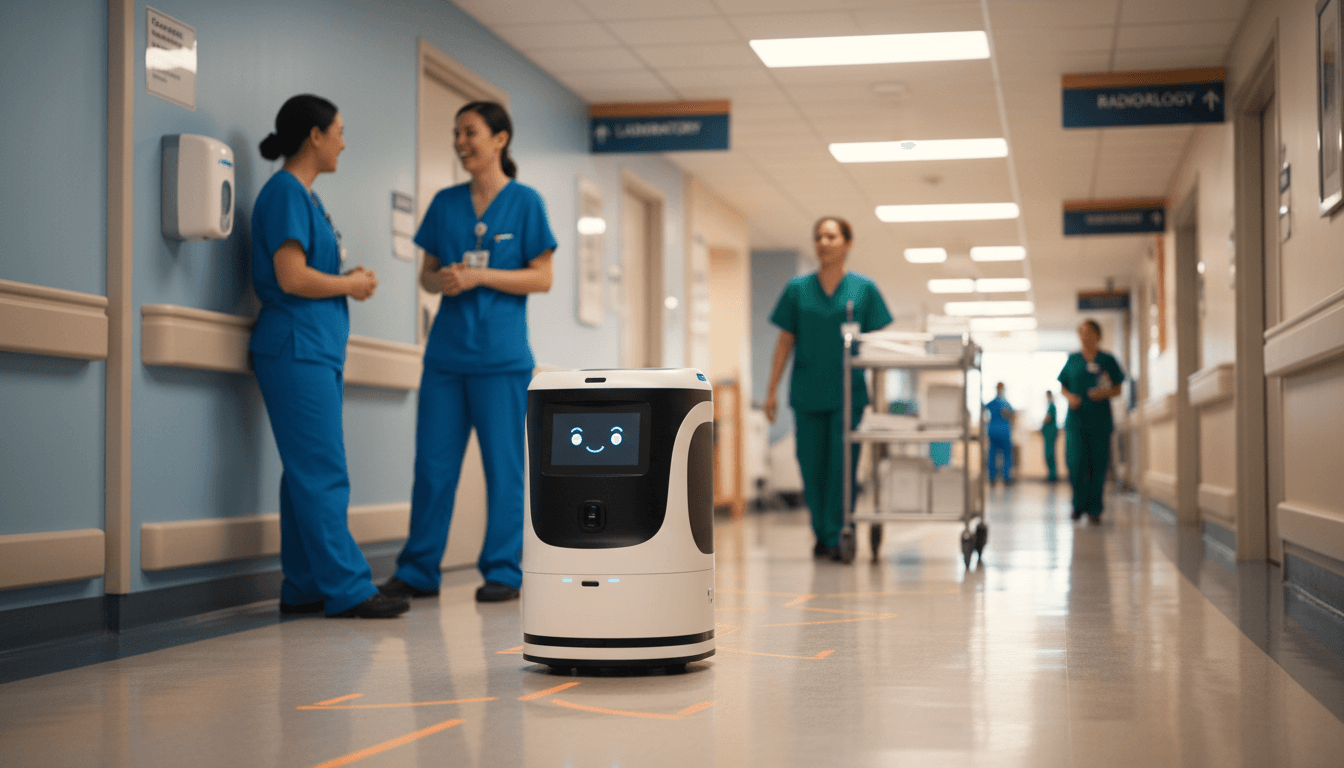
Imagine a robot delivering supplies in a hospital:
- Two nurses are walking together, talking.
- A third person is pushing a cart across the hallway.
A pure navigation system sees three moving obstacles. A socially aware system infers:
- The two nurses are a group and will likely maintain proximity.
- The cart pusher has priority because they’re moving equipment.
- The nurses are engaged in conversation, so sudden close passes may feel intrusive.
A graph representation makes those inferences expressible and actionable. Then the robot can choose a behavior like: slow down early, signal intent, pass behind the cart, and maintain a wider social distance from the conversing pair.
This is how you turn “social” from vibes into engineering.
The graph becomes a control interface for autonomy teams
Another practical win: graphs create a shared language between teams.
- Perception can output a dynamic interaction graph.
- Planning can consume it to choose policies (yield, overtake, reroute, request help).
- Product can map user needs to graph features (recognize groups; detect authority; handle turn-taking).
If you’re evaluating vendors, ask them how they represent multi-party interactions internally. If the answer is basically “we detect people and keep 1.5 meters away,” you’re buying an expensive Roomba.
Robots in education and care: success depends on misunderstandings you prevent
Answer first: In education and healthcare, social robots succeed when they manage expectations, recover gracefully from errors, and adapt to the user—not when they try to act “human.”
The podcast episode description highlights robots in education and broader misunderstandings about robots in society. That’s a big deal right now because late 2025 has seen a spike in interest in embodied AI and more capable assistants. Public expectations are rising faster than reliability.
In schools, clinics, and eldercare, the risk isn’t just technical failure. It’s a trust breach:
- If a robot tutor confidently responds incorrectly, the teacher loses time correcting it.
- If a care robot misreads a patient’s intent, it can feel invasive or unsafe.
- If a robot can’t tell when it’s confused, it can’t ask for clarification.
The organizations that succeed in these settings tend to be blunt about limitations and excellent at recovery.
What “adaptation” should mean in social robotics
“Adaptive robots” often get marketed as personalization. In operations, adaptation needs to be narrower and more measurable:
- Speed adaptation: match corridor norms (slow near patient rooms, faster in service hallways)
- Spacing adaptation: increase distance around anxious users; reduce distance when a worker requests close collaboration
- Turn-taking adaptation: wait for a pause, then speak; don’t interrupt group conversations
- Escalation adaptation: if two failed attempts occur, ask for help or switch to a safe fallback route
Adaptation that isn’t tied to measurable behaviors becomes a debugging nightmare.
The hard part: knowing when the robot made an error
Answer first: Reliable error detection in HRI is the foundation for safe autonomy because it triggers recovery behaviors before humans lose trust.
The episode summary calls out a core challenge: recognizing when errors happen. That’s not a footnote—it’s the backbone of deployable automation.
In industrial robotics, we’re used to crisp failures: collision detected, torque limit exceeded, path blocked. In social settings, many failures are soft:
- The human thought the robot was yielding, but it didn’t.
- The robot’s message was heard, but misunderstood.
- The robot chose a legal path that still felt rude.
A practical approach is to treat “error” as a combination of signals:
- Behavioral cues: humans step back abruptly, wave hands, raise voice, intervene physically
- Task outcomes: repeated replans, stalled progress, frequent manual overrides
- Interaction breakdowns: unanswered prompts, conflicting commands, repeated clarifications
If you can’t detect these, you can’t fix them.
An operations-first checklist for HRI error handling
If you’re implementing AI-driven robotics in a facility, push for these behaviors in requirements and acceptance tests:
- Explain intent in one sentence (light/sound + short phrase in local language)
- Acknowledge blockage quickly (within a few seconds, not after a minute of inching)
- Offer a clear next step: “Passing on your left,” “Waiting,” or “Need assistance to proceed”
- Time-box indecision: if no progress in X seconds, switch strategies
- Log the interaction as a structured event for continuous improvement (who, where, what happened)
If a vendor can’t show you how they instrument these events, you won’t get better after deployment—you’ll just get tired.
Getting input from target users: the only scalable way to earn trust
Answer first: User input isn’t a one-time UX exercise; it’s ongoing operational discovery that should shape robot behaviors, metrics, and safety policies.
Vázquez’s emphasis on getting input from target users sounds obvious, but most robotics programs still do it too late. Teams collect feedback after deployment issues surface—when changes are expensive and stakeholders are already skeptical.
A better approach is to treat user input like a core dataset:
- Shadowing sessions before any robot arrives on-site
- Scenario walkthroughs with workers: “What happens when a pallet is staged here?”
- Behavior preference tests: passing distance, yielding rules, audio cues, escalation steps
- Role-based authority mapping: who can command, pause, or reroute the robot
Metrics that actually reflect human-robot interaction quality
Operational teams need HRI metrics that connect to outcomes. A few that tend to work:
- Intervention rate: manual stops or reroutes per 100 missions
- Stall time: seconds stuck due to social ambiguity (not physical blockage)
- Repeat-confusion events: same location triggers confusion weekly
- Proximity complaints: qualitative feedback tagged to time/location
When you track these, “social robotics” becomes improvable engineering, not a branding line.
What generational dialogue gets right about AI in robotics
Answer first: Generational perspectives help teams avoid two costly mistakes—overpromising capability and underinvesting in integration.
The “Generations in Dialogue” format matters because robotics is getting pulled in two directions:
- Newer practitioners are fluent in modern AI methods and expect rapid iteration.
- More seasoned operators have lived through long deployment cycles and know where projects die: maintenance, training, exceptions, and safety sign-off.
You need both. AI makes perception and decision-making more capable, but it also increases the number of ways a system can behave unexpectedly. That’s why HRI research like Vázquez’s—grounded in how people move, coordinate, and influence each other—fits perfectly into 2026 planning.
Here’s my stance: If your robotics strategy for 2026 doesn’t include HRI requirements, you’re budgeting for rework.
Next steps: how to apply social HRI principles to your automation roadmap
If you’re leading robotics or automation in healthcare, manufacturing, or logistics, start with three actions this quarter:
- Write HRI acceptance criteria before you pick a platform: group detection, authority handling, error recovery, and user feedback loops.
- Pilot in the messiest area that’s still safe: shift changes, shared corridors, busy pick zones. Quiet areas hide the real problems.
- Instrument interactions like a product team: event logs, intervention reasons, and location-based heatmaps.
Social robotics is where AI meets the real world: crowded, ambiguous, and full of humans who don’t read your spec sheet. Build for that reality, and your robots won’t just navigate spaces—they’ll earn permission to operate in them.
If you’re planning an AI-driven robotics deployment in 2026, what’s the one social interaction you’re most worried your robots will get wrong?