Hierarchical reinforcement learning helps AI reuse skills to solve long tasks faster. See how HRL maps to U.S. robotics and digital service automation in 2025.
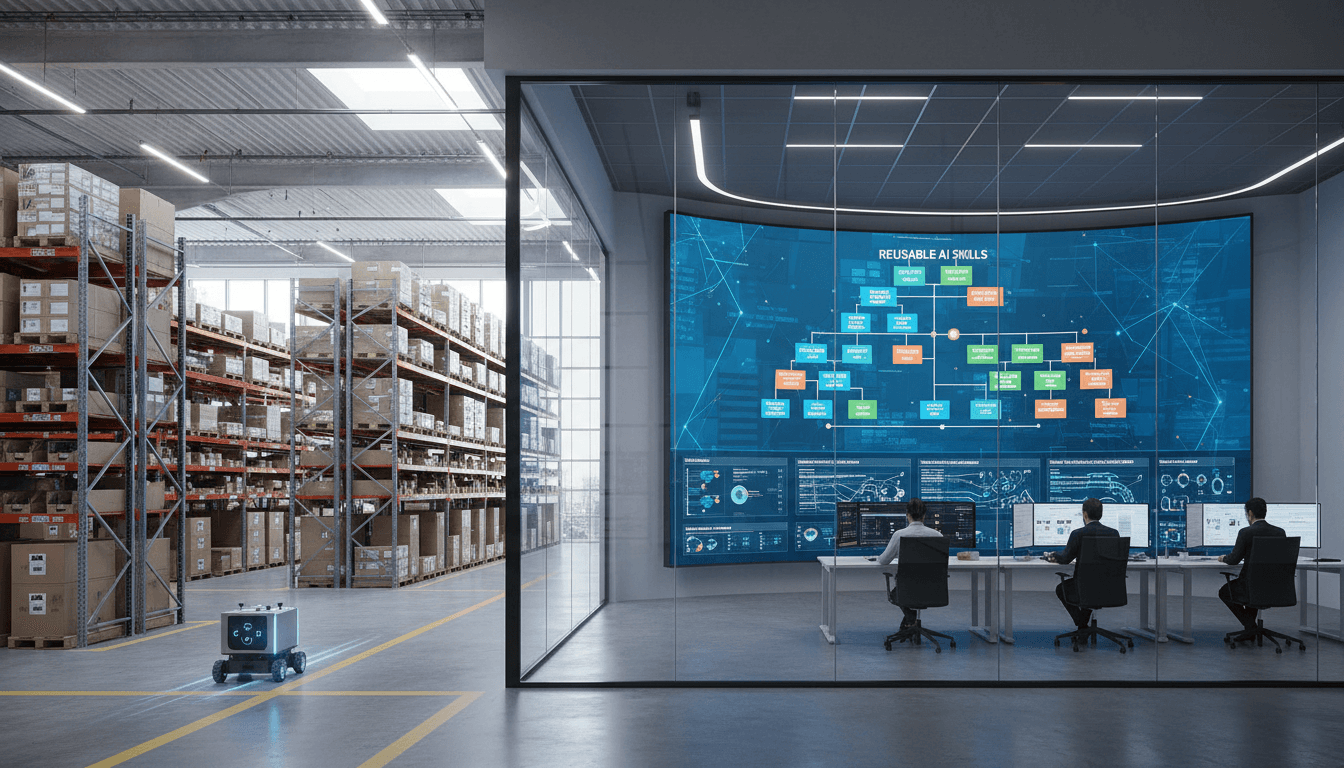
Hierarchical Reinforcement Learning for Real Automation
Most companies still train automation systems as if every task is a brand-new problem. That’s why “smart” robots and AI agents often look impressive in demos—but stall out when you ask them to do something slightly different in production.
Hierarchical reinforcement learning (HRL) is one of the most practical fixes we’ve seen for that gap. Instead of forcing an AI to search through thousands of tiny, low-level actions, HRL teaches it reusable high-level skills (walk forward, move left, pick-and-place, verify identity, route a ticket) and then learns how to sequence those skills to solve new tasks faster.
This post is part of our AI in Robotics & Automation series, and it focuses on a research idea that’s become increasingly relevant for U.S. tech and digital services in 2025: AI that learns a hierarchy of behaviors so it can adapt quickly. The core research example comes from OpenAI’s work on meta-learning shared hierarchies—but the implications go well beyond robots in mazes.
Hierarchical reinforcement learning: the productivity math
HRL matters because it changes the search problem from “find the right 2,000-step action sequence” to “choose the right 10-step plan.” That isn’t a motivational slogan—it’s a different computational reality.
Standard reinforcement learning (RL) tends to operate at the level of primitive actions: small motor torques for a robot, tiny joystick moves in a game, or micro-decisions in a workflow. When tasks are long-horizon (thousands of steps), brute-force exploration becomes expensive and slow.
HRL compresses long tasks into short programs:
- Low-level actions: the granular moves (motor commands, button clicks, token-by-token generation)
- High-level actions (skills): chunks of behavior that run for a while (e.g., 200 timesteps)
- A master policy (planner): decides which skill to run next
A clean way to say it is: HRL turns “control” into “coordination.” And coordination scales.
Why this shows up in U.S. digital services
Robotics is the obvious home for HRL, but the U.S. digital economy is full of long-horizon tasks too:
- A customer support case that spans multiple systems (CRM, billing, identity, shipping)
- A procurement flow with approvals, exceptions, and audits
- A healthcare scheduling workflow that has constraints, rescheduling, and follow-ups
These aren’t single-step predictions. They’re multi-stage processes with branching logic and delayed outcomes—exactly where hierarchy helps.
From hand-built playbooks to learned skills
Most automation programs today are either:
- Rules and scripts (fragile but predictable), or
- End-to-end models (flexible but hard to control and slow to adapt)
Hierarchical learning offers a third path: learn a library of robust skills, then learn how to compose them.
In OpenAI’s research example, the system learns sub-policies like moving in different directions (walking/crawling) and then a master policy chooses among them every N timesteps (a common example is N = 200). A sub-policy executed for N steps is treated as a single “high-level action.”
The important business translation is:
If you can standardize and reuse skills, you don’t retrain the entire system for every new workflow—you retrain the planner.
That’s a big deal for lead times and budgets, especially for U.S. SaaS teams trying to ship automation features quarterly, not annually.
What “meta-learning shared hierarchies” actually buys you
A lot of hierarchical approaches historically relied on humans to define the skills. That’s expensive, slow, and biased toward what engineers can imagine.
Meta-learning shared hierarchies (often abbreviated MLSH) pushes in a more scalable direction:
- You train across a distribution of tasks (not just one)
- The system learns shared sub-policies (skills) that generalize
- For each new task, you learn a new master policy that selects among skills
A practical definition you can reuse internally:
A “good” hierarchy is one that reaches high reward quickly on unseen tasks.
That’s the point: faster adaptation, not just higher peak performance.
A robotics example that maps cleanly to automation
The research demonstrations use navigation environments (including a simulated ant robot in different mazes). After training across multiple mazes, the agent discovers directional movement skills and then sequences them to solve new mazes more quickly.
If you work in robotics, the parallel is straightforward:
- Skills: approach shelf, grasp item, back out, align to conveyor, place item
- Master policy: chooses the next skill based on camera/LiDAR state and goal
If you work in digital services, the mapping is still surprisingly clean:
- Skills: validate address, verify identity, check refund eligibility, draft customer message, open escalation
- Master policy: chooses which skill to run based on context, policy, and outcome
The “maze” is your customer journey or operational process. The “goal” is a resolved ticket, a shipped order, or a compliant transaction.
The hidden win: fewer retries and less thrash
In production automation, time isn’t just CPU time—it’s also:
- How often the system loops
- How many times it asks a human for help
- How many dead-end branches it tries
Hierarchy reduces thrash because skills can be trained to be stable and bounded (“run this procedure for up to 200 steps, then return control”). In my experience, that one design constraint alone makes systems easier to monitor and safer to deploy.
Where HRL fits in the 2025 automation stack
HRL isn’t a replacement for modern agentic systems—it’s a structural idea that can make them more reliable.
Here’s how HRL lines up with what many U.S. product teams are building right now:
HRL + LLM agents: skills as tools, master as planner
LLM-based agents are often orchestrators: they pick tools, call APIs, and handle exceptions. That’s already “hierarchical” in spirit, but many implementations are informal.
A more disciplined HRL-inspired design looks like this:
- Skills = tool-backed procedures with clear inputs/outputs and guardrails
- Master = planner that selects which skill to run next
- Training signal = business outcomes (resolution time, containment rate, compliance pass rate)
The stance I’ll take: if your agent can call 30 tools but doesn’t have a learned or tested policy for when to use them, you’ve built a demo, not a system.
HRL for robotics and warehouse automation
Warehouse robotics in the U.S. is under constant pressure during seasonal peaks (and yes, that includes the late-December reality of returns and post-holiday fulfillment). HRL helps because peak operations involve:
- Many similar tasks with small variations
- Long-horizon recovery behaviors (blocked aisles, missing inventory, human interruptions)
- The need to adapt quickly to new layouts and SKUs
The better your skill library, the less you panic-retrain when operations change.
HRL for customer operations (the sleeper use case)
Customer operations is one of the clearest winners for hierarchical AI because the environment is messy but instrumented.
Examples of high-level skills that make sense:
- “Collect missing info” (ask the right question, validate, store)
- “Policy check” (eligibility, exceptions, compliance notes)
- “Resolution proposal” (options ranked by cost and customer impact)
- “Handoff package” (summary + evidence + recommended next step)
Once those exist, you can train a master policy to choose the best next move. That’s how you scale service quality without hiring at the same pace.
How to apply hierarchical learning without doing a PhD
You don’t need to implement a research-grade hierarchical RL algorithm to benefit from the hierarchy idea. You need to build your automation like it’s going to grow up.
1) Start by defining “skills” as products, not functions
A skill should be:
- Reusable across workflows
- Observable (inputs, outputs, logs)
- Bounded (time, steps, retries)
- Testable with clear success/failure criteria
If a skill can’t be evaluated, it can’t be improved—and you’ll end up with brittle automation.
2) Pick an N: how long should a skill run before handing back control?
In the research framing, the master chooses a sub-policy every N timesteps (often something like 200). Your “N” might be:
- One API call n- One multi-step transaction
- One conversational turn
- One minute of robot motion
The point is to make skills long enough to be meaningful, but short enough to remain controllable.
3) Train and improve skills on a task distribution, not a single flow
The fastest route to reusable automation is to train skills against variations:
- Different customer intents
- Different exception types
- Different warehouse aisle geometries
- Different device states
This is the operational version of meta-learning: skills that survive variation are the ones that scale.
4) Measure the right outcomes (the ones finance will care about)
If you want HRL-inspired automation to generate leads and budget internally, tie it to metrics that map to dollars:
- Time to resolution (minutes)
- Containment rate (percent of cases resolved without human intervention)
- Reopen rate (quality proxy)
- Cost per ticket / cost per task
- Error and compliance rates
A master policy that reduces average resolution time by 20% is more persuasive than any architecture diagram.
5) Put guardrails where hierarchy makes them easiest
Hierarchy naturally introduces checkpoints:
- After each skill run, validate state
- Require structured outputs for risky actions
- Add approval gates for regulated steps
That’s how you keep autonomy from turning into chaos.
People also ask: what’s the difference between HRL and “workflows”?
Workflows are hand-authored. HRL learns the decision policy.
A workflow engine is great when the process is stable. But when the environment changes (new policy, new fraud pattern, new product line), you either rewrite flows or accept failure modes.
HRL—and especially meta-learned hierarchies—targets the part that’s hardest to maintain: choosing what to do next under uncertainty.
What this means for AI-powered automation in the U.S.
Hierarchical reinforcement learning is a research concept with a very practical message: build AI systems that reuse skills and adapt by re-planning, not redoing everything. That’s how you get automation that survives real operations—warehouses, customer support, healthcare admin, fintech compliance—not just controlled demos.
For U.S. tech and digital services in 2025, that’s the direction the market is rewarding: faster deployment cycles, lower operating costs, and automation that doesn’t collapse under edge cases.
If you’re evaluating how to bring more autonomy into your product or ops stack, start here: What are your top 10 reusable skills, and what would it take to measure them well? Once you can answer that, the rest—planning, learning, scaling—gets dramatically easier.