BARA’s embodied AI focus could speed up warehouse and last-mile robotics. Here’s what logistics leaders should pilot, measure, and scale in 2026.
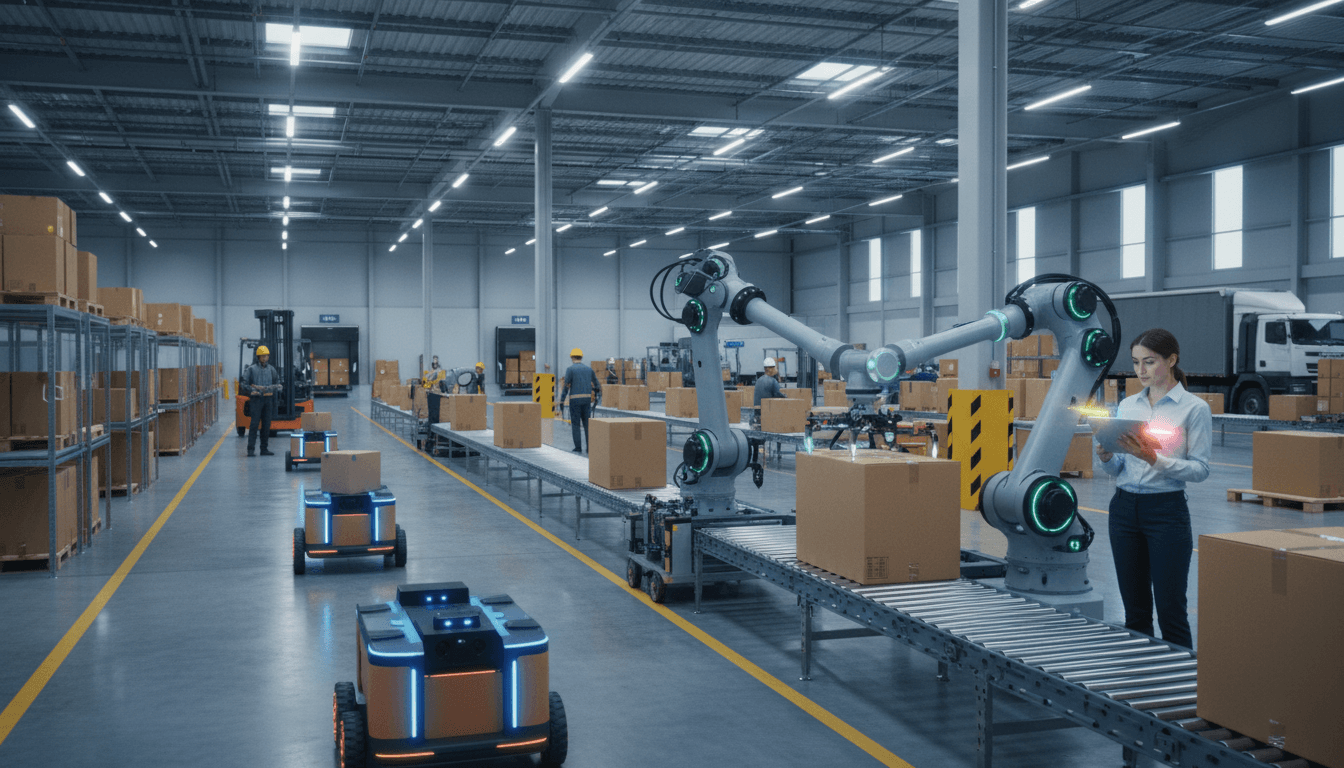
BARA’s Embodied AI Push: What Logistics Leaders Gain
Peak season doesn’t “stress test” your operation—it exposes the parts you’ve been quietly paying for all year. Travel time you can’t explain. Exceptions nobody can classify. Labor plans built on averages instead of reality. If you’re running warehouses, yards, or last-mile fleets, you already know the pattern: software insights are improving fast, but the physical execution layer still lags.
That’s why the launch of BARA (Bay Area Robotics Association) matters beyond the Bay Area hype cycle. BARA is positioning itself as a member-driven platform connecting startups, roboticists, corporates, and investors to accelerate embodied AI—AI that can perceive, decide, and act in the physical world. For transportation and logistics leaders, embodied AI isn’t a research topic. It’s the missing piece that turns forecasts into actions and dashboards into throughput.
BARA was unveiled at the Humanoids Summit Silicon Valley and is launching with collaborators across major robotics hubs: MassRobotics (U.S.), AIRoA (Japan), and Shanghai SG Robotics (China). That international alignment isn’t a nice-to-have. It’s a signal that the next phase of warehouse automation and delivery robotics will be shaped by ecosystem coordination: standards, pilots, and capital moving in tighter loops.
Why BARA’s launch is a signal for logistics automation
Answer first: BARA’s launch is a signal because embodied AI has hit the point where the bottleneck isn’t “can the robot do it?”—it’s how fast companies can pilot, integrate, and scale deployments across real facilities.
Most logistics organizations don’t fail at automation because they picked “the wrong robot.” They fail because they underestimate everything around the robot:
- Systems integration with WMS/WES/TMS
- Exception handling and edge cases
- Safety validation and operator training
- Procurement cycles and ROI proof
- Maintenance, spares, and uptime discipline
What BARA is explicitly trying to do—per its stated vision—is connect innovation to investment and commercialization partners needed to scale. That’s exactly the gap logistics teams feel when they’ve got a promising proof of concept but can’t get it over the line into multi-site rollout.
Here’s the thing about embodied AI in logistics: it doesn’t just automate tasks. It compresses the time between sensing a problem and acting on it.
- A congestion pattern shows up → robots re-route instead of waiting for a supervisor.
- A SKU’s packaging changes → perception adapts instead of halting pick.
- Weather hits last-mile routes → vehicles and dispatch adjust with fewer manual interventions.
That “sense-decide-act” loop is the core promise—and it’s also where pilots go to die if you don’t have the right partners, standards, and operational playbooks.
Embodied AI in warehousing: what changes in 2026 operations
Answer first: Embodied AI shifts warehouse automation from pre-programmed behavior to policy-driven behavior, where robots learn and adapt within constraints you define.
Classical warehouse automation (even modern AMRs) often depends on structured assumptions: known environments, predictable geometry, limited variation. Embodied AI pushes the boundary toward:
- More variability tolerated (mixed pallets, messy totes, irregular items)
- More shared spaces (robots operating closer to people with better behavior modeling)
- More autonomy (less human “traffic control”)
The practical use cases that benefit first
If you’re trying to decide where embodied AI will pay back fastest, look for workflows with high variance and high labor friction:
-
Case picking and each picking in semi-structured zones
- Vision + grasp planning improves success rates on inconsistent packaging.
- The win isn’t just pick speed—it’s fewer stoppages and less rework.
-
Trailer and container unloading/loading
- This is physically messy, constrained, and full of exceptions.
- Embodied AI matters because rigid automation breaks when the load isn’t perfect.
-
Yard and dock autonomy (spotting, staging, dwell reduction)
- Optimizing moves is easy in a spreadsheet.
- Executing moves safely, in real time, under uncertainty is the hard part.
-
Inventory visibility + physical cycle count
- Drones and mobile robots can close the gap between “system inventory” and reality.
- Embodied AI improves navigation, scanning reliability, and exception triage.
A stance I’ll take: humanoids aren’t the point—deployment readiness is
BARA launched at a humanoids-focused event, but for logistics leaders, obsessing over form factor is a distraction.
The real question is: Can the system deliver consistent throughput under your facility’s messiest conditions?
Humanoid robots might become relevant for certain retrofits (facilities built for humans, not automation). But in 2026, the near-term winners in warehouses will still be a mix of AMRs, robotic arms, mobile manipulation, conveyors/sortation, and vision systems—plus better AI control layers.
If BARA accelerates pilots and partnerships, the “humanoid vs. non-humanoid” debate becomes secondary to the outcome: more tasks automated with fewer brittle assumptions.
Why ecosystems matter: standards, interoperability, and faster pilots
Answer first: Ecosystems matter because embodied AI deployments fail when vendors, integrators, and operators lack shared interfaces, shared metrics, and shared safety expectations.
BARA’s early partner set hints at where the industry is going:
- MassRobotics (U.S.) brings a structured model for startup-to-industry collaboration.
- AIRoA (Japan) represents a robotics ecosystem with deep mechatronics heritage and disciplined commercialization.
- Shanghai SG Robotics (China) reflects manufacturing scale and rapid iteration loops.
That combination is important for logistics because supply chains are global. The robots, sensors, and compute stacks you deploy rarely come from one country—or one vendor.
Interoperability isn’t a “nice engineering detail”
If you’ve ever tried to scale from one pilot site to ten, you’ve seen the hidden tax:
- Site A uses a custom WMS connector
- Site B needs different safety zoning
- Site C’s Wi‑Fi is unreliable and you didn’t model it
- Vendor updates break your exception rules
That’s why the article’s mention of the broader U.S. standards ecosystem, including NIST work around interoperability and deployment readiness, is relevant. When standards mature, two things happen:
- Integration costs become more predictable
- Procurement risk drops, because you can compare vendors on consistent criteria
For logistics, this is how embodied AI becomes a repeatable capability instead of a science project.
A deployment playbook: how to pilot embodied AI without wasting a quarter
Answer first: The best embodied AI pilots are designed around measurable constraints: scope, throughput, exceptions, and a clear path to scale.
BARA is planning members-only capital and networking sessions beginning in early 2026, with a private directory to streamline introductions. That’s helpful—but pilots still live or die inside your operation. Here’s what works when you want results fast.
Step 1: Define the “unit of value” before the robot arrives
Pick one primary metric and two supporting metrics.
- Primary: lines picked per labor hour, dock-to-stock time, order cycle time, or trailer unload rate
- Supporting: exception rate, robot assist time, unplanned downtime
If you don’t define this, your pilot becomes a demo. Demos don’t get budget.
Step 2: Build an exception taxonomy (and assign owners)
Embodied AI reduces exceptions, but it won’t eliminate them. Create categories such as:
- Perception failure (label, glare, occlusion)
- Physical constraint (damaged carton, unstable pallet)
- System constraint (WMS mismatch, missing master data)
- Safety constraint (pedestrian density, blocked egress)
Then assign who resolves what: ops, IT, vendor, integrator. This is the fastest way to avoid “everyone thought someone else owned it.”
Step 3: Plan the integration like you plan the labor
A realistic pilot plan includes:
- Data handshake: WMS/WES tasks, confirmations, inventory adjustments
- Latency expectations: where milliseconds matter and where they don’t
- Observability: logs, video, event streams, root-cause workflow
- Rollback: what happens when the system is degraded
In my experience, observability is where teams underinvest. If you can’t diagnose failures quickly, your uptime story collapses.
Step 4: Use a two-gate scale decision
Don’t decide “scale” based on a single number at the end.
- Gate 1 (week 2–3): safety, operator acceptance, exception handling works
- Gate 2 (week 6–10): stable performance, predictable maintenance, clear integration pattern
This prevents the common trap: a pilot “succeeds” on output but fails on operability.
What this means for last-mile delivery robotics
Answer first: Embodied AI improves last-mile delivery robotics by making navigation and decision-making more robust in messy, human environments.
Last-mile is where autonomy meets real-world unpredictability: pedestrians, curb chaos, variable lighting, and constant edge cases. Embodied AI helps delivery robots and autonomous vehicles by:
- Better scene understanding (what matters vs. what’s noise)
- Stronger behavior prediction (how people and cars are likely to move)
- More reliable local planning (safe, smooth motion under uncertainty)
- Improved real-time rerouting based on micro-conditions
If BARA succeeds in accelerating pilots and partnerships, expect more cross-pollination between warehouse autonomy and last-mile autonomy—especially around perception stacks, simulation, and safety validation.
The lead-gen reality: why joining ecosystems beats “going it alone”
Answer first: For logistics leaders buying robotics, ecosystems reduce risk, shorten evaluation cycles, and expand your bench of credible vendors and integrators.
BARA’s membership is organization-only (not individuals) and targeted at companies advancing humanoid, industrial, service, and mobility robotics, plus those who invest in or buy from them. That structure signals a focus on commercial outcomes: pilots, partnerships, and capital pathways.
If you’re a shipper, 3PL, carrier, or e-commerce operator, this is the practical upside:
- You meet vendors earlier, before pricing and product roadmaps ossify
- You compare approaches side-by-side (not vendor-by-vendor over months)
- You find integration partners who’ve already learned the hard lessons
And if you’re a robotics or AI vendor, ecosystems create what you actually need: qualified deployment environments with operators who can give real feedback.
What to do next if embodied AI is on your 2026 roadmap
Embodied AI is moving from “interesting” to “budgetable,” especially as warehouses push for higher throughput with tighter labor and higher service expectations. BARA’s launch is one more indicator that the market is organizing around scaling—not just inventing.
If you’re planning robotics investments for 2026, start with three actions:
- Audit where variability is costing you the most (exceptions, rework, delays)
- Pick one workflow to pilot with clear success metrics
- Pressure-test your integration and operability plan before you pressure-test throughput
The broader theme in our AI in Robotics & Automation series is simple: AI only creates value when it’s attached to a real process and held to real metrics. Embodied AI is that theme made physical.
If the Bay Area’s new robotics association can speed up partnerships and deployment readiness, the interesting question isn’t whether robotics adoption will accelerate—it’s which logistics teams will build the operational muscle to scale it first.