Edible soft robots solve a real deployment problem: safe, biodegradable robotics for wildlife, healthcare, and swarms—plus where AI optimizes design.
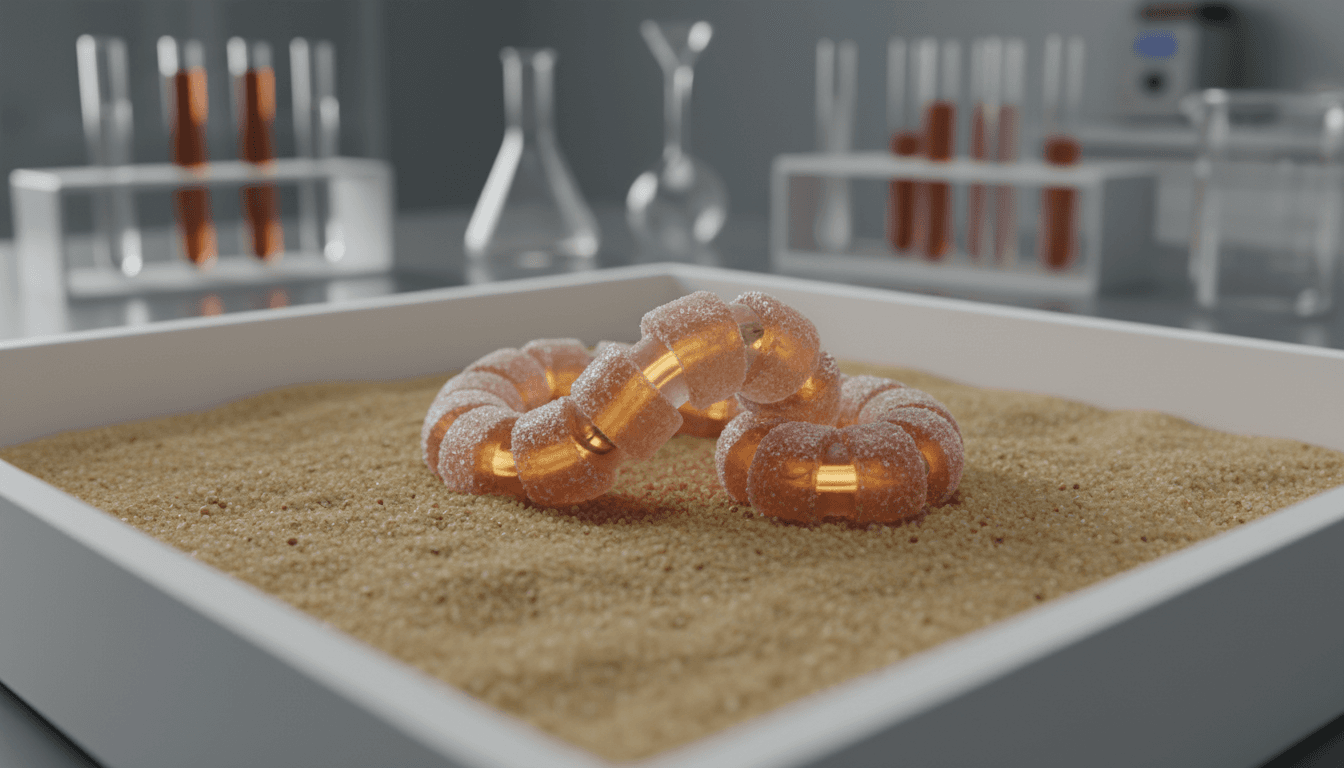
Edible Soft Robots: The Battery Is Food, Too
A soft robot that’s 100% edible—including its battery—sounds like a novelty until you realize what it solves: deployment risk. If you need to place hundreds (or thousands) of small robots into fields, forests, wetlands, or even inside bodies, the hardest part isn’t making them move. It’s making sure they don’t become trash, toxins, or liabilities once the job is done.
That’s why this edible soft robot from EPFL (built around a citric-acid-and-baking-soda “pneumatic battery,” a snap-buckling edible valve, and a bending soft actuator) matters to anyone working in AI in Robotics & Automation. The most exciting part isn’t that it tastes sour-and-sweet. It’s that it points to a serious new design space: robots engineered for safe disappearance.
And if you’re thinking “where does AI fit in a gummy robot?”—it fits in the exact place robotics is heading in 2026: design, control, deployment, and scaling.
Why fully edible robots matter (and why most teams ignore this)
Answer first: Fully edible (or fully biodegradable) robots matter because they reduce the operational and regulatory cost of deploying robotics in uncontrolled environments.
Most robotics roadmaps assume recovery: you send the robot, it does the task, you bring it back. That assumption breaks in three common situations:
- Wildlife and conservation work where retrieval is expensive or unsafe
- Agriculture and environmental monitoring where robots could be deployed in swarms
- Ingestible or near-body healthcare where “don’t leave hazardous parts behind” is non-negotiable
Traditional soft robots often rely on pumps, valves, plastics, metals, and conventional batteries. Those components are great in factories and labs. In a forest, a landfill-adjacent shoreline, or inside an animal? They’re a liability.
This edible soft robot concept flips the default: assume the robot won’t be recovered, then engineer the whole system—energy, actuation, and control—around safe materials and predictable end-of-life behavior.
How the edible robot works: battery, valve, actuator
Answer first: The robot moves using a chemical gas-generating “battery” that pressurizes an edible soft actuator through edible tubing, with motion regulated by an edible snap-buckling valve.
The EPFL system is clever because it replaces electronics-heavy actuation with something soft robotics already likes: pneumatics. But it does pneumatics without the usual non-edible hardware.
The pneumatic “battery” is chemistry plus packaging
The battery stores energy as separated edible reagents:
- Citric acid (liquid) in one chamber
- Baking soda in another
- A puncturable membrane between them
When pressure punctures the membrane, the citric acid drips into the baking soda. The reaction generates:
- CO₂ gas (this is the useful output)
- Sodium citrate (a common food ingredient)
So the “battery” is essentially a timed CO₂ generator in a gelatin-and-wax form factor. Instead of powering a motor electrically, it powers pressure and flow.
The edible valve creates repeated motion
A single pressure event can bend a soft actuator once. The trick is repeating motion (wiggling) without a complex mechanical valve.
This robot uses an edible snap-buckling valve that stays closed until pressure crosses a threshold, then snaps open and shuts again as pressure drops. Think of it as a mechanical oscillator made from safe materials.
In the demonstrated prototype, the system achieves about four bending cycles per minute for a couple of minutes before the reaction runs out.
The actuator is classic soft robotics—built from edible materials
The actuator is a familiar design: interconnected air chambers on a flexible body with a stiffer base layer that causes bending when pressurized.
That’s important: it means this isn’t a one-off gimmick architecture. It’s compatible with broader soft robotics patterns—just with a radically different bill of materials.
The real application: targeted medication delivery in the wild
Answer first: The strongest near-term use case is delivering medication or vaccines to elusive animals using motion as a behavioral trigger.
The robot was designed with a very practical goal: feed medication to wild boars.
Wild boars are a perfect example of a robotics deployment problem:
- They’re hard (and risky) to approach directly
- They can spread disease to livestock and other wildlife
- Traditional baiting is blunt: it’s hard to target the right species and dose
Here’s the clever behavioral insight: many animals are attracted to moving prey-like motion. This robot’s “wiggle” is not for entertainment—it’s a targeting mechanism.
With the right tuning (size, motion pattern, trigger pressure, scent/flavor), the same idea could be adapted for:
- Oral vaccine delivery to other wildlife species
- Targeted anti-parasitic dosing
- “Lure and deliver” supplements in conservation programs
And yes, humans are animals too. There’s a plausible future for edible robotics in pediatric medicine, swallowing therapy aids, or temporary in-mouth devices—but only if performance, safety, and repeatability get much better.
Where AI fits: design optimization, control, and scaling
Answer first: AI makes edible soft robots viable by optimizing material recipes, predicting actuation performance, and enabling robust behavior under high variability.
Edible robotics sits at the intersection of materials, mechanics, and messy real-world conditions. That’s exactly where AI helps most—not as “robot intelligence,” but as engineering intelligence.
1) AI for materials and recipe search
Edible components behave differently batch to batch:
- gelatin stiffness varies with concentration and temperature
- wax properties shift with formulation
- membranes puncture inconsistently if manufacturing tolerances drift
AI-driven experimentation (Bayesian optimization, active learning, and surrogate modeling) can reduce the number of physical prototypes needed to find stable operating ranges for:
- membrane thickness vs. puncture pressure
- gas generation rate vs. chamber geometry
- actuator chamber geometry vs. bend amplitude
If you’ve ever tried to tune a soft actuator by hand, you know the pain: the parameter space explodes. AI helps compress it.
2) AI for motion design that targets specific species
If the robot is meant to attract a species, motion becomes a “signal.” AI can help by:
- learning which motion patterns correlate with approach/avoid behavior
- optimizing gait frequency and amplitude under energy constraints
- adapting designs to local conditions (seasonal food availability, population behavior changes)
This is a strong fit for simulation-to-reality workflows plus field data. The performance metric isn’t “meters per second.” It’s “probability of ingestion by target species.”
3) AI for manufacturing quality and reliability
To scale deployment (the whole point of biodegradable swarms), you need consistent parts. Vision AI inspection can detect:
- micro-tears in gelatin tubing
- membrane defects
- chamber fill-level issues
That’s not flashy—but it’s the difference between “cool paper” and “deployable system.”
4) AI for system-level planning in swarm deployments
Imagine you deploy 5,000 edible robots as vaccine baits across a region. AI helps with:
- placement optimization (terrain, animal movement corridors)
- uptake estimation and dose coverage modeling
- adaptive redeployment where uptake is low
That’s where edible robots stop being a novelty and become an automation system.
What’s still hard (and what to ask before you build one)
Answer first: Edible robots will fail in the field if you don’t treat variability, shelf-life, and verification as first-class engineering constraints.
Here are the issues I’d pressure-test before betting a program on edible soft robotics:
Shelf-life and storage
Edible materials absorb moisture, dry out, and degrade. A robot that works in the lab today but fails after two weeks in storage is a non-starter.
Questions to ask:
- What’s the stable storage window at 5°C, 20°C, 35°C?
- Does packaging need to be biodegradable too?
- How do you prevent premature membrane puncture during transport?
Environmental robustness
Field conditions are brutal:
- temperature swings
- rain and humidity
- soil contact
- microbial breakdown
You need performance envelopes: what motion output do you get at 0°C vs 30°C? That’s where AI-assisted modeling and stress testing pays off.
Verification and compliance
If this is used for medication delivery, you’re in regulated territory fast.
You’ll need:
- ingredient traceability
- predictable dissolution/biodegradation profiles
- safety testing for non-target ingestion
Edible makes some problems easier (toxicity), but it raises others (food-grade manufacturing, contamination control).
Energy density and runtime
A couple minutes of actuation is fine for a proof-of-concept.
Real deployments will demand:
- longer runtime, or more meaningful motion per unit energy
- controlled triggers (time, pressure, humidity, bite force)
- better “dose integrity” so medication isn’t wasted
Practical takeaways for robotics and automation teams
Answer first: Treat edible robotics as a design pattern—safe deployment-first—then use AI to make it manufacturable and reliable.
If you’re leading robotics R&D in 2026 and you want this trend to create real leads (and real deployments), here’s what works:
- Start with the end-of-life requirement. If recovery is uncertain, design for safe disappearance.
- Use AI where it matters: variability. Materials and field conditions vary; AI is best at taming variability.
- Choose one performance metric that reflects the mission. For wildlife: ingestion rate by target species. For healthcare: safety + controlled release.
- Invest early in manufacturability. If you can’t make 1,000 consistent units, you don’t have a deployable robot—just a demo.
- Plan the data loop. Field outcomes (uptake, motion success, failure modes) should feed back into recipe and geometry optimization.
What this means for the AI in Robotics & Automation series
Edible soft robots are a reminder that automation doesn’t just mean faster factories. It also means systems you can deploy safely where humans can’t—or shouldn’t—go.
This is the bigger story: AI isn’t only making robots smarter at perception and navigation. It’s helping engineers design robots that are context-aware at the materials level—built to operate, deliver value, and then disappear without harm.
If you’re exploring AI-enabled robotics for healthcare, agriculture, or environmental monitoring, edible robotics is worth taking seriously now. Not because you want candy robots, but because you want deployment at scale without cleanup, toxic waste, or bad headlines.
What’s the next step? Pick a high-risk deployment scenario where retrieval is unrealistic, and ask a simple question: What would the robot need to be made of to be safe if it’s never coming back?