Edible aquatic robots can monitor water without creating e‑waste. See how fish-food hulls, smart swarm AI, and lifecycle design change field robotics.
Edible Aquatic Robots: Monitoring Without E‑Waste
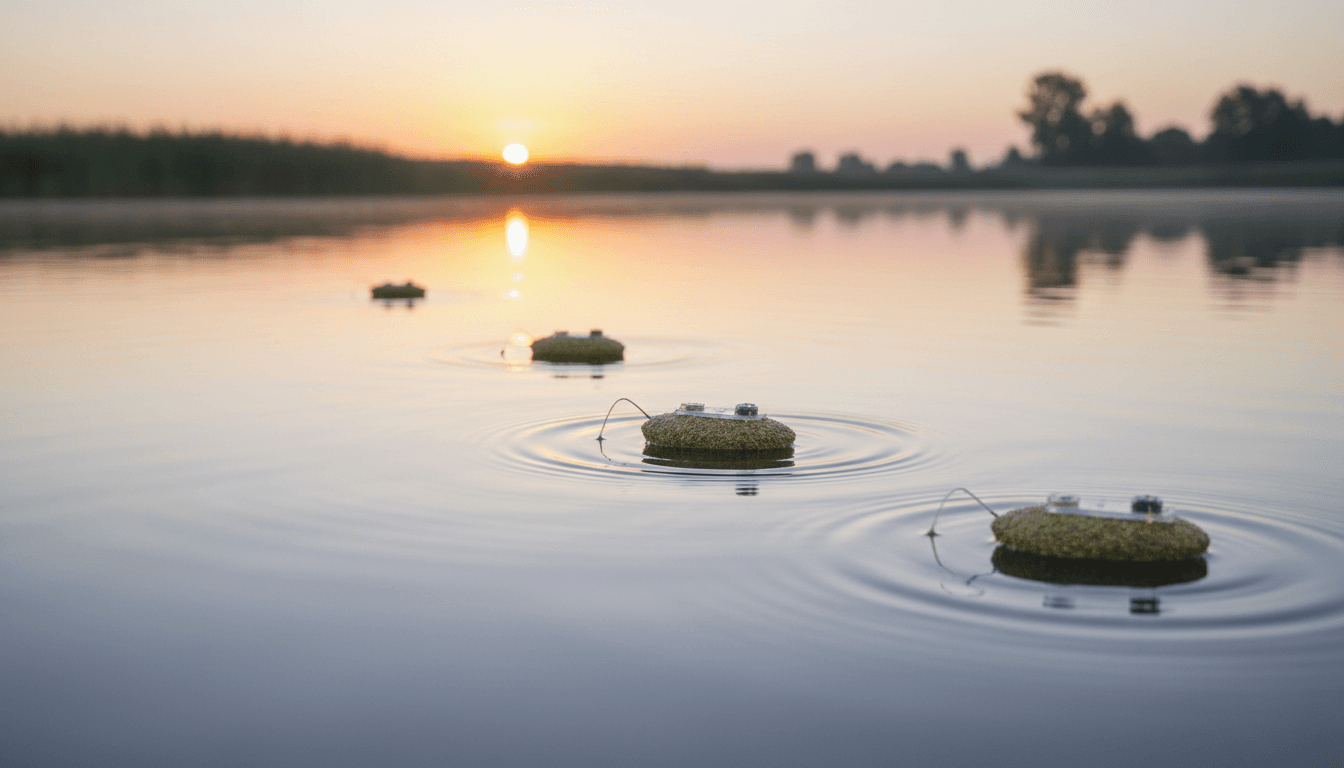
A 5‑centimeter robot that finishes its job, softens, sinks… and becomes fish food sounds like a stunt. It’s not. Researchers at EPFL in Switzerland built tiny motorboat-shaped aquatic robots with hulls made from commercial fish feed—designed for environmental monitoring in places where retrieval is unrealistic.
Most companies get this wrong: they treat “biodegradable” as the end of the sustainability conversation in robotics. In water, that bar is too low. If you’re deploying fleets of small robots into lakes, ponds, reservoirs, or aquaculture pens, the real question isn’t “Can it break down eventually?” It’s “What’s left behind while it’s breaking down—and what does it do to the ecosystem?”
This post is part of our AI in Robotics & Automation series, and it’s a good example of where the next wave is headed: intelligent automation that plans for its own end-of-life. The hardware doesn’t just work—it exits responsibly.
Why aquatic monitoring robots create a waste problem
Aquatic robotics has a retrieval problem, full stop. The moment you scale beyond a handful of prototypes, recovery becomes expensive, inconsistent, and sometimes unsafe.
Here’s why teams abandon robots in the wild more often than they admit:
- Surface conditions change fast (wind, vegetation, waves, currents), so recovery routes don’t match deployment routes.
- Small robots are hard to see at a distance, and GPS errors become “lost robot” errors.
- Battery-powered designs can fail quietly, drifting until they snag on shorelines or sink.
- Fleet deployments multiply losses—a 2% loss rate becomes painful when you deploy hundreds.
So the environmental monitoring story has a shadow side: distributed sensing can become distributed litter.
The EPFL concept flips the premise. If the robot is expected to be unrecoverable, then unrecoverable should be part of the design spec.
How EPFL’s edible robot works (simple chemistry, smart materials)
These robots are intentionally modest in capability, because their purpose is proof-of-concept: show that a robot can move on water using a non-toxic propulsion method and a body made primarily of edible/biodegradable material.
The edible hull: fish feed as a structural material
Answer first: The robot’s body is literally fish food, shaped into a hull.
The hull is made from commercial fish feed pellets that are:
- Ground into a powder
- Mixed with a biopolymer binder
- Molded into a boat shape
- Freeze-dried to hold form
The result is a small, lightweight platform (about 5 cm long, around 1.43 g) that can initially float and operate, then gradually absorb water, soften, and eventually sink—right when you’d want it to “retire.”
Propulsion via the Marangoni effect (no propellers, no batteries)
Answer first: The robot moves by releasing a surface-tension-changing liquid behind it.
Inside the hull is a chamber containing citric acid and sodium bicarbonate (baking soda). Water enters through a semi-permeable gel plug. When water reaches the powder, it generates CO₂ gas, which pushes propylene glycol out through a rear outlet.
That expelled glycol locally reduces surface tension; the robot gets a forward push via the Marangoni effect (the same physics water striders exploit).
In tests reported so far, the robots can travel for a few minutes before fuel is exhausted. Speed is described as about 0.5 to 3 body lengths per second, which is plenty for near-surface “coverage by swarm,” where many inexpensive robots roam rather than one expensive robot following a planned path.
The uncomfortable truth: the electronics are the hard part
The hull and propulsion are the easy half.
Environmental monitoring requires sensors (temperature, pH, dissolved oxygen, conductivity, nitrate, turbidity, pollutant proxies), plus power and communications. Today, that usually means conventional electronics.
EPFL’s work points straight at the real bottleneck: biodegradable or edible electronics that still perform reliably long enough to matter.
If you’re building AI-enabled robotics products, treat this as your prompt: the future isn’t just smarter autonomy. It’s smarter materials, smarter lifecycles, and smarter disposal-by-design.
Where AI fits: turning “random squiggle” into usable data
A common reaction is: “If the robots move randomly, how is the data meaningful?”
It’s meaningful when you combine swarms with AI.
Answer first: AI makes low-cost, low-duration robots useful by improving coverage, inference, and decision-making from imperfect paths.
1) Coverage planning without precise control
Even if individual robots have limited control, a fleet can still achieve useful sampling.
AI approaches that help:
- Probabilistic coverage models to estimate which surface regions were likely sampled
- Adaptive redeployment rules (if readings spike in one region, deploy more units there)
- Bayesian mapping that fuses partial trajectories into a coherent field estimate
2) “Good enough” sensing through model-based inference
Cheap sensors drift. Short missions have gaps. Waves add noise.
This is where machine learning earns its keep:
- Sensor calibration models that correct systematic errors using reference points
- Anomaly detection for spills/algal bloom signatures from noisy multi-sensor streams
- Spatiotemporal interpolation to estimate pollutant gradients across the water surface
3) Communications that tolerate partial retrieval
The EPFL concept suggests two modes: transmit data wirelessly, or retrieve only some units.
AI can optimize both:
- Opportunistic uplink scheduling (send summaries when signal quality is highest)
- On-device compression (send features, not raw time series)
- Redundancy-aware fleet control (assume some bots will be lost and design for it)
If you’re running robotics programs in manufacturing, logistics, or field services, this is familiar: reliability rarely comes from one perfect machine. It comes from systems.
Practical use cases that actually pencil out
The most promising applications are the ones where the cost of retrieval is higher than the cost of the robot, and where a short mission still produces actionable signals.
Environmental monitoring in lakes, ponds, and reservoirs
Answer first: Edible aquatic robots fit best where monitoring is frequent, distributed, and resource-constrained.
Examples:
- Stormwater ponds after heavy rain: rapid screening for runoff contamination
- Reservoir perimeter monitoring: early detection of surface-level contamination events
- Small lakes with seasonal algal bloom risk: rapid surface temperature and pH patterning
This is especially relevant in December planning cycles: many municipalities and utilities set annual monitoring budgets now, and they’re looking for ways to increase sampling frequency without increasing boat time.
Aquaculture: monitoring plus targeted feeding or medicated delivery
The EPFL team also points to fish farms as an alternative use: distribute medicated feed.
I’m bullish on this, with guardrails.
Why it’s attractive:
- You already have feeding infrastructure and regulatory oversight
- “End-of-life” is not disposal; it’s consumption
- Swarm approaches can reduce labor for routine checks
The guardrails:
- Dosing control must be precise (medicated delivery has stricter safety requirements)
- Traceability matters (batch IDs, deployment logs, and measured uptake)
- Non-target species impact must be evaluated (who eats it first?)
“Disposable robotics” for hazardous sampling
Some environments are hostile to retrieval: polluted canals, post-flood zones, industrial retention basins.
Edible/biodegradable platforms create a new option: use robots where you’d otherwise avoid deploying anything at all.
What leaders should demand before deploying biodegradable robot fleets
If you’re considering sustainable field robotics—whether aquatic or terrestrial—don’t accept “biodegradable” as a marketing checkbox. Treat it as an engineering requirement with testable metrics.
A procurement checklist (the questions that prevent greenwashing)
Use these as gating questions for pilots:
- What’s the full material inventory (binders, additives, coatings, adhesives)?
- What are the byproducts during operation and degradation (and at what concentrations)?
- What’s the mission duration vs. degradation curve (how long it floats, when it sinks)?
- What happens to the electronics (retrieved, biodegradable, inert, or still e-waste)?
- What’s the verified toxicity profile for local species (not just “non-toxic” claims)?
- What’s the failure mode (does it strand, fragment, or degrade cleanly)?
The strategic point: sustainability is becoming a deployment constraint
Field robotics is moving toward the same place manufacturing already reached: compliance, reporting, and lifecycle accountability aren’t optional.
If your automation roadmap includes distributed robotics—drones, microbots, aquatic robots—assume that sustainability constraints will tighten over the next procurement cycles. The teams that design for end-of-life early will ship faster later.
The next milestone: edible robots with edible intelligence
The EPFL prototypes show a clear path: the body can be edible; the motion can be non-toxic; the end-of-life can be beneficial.
The remaining leap is the hardest one: sensors, power, and compute that don’t leave behind a traditional electronics footprint.
That’s where AI in robotics & automation gets interesting in 2026 planning: autonomy isn’t only about navigation. It’s about making limited hardware do more, for less time, with less waste.
If you’re building environmental monitoring solutions, aquaculture automation, or any fleet-style field robotics, now’s the time to rethink the default assumption that every robot must come home.
A responsible robot isn’t just safe while it works. It’s safe when it stops working.
If your team is exploring AI-driven robotics for environmental or industrial sensing, consider piloting a “disposable-by-design” platform: define the data you actually need, design the shortest mission that captures it, and engineer the device to disappear responsibly afterward. What would your product roadmap look like if retrieval was optional?