Edge AI vision boxes cut latency for robotics and yard ops. See how NVIDIA Jetson platforms like Darsi Pro support faster, more reliable warehouse decisions.
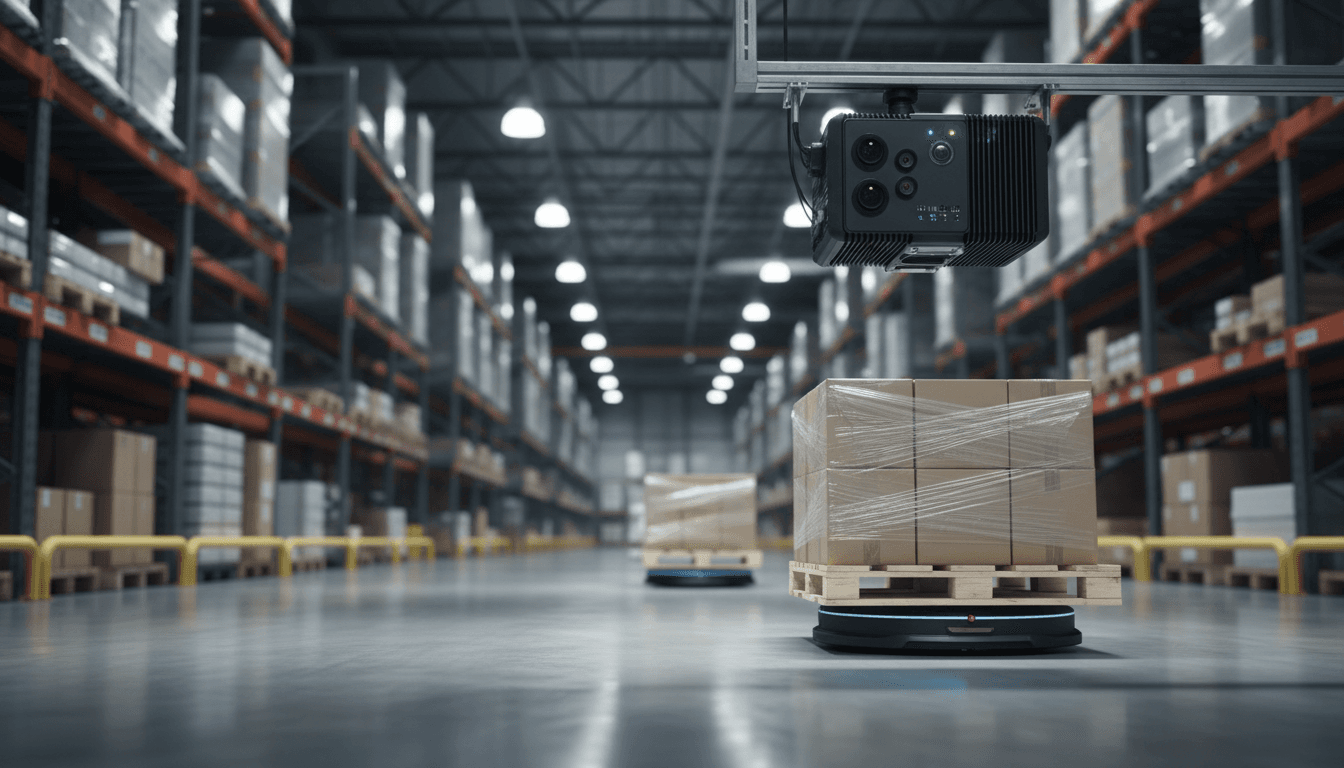
Edge AI Vision Boxes for Faster Warehouse Decisions
Peak season doesn’t forgive latency.
If you run warehouse automation, yard operations, or last‑mile delivery fleets, you’ve felt the pain: cameras see everything, but your system still hesitates. Video streams pile up. Wi‑Fi drops in the worst aisle. Cloud inference adds seconds you don’t have. And when perception is late, robots get conservative, conveyors pause, and exceptions multiply.
That’s why edge AI vision boxes are showing up in more logistics RFPs—and why e‑con Systems’ new Darsi Pro, announced ahead of CES 2026, is worth paying attention to. It’s a rugged, NVIDIA Jetson-powered box that aims to bundle the messy parts of “real-time vision for robotics” into one platform: compute, multi-camera sync, sensor fusion, and remote device management.
Why edge AI matters in logistics (and why cloud-only is a trap)
Edge AI matters because perception is a control loop, not a report. In warehouses and transportation systems, vision isn’t just for dashboards—it’s used to make immediate decisions: slow down, stop, re-route, pick, count, verify, or flag.
When inference happens offsite, you introduce failure modes that have nothing to do with your model accuracy:
- Network jitter becomes operational risk. The “average” latency doesn’t matter—your robots experience the worst-case moments.
- Bandwidth gets expensive fast. Multi-camera robotics (or even fixed cameras with high resolution and low-light needs) creates constant data gravity.
- Security and privacy get harder. Streaming identifiable video outside the facility can create compliance headaches.
Edge AI flips the equation: process video locally, send only events and metadata upstream, and keep robots responsive even when connectivity is imperfect.
Here’s the stance I take: If the decision needs to happen in under a second, cloud-only shouldn’t be your primary architecture. Use the cloud for fleet analytics, retraining, monitoring, and OTA updates—just don’t make it the steering wheel.
What Darsi Pro brings to the table (beyond “it runs Jetson”)
Darsi Pro is positioned as a production-ready edge AI vision box for physical AI workloads—especially robotics and intelligent transportation systems. The headline spec from the announcement is up to 100 TOPS (trillions of operations per second) of AI performance on NVIDIA Jetson.
Specs aren’t the full story, though. In logistics automation, the differentiators tend to be the unglamorous details: synchronization, sensor timing, camera compatibility, and the ability to manage devices at scale.
Multi-camera synchronization: the quiet requirement that makes or breaks perception
Synchronized cameras are the difference between “it works in the lab” and “it survives production.” If you’re doing 360° perception on an AMR, pallet detection at speed, or trailer loading assistance, time alignment matters.
Darsi Pro’s GMSL variant supports up to eight synchronized GMSL cameras, aimed at exactly those multi-view problems. That matters because:
- Multi-camera rigs let you reduce blind spots without relying on a single ultra-wide lens that distorts edges.
- Synchronization reduces “phantom motion” artifacts when robots move quickly.
- It simplifies downstream fusion with lidar/radar/IMU.
Sensor fusion with PTP: where reliability actually comes from
Good autonomy is mostly about timing. Darsi Pro supports synchronized inputs from cameras, lidar, radar, IMUs, and other sensors using Precision Time Protocol (PTP).
In practical terms, PTP helps you answer: “Did the camera frame and the lidar scan describe the same moment?” Without that, your system can be accurate and still wrong—because it’s mixing timestamps.
If you’ve ever watched a robot “see” an obstacle, then brake late, you already understand why this matters.
Connectivity and industrial deployment reality
Logistics environments punish fragile hardware. Forklifts clip mounts. Dust and vibration are constant. Temperature swings happen near dock doors.
Darsi Pro includes a rugged enclosure designed for a wide operating temperature range and field durability. On the connectivity side, it supports common deployment needs:
- Dual GbE with PoE (Power over Ethernet) options for easier camera and device placement
- USB 3.2, HDMI, CAN, GPIO, plus IMU and wireless modules
This isn’t “nice to have.” It’s what keeps you from redesigning your wiring plan mid‑pilot.
Cloud device management: the part everyone forgets until the first fleet rollout
Fleet scale is where many edge AI pilots fail—because nobody plans for operations. e‑con’s announcement highlights CloVis Central, a cloud-based device management platform supporting:
- Secure over-the-air (OTA) updates
- Remote configuration
- Device health monitoring
That’s essential if you expect to deploy dozens (or hundreds) of perception nodes across warehouses, yards, and vehicles. Without it, updates become manual, drift appears across devices, and troubleshooting turns into on-site visits.
A practical rule: if you can’t update and monitor perception nodes remotely, you don’t have a product—you have a science project.
Where edge AI vision boxes pay off in transportation and logistics
The best edge AI ROI shows up in fewer exceptions, fewer stops, and faster throughput. Not “more AI.” More flow.
Here are three concrete use cases where an edge AI vision box like Darsi Pro fits naturally.
1) AMRs and warehouse robots: safer speed, fewer deadlocks
For AMRs, perception quality determines how fast you can safely travel and how often you’ll get stuck in awkward edge cases.
Edge vision boxes help by enabling:
- On-robot or near-robot inference for obstacle detection and aisle navigation
- Better low-light performance for facilities that dim lights after hours
- More camera angles without collapsing your network
A subtle benefit: local inference encourages “confidence-based behavior.” When perception results arrive consistently and quickly, you can tune motion planners to be assertive when confident and conservative only when needed—rather than conservative all the time.
2) Automated license plate recognition (ALPR) and yard management
e‑con plans to demo ALPR at CES 2026, and it’s a strong logistics example because it’s timing-sensitive and operationally messy.
Edge ALPR can:
- Identify trucks at the gate with minimal delay
- Trigger barrier control and appointment verification
- Reduce manual check-in labor and errors
Most importantly, it keeps working during connectivity issues because the recognition and decisioning can happen locally.
3) Inventory robots and shelf analytics: getting data without stopping the operation
Vision-based inventory is easy to promise and hard to operate. You need consistent image quality, stable exposure, and reliable detection—while moving.
A platform designed around camera compatibility and ISP tuning (something e‑con has emphasized across its camera portfolio) can reduce the integration burden. That matters because shelf analytics systems typically fail for boring reasons:
- Inconsistent lighting between aisles
- Motion blur during turns
- Poor synchronization with robot pose
Edge compute doesn’t solve all of that, but it removes bottlenecks so you can focus on the real constraints: optics, mounting, and data quality.
What to ask before you buy an edge AI vision box
Buying edge AI hardware isn’t about TOPS; it’s about total integration time and lifecycle cost. If you’re evaluating Darsi Pro or similar Jetson-based platforms for warehouse automation, use this checklist.
Model and performance fit
- What are your target frame rates per camera (15 fps? 30 fps?) at your needed resolution?
- How many cameras will run concurrently during peak operation?
- Do you need multiple models (detection + segmentation + OCR), or a single pipeline?
Time synchronization and calibration
- How will you guarantee camera synchronization across all sensors?
- Do you have a repeatable calibration procedure for multi-camera rigs?
- Can your stack consume PTP timestamps end-to-end?
Data path and networking
- Will you stream video anywhere, or only send events/metadata?
- Can your wired infrastructure support PoE at the right points (dock doors, aisles, yard poles)?
- What’s your plan for intermittent connectivity?
Fleet operations and security
- How do OTA updates get staged, tested, and rolled back?
- What telemetry do you need for debugging perception issues (latency, dropped frames, temps)?
- How will devices be authenticated and monitored across sites?
If a vendor can’t answer these cleanly, the pilot might still work—but the rollout will hurt.
What this signals for the “AI in Robotics & Automation” series
Warehouse automation is shifting from “robot + sensors” to “platform + lifecycle.” That’s the larger thread in the AI in Robotics & Automation series: perception hardware is becoming standardized, and competitive advantage is moving to integration speed, maintainability, and uptime.
Darsi Pro is a clear example of that platform shift. e‑con Systems is explicitly positioning itself not only as a camera supplier but as a full vision-and-compute partner—compute module, carrier board, cameras, and the management layer.
That direction aligns with what logistics teams actually want:
- Faster time to deployment
- Fewer vendors to coordinate when something breaks
- Repeatable rollouts across buildings and fleets
Over the next 12 months, expect more “vision boxes” and fewer one-off embedded builds—especially as companies try to scale AMRs, yard automation, and intelligent transportation systems across multiple sites.
Next steps: how to turn edge vision into a real logistics outcome
If you’re considering edge AI vision boxes for warehouse automation, start with one measurable workflow—gate processing time, robot deadlock rate, mis-pick verification time, or exception volume—and design the perception pipeline backwards from that KPI.
Darsi Pro’s launch timing (right before CES 2026) is also useful: it’s a reminder that Q1 planning is the moment to modernize perception infrastructure, before peak volumes return and pilots get delayed by operational firefighting.
If your team is already running AMRs, inventory robots, or ALPR, where is your biggest latency or reliability bottleneck right now: the model, the network, or the device operations layer?