Willow X hints at where AI robotics is headed: dual-arm manipulation, outdoor autonomy, and safe automation beyond factories. See what to watch in 2025.
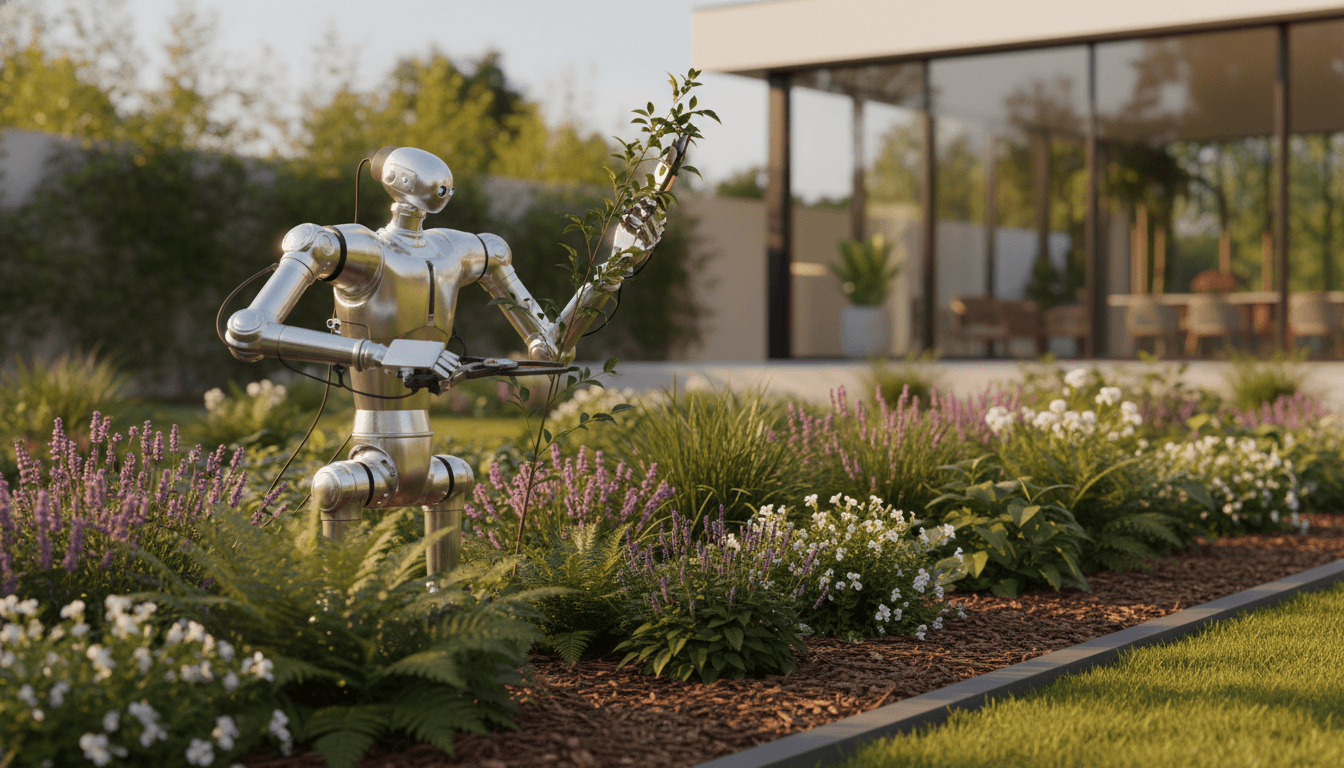
Willow X: Dual-Arm Garden Robot That Works Like Automation
A two-armed garden robot sounds like a novelty—right up until you look at what two arms unlock: stable grasping, tool changes, bimanual tasks, and real manipulation instead of simple “go here, spin blade” automation. That’s why the upcoming commercial release of the Willow X (a smarter dual-armed garden robot first teased back in 2022 and now reportedly nearing a 2025 rollout) matters to anyone tracking AI in robotics & automation.
Most companies get this wrong: they treat consumer robots as toys and industrial robots as “serious.” The reality is that the same stack—perception, planning, safety, and reliability—has to work in both places. A backyard is basically a messy, unstructured factory floor with worse lighting and more surprises.
This post uses Willow X as a lens to talk about what actually makes AI-powered field robotics viable: dual-arm manipulation, outdoor perception, error recovery, human-safe behavior, and the operational playbook that turns impressive demos into daily utility.
Why dual-arm garden robots are a big deal (beyond lawns)
Dual arms change the category from “yard gadget” to “general-purpose outdoor manipulation.” Single-purpose robots—like many robot lawnmowers—are great at one controlled behavior. But gardens demand variety: pulling weeds, trimming, collecting debris, placing mulch, moving irrigation lines, handling tools, and working around fragile plants.
Two arms matter for three concrete reasons:
- Bimanual tasks: Many real tasks require holding with one hand and acting with the other (e.g., stabilize a branch while cutting, hold a bag open while picking up clippings).
- Tool orchestration: A dual-arm robot can keep one tool in hand while switching the other, or use one hand for positioning and the other for work. That reduces time lost to tool swaps.
- Error recovery: Outdoors, “oops” happens constantly—slipping grips, tangled vines, uneven ground. Two arms give the robot more ways to recover without calling a human.
Here’s the bridge to the broader AI in robotics & automation story: the same dual-arm principles show up in warehouse kitting, electronics assembly, food handling, and lab automation. The garden is just a harder environment with fewer fixtures.
The myth: “Outdoor automation is easier than factories”
Factories look complex, but they’re engineered for predictability: consistent lighting, known part bins, marked walkways, and controlled access. A yard offers none of that. Shadows move. Leaves occlude targets. Dirt changes traction. Pets appear. Hoses migrate.
So when a garden robot works reliably, it’s not because the task is simple—it’s because the autonomy stack is getting good.
The AI stack a garden robot needs to survive 2025 backyards
To be useful, Willow X-class robots must combine perception, planning, and safety into a system that degrades gracefully. Not “perfect recognition,” but robust behavior when recognition is imperfect.
Most people think the hard part is detecting weeds. I think the hard part is everything around that: knowing what’s a plant versus a stake, tracking where the robot has already worked, handling changing daylight, and staying safe near people.
Perception: plants aren’t parts
Industrial perception often assumes rigid objects with clear edges. Gardens are soft, irregular, and highly variable across seasons.
A practical outdoor perception stack typically includes:
- Semantic segmentation to classify plant, soil, mulch, border edging, obstacles
- Depth sensing (stereo or time-of-flight) to understand reachability and avoid collisions
- Object tracking for moving obstacles (kids, pets)
- Self-localization to build a workable map of the yard and maintain task context
A subtle but important capability is uncertainty awareness. When the model isn’t confident, the robot should slow down, change viewpoint, or ask for help—not guess with a blade or gripper.
Planning and control: the job isn’t “pick the weed,” it’s “finish the bed”
A good garden robot is evaluated on outcomes, not actions. Homeowners care about a clean bed line and healthy plants. That pushes autonomy toward higher-level planning:
- Coverage planning (what areas have been serviced)
- Multi-step task graphs (detect → approach → grasp → extract → place → verify)
- Replanning when the environment changes (wind, fallen branch, wet soil)
In robotics terms, this is the shift from a scripted routine to closed-loop autonomy.
Safety: consumer environments raise the bar
If Willow X is heading into commercial release, safety can’t be bolted on.
Expect the design targets to include:
- Speed and force limits near humans
- Emergency stop behaviors that are reliable even under network loss
- Tool interlocks (the robot shouldn’t “arm” a cutter outside defined contexts)
- Geofencing and keep-out zones for ponds, roads, neighbor property
From an automation perspective, this is the same philosophy used in collaborative robotics: safe behavior must be a default operating mode, not a special mode.
What dual arms enable that single-purpose yard robots can’t
The real promise is task breadth, not just task speed. A dual-armed platform can plausibly become an “outdoor service robot” with multiple skills.
Below are examples that are realistic if the robot has reliable perception and compliant manipulation.
Weed removal that doesn’t destroy the garden
Weeding sounds straightforward until you try to automate it. The robot must:
- Identify weeds near desirable plants
- Approach without crushing stems
- Extract with the right force profile (taproot vs fibrous)
- Confirm removal (no regrowth point left)
Two arms help because one can part foliage while the other performs the extraction, or one can stabilize soil cover while pulling.
Pruning and trimming with better control
Trimming is a classic “hold and act” task.
- Arm A holds or supports a branch to reduce vibration
- Arm B positions a cutter and executes the cut
That’s the same bimanual logic used in industrial deburring or finishing, just adapted to living materials.
Pickup, sorting, and outdoor “kitting”
A lot of yard work is logistics:
- Collecting fallen fruit
- Picking up sticks before mowing
- Sorting debris into compost vs trash
- Moving small pots, stakes, or irrigation accessories
It maps cleanly to warehouse picking problems, except items are dirtier, deformable, and partially hidden.
A dual-armed garden robot is basically a mobile picking system that learned to handle uncertainty, not just objects.
What it will take for Willow X-class robots to succeed commercially
The winning product won’t be the one with the fanciest demo. It’ll be the one that keeps working on week 14. As 2025 buyers get more skeptical of “smart” devices, reliability and support will decide the category.
Reliability metrics that actually matter
If you’re evaluating a dual-arm service robot—garden or industrial—push vendors to talk about measurable field metrics, such as:
- Intervention rate: how many human assists per hour of operation
- Task completion rate per run (not per grasp)
- Mean time between failures (MTBF) for arms, end-effectors, and sensors
- Recovery behavior: what happens after a failed grasp or localization loss
Even without published numbers, the vendor’s willingness to define these metrics tells you how mature their deployment mindset is.
Operations: the hidden cost center
Consumer robots are often sold as “set and forget.” Real autonomy is closer to “set and supervise lightly.” A practical operating model looks like:
- A quick mapping and boundary setup
- Seasonal re-training or re-calibration prompts (new plants, new mulch)
- Notifications for edge cases (“I found something I can’t classify. Approve?”)
- Consumables and tool maintenance routines
In B2B automation, this is called robot operations (RobOps). The garden is simply bringing RobOps into everyday life.
Data flywheel—done responsibly
These robots improve by learning from real environments, but that raises privacy expectations. The commercial winners will be transparent about:
- What data is stored locally vs in the cloud
- How long data is retained
- Whether users can opt out of shared learning
- How models are updated and validated
Trust is a feature. Especially for always-on devices operating around homes.
Lessons for manufacturing and service automation teams
If Willow X can function in a backyard, many industrial assumptions will look outdated. Outdoor autonomy forces progress on the hard stuff: unstructured perception, compliant manipulation, and robust recovery.
Here are practical crossovers worth stealing for your own automation roadmap:
1. Design for recovery, not perfection
The best automation cells aren’t the ones that never fail—they’re the ones that fail safely and recover quickly.
A strong recovery playbook includes:
- Retry with a different grasp
- Reacquire target from a new viewpoint
- Switch tools (gripper → rake-like end-effector)
- Escalate to human with a clear prompt and minimal friction
2. Two arms can reduce fixtures (and integration time)
Dual-arm systems can sometimes replace expensive custom fixturing by using one arm to hold/position parts. That can shorten deployment cycles, especially in high-mix environments.
3. Unstructured autonomy is a competitive moat
Anyone can buy an arm. The moat is in:
- Sensor fusion tuned for real environments
- Planning that handles uncertainty
- Behavior libraries built from messy edge cases
That’s why consumer field robots matter to enterprise teams: they pressure-test autonomy at scale.
People also ask: what should buyers watch for in a dual-arm garden robot?
Buyers should evaluate autonomy, safety, and serviceability—not just features. If you’re considering a Willow X-class robot as this category matures, focus on questions like:
- What tasks are supported end-to-end today? (Not “in development.”)
- What’s the human intervention rate? How often will you need to rescue it?
- How does it behave around kids/pets? What sensors enforce safety?
- How are tools maintained and replaced? Are parts standardized?
- How does it handle weather and seasons? Wet soil and low winter sun are brutal.
A robot that does fewer tasks reliably will beat a robot that attempts everything and needs constant babysitting.
Where this fits in the “AI in Robotics & Automation” story
A decade ago, “automation” mostly meant fenced robots doing repeatable moves. The new frontier is robots that operate in human spaces, making decisions under uncertainty and manipulating real-world objects safely. A dual-armed garden robot like Willow X is a visible marker of that shift.
If you’re building an automation roadmap—whether for manufacturing, logistics, facilities, or field service—watch this category closely. Backyards are becoming a proving ground for the same autonomy capabilities enterprises are paying for: perception that generalizes, planning that recovers, and manipulation that adapts.
What do you think will be the first non-garden job where dual-arm mobile robots become normal: warehouse returns, hospital supply runs, or facilities maintenance?