DIY robotics is one of the fastest ways to learn practical AI automation. Here’s how hobby builds translate into real-world robotics skills.
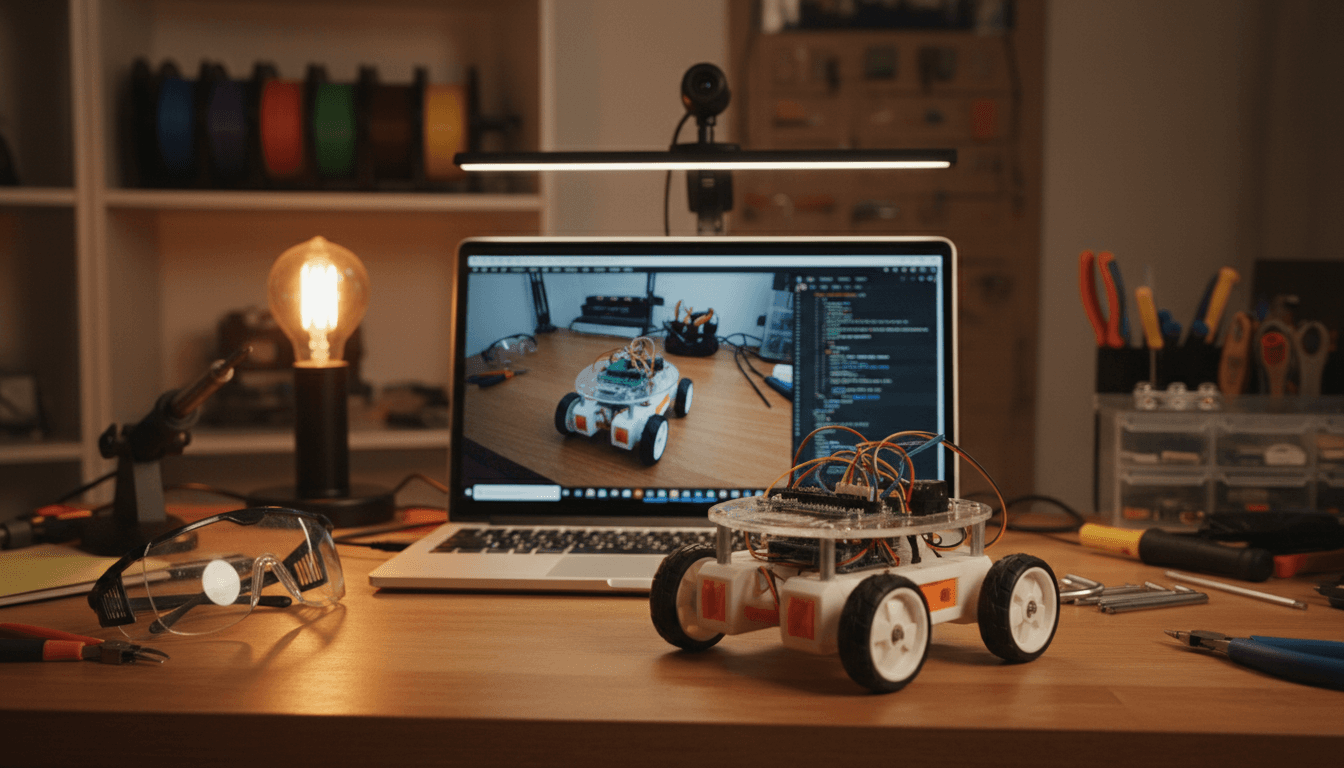
Building DIY Robots at Home: The Hobbyist AI Edge
Robotics used to have a “permission barrier.” You needed a lab, pricey hardware, and access to the right people. That barrier has cracked wide open—mostly because the tools got cheaper (3D printers, microcontrollers, commodity sensors), and because software got friendlier (Python-first stacks, MicroPython, and off-the-shelf AI models).
Robot Talk Episode 134, featuring hobbyist creator Kevin McAleer (kevsrobots), lands on a point I strongly agree with: building robots as a hobby isn’t a distraction from “real” automation—it’s one of the fastest ways to learn how AI-powered robotics actually works. When you’ve fought with a servo that jitters under load or a camera feed that drops frames, you start making better engineering decisions.
This post sits inside our AI in Robotics & Automation series for a reason. If you’re leading automation projects, hiring robotics talent, or just trying to understand where embodied AI is headed, hobbyist robotics is a surprisingly good signal. It’s where new ideas get tried cheaply, publicly, and at a pace most organizations can’t match.
Why hobby robotics is a serious on-ramp to AI automation
Answer first: Hobby robotics teaches the exact integration work that makes or breaks AI in robotics—sensor reliability, compute limits, latency, power budgets, and mechanical tolerances.
In industrial robotics, it’s easy to talk about “AI perception” or “autonomous navigation” as if it’s just a model you download. The reality is that embodied AI only looks impressive when the whole system holds up:
- The camera has consistent exposure, mounting, and vibration control
- The compute can run inference without stalling control loops
- The drivetrain is repeatable enough for mapping and localization
- Your code can recover from the messy edge cases (slip, glare, dropouts)
Home builds force you to face those constraints early. That’s why Kevin’s path—starting with a 3D printer and wanting “more interesting builds”—is so common. 3D printing doesn’t just make parts; it makes iteration cheap. Cheap iteration is how you learn robotics.
The hidden curriculum: integration beats theory
A hobby project exposes you to the stuff that rarely shows up in glossy demos:
- Timing: your robot isn’t “slow,” your control loop is blocked by a camera read
- Noise: your sensor isn’t “bad,” it’s unfiltered and mounted poorly
- Power: your robot isn’t “buggy,” your voltage dips under motor load
If you’re evaluating AI-driven automation for a business, this matters because integration is where schedules slip and budgets balloon. Hobbyists learn to respect that early.
The stack that makes home robotics practical (Python + MicroPython)
Answer first: Python lowers the learning curve, and MicroPython makes embedded control approachable—together they’re a pragmatic stack for DIY robots.
Kevin’s preference for Python and MicroPython reflects what’s happening broadly: Python is the common language between AI and robotics. It’s what people use to prototype perception, train models, manipulate data, and glue components together.
MicroPython adds a second advantage: it reduces the intimidation factor of embedded development. Instead of wrestling with toolchains and C++ build systems on day one, you can:
- Bring up sensors quickly
- Test motor control logic interactively
- Iterate on behaviors without recompiling everything
That’s not “less serious.” It’s faster learning.
A practical division of labor: edge control vs. AI compute
A simple architecture that works well at home (and maps cleanly to industry) is:
- Microcontroller (MicroPython): real-time-ish tasks
- motor PWM
- reading encoders/IMU
- safety stops
- Single-board computer (Python): higher-level intelligence
- camera processing
- path planning
- voice or gesture control
- logging and debugging
Even if your first robot is basic, this split teaches a big idea in AI robotics: keep safety and low-latency control close to the hardware, and run “thinking” where you have compute.
How hobbyists are using AI at home (without building a lab)
Answer first: Hobbyists get real AI capabilities by combining small models, classical robotics, and practical constraints—rather than chasing giant end-to-end systems.
If you’re building at home, you don’t need a humanoid or a warehouse AMR to learn AI in robotics. You need one closed-loop behavior that works reliably.
Here are AI-driven features that are realistic for hobbyists and relevant to automation teams.
1) Vision-based line following that doesn’t fall apart
Classic line following uses IR sensors. Vision-based line following uses a camera and can handle:
- worn tape
- multiple lanes
- intersections
- changing lighting
A lightweight approach:
- Start with OpenCV thresholding and contour detection
- Add a small classifier only when needed (e.g., intersection type)
Business parallel: This is the same “good enough perception” strategy used in many production systems—classical methods first, ML where it pays.
2) Object detection for pick-and-place or “tidy-up” bots
You don’t need a full grasping research stack. A hobbyist can:
- detect an object class (cups, blocks, tools)
- estimate a rough centroid
- approach and nudge, scoop, or simple-grab
Business parallel: Many automation wins come from constraining the problem, not maximizing model complexity.
3) Voice control that’s actually useful
Hobby robots can support voice commands like “stop,” “come here,” or “patrol.” The trick is not the speech model—it’s the system design:
- require wake words
- confirm critical commands
- prioritize safety override
Business parallel: Human-in-the-loop controls and clear operator intent are central to service robotics and collaborative automation.
4) Simple reinforcement learning—mostly for learning, not deployment
If you’re tempted by reinforcement learning, keep expectations grounded. It’s a great way to learn about policies, reward shaping, and sim-to-real gaps. For home projects, the value is educational: you’ll understand why many real deployments still prefer hybrid approaches.
From garage builds to industry wins: what companies should pay attention to
Answer first: Hobby robotics is a talent pipeline and a testing ground for practical AI behaviors, especially in perception, embedded control, and rapid prototyping.
Most companies say they want “robotics engineers,” but they screen for degrees and years of experience in specific stacks. Meanwhile, hobbyists are out there proving something more relevant: they can ship working systems under tight constraints.
Here’s what I’ve seen translate well from hobby projects to professional AI automation:
Rapid prototyping mindset
Hobbyists learn to iterate in days, not quarters:
- print a new bracket
- adjust weight distribution
- rewrite the control loop
- re-test
That pace is exactly what early automation programs need.
Reliability instincts
A hobbyist who’s built three robots learns patterns quickly:
- every wire needs strain relief
- every connector will fail eventually
- every moving part needs a tolerance plan
Those instincts are gold in field robotics.
Systems thinking (the rare skill)
AI in robotics fails when teams treat perception, planning, and control as separate projects. Hobby builders can’t afford that separation. They end up with systems thinking by necessity.
“AI in robotics isn’t one model. It’s a chain of decisions that must stay stable under real-world mess.”
A realistic “first robot” plan (that teaches AI fundamentals)
Answer first: Build one small robot that moves reliably, senses one thing well, and logs everything—then add AI as a layer, not a replacement.
If you want robotics as a hobby to pay off—either for your career or your organization’s automation strategy—start with a plan that creates momentum.
Step 1: Build for motion you can trust
Pick a simple platform (2WD or tracked) and focus on:
- consistent steering
- stable power delivery
- repeatable speed control
If motion is unreliable, perception and AI won’t matter.
Step 2: Add one sensor and treat it like a product
Choose one:
- camera
- ultrasonic
- lidar (if you have the budget)
- IMU + wheel encoders
Then do the boring work:
- calibration
- filtering
- mounting rigidity
- data logging
Step 3: Add one autonomy behavior
Examples that teach a lot fast:
- wall-following with distance sensor
- waypoint driving using dead reckoning + correction
- camera-based target tracking
Step 4: Add AI where it reduces brittleness
This is where hobbyists often get it right: use AI to handle variability, not to replace everything.
Good uses of AI early on:
- classify signs or markers
- detect obstacles that rule-based code misses
- adapt thresholds to lighting changes
Step 5: Document and share (seriously)
Kevin’s content focus—videos and teaching—highlights a multiplier effect. When you explain your build:
- you debug your own thinking
- you attract collaborators
- you build a portfolio others can evaluate
For teams, internal demos and build logs serve the same purpose.
Where AI hobby robotics is headed in 2026 (and why it matters)
Answer first: The next wave is smaller, more capable on-device models paired with better dev tooling—meaning more autonomy will be built by individuals, then borrowed by industry.
Right now, the “AI in robotics” conversation is dominated by big labs and big budgets. But the practical direction is clear:
- On-device AI becomes normal as efficient models run on modest hardware
- Tooling improves (better simulators, better deployment workflows)
- Communities accelerate learning through open tutorials and shared code patterns
This creates a feedback loop: hobbyists try ideas quickly, the community refines them, and industry adopts the patterns once they’re proven.
Robotics as a hobby is also seasonal in a helpful way. Heading into the end-of-year break, a lot of people have time to tinker, learn, and build. If you’re running an automation program, this is a smart time to:
- sponsor internal “weekend robot” projects
- encourage engineers to prototype with MicroPython/Python stacks
- recruit makers who can show working demos
What to do next if you’re serious about AI-driven robotics
If you’re an individual, start small and build something that moves reliably. If you’re a business leader, pay attention to hobby robotics because it’s an early indicator of where AI automation skills are forming.
The fastest path to competency in AI-driven robotics isn’t memorizing model architectures. It’s learning how to connect sensors, compute, code, and mechanics into one system that behaves predictably.
If you were to build a “home robot” that teaches your team the most about real automation—would you prioritize perception, manipulation, or navigation first?