Learn how AI-driven warehouse robots collaborate with humans, what to evaluate, and which use cases deliver ROI fast.
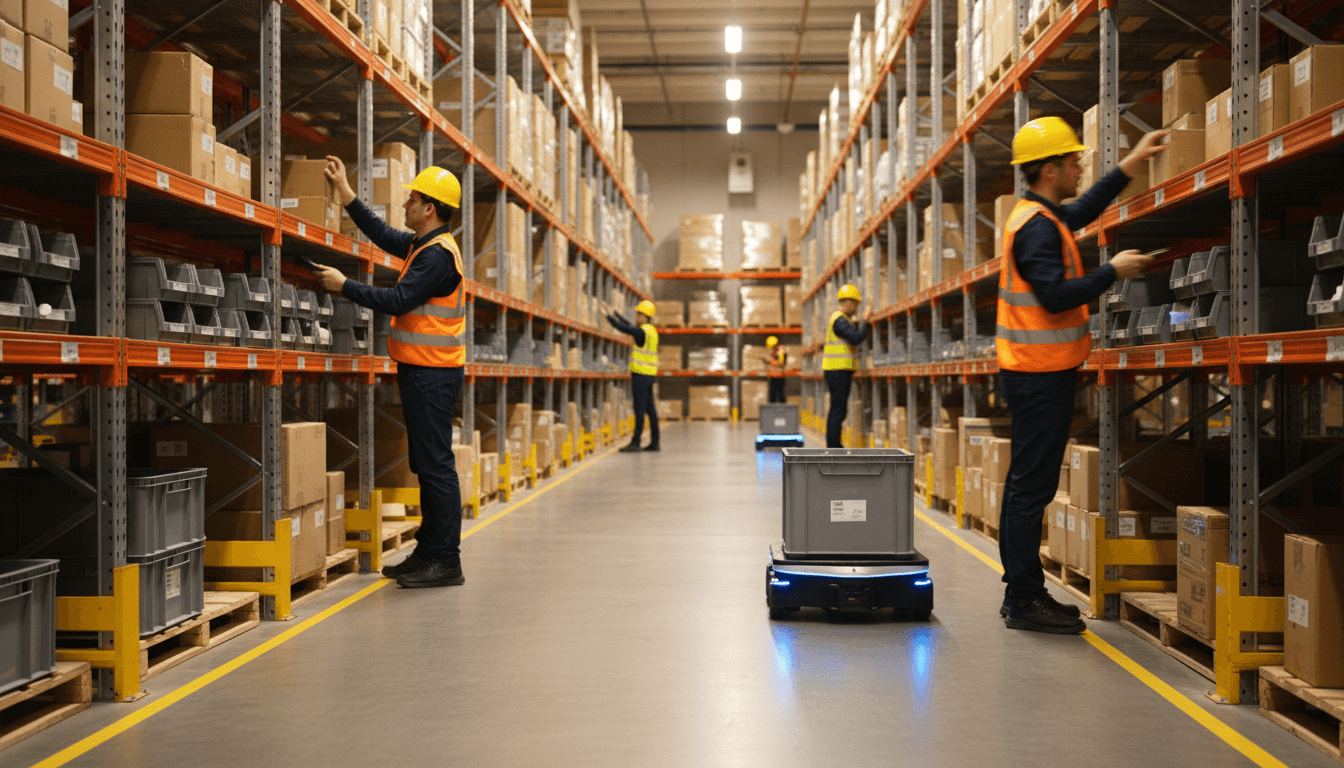
AI Warehouse Robots That Actually Work With People
Peak season exposes a truth most automation plans try to ignore: the warehouse is a human system first. You can add conveyors, sensors, and robots—but when orders spike, aisles clog, pickers improvise, pallets land in the “wrong” spot, and yesterday’s perfect process map stops matching reality.
That’s why I liked the framing in Robot Talk Episode 132, where host Claire chatted with Anthony Jules, CEO and co-founder of Robust.AI, about autonomous warehouse robots designed to collaborate with humans, not replace them or force a facility redesign. Robust.AI’s flagship robot, Carter™, is built for existing environments and workflows—an approach that’s quickly becoming the most practical path to ROI in AI-driven warehouse automation.
This post is part of our “AI in Robotics & Automation” series, and I’m going to take the podcast’s big ideas and translate them into decisions you can use: what “collaboration” actually means on a warehouse floor, where AI does the heavy lifting, and how to evaluate a deployment without getting distracted by glossy demos.
Collaborative warehouse robots succeed when they fit the real workflow
A collaborative robot in logistics wins by reducing friction for people. Not by showing off speed in a controlled pilot lane.
In warehouses, the highest-cost moments aren’t the steady-state tasks—they’re the exceptions: blocked aisles, mixed SKU carts, last-minute re-slotting, partial pallets, seasonal temps who don’t know the layout yet, and teams working around each other under time pressure. The practical question is simple:
If your building is messy at 2:30 p.m. on a Friday, does the robot still help—or does it become one more thing everyone works around?
Anthony Jules’ background (robotics, AI, plus decades of building and scaling businesses) shows up in this “humans-first” emphasis. Warehouses aren’t labs. They’re dynamic, social, and time-sensitive.
What “work alongside humans” means in practice
Human-robot collaboration in manufacturing and logistics usually comes down to three non-negotiables:
- Predictability: People need to understand what the robot will do next.
- Courtesy behavior: The robot has to yield, reroute, and avoid “assertive” moves that feel unsafe.
- Workflow compatibility: It should support how work already happens (pick, stage, replenish), not require constant process changes.
If a robot can’t do those three, it isn’t collaborative—it’s just co-located.
The AI stack that makes collaboration possible (and what buyers should ask)
AI in warehouse robotics isn’t one feature; it’s a stack of capabilities that turns sensors + compute into useful behavior around people.
Even if vendors describe it differently, collaboration typically relies on five layers:
1) Perception that holds up in warehouse lighting and clutter
Warehouses are full of reflective wrap, mixed lighting, narrow aisles, and moving obstacles. A collaborative autonomous mobile robot (AMR) has to detect:
- People (including unpredictable motion)
- Pallets, carts, and lift trucks
- Temporary obstructions (spill kits, stretch wrap, floor debris)
What to ask vendors:
- How does perception degrade with glare, dust, or dim zones?
- What happens when sensors are partially occluded?
- How does the system handle “unknown objects” without freezing operations?
2) Navigation that prioritizes human comfort, not just shortest path
Classic navigation optimizes distance and time. Collaborative navigation optimizes trust. That means conservative passing distances, smooth speed changes, and behavior that “reads” as polite.
What to ask:
- Can the robot infer congested areas and choose alternative routes?
- Does it slow down near staging areas automatically?
- Can you tune “social navigation” parameters by zone (packing vs. bulk storage)?
3) Task planning that matches how work is actually assigned
Robots don’t create value by moving—they create value by moving the right thing at the right time without adding coordination overhead.
Strong AI task planning should:
- Batch missions intelligently (milk-runs, zone-based routes)
- Balance robot utilization against picker needs
- Avoid “robot traffic jams” near choke points
What to ask:
- How are missions prioritized when everything is urgent?
- Is there a dispatch layer that understands labor waves and cut-off times?
- Can supervisors override plans without breaking the system?
4) Human-robot communication that’s obvious and low-effort
This part is frequently underestimated. A robot that collaborates needs to communicate intent and handle human input without a training manual.
Look for:
- Clear signals for yielding/turning/stopping
- Simple ways for associates to request help or reroute a robot
- Fast recovery from “human interventions” (someone moves it, blocks it, or changes the task)
What to ask:
- If an associate does something unexpected, how does the robot recover?
- How do you handle temporary workers during peak season?
5) Continuous learning and operations tooling
A real deployment is never “done.” Layout changes, slotting shifts, and operational policies evolve.
You want:
- Fleet analytics (bottlenecks, idle time, congestion heatmaps)
- Safe updates and rollbacks
- Tools that let ops teams adjust behavior without calling engineering
What to ask:
- What can my ops team tune themselves?
- How often do maps and behaviors need refreshing?
- What’s the process for change management during peak?
Why “don’t disrupt existing workflows” is the right hill to die on
Most companies get this wrong: they buy automation that assumes the building will behave. Then they spend months forcing the building to behave.
The more practical philosophy—highlighted in the episode’s focus on Carter™—is to bring robots into the facility as it exists today and earn adoption by making people’s days easier.
Here’s what “no workflow disruption” looks like on the floor:
- The robot integrates into current pick paths rather than forcing a redesign.
- The robot handles the variability of human motion and ad-hoc staging.
- Associates don’t need to babysit it to hit throughput.
That approach matters even more in December. Peak brings:
- More people (often less experienced)
- More exceptions (split shipments, substitutions)
- Less tolerance for operational downtime
A collaborative AMR that performs “well enough” across messy conditions beats a perfect robot that needs the environment to be perfect.
Practical use cases where collaborative AMRs pay off fastest
Collaborative robots deliver ROI when they remove non-value travel and reduce chaos around staging. The biggest wins are usually unglamorous.
Goods-to-person support without the full goods-to-person build
Full goods-to-person systems can be great, but they’re capital-heavy and facility-specific. Collaborative AMRs can support a lighter version by:
- Moving totes/carts between pick zones and pack-out
- Feeding workstations with replenishment
- Clearing completed picks to reduce floor clutter
Zone replenishment and “runner” tasks
A common pain point is burning skilled labor on low-skill movement. AMRs are strong at:
- Moving empty containers
- Taking cardboard/waste to consolidation
- Bringing high-velocity SKUs to forward pick locations
Exception handling and overflow lanes during peak
During peak, you often add overflow staging areas and temporary lanes. Collaborative robots help when they can adapt to:
- Temporary keep-out zones
- Pop-up staging
- Shifting choke points
If a robot needs a week of reconfiguration for a seasonal change, it’s not a peak-season tool.
A buying checklist: how to evaluate collaborative robotics like an operator
The reality? It’s simpler than you think: you’re not buying a robot—you’re buying a new operating model for material movement.
Here’s a checklist I’ve found useful when teams evaluate AI-powered warehouse robots.
Define success with a small set of operational metrics
Pick 3–5 metrics and commit to them:
- Travel time reduced per picker per hour
- Lines per hour improvement at pack or pick
- Congestion incidents per shift
- Robot assists per hour (productive moves)
- Time-to-recover from blocked path events
Run the “Friday afternoon” test
Don’t judge performance on a quiet morning.
- Put the robot near your worst choke point.
- Run it during shift change and breaks.
- Include mixed traffic: carts, pallets, and pedestrians.
If the robot becomes timid and stops too often, throughput suffers. If it becomes aggressive, people lose trust. Collaboration is a narrow band, and that’s exactly why it’s valuable.
Check integration reality, not integration promises
Most deployments need to interface with a WMS/WES, dispatch logic, and safety procedures.
Ask:
- What’s required from my IT team (weeks, not “hours”)?
- What happens if the WMS is down—do robots fail safely?
- How are missions created, queued, and audited?
Plan the human side like it’s the whole project (because it is)
The fastest deployments treat change management as a first-class workstream:
- Train associates on how the robot behaves more than on buttons.
- Create clear “right of way” rules and zone signage.
- Give one supervisor ownership of robot ops each shift.
A collaborative robot that no one “owns” operationally will drift into underuse.
People Also Ask: collaboration, safety, and ROI
Are collaborative warehouse robots the same as cobots?
No. Cobots usually refer to collaborative arms working near people at a workstation. Collaborative AMRs are mobile robots navigating shared spaces like aisles, pack-out zones, and staging areas.
Do collaborative AMRs reduce headcount?
Sometimes, but the most reliable value is redeploying labor from walking and shuttling into higher-throughput work. In practice, many sites use AMRs to hit service levels during growth or peak without constant hiring pressure.
What’s the biggest failure mode in AI warehouse automation?
Buying a system optimized for demos rather than operations. If the robot needs the environment to be controlled, it won’t survive real shift variability.
Where this fits in the bigger “AI in Robotics & Automation” story
This episode sits in a broader trend we’re tracking across manufacturing, logistics, and service operations: AI is shifting robotics from “automation cells” to “automation coworkers.” The point isn’t that robots become human; it’s that AI makes robots understandable, adaptable, and safe enough to share space and timing with people.
If you’re considering collaborative robots for manufacturing intralogistics or warehouse fulfillment, take a clear stance: optimize for adoption, not novelty. The robot that earns trust on day three beats the one that looks impressive on day one.
If you want help scoping a collaborative robotics deployment—use cases, KPI targets, and an evaluation plan that survives peak—build a short list of your top workflows and constraints (layout, WMS, safety policies, labor model). That’s the fastest way to figure out whether AI-driven warehouse automation will pay off in your building.
Where do you see the most wasted motion in your operation right now: replenishment runs, staging congestion, or long pick travel?