AI warehouse robots using pneumatic suction can handle up to 75,000 lb/hour. Learn where they fit, how AI boosts reliability, and what to ask in pilots.
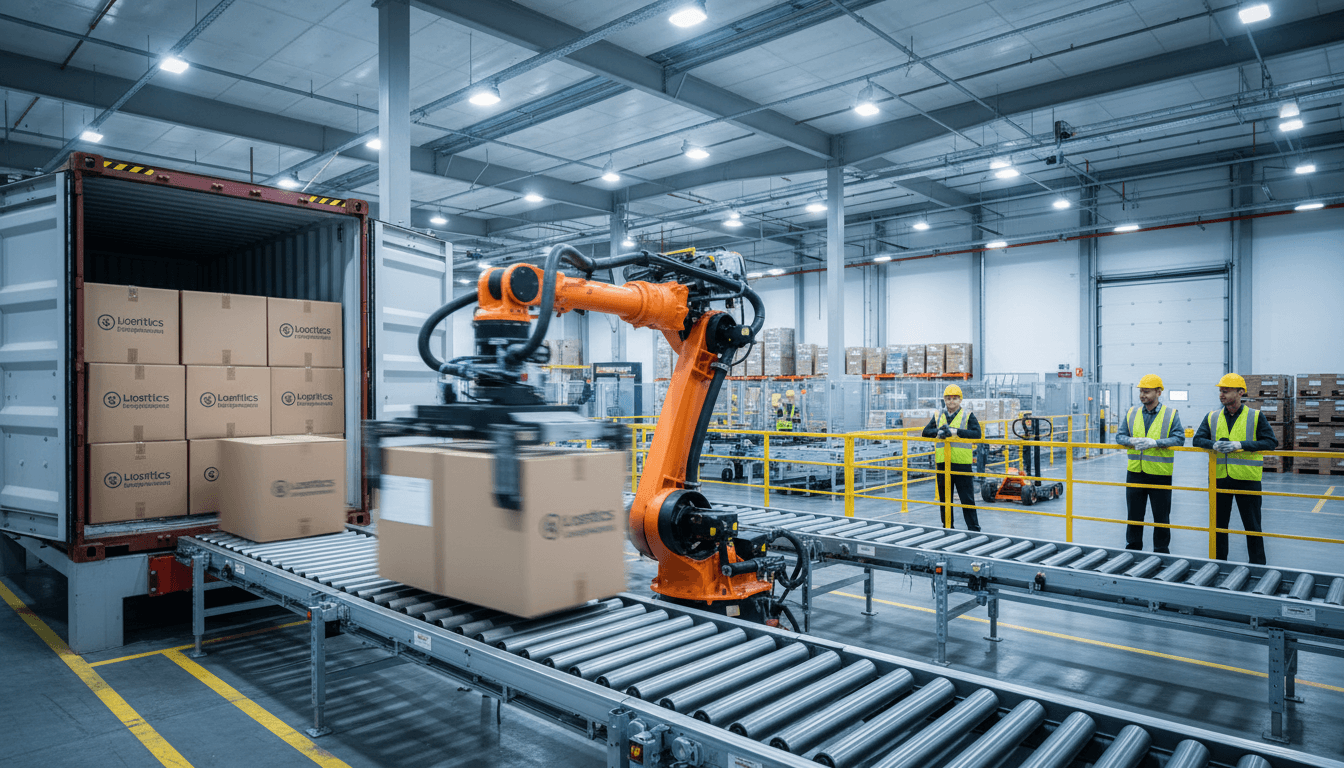
AI Warehouse Robots: 75,000 lb/hr Cargo Handling
A robot that can move 75,000 pounds of cargo per hour isn’t a cool lab demo—it’s a loud signal that warehouse automation has entered a new phase. Not the “maybe someday” phase. The “your competitors are piloting this” phase.
The interesting part isn’t just speed. It’s how systems like a pneumatic-suction cargo robot pull it off: perception that understands messy real-world freight, planning that chooses safe grasps in milliseconds, and control that keeps a seal while the load shifts. That’s where AI in robotics & automation stops being a buzzword and starts being a line item on your ops roadmap.
This post breaks down what suction-based industrial robots are doing differently, why AI is the difference between a fragile prototype and a production workhorse, and how to evaluate whether this kind of AI-powered warehouse robot fits your facility in 2026.
Why 75,000 lb/hour matters in real operations
Answer first: Throughput at this level changes the economics of dock and container workflows because it targets the slowest, most labor-constrained steps—loading, unloading, and high-volume transfer.
If you run a warehouse, cross-dock, or manufacturing distribution center, you already know the pinch points: unpredictable inbound schedules, seasonal labor volatility (hello, late Q4 and post-holiday returns), and the constant tradeoff between speed and damage rates. A robot rated at 75,000 lb/hour suggests a system designed for sustained material handling, not occasional picks.
Here’s what that throughput implies when you translate it into warehouse math:
- Faster trailer/container turn: Minutes matter at the dock. If you reduce dwell time, you reduce yard congestion and detention costs.
- Higher utilization of upstream automation: Conveyors, sortation, and palletizers only help when inbound flow is consistent.
- A new baseline for staffing: Not “replace everyone,” but “stop scaling headcount linearly with volume.”
And yes—humanoids make headlines. But for 2026 planning, most teams will get more ROI from task-specific robots that can do one painful job extremely well.
What pneumatic suction robots do better than grippers
Answer first: Suction excels in high-mix cargo handling because it reduces the need for precise finger placement and can tolerate variation in shape—if the system can reliably find seals and manage failures.
Traditional robotic grippers are great when the objects are consistent: same carton size, known orientation, predictable spacing. Warehouses don’t behave like that. Loads arrive dented, shrink-wrapped, bulging, tilted, and occasionally “mystery boxed.”
A pneumatic-suction end effector changes the contact problem. Instead of pinching an object, it forms a seal and uses pressure differential to lift. That brings several operational advantages:
- Speed: Suction can be a one-step “touch and lift” interaction.
- Gentle handling: Less squeezing reduces crush risk for certain packaging.
- Simpler grasp planning: Often you just need a suitable surface patch, not edges or handles.
The catch: suction is only “easy” when the world is perfect
Suction fails in predictable ways:
- Porous materials (some papers, unsealed cardboard)
- Uneven surfaces, straps, or wrinkles in shrink wrap
- Dusty surfaces or condensation that breaks seals
- Small leaks that turn into drops during acceleration
This is why the AI layer matters. A fast suction cup doesn’t help if the robot spends half its cycle reattempting failed picks or—worse—dropping cargo.
Suction hardware creates the opportunity. AI makes it dependable.
Where AI shows up in industrial cargo robots (and why it’s non-negotiable)
Answer first: AI enables the robot to perceive irregular freight, choose reliable pick points, and adapt in real time when friction, weight, or packaging behaves differently than expected.
When people hear “AI-powered robotics,” they often picture chatbots attached to arms. That’s not what runs a high-throughput dock robot. The practical AI stack is usually four pieces:
1) Perception that works in ugly lighting and clutter
Warehouses have glare, shadows, barcode labels, torn packaging, and occlusions. AI-based vision models help classify surfaces and detect:
- Box faces vs. straps vs. voids
- Pallet edges and “no-go” zones
- Deformation (bulges, tears) that predicts weak seals
In suction handling, perception isn’t just “find the box.” It’s “find the part of the box that will hold a seal under acceleration.”
2) Grasp (seal) selection and scoring
A strong approach is to treat every potential suction point as a candidate and score it.
A production system typically learns from:
- Visual cues (texture, edges, labels)
- Depth/geometry (flatness, curvature)
- Historical outcomes (which surfaces failed previously)
A simple but effective KPI to track in pilots is first-attempt success rate (how often the robot lifts successfully on the first try). If you don’t measure this, you’ll overestimate throughput.
3) Motion planning tuned for “don’t break the seal”
High-speed motion isn’t just moving quickly—it’s managing jerk, vibration, and swing.
AI-assisted control can adjust trajectories based on:
- Estimated weight and center of mass
- Real-time vacuum pressure readings
- Micro-slippage detection (the moment a seal starts to fail)
4) Exception handling (the real difference between demos and deployments)
The warehouse isn’t impressed by a robot’s best-case cycle time. It cares about what happens on the 500th odd-shaped package.
Good AI-driven robots have explicit behaviors for:
- Reattempting with a different suction point
- Switching to a different end-effector mode (multi-cup arrays, edge suction, or hybrid grip)
- Flagging items for human assist when confidence drops below a threshold
This is also where integration with a warehouse execution system (WES) or warehouse management system (WMS) pays off: you can route “problem freight” to an exception lane instead of stalling the whole line.
Best-fit use cases: where suction cargo robots win first
Answer first: The strongest early wins are in high-volume, repetitive transfer tasks—especially at docks—where variability is high and labor availability is the bottleneck.
If you’re evaluating an AI warehouse robot, don’t start by asking “Can it do everything?” Start by asking “Which 20% of workflows cause 80% of delays?” In my experience, it’s usually one of these:
1) Trailer and container unloading
Unloading is physically demanding, hard to staff, and inconsistent. Robots that can quickly pick cartons or parcels from a packed container and place them onto a conveyor can stabilize inbound flow.
What to look for:
- Ability to handle crushed or tilted cartons
- Safe behavior near humans (mixed zones are common at docks)
- Clear recovery strategy when loads shift
2) Cross-dock transfers and build-out lines
When inbound becomes outbound fast, the cost of pauses is huge. A high-throughput suction system can feed sorters or pallet build lines more consistently than manual teams during peak surges.
3) Manufacturing logistics (line-side replenishment)
Manufacturing plants often move heavy cases, totes, or packaged components at a steady cadence. If your line stops due to missing parts, you don’t need a humanoid—you need predictable material flow.
What buyers should ask before they pilot one
Answer first: Ask questions that force clarity on throughput under exceptions, integration effort, and safety—not just peak pick rate.
Robotics vendors love quoting best-case performance. You need the “real shift” numbers. Here’s a practical checklist.
Performance questions (get numbers, not adjectives)
- Sustained throughput: What’s the average over an 8-hour shift with mixed freight?
- First-attempt pick success: What percentage of picks succeed on the first try?
- Damage rate: What’s the observed damage/marking rate on common packaging types?
- Exception rate: What percentage of items require human assist?
- Changeover time: How long to reconfigure for new carton ranges or workflow changes?
Integration and data questions
- What does the robot need from WMS/WES—SKUs, carton dimensions, inbound manifests?
- How are events logged (pick success, vacuum loss, drop prevention triggers)?
- Can you export data for continuous improvement, or is it trapped in a dashboard?
Facility readiness questions
- Do you have the right compressed air capacity for pneumatic suction at scale?
- Is dock layout compatible with the robot’s reach and safety envelope?
- Do you have consistent pallet quality and floor conditions (flatness matters)?
A good pilot is boring. The goal is repeatability, not hero demos.
The bigger trend in the AI in Robotics & Automation series
Answer first: Task-specific robots with AI-driven perception are scaling faster than general-purpose humanoids because they fit existing workflows and deliver measurable ROI.
This pneumatic-suction cargo robot headline fits a pattern we’ve been tracking across the AI in Robotics & Automation series: the most valuable automation is often the least flashy.
AI is pushing industrial robots from “structured automation” into “semi-structured reality.” That means:
- Warehouses don’t need perfect item presentation.
- Robots can make reasonable decisions with incomplete information.
- Exception handling becomes a designed feature, not a failure state.
The facilities that win in 2026 won’t be the ones with the most robots. They’ll be the ones that treat robotics like a performance system: instrumented, optimized, and continuously improved.
Next steps: how to decide if an AI cargo robot fits your site
Start with one workflow and one measurable outcome. For most operations teams, that’s dock unloading or high-volume transfer.
A solid plan looks like this:
- Pick a lane: One door, one container type range, one shift.
- Define success metrics: Sustained throughput, first-attempt success rate, exception rate, and damage rate.
- Design the human-robot handshake: Where humans step in, how exceptions are routed, and who owns uptime.
If you’re considering an AI-powered warehouse robot for suction-based cargo handling, the main question isn’t “Can it hit 75,000 lb/hour?” It’s: Can it keep your dock moving at a predictable pace when the freight is messy and the schedule is worse?