Spot’s septuple backflip isn’t just a stunt. Here’s what it reveals about AI robotics—and how that capability translates to real automation in logistics and manufacturing.
AI Robotics Lessons Behind Spot’s Septuple Backflip
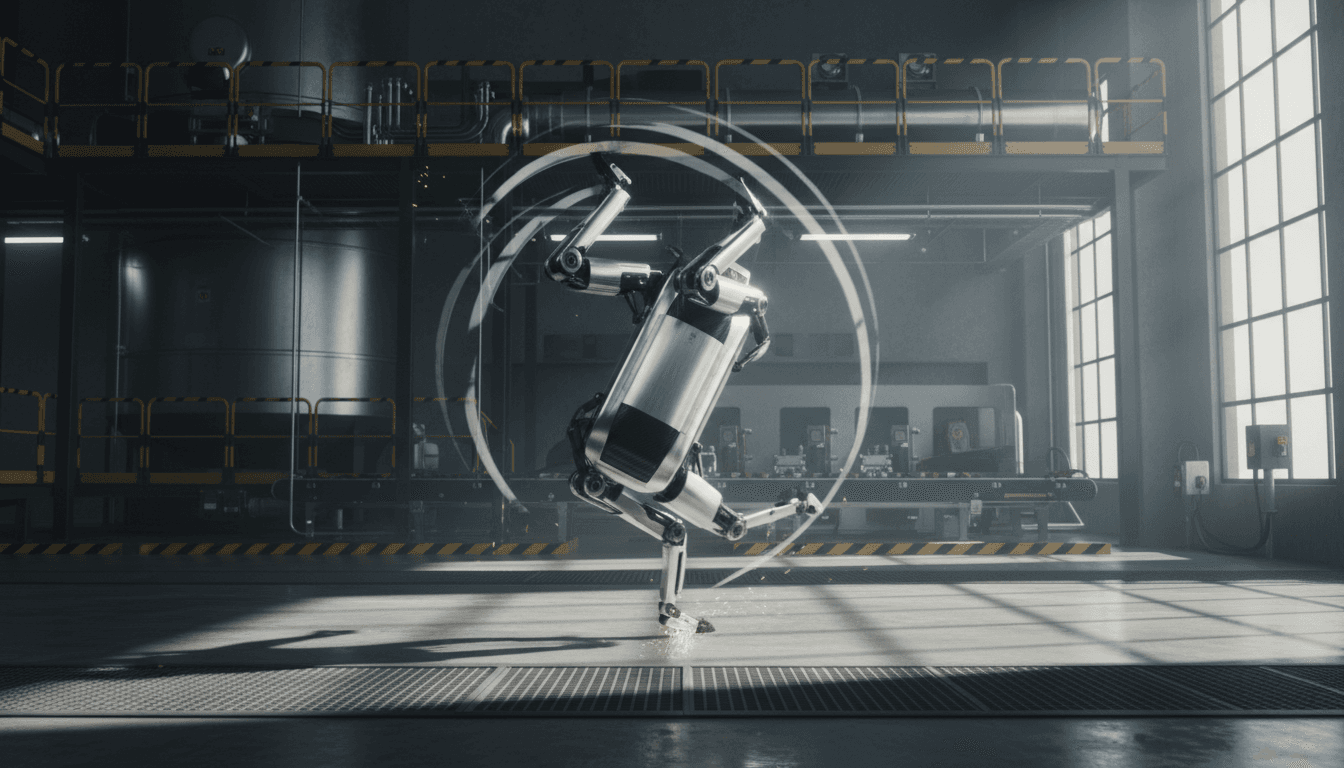
A septuple backflip isn’t a factory requirement. But when Boston Dynamics’ Spot sticks one into a post, it’s not “just a stunt.” It’s a public proof that AI-powered robotics has crossed a threshold: complex, high-speed whole-body motion is becoming reliable enough to package, repeat, and eventually deploy.
Most companies get this wrong. They see acrobatics and assume it’s entertainment. The practical signal is different: if a legged robot can manage seven consecutive rotations and land with control, it can also manage the messy physics of real sites—slippery floors, uneven surfaces, imperfect payloads, and last-minute changes. That’s what automation teams actually need in 2026 planning cycles.
This post breaks down what a “show-off” maneuver tells us about the state of AI in robotics and automation, what’s likely happening under the hood, and how to translate that capability into real-world wins in logistics, manufacturing, inspection, and hazardous operations.
What a septuple backflip really proves
A septuple backflip demonstrates one thing above all: robust whole-body control under tight timing constraints. In industrial robotics, the hardest problems aren’t the ones that look hard (like lifting a heavy box). They’re the ones where small errors cascade—foot slip, joint backlash, a slightly off-center payload, or a minor delay in sensor updates.
For a legged system to rotate repeatedly and land, it must do all of the following reliably:
- Estimate state (position, velocity, orientation) in real time while the body is moving fast
- Plan motion that respects joint torque limits, contact forces, and balance constraints
- Control contacts (when and how feet touch, push, and release) with millisecond-level precision
- Recover from small deviations without “starting over”
In other words, it’s the same stack you want for a robot that:
- steps over debris in a warehouse aisle,
- climbs a short set of stairs on a construction site,
- carries a sensor mast without wobble,
- or rebalances after a bump from a rolling cart.
The myth: “Acrobatics don’t matter for automation”
They matter because automation fails at the margins. A robot that performs well only in tidy, lab-like conditions is expensive theater.
A robot that can execute a physically extreme routine is showing something more valuable: margin. The extra stability, actuation bandwidth, and control sophistication needed for acrobatics tends to translate into fewer falls, fewer emergency stops, and fewer human interventions in real deployments.
How AI likely enables this behavior (without the buzzwords)
The “AI” in a backflip isn’t one magical model doing everything. It’s usually a layered system where different methods handle perception, planning, and control. The high-level takeaway: modern robot performance comes from closing the loop faster and smarter.
Learning-based control: policies that handle messy dynamics
For highly dynamic behaviors, classical control alone can be brittle because the real world never matches the model perfectly. Many top robotics teams use reinforcement learning (RL) or other learning-based approaches to train a control policy that’s good at:
- dealing with slight differences in friction,
- tolerating actuator lag,
- adapting to small disturbances,
- and maintaining stability across varied initial conditions.
A common pattern is:
- Train in simulation with randomized physics (domain randomization)
- Validate on hardware with safety constraints
- Gradually expand the “allowed” behavior as confidence grows
That training style is directly relevant to industrial automation because it reduces the “hand-tuning tax”—the endless on-site parameter tweaking that kills timelines.
Model predictive control (MPC): planning with constraints
Dynamic maneuvers typically need a controller that looks ahead. Model predictive control can optimize the next sequence of actions while respecting constraints like torque limits and contact forces.
Even if a learning policy is in charge, MPC often appears somewhere in the stack to enforce safety or improve precision. In automation terms, MPC is the difference between:
- “the robot can do it once,” and
- “the robot can do it 10,000 times without breaking itself.”
Sensor fusion: knowing where the robot is, even mid-air
To land a backflip, the robot must keep accurate orientation and velocity estimates during rapid rotation. That usually means blending:
- inertial measurement unit (IMU) data,
- joint encoders,
- possibly vision or depth cues,
- and contact sensing when feet touch down.
This matters on production floors because perception isn’t always perfect. Dust, reflective surfaces, and clutter can degrade cameras. A robot that can maintain control with partial information is a robot that can keep working when conditions aren’t ideal.
Snippet-worthy reality: The quiet breakthrough in modern robotics isn’t “smarter robots.” It’s robots that stay stable when reality doesn’t cooperate.
From backflips to production lines: practical automation use cases
If you’re responsible for robotics and automation in a facility, you’re not buying backflips. You’re buying uptime, safety, and throughput. Here’s where this kind of dexterity and control shows up as ROI.
Logistics: mobile manipulation and better exception handling
Warehouses are full of exceptions: misplaced totes, half-collapsed boxes, temporary pallets in the wrong place, people stepping into the aisle.
A legged robot’s advantage isn’t speed on a perfect floor—it’s adaptability:
- stepping around obstacles without rerouting the whole mission,
- handling ramps and thresholds,
- maintaining stability while carrying awkward sensor payloads,
- and moving through areas where wheeled AMRs struggle.
If your operation spends real labor hours on “go see what happened” tasks, legged inspection robots can reduce those interruptions.
Manufacturing: safety inspections and “boring-but-critical” tasks
Most plants already have robotic arms and conveyors. The gap is everything between cells: inspections, checks, and the awkward spaces humans squeeze into.
Dynamic control translates into:
- stable sensor positioning for thermal or acoustic inspections,
- consistent repeatability while walking around tight equipment,
- safer operation near hazards because the robot can recover balance instead of falling into a restricted zone.
Hazardous environments: go where people shouldn’t
Legged robots have proven value in:
- industrial incident response,
- chemical facilities,
- power generation sites,
- and confined or unstable areas.
A robot that can manage aggressive maneuvers is also typically better at self-righting, stepping over debris, and recovering from slips—all critical in hazard zones.
Service and security: patrol with fewer blind spots
Security patrol isn’t glamorous, but it’s constant. Robust mobility means fewer “can’t access that area” gaps:
- stairs,
- curbs,
- uneven outdoor walkways,
- and temporary obstructions.
For organizations thinking about after-hours monitoring (especially in Q4 and holiday staffing crunches), physical robustness often matters more than fancy analytics.
What it takes to operationalize this level of robotics
The hard part isn’t getting a robot to do something impressive. The hard part is making it dependable in your environment.
Here’s what I’ve found works when teams move from demos to deployment.
1. Start with a “mobility-first” job
Pick a task where mobility is the differentiator and manipulation is minimal, such as:
- routine inspection routes,
- meter reading and gauge checks,
- thermal scans,
- perimeter patrol with incident reporting.
This keeps the scope sane and gets you real data quickly.
2. Define success metrics that match operations
Avoid vague goals like “improve safety.” Use measurable metrics:
- interventions per shift (how often a human has to rescue it)
- mission completion rate
- mean time between failure (MTBF)
- false alarm rate for detections
- time-to-acknowledge an anomaly
If you can’t measure it, you can’t scale it.
3. Treat your facility like training data
Even if you’re not training models yourself, deployments still benefit from an “AI mindset”:
- record edge cases (slippery zone by Door 7, glare near the dock, Wi‑Fi drop at mezzanine)
- feed those observations into configuration, route planning, and safety constraints
- iterate weekly, not quarterly
4. Plan for the boring infrastructure
Physical AI systems depend on practical plumbing:
- charging strategy and battery swap cadence
- network coverage mapping
- maintenance intervals and spare parts
- clear procedures for emergency stop zones
- logging for post-incident analysis
The ROI comes from reliability, and reliability comes from operations discipline.
People also ask: what does a stunt tell me about AI robots?
Can AI-powered robots outperform humans in physical tasks?
In narrow, repeatable physical tasks, yes—robots already exceed humans in precision and endurance. In general-purpose mobility across messy environments, humans still win overall. What’s changing is the gap: robots are becoming competent at more of the “in-between” physical work that used to require a person.
Is this mostly software or mostly hardware?
It’s both, but software is increasingly the multiplier. Better actuators and mechanical design provide headroom; AI control and planning turn that headroom into reliable behavior. The companies that win industrial deployments usually have strong operations support on top.
When will we see this in everyday warehouses and plants?
You’re already seeing early deployments, especially in inspection and security roles. Broad adoption depends on cost, safety validation, and integration effort. Over the next 12–24 months, expect more pilots focused on measurable tasks rather than general-purpose “robot coworkers.”
Where this fits in the AI in Robotics & Automation series
Within the AI in Robotics & Automation theme, Spot’s septuple backflip is a useful marker: it shows the control stack is maturing fast, and the remaining bottlenecks are shifting toward deployment realities—workflow integration, safety cases, and reliability engineering.
If you’re exploring AI robotics for logistics or manufacturing, treat flashy demos as a diagnostic: they indicate the platform’s control margin. Your job is to translate that margin into fewer stoppages, safer inspections, and tighter response times.
If you want to sanity-check whether a legged robot (or any AI-powered robot) fits your operation, start with one route, one shift, and one measurable outcome. Then scale only when the data says you should.
What physical task in your operation still depends on a human mainly because “the environment is too unpredictable”? That’s the first place AI-powered robotics can pay off.