Roomba’s early focus group cut its value in half—until the team added a micro-vacuum. Learn what this teaches AI robotics adoption and design.
The Roomba Focus Group Lesson: Build Robots People Trust
A single phrase cut Roomba’s perceived value in half: “It’s a carpet sweeper, not a vacuum.”
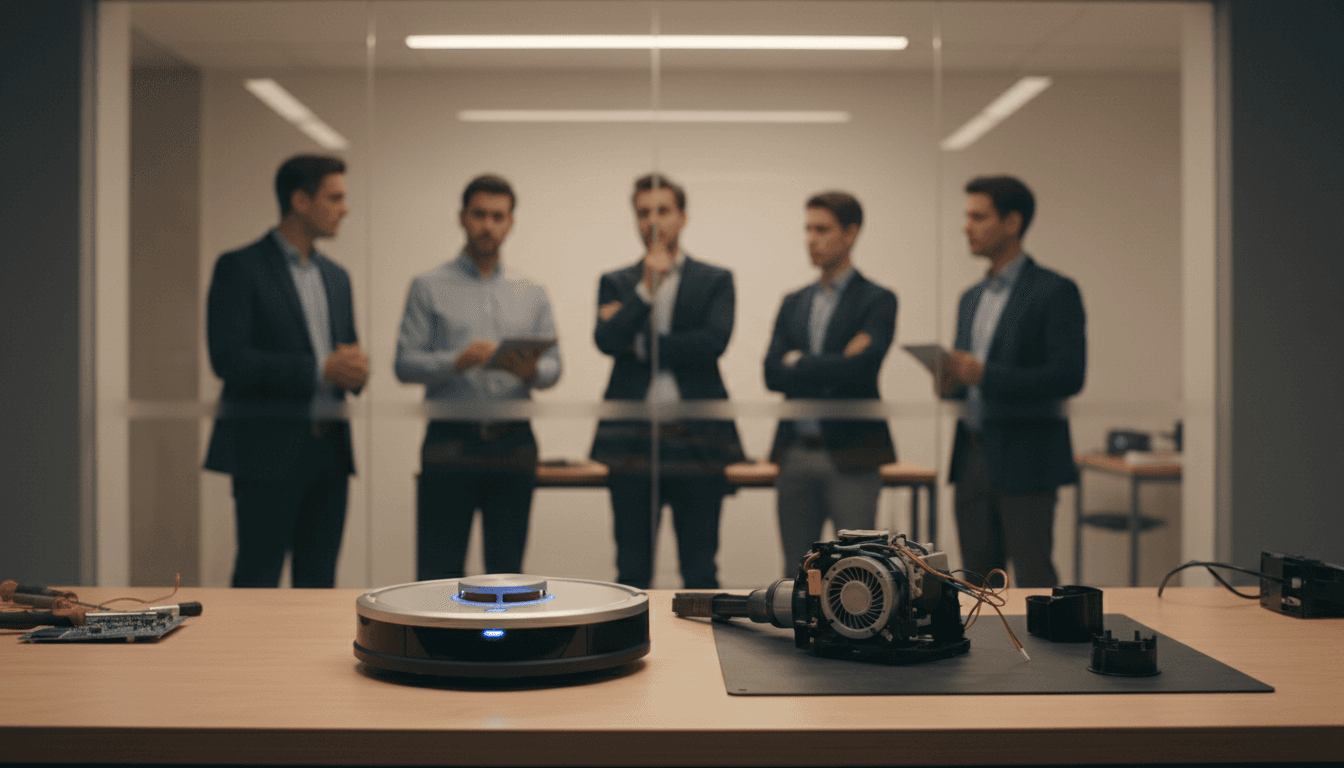
In a 2001 focus group outside Boston, people watched an early Roomba prototype clean both hard floors and carpet. They were intrigued. Some even looked ready to buy. Then the facilitator revealed the cleaning mechanism wasn’t a “real vacuum,” and the expected price collapsed from roughly $200 to $100—even though the robot had just proved it could clean.
That moment is more than a fun origin story. It’s a case study every team building AI robotics and automation should keep close. Because the hard part isn’t only perception or only engineering. It’s building a robot that works and fits the mental model users already trust.
The real product wasn’t “a robot”—it was belief
Roomba’s team learned something painfully practical: customers don’t buy mechanisms; they buy narratives they recognize. In the focus groups, the facilitator avoided calling Roomba a “robot,” describing it as an automatic floor cleaner. Only two out of roughly two dozen participants spontaneously used the word robot.
That detail matters for modern AI robotics. In 2025, many buyers still don’t want “a robot.” They want:
- “A way to keep the facility safer without adding headcount.”
- “A faster pick-and-pack flow.”
- “A reliable night shift for routine inspection.”
Calling something an “AI robot” can be a distraction—sometimes even a red flag. People start imagining failure modes, complexity, and hidden costs.
Answer-first insight
If the customer’s mental model doesn’t match what your robot is, their willingness to pay drops—even if performance is strong.
This is why the Roomba story belongs in an AI in Robotics & Automation series: whether you’re shipping a warehouse AMR, a hospital delivery bot, or a cobot on an assembly line, adoption is shaped by the buyer’s category expectations.
Focus groups didn’t “validate” Roomba—they changed it
Most teams treat customer research as a checkbox: confirm the product and move on. iRobot’s team used the focus group the way it should be used—to surface the uncomfortable truth early enough to act.
The brutal part is what happened next. Roomba’s enabling innovation was its low-power approach: a relatively simple carpet-sweeping mechanism that fit the battery budget. The team could demonstrate cleaning success. Yet the group anchored on a cultural rule:
Vacuums clean. Sweepers are cheap.
When participants heard “carpet sweeper,” they didn’t reinterpret the demo. They reinterpreted the product’s value.
That’s a pattern you’ll see constantly in AI robotics deployments:
- If your inspection robot doesn’t “look industrial,” operators assume it isn’t.
- If your AI quality system can’t explain a reject, supervisors assume it’s guessing.
- If your cleaning bot doesn’t “sound” like it’s working, guests assume it’s not.
What changed Roomba’s roadmap
After the focus group, iRobot VP Winston Tao delivered the line that forced a redesign: “Roomba has to have a vacuum.”
Not because the engineers didn’t care about cleaning.
Because the market required the vacuum story to support the price point needed for the business model.
The 3-watt constraint: engineering under real-world limits
Roomba couldn’t just “add a vacuum.” The robot’s battery and space budget were already spoken for, with a total power envelope around 30 watts. The team estimated they could spare only 10%—about 3 watts—for vacuuming.
Compare that to traditional upright vacuums commonly drawing around 1,200 watts. The gap isn’t incremental. It’s existential.
Here’s the part I love about this story: it’s a clean example of robotics reality.
Robots are constraint machines. Weight, power, cost, noise, heat, airflow, safety, manufacturability—everything fights everything else.
So the team stared at the source of the power draw: moving lots of air through a wide inlet at high velocity. Physics won’t negotiate.
The micro-vacuum idea (and why it worked)
To get useful suction on ~3W, Joe Jones realized you can reduce airflow volume without reducing air velocity by narrowing the inlet dramatically. His math pointed to an opening only 1–2 millimeters wide.
That meant Roomba couldn’t use the standard “beater brush inside a wide inlet” architecture. The configuration had to change.
So he prototyped the concept with cardboard and packing tape, repurposed a blower from a heat gun, and tested it on crushed Cheerios and other debris stand-ins. The narrow slit was surprisingly effective on hard floors.
Then the team packaged it into the robot by:
- Building a narrow inlet using two rubber vanes with small bumps to keep the slit from collapsing
- Placing the inlet behind the brush
- Taking space from the dust cup to fit the impeller, motor, and filter
This wasn’t “add a part.” It was a full system trade-off.
Answer-first insight
Great robotics design is rarely about adding capability; it’s about re-architecting for constraints.
That’s exactly how AI robotics and automation products mature today—especially mobile robots and service robots where battery life and size are non-negotiable.
Perception engineering is part of robotics engineering
Some teams hear this story and conclude: “So… marketing won?”
I don’t think that’s the right read.
The focus group didn’t prove customers are irrational; it proved customers use proxies. When a buyer can’t measure cleaning efficacy objectively in a store aisle, they lean on labels, familiar categories, and cues. In Roomba’s case, “vacuum” was the proxy.
The same thing happens in AI-driven robotics deployments where the buyer can’t easily verify performance before purchase:
- Autonomy claims become proxies (Level of autonomy, maps vs mapless, “AI navigation”).
- Sensor lists become proxies (lidar + depth + vision must be “better”).
- Dashboard polish becomes a proxy for reliability.
The uncomfortable truth: if your proxy signals are wrong, the customer won’t pay for the real performance you built.
A better way to approach “perception engineering”
I’ve found it helps to treat perception like a requirements document. Not “spin,” but observable evidence that aligns with the user’s model.
For AI robotics products, that usually means:
-
Name the category the customer already buys
- “Autonomous floor scrubber” can sell better than “cleaning robot.”
- “Automated inspection cart” may land better than “mobile AI robot.”
-
Instrument outcomes in plain language
- “Covers 28,000 sq ft per night” beats “improved efficiency.”
- “Mean time to recover from a blockage: 42 seconds” beats “robust.”
-
Make the robot’s work legible
- Visible before/after proof.
- Confidence indicators that map to operator intuition.
- Explanations for AI decisions: what it saw, why it acted, what it couldn’t see.
-
Match the sensory cues users expect
- If “it’s working” is associated with a sound, a motion pattern, or a visible trail, design for that—without compromising safety or power.
Roomba’s vacuum wasn’t only a cleaning upgrade. It was a trust upgrade.
What this teaches modern AI robotics teams (and buyers)
Roomba’s “vacuum pivot” is a clean template for building AI robotics and automation products that actually get adopted.
1) Validate willingness to pay before you over-optimize the mechanism
The engineers had a clever, feasible approach. The market still demanded a specific feature category. The sequence matters.
Do pricing and positioning tests early enough that you can still change hardware. Hardware changes late are expensive. Hardware changes after launch are brutal.
2) Your user’s bias is a design constraint
Roomba couldn’t afford to “re-educate the masses.” Most AI robotics companies can’t either.
If your target operator believes “real inspection requires a human” or “real cleaning requires suction,” that belief is as real as your battery budget.
3) Under-the-hood AI is only valuable if it supports an observable promise
This is where AI fits naturally into the Roomba lesson.
AI can help you:
- Allocate limited power dynamically (when to boost suction, when to conserve)
- Adapt behaviors per surface type (tile vs carpet) using sensor fusion
- Detect failure states early (clogs, brush entanglement) and recover
- Optimize paths for coverage given real-time constraints (chairs moved, new obstacles)
But none of that matters commercially unless the robot produces a promise that users recognize and can verify.
4) Don’t ship “vestigial” features—ship honest features
The team considered adding a tiny vacuum that did almost nothing—just so they could print “vacuum” on the box. They rejected that path and built a real micro-vacuum that improved hard-floor cleaning.
That’s the standard to copy.
If you’re adding “AI” to satisfy a checklist, buyers will feel it in week two.
A practical checklist for your next AI robotics pilot
If you’re planning a pilot in manufacturing, healthcare, logistics, or facilities, use this to avoid Roomba’s near-miss.
- Category clarity: What do buyers call this in their own words?
- Proxy alignment: What cues do they use to judge quality quickly?
- Measurable outcomes: What numbers will you report weekly (coverage, throughput, downtime, recovery time)?
- Constraint map: What are the hard limits (power, payload, footprint, noise, safety zones)?
- Trust features: What makes the robot’s decisions understandable to operators?
- Recovery plan: What happens when it fails at 2 a.m.?
If you can’t answer those cleanly, you’re not ready for scale—even if the demo looks great.
Where this fits in AI in Robotics & Automation
Roomba’s early story is a reminder that robots succeed when engineering truth and human expectation meet in the same product. The micro-vacuum wasn’t just a clever mechanical hack; it was a decision shaped by user psychology, pricing reality, and physical constraints.
If you’re building or buying AI-enabled robots in 2025, that’s still the job: design for battery budgets and airflow physics, yes—but also for the labels people trust, the proof they can verify, and the stories they’ll repeat to the next stakeholder.
If you’re evaluating an AI robotics and automation initiative this quarter, ask one question your team might be avoiding: what’s the “vacuum word” in your category—the feature or cue customers need in order to believe?