AI robotic arc welding can boost throughput fast. See how a Comau system delivered 35% efficiency gains and 20% lower maintenance costs.
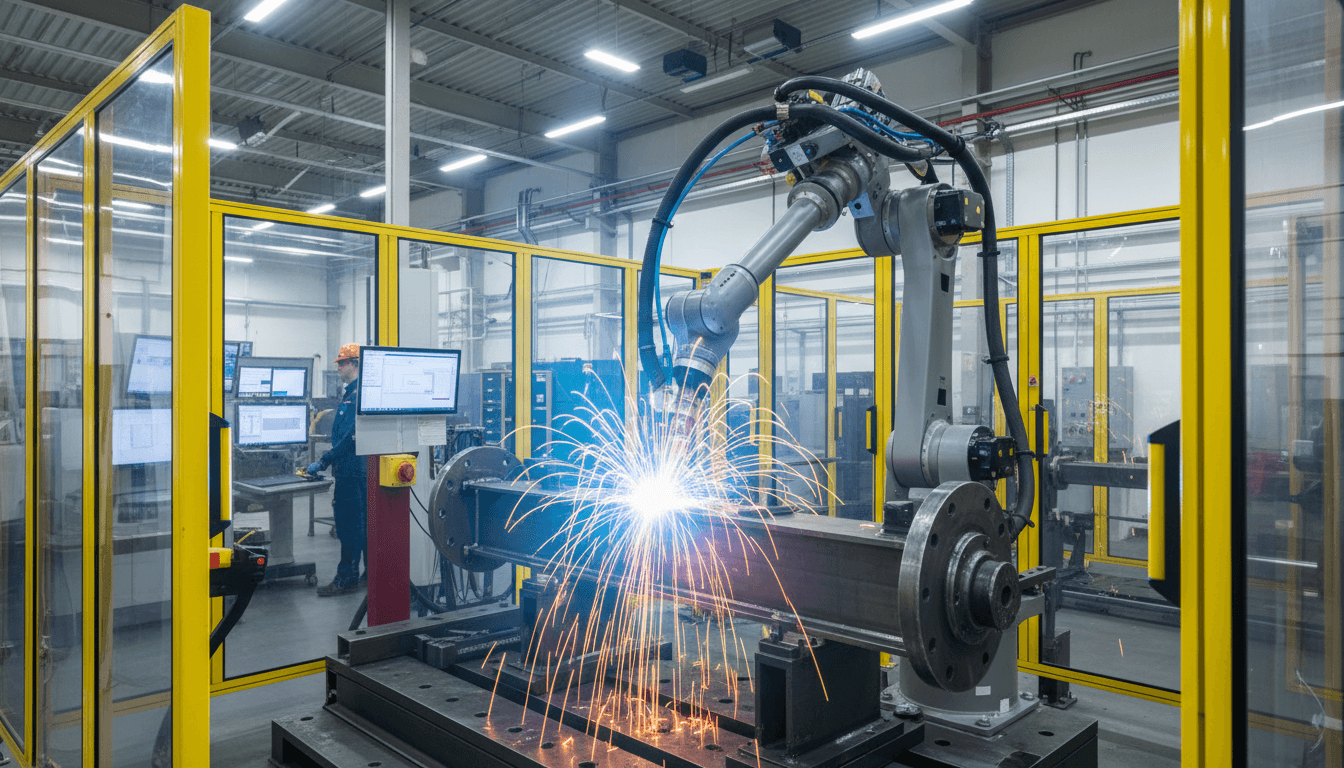
AI Robotic Arc Welding: 35% Efficiency, 20% Lower Costs
A 35% efficiency lift and a 20% drop in maintenance costs isn’t a “nice to have” in welding—it’s a competitive advantage you can price into every quote.
That’s why Comau’s newly deployed AI-enabled robotic arc welding system (implemented with Italian system integrator X‑Machine for steel manufacturer Tubosider) is worth paying attention to in our AI in Robotics & Automation series. Not because it’s another robot-on-a-pedestal story, but because it shows what happens when AI is treated as an operating system for production: better weld consistency, fewer interruptions, and decisions driven by real plant data—not gut feel.
Most companies get one part right (buy the robot) and leave the real value on the table (make it intelligent, diagnosable, and scalable). This example is a clean case study of doing the second part properly.
Why AI in robotic arc welding is showing up now
AI-powered robotics is accelerating in welding for a simple reason: manual welding capacity can’t scale reliably. Skilled labor is tight, training takes time, and many steel fabrication environments are punishing—heat, fumes, repetitive strain, and high safety exposure.
Robotic arc welding has been around for decades, so what’s different in 2025? The difference is the combination of:
- Smarter sensing and compensation (the robot adapts to part variation rather than demanding perfect fixturing)
- AI-driven diagnostics (the system notices drift and anomalies before people do)
- Digital twin workflows (process optimization happens continuously, not only during annual improvement projects)
In other words, the center of gravity is moving from “automation that repeats” to automation that perceives and improves.
The steel manufacturing reality: variability is the tax you pay
Steel components for civil works—barriers, pipelines, tunnel linings—aren’t always pristine. Small misalignments, tolerances drifting over a production run, and mixed component sizes create a constant risk of:
- inconsistent bead geometry
- rework and scrap
- slower takt time because operators must stop and adjust
AI in welding matters because it reduces the “variability tax” without demanding heroics from operators.
What Comau and X‑Machine actually built (and why it works)
This deployment isn’t just a robot cell. It’s a system: robot hardware, AI functions, safety interlocks, centralized control, and a data layer that supports real-time decisions.
The core robot is Comau’s S‑13 (from the S‑Family). On paper it’s a compact industrial arm, but the specs tell you why it fits welding cells where space and cable management are constant pain points:
- 13 kg payload
- 1960 mm reach
- 33 × 33 cm footprint
- Hollow wrist for protected cable routing (a big deal in harsh welding environments)
That’s the mechanical foundation. The performance story comes from how the cell is designed to run.
AI-assisted joint finding: the quiet hero feature
One of the most practical AI features described is the robot’s ability to perform an accurate joint search before welding and then automatically compensate for part misalignment.
This is where many welding automations stumble. Without compensation, you end up over-investing in fixturing, slowing changeovers, or accepting higher defect rates. With intelligent joint search and compensation:
- you can tolerate more real-world variation
- you reduce setup pressure on upstream processes
- you get repeatable results across mixed batches
Snippet-worthy truth: In welding automation, path accuracy is cheap; part variability is expensive.
Centralized operator control: fewer touchpoints, fewer mistakes
X‑Machine built a centralized control panel so operators can start workflows, access documentation, log activity, and request support from one place.
This sounds “small,” but it’s how you make automation scalable. A cell that requires tribal knowledge doesn’t scale across shifts; a cell with a clean interface does.
Safety design that also boosts throughput
A smart detail in the system is an intelligent ON/OFF switch placed near the robot to separate operator and robot work zones. The outcome isn’t only safer operations—it enables parallel work (people prep while the robot welds), which reduces waiting time and improves cell utilization.
This is a pattern I’m bullish on: safety architecture that increases productivity rather than slowing it.
The real value is in the data layer: digital twin + OEE control
The biggest jump in capability isn’t the robot—it’s the system’s ability to act like a monitored, optimizable production asset.
According to the deployment results, AI integration supported:
- Digital twin of the plant to track and optimize production in real time
- dashboards that keep OEE (Overall Equipment Effectiveness) visible to operators
- collection and interpretation of millions of data points to support decisions
This is the practical definition of Industry 4.0 welding: the cell becomes measurable and explainable.
What a digital twin does for a welding cell (in plain terms)
A digital twin isn’t only a 3D model. In this context, it’s a living representation of:
- what the cell should be doing (target parameters, cycle time, expected quality)
- what it’s actually doing (real run data)
- how it’s trending (drift, anomalies, downtime causes)
When you connect that to OEE tracking, your improvement conversations change. Instead of “the robot seems slower lately,” you get “torch wear increased arc instability after X cycles; cycle time rose Y%; schedule maintenance at the next planned stop.”
Predictive diagnostics: catching what humans don’t see
The article describes AI identifying anomalies “invisible to the human eye.” In welding operations, this often shows up as subtle drift or early warning signals—before you see visible defects.
The operational payoff is straightforward:
- fewer unplanned stoppages
- maintenance that’s triggered by condition, not calendar
- fewer quality surprises at inspection
A stance worth taking: predictive maintenance only matters if your maintenance team trusts the signals. That means clear thresholds, explainable alerts, and a workflow that turns detection into action.
Results that matter: 35% efficiency gain and 20% lower maintenance costs
This implementation reported two outcomes that decision-makers can model:
- 35% increase in efficiency
- 20% reduction in maintenance costs
Those numbers are meaningful because they hit two budget lines that usually fight each other: production wants speed, maintenance wants stability. AI-enabled robotic arc welding can improve both when the system is designed for repeatability and observability.
Where those gains typically come from
Even without seeing the full internal breakdown, efficiency and cost improvements in arc welding automation usually come from a mix of:
- Less rework and scrap due to consistent bead quality
- Higher arc-on time because fewer stops are needed for adjustments
- Shorter changeovers through smarter search/compensation routines
- Reduced unplanned downtime via anomaly detection and condition-based maintenance
- Better operator utilization (parallel work zones, simpler interfaces)
If you’re evaluating an AI welding cell, you want your integrator to quantify at least three of these with baseline measurements.
How to evaluate an AI-powered welding system (a practical checklist)
If you’re a plant manager, manufacturing engineer, or operations leader trying to justify AI in robotic arc welding, here’s what I’ve found separates strong projects from expensive science experiments.
1) Start with quality metrics that production actually feels
Don’t begin with “AI features.” Begin with measurable quality targets:
- first-pass yield (FPY)
- rework hours per shift
- defect types by station
- bead consistency requirements (by part family)
Then ask: Which of these metrics will the cell improve in 60–90 days after commissioning?
2) Demand a plan for variability, not perfection
Ask how the system handles:
- part misalignment
- tolerance stacking
- mixed batch sizes
- fixture wear over time
If the answer is “better fixtures,” you may still need them—but you’re missing the AI value.
3) Make the data usable on the shop floor
A dashboard that only engineers read won’t change outcomes. Insist on:
- OEE visibility at the cell
- downtime reason capture that operators can complete in seconds
- alarms that state the likely cause and the next action
4) Treat safety as throughput design
Look for designs that enable parallel work and reduce waiting. Physical separation, interlocks, and smart switching can improve both safety and cycle time when planned early.
5) Decide what “digital twin” means for you
For some teams, a digital twin is simulation for offline programming. For others, it’s real-time monitoring and optimization. Define it upfront:
- Is it used for line balancing?
- For parameter optimization?
- For remote support and diagnostics?
- For training new operators?
Vague digital twin goals lead to vague results.
Where AI welding fits in the broader robotics roadmap
In the AI in Robotics & Automation series, a recurring pattern keeps showing up: the winning projects connect perception, control, and feedback loops.
Welding is a perfect proving ground because it’s unforgiving. Quality issues are expensive, safety risk is real, and throughput pressure never lets up. When AI improves a welding cell, it’s not because it’s flashy—it’s because the system becomes:
- more adaptable to real parts
- easier to operate across shifts
- diagnosable when performance drifts
- continuously optimizable via data
If you’re planning your 2026 automation roadmap, this is the type of deployment to study: clear operational goals, a compact and capable robot platform, AI where it matters (joint finding + diagnostics), and a data layer that supports daily decisions.
Most companies don’t need “more automation.” They need automation that stays stable under real production conditions.
If you’re considering an AI-powered robotic welding system, the next step is simple: pick one high-volume part family, baseline your FPY/OEE/downtime for 30 days, and run a pilot with success criteria tied to those metrics. What would a 35% efficiency lift mean for your backlog—and what would you stop doing if predictive diagnostics cut your unplanned downtime in half?