A TARS-inspired marching robot highlights the real frontier: AI-driven mobility that reduces exceptions and expands automation beyond perfect floors.
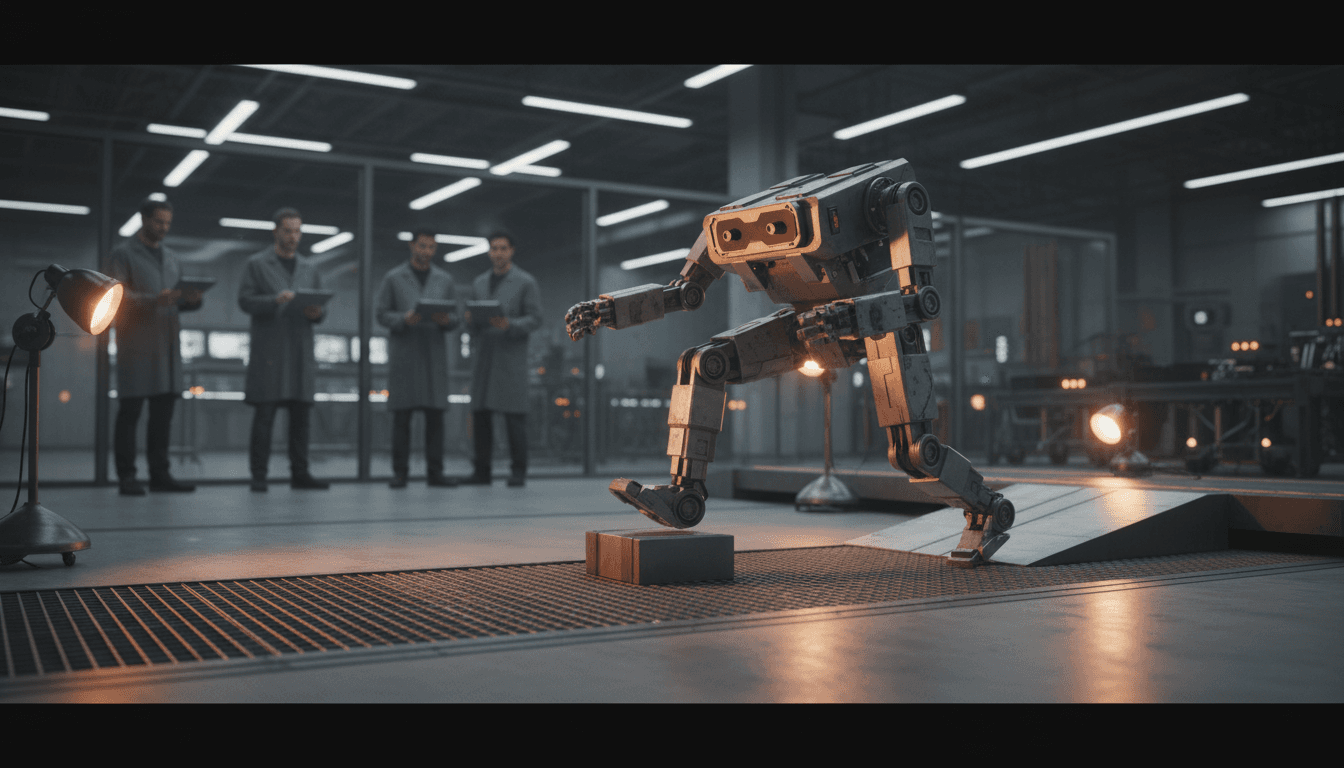
TARS-Inspired Robot Walking Shows What AI Mobility Can Do
A lot of robotics demos look impressive right up until the robot meets a curb, a cable on the floor, or a pallet that’s slightly out of place. Locomotion in the real world is unforgiving—and that’s why a biomimetic “marching” robot inspired by Christopher Nolan’s Interstellar (the blocky TARS) is more than a fun movie homage.
This kind of design—rigid-looking body, leg-like appendages, and a gait that’s closer to marching than rolling—points at a practical truth in AI in robotics & automation: if you want robots that can work outside perfectly structured environments, mobility has to be adaptable, not fragile.
What I like about the TARS-style concept is that it forces engineers to solve a problem industry keeps bumping into: how do you build robots that stay stable, keep moving, and still do useful work when the environment isn’t “robot-friendly”? The answer isn’t just better motors or stronger frames. It’s the fusion of mechanical design with AI-driven control, perception, and planning.
Why a “marching” robot matters for automation
A marching or legged robot matters because wheels don’t fail gracefully in messy environments. If an AMR (autonomous mobile robot) loses traction, gets hung up on a threshold, or can’t handle uneven flooring, your operations team ends up redesigning the building around the robot. That’s backwards.
Legged locomotion (even simplified, stylized legged locomotion like a TARS-inspired mechanism) offers a different trade:
- Better obstacle negotiation: stepping over small debris, floor transitions, and cable covers
- More stable posture control: adjusting stance when carrying shifting payloads
- Expanded operating zones: ramps, rough concrete, outdoor corridors, temporary worksites
This matters because modern automation is increasingly hybrid. Warehouses connect to yards. Factories connect to loading docks. Hospitals connect to elevators and mixed foot traffic. The environment changes by the hour.
The hidden cost of “perfect floors”
If you’ve worked with mobile robotics deployments, you’ve seen the quiet scope creep:
- Facilities changes (floor resurfacing, ramps, edge marking)
- Process changes (restricting pedestrians, controlled traffic lanes)
- Exception handling (people rescuing stuck robots)
A more adaptable mobility platform reduces those downstream constraints. That’s the business case for exploring designs that look “cinematic” but solve real constraints.
From Hollywood geometry to real locomotion engineering
TARS looks like a stainless-steel monolith that can split into moving segments and walk. In film, it’s stylized. In the lab, you still have to make physics cooperate.
A TARS-inspired marching robot forces three engineering challenges into the open:
1) Dynamic stability isn’t optional
When a robot walks, it repeatedly enters states that are inherently unstable (single-leg support, transitions, rapid center-of-mass shifts). Stability becomes a control problem.
In practice, this means using some combination of:
- Inertial measurement units (IMUs) for tilt, acceleration, and angular velocity
- Force/torque sensing at joints or contact points
- Real-time control loops that correct posture in milliseconds
The key point: the better your model and sensors, the less you need to “overbuild” the hardware for worst-case conditions.
2) Gait planning is where AI starts paying rent
A marching gait sounds simple until you try to keep speed, stability, and energy use under control. Traditional approaches rely on carefully tuned controllers. Modern approaches add machine learning to help adapt to variation.
Examples of where AI techniques fit naturally:
- Terrain classification from vision (smooth floor vs. gravel vs. wet surface)
- Adaptive gait selection based on slip detection and load
- Policy learning (often via reinforcement learning in simulation) for robust stepping behaviors
Here’s the stance I’ll take: if your robot’s gait can’t adapt, it’s not ready for operations—it’s ready for a demo.
3) Mechanical simplicity can beat mechanical realism
Biomimetic doesn’t always mean “copy an animal joint-for-joint.” The best industrial robots often use simplified bio-inspired principles:
- Fewer actuators, but smarter control
- Compliance in the right places to absorb shocks
- Modular limbs that are serviceable in minutes, not hours
A blocky robot with fewer degrees of freedom can still be highly capable if the AI controller is good at planning foot placement, managing balance, and recovering from small errors.
The real opportunity: AI-driven mobility for logistics and manufacturing
The most practical connection to intelligent automation is straightforward: mobility expands where automation can operate.
In late 2025, many teams are trying to extend automation beyond “golden paths” (clean, mapped, predictable routes) into:
- Cross-dock areas with variable pallet positions
- Mixed indoor/outdoor routes
- Temporary storage overflow zones (holiday peak operations)
- Construction-adjacent facilities where conditions shift daily
A TARS-inspired marching platform hints at robotics that can handle those spaces without requiring a building to become a robotics museum.
Use case 1: Flexible material movement in brownfield facilities
Brownfield sites—older plants and warehouses—are full of small annoyances: uneven slabs, patched flooring, narrow corridors, odd thresholds. Wheeled AMRs can work there, but you often pay in constraints.
A more adaptive walking (or quasi-walking) robot could:
- Navigate inconsistent floor transitions
- Maintain stability with irregular payloads
- Recover from minor bumps without human intervention
The automation win isn’t “walking is cooler.” It’s fewer exceptions per shift.
Use case 2: Disaster response and industrial inspection
Legged mobility shines when environments are partially degraded. For industry, that translates to:
- Post-incident inspection (after a small fire, leak, or structural issue)
- Remote sensing in high-risk zones
- Temporary worksites where maps and layouts change
AI-driven perception—thermal, vision, depth—paired with stable locomotion gives you robots that can go where people shouldn’t go first.
Use case 3: Handling variability during peak season
December is when operations teams learn what “edge cases” really means. Seasonal demand creates overflow storage, temporary pick lines, and constantly changing aisle conditions.
Robots that rely on perfect lane geometry struggle. Robots with adaptable mobility and AI navigation tolerate change better, which can reduce:
- Re-mapping overhead
- Blocked-route downtime
- Manual “robot babysitting”
What makes a movie-inspired robot “AI-powered” in practice?
“AI” is an overloaded word. In robotics and automation, it’s most useful when you can point to concrete capabilities.
A practical AI stack for a TARS-like walker typically includes:
Perception: seeing and understanding the floor, fast
- RGB or stereo cameras for scene understanding
- Depth sensing (lidar or depth cameras) for obstacle geometry
- On-device models for low latency (milliseconds matter for balance)
The output you care about isn’t a pretty 3D map. It’s actionable labels: step here, avoid that, slow down now.
State estimation: knowing where the body is in space
Legged robots live or die on accurate estimation:
- IMU + joint encoders + contact sensing
- Sensor fusion to reduce drift
- Rapid failure detection (slip, stumble, abnormal vibration)
This is where many “cool” prototypes fall apart: the robot moves fine—until it can’t trust its own state.
Control and planning: reacting without panicking
A robust controller does three things well:
- Plans footsteps that keep the center of mass stable
- Manages energy use so the robot isn’t exhausted after 10 minutes
- Recovers from errors (a small slip shouldn’t become a fall)
The AI angle shows up when the system adapts across conditions instead of being hand-tuned for one floor.
A useful rule: If a robot can’t recover from a small mistake on its own, it’s not autonomous—it’s supervised automation.
If you’re evaluating AI robotics, here’s what to ask vendors
Movie-inspired robots are fun, but buyers need a filter. If you’re looking at AI robotics for manufacturing, logistics, or inspection, ask questions that reveal whether the “intelligence” is real.
The questions that separate demos from deployments
-
What’s the mean time between human interventions (MTBHI)? You want a number per shift or per day, not a vague promise.
-
How does it handle unknown obstacles? Does it stop and wait forever, or can it reroute and continue?
-
What happens when sensors degrade? Dust, glare, and vibration are normal in industrial settings.
-
Can it recover from slips/stumbles without resets? Recovery behaviors are a strong signal of maturity.
-
What’s the maintenance model for the mobility system? Modular legs/joints and quick calibration matter more than polished renderings.
A practical pilot checklist
If I were running a pilot for AI-driven mobile robotics (wheeled or legged), I’d insist on:
- A defined route with intentional disturbances (thresholds, slopes, minor debris)
- A log of every stop event and its cause
- A measurement of throughput impact (not just “it walked”)
- A clear handoff plan for exceptions
The goal is simple: prove the robot improves operations when conditions aren’t curated.
Where this goes next in AI in Robotics & Automation
The TARS-inspired marching robot is a reminder that form can be a forcing function: when you choose a challenging body plan, you’re forced to build better control, better perception, and better recovery.
In the broader AI in Robotics & Automation series, this sits in a bigger pattern I keep seeing: companies are moving from “robots that follow rules” to robots that adapt within guardrails. That’s what modern AI is good at—handling variation while still respecting constraints like safety, speed limits, and geofences.
If you’re building or buying automation, the near-term opportunity isn’t humanoids replacing entire teams. It’s more specific: AI-driven mobility that reduces exceptions, expands coverage, and keeps workflows moving when reality doesn’t match the map.
So here’s the question worth sitting with: when your facility changes next week—new racks, new routes, new clutter—will your robots still be productive, or will your people be the ones adapting to the machines?