Robots throwing 70 mph fastballs reveal what real-time AI control can do. See the automation lessons for logistics, manufacturing, and safer robot workcells.
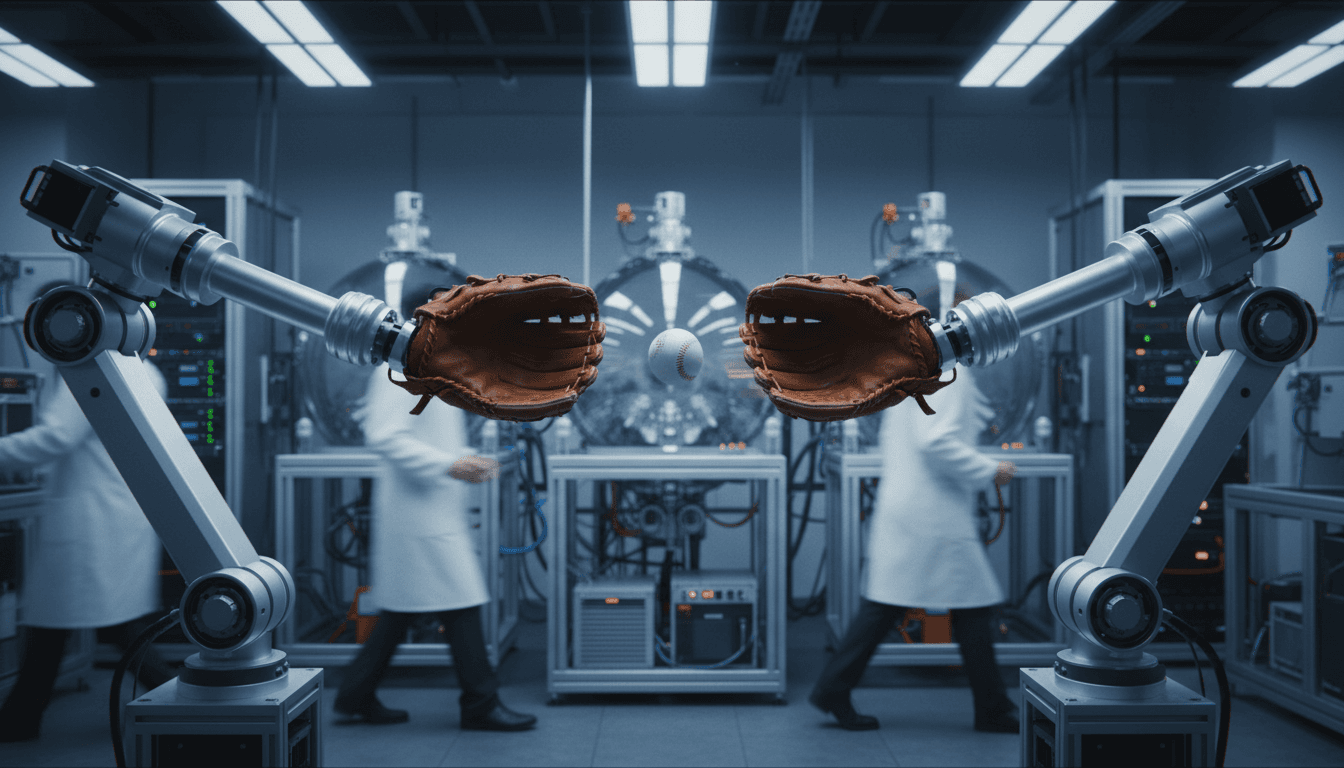
AI Robots Playing Baseball: What It Means for Automation
Robots throwing 70 mph fastballs sounds like a stunt—until you notice the engineering choices behind it. The same ingredients that let a robot catch a ball at 23 feet (7 meters) are the ones manufacturers and logistics teams keep asking for: fast perception, safe physical interaction, and reliable control when the world gets messy.
A recent set of demos from the RAI Institute shows robots throwing, catching, and even batting in tight quarters, sometimes with humans in the loop. It’s entertaining, sure. But I think it’s more useful as a stress test for AI in robotics and automation than many “factory-perfect” videos. Baseball is unforgiving. The ball moves fast, contacts are impulsive, and errors compound quickly. If a robot can handle that, it’s a clue—maybe not that it can play in the MLB, but that we’re getting better at making robots function in dynamic environments where timing and safety actually matter.
Why baseball is a brutal benchmark for robot manipulation
Baseball forces robots to solve three hard problems at once: dynamic perception, contact-rich manipulation, and real-time control.
In a typical industrial pick-and-place cell, the world is engineered to be easy: known part poses, predictable trajectories, fixed lighting, and plenty of time. Baseball flips that.
- The object is fast and ballistic. The demo numbers matter: catching balls thrown up to 41 mph (66 kph) and batting pitched balls up to 30 mph (48 kph) at short distance. That shrinks the reaction window to fractions of a second.
- Contact is inevitable. Catching, throwing, and hitting are all impact problems. You don’t just “reach a pose.” You manage impulse without breaking hardware.
- Small errors explode. A couple of degrees off in bat angle, or a few milliseconds late, and you miss entirely.
Here’s what I like about sports robotics as a benchmark: it punishes systems that look good only when everything is scripted. That’s exactly the failure mode that burns teams deploying robotics into warehouses, food plants, recycling facilities, and hospitals.
The hidden star: low-impedance control (and why industry should care)
The RAI demos emphasize a low-impedance platform—basically a robot that can be both strong and “give” when it makes contact. This isn’t a cosmetic detail. It’s the difference between a robot that survives real work and one that needs a safety cage forever.
Low impedance is how you get speed without becoming dangerous
High-speed motion plus rigid control is a recipe for broken tools, damaged products, and safety headaches. Low-impedance (compliant) behavior lets the robot:
- absorb impact energy during catches and hits
- tolerate uncertainty in where contact happens
- recover quickly without oscillations or instability
In practical automation terms, this is what makes it possible to do things like:
- high-speed parcel singulation where boxes collide
- bin picking with partial occlusion where grasps aren’t perfect
- kitting and packing where items can shift during placement
- human-assisted cells where a person may hand over parts at variable angles
Most companies get this wrong by treating compliance as a “nice-to-have.” If you’re deploying robots outside of tightly controlled fixtures, compliance is a core requirement.
The AI piece isn’t just vision—it’s control policy under uncertainty
When people say “AI robots,” they often mean a camera plus a neural net that labels objects. That’s not the hard part anymore.
The hard part is closing the loop between sensing and action fast enough to matter, while respecting constraints:
- joint torque limits
- end-effector force limits
- tool protection
- collision avoidance
- task success probability
Sports are a clean way to show that loop working. The ball doesn’t care about your demo script.
From robot baseball to factory ROI: the real transfer points
Watching robots play catch is fun. Turning that capability into leads (and real deployments) requires mapping it to pain points buyers recognize.
1) Reaction time translates to throughput
Baseball demands short-latency perception and control. In industry, that same capability translates into:
- higher conveyor speeds without missed picks
- reduced buffering and accumulation
- fewer stops from sensor uncertainty
If your automation cell is limited by “we can’t move faster or we’ll mis-pick,” you’re not really limited by mechanics—you’re limited by closed-loop intelligence.
2) Impact management translates to uptime
Every impact event is a test of mechanical robustness and control design. In warehouses and factories, impact is everywhere:
- totes bumping in depalletizing
- jams in singulation
- odd-shaped items shifting during a grasp
The business metric that matters is simple: mean time between interventions. Better compliance and smarter contact policies reduce broken grippers, bent mounts, and “mystery downtime.”
3) Human-robot interaction translates to flexible labor models
In the demo, humans can throw to the robot and interact at close distances. That’s a signal we’re moving toward a more realistic model for robotics adoption:
- smaller cells
- shared workspaces
- robots taking the repetitive, humans handling exceptions
This is also where many automation projects fail—not because the robot can’t move, but because the workflow assumes perfect upstream conditions.
What these demos don’t show (and what buyers should ask next)
Robotics videos can hide the uncomfortable questions. If you’re evaluating AI-enabled robotics for manufacturing or logistics, here are the practical follow-ups I’d push for.
“How often does it fail, and what happens when it does?”
A single clean catch doesn’t tell you much. You want to know:
- failure rate over 1,000+ trials
- whether failures are safe (no dangerous rebounds, no runaway motion)
- recovery behavior (does it reset automatically or need an operator)
A good rule of thumb: the recovery loop is the product. The skill is just the demo.
“How is it trained, and how portable is the skill?”
If the behavior is tuned to one robot and one setup, it’s less interesting for real deployments. Look for:
- simulation-to-real transfer strategy
- calibration requirements
- robustness to lighting and background changes
- robustness to object variation (ball wear, reflectivity, texture)
In industrial terms: can you redeploy this to a second line without a PhD living onsite?
“What’s the sensor stack and latency budget?”
For dynamic manipulation, latency is everything. Even if vendors won’t share all details, you can still ask:
- camera frame rates n- end-to-end inference + control latency
- controller frequency
- how timing jitter is handled
If the system is sensitive to timing drift, it’ll behave great at 10 a.m. and weird at 2 a.m.
A quick reality check: sports robots vs. production robots
Sports robotics is not the same as production automation. It’s closer to an R&D wind tunnel: great for pushing performance limits, not automatically a deployable product.
Still, the direction is clear. The field is shifting from “repeatable motion in structured environments” to adaptive manipulation in semi-structured environments.
That matters because the biggest automation opportunities in 2026 aren’t in the fully engineered cells—we already automated many of those. The messy opportunities are in:
- mixed-SKU fulfillment
- returns processing
- grocery and fresh food handling
- light industrial assembly with variance
- healthcare logistics and supply rooms
Those environments look a lot more like a baseball drill than a pristine robotics lab.
Practical next steps if you’re exploring AI in robotics & automation
If you’re a manufacturing, logistics, or operations leader trying to separate “cool robot video” from “usable automation,” here’s a grounded path forward.
- Pick one dynamic task you currently avoid automating because it’s too variable (singulation, depalletizing, random bin picking, bag handling).
- Define the real constraint: is it reaction time, safe contact, perception failures, or recovery from exceptions?
- Run a pilot with metrics that punish fragility:
- interventions per hour
- mean time to recover
- damage rate (product and equipment)
- throughput at target accuracy
- Require an “exceptions plan.” Who clears jams, how often, and what’s the operational cost?
I’ve found that teams who start with exceptions—rather than ideal-case cycle time—end up with deployments that scale.
Where robot baseball fits in the bigger AI automation story
Robot baseball is a loud, physical proof that AI-powered robots can operate under speed, uncertainty, and impact—the same trio that defines many high-value automation jobs.
For this AI in Robotics & Automation series, the takeaway isn’t “robots are coming for sports.” It’s simpler: dynamic manipulation is moving from research novelty to an engineering discipline with transferable patterns—compliance, fast closed-loop control, and robust recovery.
If you’re evaluating robotics for a warehouse, a factory, or a lab, the right question to ask after watching a robot catch a baseball isn’t whether it can do it again. It’s whether that same control stack can keep your operation running at 2 a.m., with worn parts, messy inputs, and zero patience for downtime.