AI quadruped robots are learning to walk on Mars-like sand at White Sands. See what their autonomy breakthroughs mean for real-world automation.
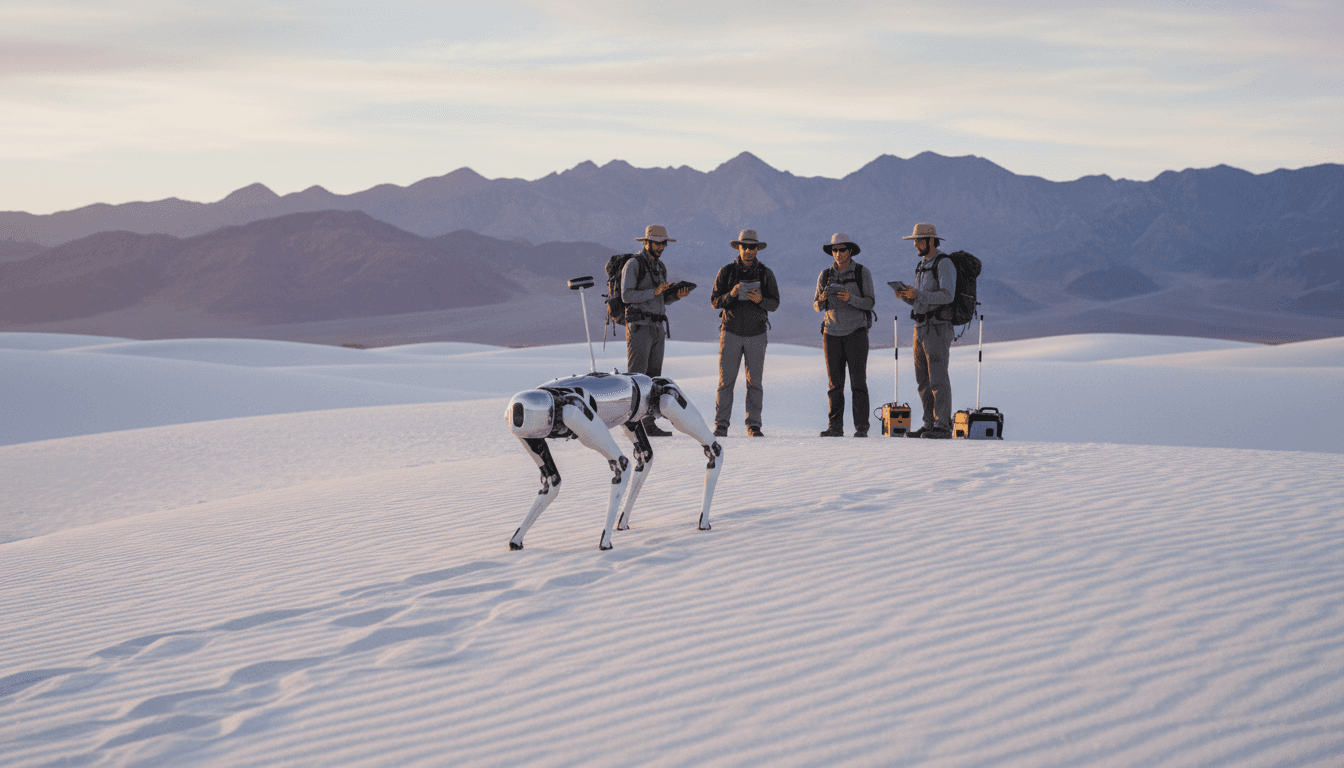
AI Quadruped Robots Learning to Walk on Mars Sand
A five-day field test in New Mexico may sound like a small step—until you remember what it’s trying to solve: teaching an AI-powered quadruped robot to walk reliably on Mars-like terrain. Researchers at White Sands National Park recently pushed a dog-like robot through soft dunes and punishing heat, collecting the kind of gritty, high-signal data you can’t get in a lab.
Most companies get this wrong: they assume autonomy is mainly a software problem. The reality is that autonomy is a contact sport—especially for legged robots. If your robot can’t “read” the ground under its feet, all the perception and planning in the world won’t save it from slipping, wasting energy, or face-planting at the worst moment.
This post is part of our AI in Robotics & Automation series, and it matters well beyond space exploration. The same methods being developed to help a quadruped traverse shifting sand on Mars are already shaping how we build robots that operate in messy factories, high-variability warehouses, construction sites, mines, and outdoor logistics yards.
Why Mars walking is really an AI autonomy problem
Mars mobility fails when robots can’t adapt to uncertainty fast enough. Unlike a warehouse floor, Mars terrain changes step to step—granular soil, crusty patches, slopes, hidden sink spots. For quadruped robots, walking is a loop of constant decision-making: place foot → sense response → update belief about terrain → adjust next step.
White Sands is being used as a Mars analog environment precisely because sand exposes weaknesses in control systems. Wheels can dig in. Feet can sink. The robot’s controller has to answer a simple question over and over:
“Is the ground stable enough for my next step—and how much energy will it cost?”
That’s why this NASA-funded effort (the LASSIE project: Legged Autonomous Surface Science in Analog Environments) is so relevant to AI-enabled robotics. It’s not just about walking; it’s about autonomous decision-making under real physics.
The myth: “Just train a model in simulation”
Simulation is essential, but it’s not sufficient. Soft terrain is notoriously hard to model perfectly. Small errors in soil parameters or contact models can create big differences in slip, sink, and stability.
Field tests create what robotics teams crave: ground-truth interaction data. That includes the mechanical response at the robot’s feet—effectively, the robot learning what “bad footing” feels like.
What White Sands teaches us that labs don’t
Real terrain gives you failure modes you didn’t predict. The team’s experiments at White Sands focused on gathering data from the robot’s feet and using it to improve autonomy—similar to how humans sense stability through micro-shifts underfoot.
Here’s what makes this kind of testing uniquely valuable:
1) Foot–ground interaction becomes a sensor, not just a nuisance
In many robotics stacks, contact is treated as something to “handle.” In legged autonomy, contact is information.
When a quadruped steps, the robot can infer terrain properties by measuring variables such as:
- Ground reaction forces (how the force profile changes as the foot loads)
- Slip signatures (lateral force vs. motion mismatch)
- Sink depth proxies (stance dynamics and joint behavior)
- Compliance/firmness (how much the surface yields)
That data can feed AI models that classify terrain in real time and tune gait parameters accordingly.
2) Heat and power limits force smarter autonomy
The White Sands session faced triple-digit temperatures. That matters because extreme heat isn’t just uncomfortable for humans—it constrains robot performance too.
In high heat, you’re effectively running an autonomy system under tighter budgets:
- Battery performance can degrade
- Thermal limits may reduce compute headroom
- Motors and power electronics hit derating thresholds
So you’re not only asking “Can it walk?” You’re asking “Can it walk efficiently enough to finish the mission?” That’s the same question manufacturers and logistics operators ask when robots must run multiple shifts without downtime.
3) Field work exposes coordination bottlenecks
The project also explores future operational scenarios involving astronauts, rovers, quadrupeds, and Earth-based Mission Control. That’s a fancy way of describing a problem many automation leaders already have:
How do humans supervise multiple autonomous agents without becoming the bottleneck?
If one person has to babysit every step, you don’t have autonomy—you have remote control with extra steps.
The big milestone: the robot made its own decisions
The most important result from the White Sands tests is that improved algorithms allowed the robot to operate autonomously and make its own decisions. That’s the line that should jump out at anyone building AI in robotics.
Autonomy that matters isn’t “it followed a route.” It’s:
- It detected changing conditions
- It selected a behavior that fit those conditions
- It recovered when the world didn’t match expectations
Why independent robot action increases mission output
Cristina Wilson (Oregon State University) pointed out the operational value: if a quadruped is on Mars with an astronaut, both can work independently, increasing scientific productivity.
Translate that to Earth:
- In a warehouse, a robot that adapts to congestion without calling a human increases throughput.
- In a factory, a mobile manipulator that reroutes around a spill reduces stoppages.
- On a construction site, a quadruped that changes gait for loose gravel avoids damage and delays.
Autonomy multiplies output only when it reduces coordination overhead. Otherwise, you’ve just moved labor from physical work to constant monitoring.
Adaptive locomotion: one robot, multiple “modes”
The practical path to robust legged autonomy is not one perfect gait—it’s a toolkit of behaviors. The team tested advances that let the robot move differently depending on surface conditions, with the goal of better energy efficiency.
That concept maps neatly to modern automation: you don’t run one control policy everywhere. You switch strategies based on context.
What “adaptive gait selection” looks like in practice
A quadruped operating in variable terrain may select between modes like:
- High-stability gait for uncertain footing (slower, safer)
- Energy-saving gait for firm ground (faster, efficient)
- Cautious probing steps for transition zones (test before committing)
- Recovery behaviors when slip exceeds threshold (widen stance, lower center of mass)
The AI work is in deciding when to switch, how to parameterize the gait, and how to avoid oscillating between modes.
The energy efficiency angle is the real business story
On Mars, energy is mission life. On Earth, energy is operating cost.
If adaptive locomotion reduces wasted motion (slip, re-steps, recovery events), it can:
- Extend runtime per charge
- Reduce wear on actuators and gearboxes
- Increase task completion per shift
Those are lead-worthy metrics because they tie directly to ROI.
What automation teams can copy from NASA-style field robotics
The Mars analog workflow is a blueprint for deploying AI robotics in the real world. You don’t need dunes or astronauts to benefit from the approach.
1) Test autonomy where the physics bite
If your robot will operate on:
- Wet floors
- Uneven docks
- Gravel yards
- Expansion joints
- Ramps and thresholds
…then your validation environment should include those conditions early. I’ve found that teams that postpone “ugly environment testing” pay for it twice: first in delays, then in reliability workarounds.
2) Instrument contact and treat it as first-class data
Vision is great, but contact is truth.
If you’re building mobile robots (wheeled or legged), prioritize:
- Force/torque sensing where feasible
- High-rate proprioception logging (joints, IMU, motor currents)
- Terrain outcome labels (slip/no-slip, sink/no-sink, recovery event)
This creates datasets that actually improve decision-making, not just mapping.
3) Measure autonomy with “supervision cost,” not demos
A demo can look flawless and still fail commercially.
Add metrics like:
- Interventions per hour
- Mean time between recovery events
- Energy per meter (or per task)
- Task completion rate under variability
If those metrics don’t improve, autonomy isn’t improving—presentation is.
4) Plan for mixed-agent operations
Mars scenarios include astronauts, rovers, quadrupeds, and Mission Control. Your facility has people, forklifts, AMRs, conveyors, and software systems.
The design principle is the same: each agent should be able to proceed safely without waiting on a central brain.
That means investing in:
- Local decision-making
- Robust exception handling
- Clear “handoff” rules for human override
People also ask: can AI-powered robots really walk on Mars?
Yes—AI-powered robots can walk on Mars, but only if autonomy is grounded in real terrain interaction data. The main blockers aren’t “making legs move”; they’re handling uncertainty: traction, sink, slope, energy limits, and delayed communication.
Why use Mars analog sites like White Sands? Because analog environments produce real failure cases—slip, sink, thermal constraints—that simulations and indoor testbeds routinely miss.
Will quadrupeds replace rovers? No. Rovers are efficient on moderate terrain and carry heavy payloads well. Quadrupeds shine when terrain is too rough, too steep, or too granular for wheels—and when you need to step over obstacles rather than push through them.
Where this is heading in 2026 (and why leads should care)
Legged robots are moving from “cool videos” to serious autonomy programs because AI can finally connect perception, contact sensing, and control into a reliable loop. The White Sands results—especially autonomous decision-making and adaptive movement strategies—are the kind of progress that transfers directly to industrial automation.
If you’re evaluating AI robotics for manufacturing, logistics, inspection, or field operations, take a cue from the Mars playbook: prioritize robustness, supervision cost, and energy efficiency over perfect maps and polished demos.
The next question worth asking isn’t “Can a quadruped walk on Mars?” It’s “What would your operations look like if robots could handle uncertainty without calling for help?”