Flexxbotics’ Detroit expansion signals rising demand for AI-driven process control. See what it means for warehouse automation and resilient logistics.
Flexxbotics in Detroit: AI Control for Warehouse Robots
The Midwest doesn’t need more robots. It needs robots that can actually work together—across brands, cells, plants, and shifts—without turning every production change into a mini software project.
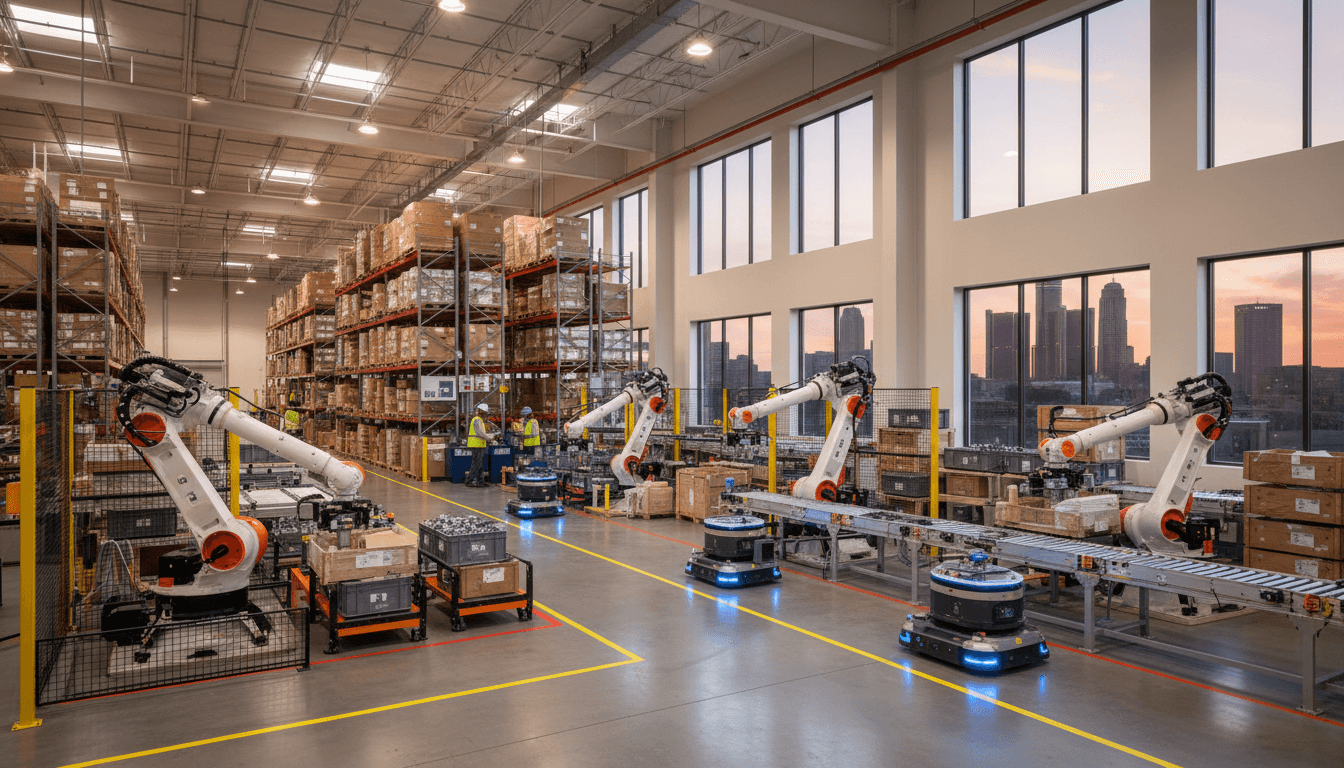
That’s why Flexxbotics opening an office at Newlab at Michigan Central in Detroit matters beyond the manufacturing press release. Flexxbotics builds process-control software that coordinates industrial robots, people, and IT systems. That same “orchestration layer” is quickly becoming a requirement in warehouse automation and broader transportation logistics.
I’ve found the biggest bottleneck in automation isn’t buying the hardware. It’s the messy middle: integrating multiple robots, legacy systems, and human workflows into something reliable enough to run nights, weekends, and peak season. Flexxbotics’ Detroit move is a signal that companies are putting budget and urgency behind solving that problem—especially across the Great Lakes manufacturing and distribution corridor.
Why Flexxbotics’ Detroit expansion is a logistics signal
Answer first: Flexxbotics expanding into Detroit signals rising demand for software-defined automation—exactly what logistics teams need when warehouses and factories are tightening cycle times and reshoring capacity.
Flexxbotics announced new offices in Newlab Detroit to collaborate more closely with customers and partners across the Midwest. This region isn’t just “manufacturing country.” It’s also one of North America’s most consequential logistics zones: automotive supply chains, defense suppliers, medical device production, and the warehouses that feed them.
When automation vendors set up local delivery capacity in Detroit, they’re usually responding to one of three realities:
- More facilities are running mixed fleets (different robot brands, different generations, different controls)
- Operational change is accelerating (SKU proliferation, shorter product life cycles, more engineering changes)
- Uptime is now a competitive advantage (labor volatility and service-level penalties punish fragile automation)
Newlab’s own footprint reinforces this. The organization has supported 400+ member companies and its members have raised $5.8B in venture funding, with $2.3B in exits and a $20B+ collective valuation. In plain terms: Newlab is built to turn industrial tech into deployed projects, not demos.
For transportation and logistics leaders, the takeaway is straightforward: industrial automation software is converging with warehouse automation software. And Detroit is one of the places where that convergence will show up first.
From “robots in a cell” to autonomous process control
Answer first: The next step in warehouse productivity isn’t adding more robots—it’s adding autonomous process control that keeps robots productive when conditions change.
Flexxbotics positions its FlexxCORE technology as a way to connect and coordinate robots with existing robots, IT systems, and people—supporting “lights-out” manufacturing. Whether you run a factory or a fulfillment center, the ambition is similar: keep equipment producing value with minimal human intervention.
Here’s the part many teams underestimate: lights-out operations are less about darkness and more about exceptions. A system can only run unattended when it can detect, classify, and route the messy stuff:
- A part is misloaded
- A tote arrives late
- A barcode won’t scan
- A gripper slips
- A robot faults intermittently
- A downstream station is starved or blocked
This is where AI becomes practical rather than hype.
What “process control software” really does in automation
Answer first: Process control software sits between robots and business systems and enforces the rules of safe, predictable production.
In logistics terms, it’s comparable to a warehouse execution layer that:
- Orchestrates tasks across robots, conveyors, and workstations
- Coordinates handoffs with humans (who does what, when)
- Tracks state in real time (what’s running, what’s waiting, what’s failing)
- Provides a single place to manage change (new workflow, new SKU, new tooling)
If you’ve ever watched a warehouse or plant scramble because one subsystem went down, you’ve seen the value of a coordinating brain. Individual robots can be smart. The operation still fails if the system isn’t.
Why Detroit is the right place to build orchestration muscle
Answer first: Detroit’s mix of automotive, defense, industrial, and medical manufacturing creates hard problems that force orchestration software to mature.
Flexxbotics called out Detroit’s sector density and its role in U.S. reindustrialization. Those industries share a trait: complex change control. That’s exactly what logistics faces during peak season.
If your automation can’t handle engineering changes, substitutions, partial pallets, backorders, or shifting carrier cutoffs, you don’t have automation—you have a fragile demo running in production.
The warehouse connection: orchestration is the productivity multiplier
Answer first: Orchestration software increases warehouse productivity by reducing idle time, smoothing handoffs, and making multi-vendor automation behave like one system.
In the “AI in Robotics & Automation” series, we’ve been tracking a consistent pattern: most ROI is trapped in coordination problems.
Warehouses often buy automation in phases:
- Start with goods-to-person AMRs or autonomous forklifts
- Add robotic picking or palletizing
- Integrate sortation, pack-out, and QA
- Try to unify reporting, exception handling, and task allocation
The pain typically hits at step 4. Suddenly you have multiple vendors, each with their own dashboards, APIs, and service contracts. The warehouse manager becomes the integration layer.
A process-control approach like Flexxbotics’ points to a more scalable model: treat robots as resources and workflows as software. That’s how you get beyond “we automated a station” and into “we automated a process.”
Practical examples in transportation & logistics
Answer first: The same automation control concepts apply to inbound, outbound, and value-added services.
Here are three places orchestration creates measurable impact:
-
Inbound receiving and putaway
- Coordinate autonomous forklifts with dock scheduling
- Prioritize putaway based on demand forecasts and slotting rules
- Reduce congestion by routing tasks dynamically when aisles get blocked
-
Outbound palletizing and trailer loading
- Align pallet build sequences with carrier cutoff times
- Adjust pallet patterns when SKU availability changes mid-wave
- Trigger rework flows automatically when a pallet fails QA
-
Manufacturing-to-warehouse handoff (the “gray zone”)
- Synchronize finished-goods output with staging and yard capacity
- Prevent line stoppages by predicting warehouse starvation
- Provide traceability for recalls and compliance without manual spreadsheets
If you’re investing in robotics but still missing SLAs, I’d bet the issue isn’t robot speed. It’s system-level decisioning.
Reshoring, reindustrialization, and the supply chain resilience play
Answer first: Reshoring increases the number of handoffs and constraints in North American supply chains, making AI-driven automation coordination a resilience requirement.
Flexxbotics explicitly tied its Detroit presence to reindustrialization momentum. From a logistics lens, reshoring creates a familiar paradox:
- You reduce ocean risk and lead time variability
- But you increase domestic throughput pressure (plants and DCs must run tighter)
That pressure shows up in the form of:
- Higher volume variability across weeks
- More frequent product introductions
- Shorter replenishment windows between production and ship
- Greater dependence on local labor markets
The winning operations respond with two moves:
- Automate physical work where it’s repetitive and safe to standardize
- Automate decision work where exceptions used to live in people’s heads
Flexxbotics’ CEO Tyler Bouchard framed the mission as achieving autonomous process control to scale factory autonomy. I agree with the direction, and I’ll go further: autonomous process control is the missing layer for resilient supply chains because it turns “tribal knowledge” into repeatable operations.
What to watch next (especially in 2026 planning)
Answer first: The next wave of warehouse AI isn’t about chat interfaces—it’s about closed-loop control.
As you plan for 2026 budgets, watch for these signals:
- Multi-site standardization projects: companies rolling out the same orchestration patterns across multiple facilities
- Vendor-agnostic robot coordination: orchestration that supports mixed robot fleets without rewriting everything
- Exception automation: systems that can classify faults and trigger the right workflow (recovery, rework, or escalation)
- Operational analytics that drive action: not just dashboards, but recommendations and automated task rebalancing
If a platform can’t help you recover from a jam at 2:00 a.m., it’s not warehouse AI. It’s reporting.
A practical adoption checklist for ops and IT teams
Answer first: The safest path to AI-driven warehouse automation is to start with orchestration primitives—events, states, exceptions—before you chase full autonomy.
If you’re evaluating process control software (for manufacturing or warehouse automation), use this checklist to avoid expensive dead ends:
-
Define the control surface
- What needs orchestration: robots, conveyors, forklifts, AS/RS, workstations, docks?
-
Map the exception taxonomy
- List the top 20 failure modes by frequency and impact
- Decide which can be auto-recovered vs. require human sign-off
-
Choose two “golden workflows” to pilot
- Example: inbound receiving + putaway
- Example: outbound palletizing + trailer staging
-
Make latency and uptime explicit
- Real-time control needs different guarantees than BI reporting
- Set expectations for failover, offline modes, and manual override
-
Treat integration as a product, not a project
- The system should get easier to extend over time
- If every change requires a custom sprint, you’ll stall
This is also where innovation hubs like Newlab can help: pilots with real constraints, real stakeholders, and a faster path to commercialization.
What Flexxbotics’ move means for leaders in logistics automation
Flexxbotics opening in Detroit is a vote of confidence in a simple idea: automation scales when control scales. Hardware is getting more capable and more affordable. The differentiator is whether you can run that hardware as an integrated system across sites, shifts, and product lines.
If you’re responsible for warehouse productivity, transportation performance, or supply chain resilience, this should influence how you prioritize investments. Put orchestration and exception handling on the same tier as robots and sensors. Otherwise you’re paying for capacity you can’t reliably use.
The forward-looking question I’m watching: Which logistics networks will treat AI-driven process control as core infrastructure—before peak season forces their hand?