Flexxbotics’ Detroit expansion shows how AI process control is becoming the key to scaling automation, reshoring production, and stabilizing factory-to-warehouse flow.
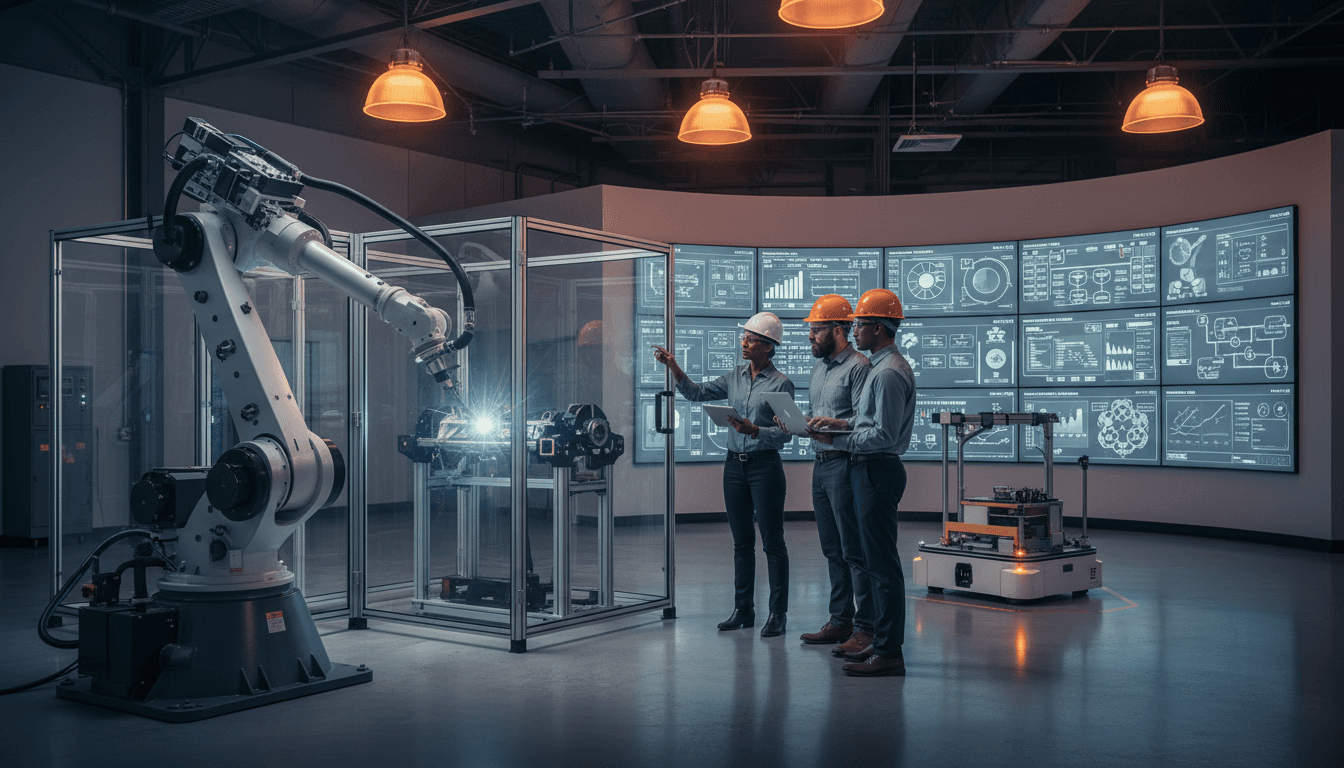
AI Process Control Moves to Detroit for Reshoring
Detroit is becoming a serious home base again for industrial execution—not just design. Flexxbotics opening an office at Newlab in Detroit is a signal that software-defined automation is shifting closer to the plants that need it most, especially across the Great Lakes manufacturing corridor.
For transportation and logistics leaders, this isn’t “robotics news” in the narrow sense. It’s a practical indicator of where factory throughput, supplier lead times, and even warehouse flow are headed in 2026: toward AI-driven process control that connects robots, people, and IT systems into one operational layer.
This post is part of our AI in Robotics & Automation series, and I’ll take a clear stance: the next wave of reshoring wins won’t be decided by buying more robots—it’ll be decided by orchestrating them better. Flexxbotics’ expansion is a case study in that shift.
Detroit matters because orchestration is now the bottleneck
Detroit’s advantage isn’t nostalgia—it’s density. When a region concentrates automotive, defense, industrial equipment, and medical manufacturing, you get a unique mix of high-mix production, strict quality demands, and complex supplier networks. That combination creates a specific pain point: automation exists, but it’s fragmented.
Most companies don’t struggle to find a robot vendor. They struggle to make robots behave like a coordinated system across:
- Multiple brands of robots and controllers
- Machine tools and PLC-driven equipment
- MES/ERP and quality systems
- Human work instructions and exception handling
That coordination problem is exactly where “AI process control” earns its keep.
Flexxbotics positions itself as process control software for automated manufacturing, built to connect and coordinate robots with existing automation and business systems. Their Detroit presence at Newlab puts them closer to the industrial customers who can pressure-test these integrations in real production, not just demos.
And Newlab itself brings scale dynamics. The organization reports supporting 400+ member companies, helping raise $5.8B in venture funding, and enabling $2.3B in exits with a collective valuation north of $20B. Whether you love startup ecosystems or not, the point is simple: hubs like this pull pilots, capital, and partners into one place—faster learning cycles for factory automation.
A quick myth-bust: “lights-out” isn’t the goal—predictable flow is
“Lights-out manufacturing” gets headlines, but most operations don’t need full autonomy to see real ROI. What they need is:
- Fewer line stoppages due to integration issues
- Faster changeovers without heroics
- Repeatable quality with traceability
- Reliable schedules that upstream logistics can trust
The best automation strategy is the one that creates predictable flow, because predictable flow reduces expediting, premium freight, and warehouse firefighting.
Flexxbotics’ model: software-defined manufacturing automation
The most useful way to think about Flexxbotics (and similar platforms) is as an orchestration layer. Robots are the “muscle.” Orchestration is the “nervous system.”
Flexxbotics’ FlexxCORE is described as technology that connects robots with existing robots, IT systems, and people to enable highly automated operations. The important concept here is not the brand name—it’s the architecture:
- Open connectivity across heterogeneous robot fleets (the real world is mixed-vendor)
- Centralized control logic for tasks, routing, and exception handling
- Integration hooks into IT systems that carry orders, recipes, quality constraints, and maintenance signals
This is where AI becomes practical. Not “a chatbot on the shop floor.” Real operational AI shows up as:
- Adaptive scheduling based on constraints and real-time status
- Process anomaly detection (drift before defects)
- Automated recovery workflows when a robot fails a pick, a machine faults, or a pallet isn’t where it should be
If you’re a logistics or supply chain leader, read that list again and translate it into your world:
- Adaptive scheduling = fewer missed ship windows
- Anomaly detection = fewer returns/rework and less inventory padding
- Automated recovery = less downtime and fewer manual interventions
Example: why machine tending ties directly to logistics performance
Flexxbotics has collaborated with IPR Robotics on a dual-rail robotic transfer unit (RTU) for machine tending. Machine tending sounds like a manufacturing-only concern, but it impacts logistics in a very direct way.
When machine tending is inconsistent, you get:
- Batch completions that slip unpredictably
- Last-minute changes to packing plans
- Labor spikes in shipping to catch up
- More WIP staged near machines “just in case”
Orchestration software that improves uptime and stabilizes output doesn’t only raise OEE—it reduces warehouse variability. And variability is what makes distribution expensive.
Reshoring in 2026 is a software problem as much as a labor problem
Reshoring has become a board-level priority for many manufacturers and their logistics partners. The operational reality is rougher: bringing production closer often means dealing with higher labor costs and a tighter labor market.
Automation helps, but here’s what most companies get wrong: they treat automation as a set of projects instead of a system.
A reshoring-ready automation strategy needs three capabilities:
- Scale across lines and plants (not one “golden cell”)
- Absorb product mix changes without months of re-engineering
- Standardize execution data so quality, maintenance, and planning aren’t blind
This is why software-defined automation is getting investment and attention. Once your execution layer is standardized, you can add robots faster, change products faster, and replicate improvements across sites.
Detroit and the Great Lakes region are a strong fit for that approach because of the concentration of multi-plant enterprises and suppliers serving regulated or high-reliability markets (automotive, defense, medical). Those industries punish inconsistent process control.
Where AI meets transportation & logistics: the factory-warehouse handshake
AI in transportation and logistics often gets framed as route optimization, carrier selection, or demand forecasting. Those matter, but they assume supply is stable. In reality, supply is frequently destabilized inside factories.
Factory variability becomes logistics cost. That’s the handshake worth fixing.
Here’s how AI-driven automation platforms support logistics outcomes:
1) Better schedule adherence reduces expediting
If production completion times are reliable, planners can stop building buffers everywhere. That reduces:
- Premium freight
- Safety stock
- Last-minute labor overtime in distribution
2) Cleaner execution data improves inventory accuracy
Orchestration systems can create more consistent digital records for:
- What was produced
- When it was produced
- Where it moved next
- Whether it passed inspection
That data quality is the foundation for accurate WIP tracking and fewer “inventory surprises” that force manual counts.
3) Faster recovery limits cascade failures
In many plants, a minor automation fault turns into a cascade: the cell stops, upstream feeding continues, downstream starves, and shipping gets disrupted. Good orchestration is designed to:
- Detect faults quickly
- Route work around issues when possible
- Trigger human intervention with clear context
This is one of the simplest, most profitable uses of AI in robotics: not autonomy for its own sake, but fewer cascading disruptions.
What to ask vendors when you’re evaluating AI process control
If you’re a COO, VP of Operations, Head of Automation, or a logistics leader pulled into factory modernization, vendor conversations can get fuzzy fast. I’ve found it helps to ask questions that force operational specificity.
Integration and openness
- Can you run a mixed fleet (different robot brands/controllers) without custom code per cell?
- Which MES/ERP/QMS systems do you support out of the box?
- How do you handle versioning and change control for automation logic?
Exception handling (the real ROI area)
- What happens when a part is missing, misoriented, or fails inspection?
- Do you support automated recovery workflows, or do you just alarm and stop?
- How are exceptions logged and tied back to quality and maintenance?
Scalability and replication
- What does it take to deploy the same logic to a second line or second plant?
- How do you manage templates, recipes, and site-specific constraints?
- What’s the typical timeline from pilot to multi-line rollout?
Data and AI specifics
- What data do you collect by default (events, cycle times, faults, quality checkpoints)?
- Can we export that data to our analytics stack without friction?
- Where exactly is AI used—scheduling, anomaly detection, optimization—and how do you validate results?
If a vendor can’t answer these crisply, you’re not buying a platform—you’re buying an expensive demo.
Why the Newlab Detroit move is strategically smart
Flexxbotics describes Detroit as a major cluster for advanced manufacturing and reindustrialization, and that’s accurate in a way that matters operationally: this is where automation has to work under pressure.
Being close to customers in the Midwest isn’t just about sales. It’s about shortening the loop between:
- a production problem (downtime, changeover pain, integration failures)
- a software fix (logic updates, connector improvements, exception workflow tuning)
- measurable results (throughput, scrap reduction, schedule adherence)
For AI-driven warehouse automation and supply chain optimization, that feedback loop is everything. The best systems improve because they’re exposed to messy reality.
Reshoring doesn’t fail because robots are weak. It fails because processes aren’t controlled end-to-end.
That’s the bet Flexxbotics is making by building in Detroit.
What you can do next (even if you’re not buying new robots)
If you’re planning 2026 initiatives right now, here are practical next steps that don’t require a massive capex request.
- Map variability sources between factory completion and warehouse shipping. Identify the top 3 causes of last-minute expediting.
- Audit your automation stack for orchestration gaps: mixed-vendor cells, manual handoffs, and “tribal knowledge” exception handling.
- Run a pilot focused on exceptions, not throughput. Pick one process where faults cause frequent stops and measure recovery time.
- Define integration requirements upfront (MES/ERP/QMS, traceability fields, event schema). This prevents “pilot purgatory.”
In our AI in Robotics & Automation series, a consistent theme keeps showing up: the winners treat AI as operations infrastructure, not a novelty layer. Flexxbotics’ Detroit expansion is another datapoint in that direction.
If you’re pushing for reshoring, faster lead times, or more stable OTIF performance in 2026, ask yourself one forward-looking question: where is variability being created—inside the factory, at the factory-warehouse handoff, or in transportation—and which system is actually accountable for controlling it?