See what Caltech’s walk-drive-fly robot duo means for AI-powered automation—and how multi-modal robots can cut exceptions in logistics and manufacturing.
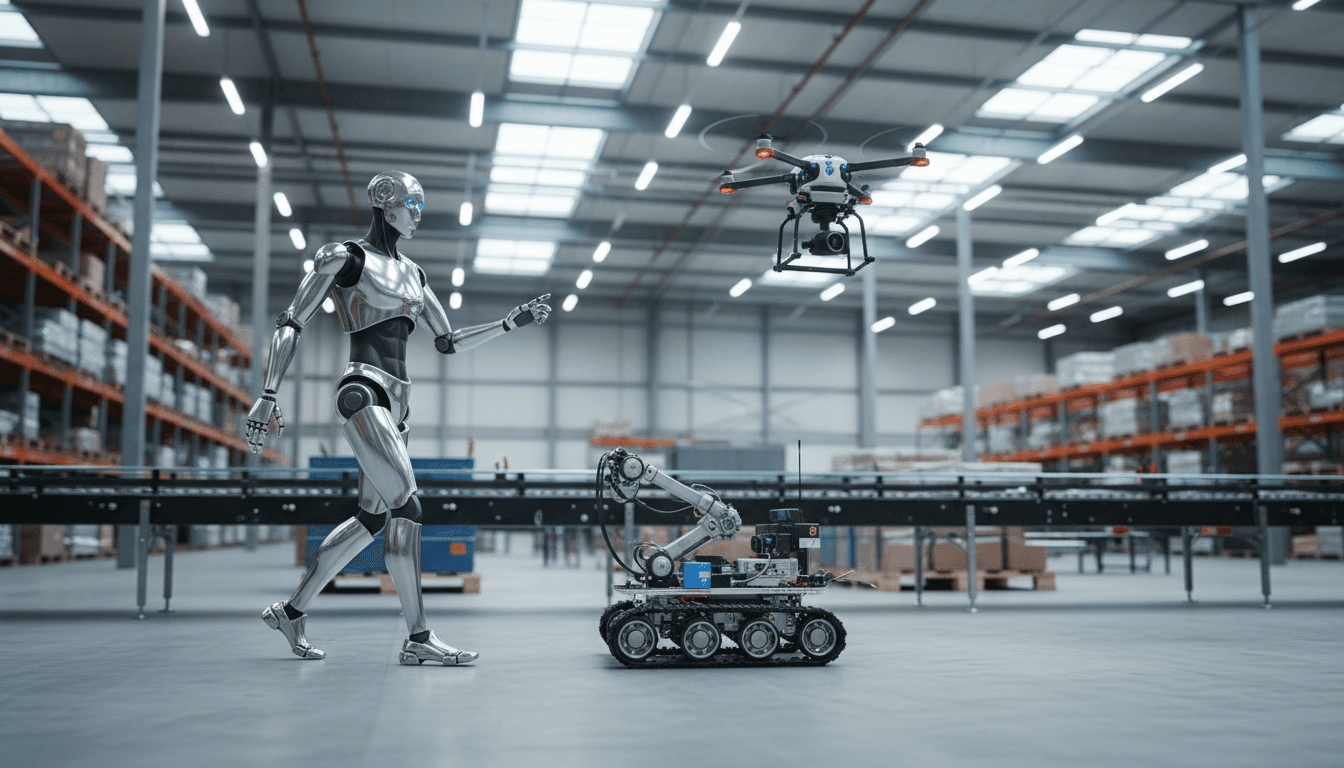
AI Morphing Robots: Walk, Drive, Fly—One System
A morphing robot that walks like a humanoid, drives like a rover, and flies like a drone isn’t just a flashy lab demo—it’s a direct response to a problem most automation leaders run into fast: real facilities aren’t built for one kind of movement.
Researchers at Caltech recently demonstrated a duo that behaves like a team: a humanoid form and a drone form coordinating to cover different mobility modes. The “Transformers” comparison is fun, but the real story is operational: multi-modal robotic systems reduce handoffs, reduce stalled missions, and expand where robots can actually work.
In this installment of our AI in Robotics & Automation series, I’ll break down what this morphing robot duo signals for AI-powered robotics, where the near-term business value is (logistics, manufacturing, inspection), and what you should demand from vendors if you’re evaluating “adaptive” automation.
Why a walk-drive-fly robot matters for automation
Answer first: Most robot deployments fail at the edges—thresholds, stairs, narrow aisles, mixed indoor/outdoor zones, or “last 20 meters” access. A system that can change locomotion mode is a practical way to keep jobs moving instead of escalating to humans.
Traditional fleets split mobility into silos:
- AMRs/AGVs handle flat, mapped floors well.
- Humanoids can manipulate human-made tools and spaces, but are slower and energy-hungry.
- Drones excel at vertical access and fast traversal, but have limited payload and endurance.
The gap shows up in simple scenarios: a pallet arrives at a dock, a part needs delivery to a mezzanine line, a quality issue appears on a high rack, or an inspection point sits across a yard with uneven ground. You end up with handoffs—robot to human, robot to robot, or robot to forklift—and every handoff is where time, safety, and accountability get messy.
A morphing or teaming approach tackles this head-on: use the right locomotion at the right moment, under one orchestration layer. Even if the robot isn’t literally “one body that transforms,” a tightly coordinated duo can behave like a single capability.
The business case is fewer exceptions, not fancy motion
In most facilities, the ROI comes from reducing “exceptions”—the tasks that break the automation flow:
- Getting around temporary obstacles (holiday overflow inventory in December, pop-up staging lanes)
- Crossing between zones (inside/outside, elevator transitions, door thresholds)
- Recovering from navigation failures (blocked aisle, moved racks)
- Reaching vertical targets (upper shelves, overhead utilities)
If your robot can switch modes (or call in its counterpart), you’re not paying for theatrics. You’re paying for higher task completion rate and less human babysitting.
What Caltech’s morphing robot duo signals technically
Answer first: The important innovation isn’t just mechanics—it’s coordination: perception, planning, and control that decide when to walk vs drive vs fly and manage the risks of switching.
The RSS summary describes a humanoid and a drone teaming up to accomplish multiple forms of movement. That hints at an architectural shift: robots aren’t single-purpose machines anymore; they’re increasingly systems-of-systems.
Here are the technical themes that matter for buyers and builders of AI robotics.
1) Multi-modal planning: one mission, multiple bodies
A multi-modal robot has to answer questions that don’t exist in a single-mode world:
- Is it faster to walk around a blockage, drive under a conveyor, or fly over it?
- Does the environment allow flight (airflow, people nearby, ceiling height)?
- What’s the energy cost of each choice, and will the robot still finish the job?
This is where AI planning earns its keep. You need a policy that balances time, energy, and safety—ideally learning from operations over weeks, not hard-coded once.
2) Perception that survives transitions
Walking, driving, and flying produce different camera motion, vibration patterns, and occlusions. A perception stack that works great on a smooth AMR can struggle the moment the robot starts stepping or taking off.
A robust system typically needs:
- Sensor fusion (vision + IMU + depth/LiDAR where appropriate)
- State estimation tuned for different dynamics
- Scene understanding that stays stable when the viewpoint changes quickly
In plain terms: it has to keep “knowing where it is” while the entire way it moves changes.
3) Control and safety: mode switches are where incidents happen
Most robotics incidents happen during transitions: starting, stopping, turning sharply, lifting, docking, undocking, takeoff/landing.
A morphing duo adds more of them:
- Coupling/decoupling (if one robot docks with another)
- Takeoff/landing near people
- Handing off payloads or tools
If you’re evaluating solutions, ask vendors what their safety case looks like specifically during transitions. That’s where the engineering maturity shows.
Snippet-worthy reality: A robot that moves in three ways isn’t 3× as capable—it’s often 10× harder to make safe and reliable. The value is real, but so is the bar.
Where adaptive locomotion wins first: three high-ROI use cases
Answer first: The earliest wins are jobs where terrain, vertical access, and variability defeat single-purpose robots—especially in logistics, manufacturing operations, and industrial inspection.
1) Intralogistics across mixed environments
Many sites have “robot-friendly” zones and “robot-hostile” zones. The hostile ones aren’t exotic—they’re normal:
- Dock plates and thresholds
- Temporary staging areas
- Outdoor connectors between buildings
- Tight aisles created by peak-season overflow
A coordinated humanoid-drone (or drive-fly) system can keep materials moving by selecting the appropriate mobility mode per segment. A practical pattern I’ve seen work conceptually is:
- Drive for the long flat segments (best energy efficiency)
- Walk for precise handoff at human-height stations
- Fly for bypassing congestion or reaching elevated drop points (where permitted)
2) Manufacturing support: “go fetch + go fix + go verify”
Manufacturing has a lot of small tasks that are individually minor but collectively expensive:
- Retrieve a tool, label roll, or part tote
- Verify a gauge reading or machine light state
- Capture a photo of a defect area
- Deliver small components between cells
A humanoid brings manipulation (buttons, latches, drawers). A drone brings rapid situational awareness (quick fly-by inspection, overhead visibility). Coordinated, they can close the loop:
- Drone spots the issue fast
- Humanoid executes the physical intervention
- Drone re-verifies outcome
That’s not “cool robotics.” That’s cycle time and downtime reduction.
3) Inspection and incident response in large facilities
Inspection is a perfect fit for multi-modal mobility because targets are often vertical or awkward:
- Ceiling utilities, cable trays, vents
- High racks and mezzanines
- Roofline checks or exterior façades
- After-hours alarm verification
A drone can do first-look triage. A humanoid can interact with panels, doors, and physical controls if follow-up is needed.
The AI layer that makes multi-robot teams useful
Answer first: The differentiator is orchestration AI—task assignment, shared mapping, and exception handling—more than individual robot skills.
Most companies get distracted by the body. The body matters, but the brain that schedules and coordinates the team is what turns a demo into automation.
Shared world model: one map, multiple perspectives
For a duo to act like one system, they need a shared understanding of:
- Facility layout (static map)
- Dynamic obstacles (people, pallets, temporary racks)
- Restricted zones (no-fly areas, safety curtains, high-traffic times)
The valuable capability here is continuous mapping: the system learns the facility as it changes. In December, that matters because peak volume often forces layout changes that break carefully tuned routes.
Fleet orchestration: dispatching by capability, not by device
In mature automation, tasks are expressed as outcomes (“deliver tote to station 12,” “inspect bay 3 overhead line”). The orchestrator decides who does it and how.
For multi-modal systems, orchestration should handle:
- Capability-based routing (fly segment vs drive segment)
- Battery-aware scheduling across modes
- Priority and SLA logic (production stoppage beats routine inspection)
- Fallback behaviors (if flight is blocked, reroute to walking)
Exception handling: the feature that determines ROI
Here’s my stance: exception handling is the product in real-world robotics.
Ask vendors to demonstrate:
- Recovery from blocked paths
- Lost localization recovery
- Safe pause/resume around humans
- Mode-switch retry logic (what happens after a failed landing?)
If they can’t show recoveries, you’re buying a prototype with a nice video.
What to ask before you invest in “morphing” robotics
Answer first: Don’t buy the promise of multi-modal movement—buy measurable reliability, safety, and integration readiness.
Use these questions in demos, pilots, and RFPs:
- Task completion rate: Over a week of operation, what percent of missions complete without human intervention?
- Mode-switch safety: What’s the validation approach for transitions (takeoff/landing, docking/undocking, walk-to-drive switching)?
- Operational constraints: Where can’t it fly? What are the ceiling height, airflow, and people-density limits?
- Integration: Can it integrate with WMS/MES/CMMS workflows (work orders, inventory moves, inspection logs) without custom heroics?
- Observability: Do you get logs that explain why the robot chose to walk vs fly vs drive? Can ops teams diagnose issues quickly?
- Maintainability: What’s the service interval? How long to swap wear parts? What breaks most often?
- Security and governance: How is video handled, stored, and redacted? Who can access it?
One-liner for decision-makers: If your operations team can’t troubleshoot it at 2 a.m., it’s not automation—it’s a science project.
The bigger trend in AI robotics: adaptable systems beat single-purpose bots
Answer first: The future of intelligent automation is adaptability across environments, not perfect performance in one curated zone.
The Caltech demo is a glimpse of where the industry is going: robots that don’t ask you to redesign your facility around them. They adapt—through multi-modal locomotion, multi-robot collaboration, and AI planning that treats variability as normal.
For leaders building roadmaps in 2026, this matters because the pressure is coming from both sides:
- Facilities are getting more dynamic (shorter product cycles, seasonal surges, space constraints)
- Labor constraints keep pushing more “edge tasks” onto automation
A robot that can only drive on a clean floor will always hit a ceiling. A system that can walk, drive, and fly—coordinated by AI—keeps expanding its usable footprint.
If you’re exploring AI-powered robotics for logistics, manufacturing support, or inspection, the next step is simple: pick one workflow with high exception rates and test whether multi-modal mobility reduces escalations and downtime.
Where in your facility do tasks fail today because the robot can’t reach, can’t pass, or can’t see—and what would change if it could switch modes on the fly?