Crane-fly-inspired legs help RoboBee land reliably. Here’s what it teaches about AI landing control, docking, and real-world automation.
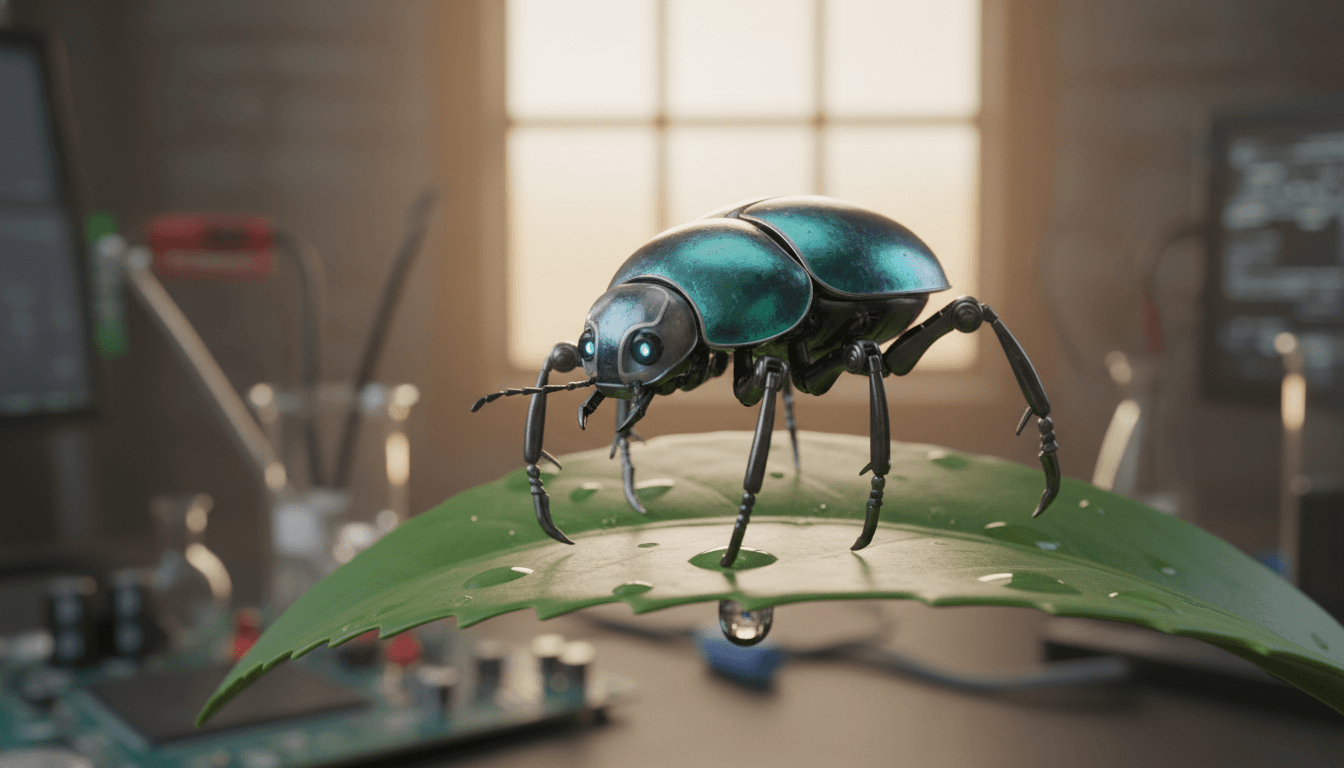
AI Landing Control: What RoboBee Legs Teach Automation
Landing is where autonomy stops being theoretical.
If you work in robotics, you’ve seen it: a robot can navigate beautifully—until the last 20 centimeters. That final moment is where airflow gets messy, sensors saturate, contact dynamics get weird, and your “nearly solved” demo turns into a tipped platform, a broken prop, or a failed pick-and-place.
Harvard’s latest RoboBee update—adding crane-fly-inspired legs plus a smoother landing control algorithm—matters for a reason that goes beyond insect robots. It’s a crisp example of how biomimicry + AI control turns fragile prototypes into systems that can actually operate in real environments. And that’s the difference between a research video and an automation deployment.
The real problem: ground effect turns “hover” into chaos
Ground effect is the hidden tax on small flying robots. When a flapping-wing micro air vehicle (MAV) like RoboBee approaches a surface, vortices and turbulent flow get trapped between the wings and the ground. The air cushion sounds helpful, but for tiny vehicles it can be destabilizing—especially when the vehicle has minimal mass and tiny control authority.
In the RoboBee’s earlier form, landing was basically: cut power slightly above the surface and hope it drops upright. That’s not a “landing mode.” It’s a coin flip.
For automation leaders, the translation is straightforward:
- Autonomous systems fail most often during transitions: air-to-surface, surface-to-grasp, grasp-to-place.
- The last step is where uncertainty spikes and mechanical tolerances matter.
- If you can’t control contact reliably, you can’t scale operations.
Why this shows up in logistics and service robotics
The same physics-meets-contact problem shows up across modern automation:
- Indoor drones that must land on charging pads or docking rails.
- Inventory-scanning drones that need stable perch points to save energy.
- Hospital and hotel service robots transitioning from smooth floors to ramps, carpets, elevator thresholds.
- Warehouse mobile manipulators aligning to shelves, conveyors, and totes.
The lesson: autonomy isn’t only perception and planning. It’s also “closing the loop” through the messy final interaction with the world.
Why crane fly legs are the right kind of biomimicry
Crane flies are good at soft landings because their legs buy them time. Long, flexible, jointed legs reach the surface first, allowing the body to remain higher—away from the worst turbulence—while the insect stabilizes.
Harvard’s redesign gives RoboBee four long, compliant legs inspired by crane flies. The key mechanical idea isn’t “legs” in general; it’s this:
A good landing system separates “first contact” from “body contact,” creating a controlled buffer zone.
That buffer zone is doing several jobs at once:
- Avoiding destabilizing flow near the ground by keeping the main body higher.
- Increasing the margin for error in attitude and descent rate.
- Turning impact into a manageable event via flex and compliance.
This matters more at small scales
RoboBee is tiny—under 3 cm wingspan and roughly 0.1 g in mass—and (in the demonstrated versions) tethered to power and compute. At that scale, small disturbances are big problems.
But the design principle scales upward:
- For micro-drones, “landing gear” isn’t cosmetic; it’s control authority.
- For larger drones, compliant landing structures reduce bounce, slip, and tip-over on imperfect surfaces.
- For legged robots, compliant feet and ankles reduce the need for perfect terrain maps.
In other words, bio-inspired mechanics often reduce the burden on AI. You still want smart control, but you don’t want to ask your controller to defeat physics with milliseconds and miracles.
The underappreciated hero: landing is an AI control problem
The RSS article mentions a “new control algorithm” that guides RoboBee more smoothly to the ground rather than letting it drop. That line hides the real point:
A stable landing requires a dedicated control regime, not just a slowed-down flight regime.
In practical robotics terms, you’re switching between controllers and objectives:
- In free flight: stabilize attitude, track velocity/position, reject disturbances.
- In approach: manage descent while anticipating aerodynamic interactions.
- In contact: detect touchdown, prevent rebound, stabilize with intermittent constraints.
What “AI landing control” usually means in deployed robots
Most real systems blend classic control with learning-based components:
- Model-based control for guaranteed stability margins (PID/LQR/MPC).
- State estimation that fuses IMU, optical flow, cameras, range sensors.
- Learning components that handle the parts modeling struggles with:
- contact detection thresholds
- surface variability (dust, slope, compliance)
- aerodynamic quirks near obstacles
- perching/landing site scoring
If you’re building for logistics or service environments, here’s the stance I’ll take: don’t start with end-to-end learning for landing. Start with a reliable controller, then use learning to expand the envelope. Landing is too safety-critical and too scenario-diverse to treat as a single black box.
A simple but powerful framing: “energy management”
If you want a landing system your ops team can trust, design it around energy.
- Reduce kinetic energy before contact (descent shaping).
- Dissipate what remains via compliant structures (legs/feet).
- Prevent energy from turning into bounce or tip (post-contact stabilization).
RoboBee’s crane-fly legs are effectively an energy-management device. The control algorithm is the other half: it ensures contact happens inside a safe energy window.
What this enables: perching, docking, and repeatable autonomy
The RoboBee work is often discussed in futuristic contexts like crop pollination or search and rescue. Those are valid long-term visions. But the nearer-term, money-on-the-table path is more mundane:
reliable landing unlocks repeatable operations.
Docking is the real commercial requirement
Most autonomous aerial robots hit a wall on endurance and uptime. Docking solves that.
A drone that can:
- land precisely on a charging pad,
- make contact without bouncing,
- and take off reliably from cramped locations,
…is one step closer to being a 24/7 system instead of a lab prototype.
And docking isn’t only charging. It’s also:
- data offload
- tool swapping
- payload exchange
- sheltered standby (noise reduction, safety)
Precision landing also improves safety cases
For regulated or semi-regulated settings (warehouses with people, hospitals, public facilities), the safety argument often hinges on controlling the end state:
- predictable touchdown location
- predictable shutdown behavior
- predictable failure modes
A “drop and pray” landing approach is hard to certify, hard to insure, and hard to scale.
Design takeaways you can apply to automation projects now
You don’t need flapping wings or insect scale to benefit from this.
Here are practical, field-tested principles that mirror what RoboBee’s update demonstrates.
1) Use mechanics to simplify control
If your controller needs perfection, your robot won’t survive operations. Add passive stability where you can:
- compliant landing feet
- flexures that absorb impact
- wider stance at touchdown
- sacrificial bumpers around sensitive components
A small mechanical change can remove whole categories of corner cases from your software backlog.
2) Treat landing as a separate autonomy mode
Build explicit phases with clear switching logic:
- approach
- flare (final descent shaping)
- touchdown detection
- settle (anti-bounce)
- safe shutdown or dock latch
This helps debugging, logging, and root-cause analysis—especially in multi-robot fleets.
3) Instrument the last 20 cm aggressively
The final moments need dedicated sensing. Common stack choices include:
- downward range (ToF/LiDAR)
- optical flow for near-ground velocity
- IMU for attitude and vibration signatures
- motor current/torque signatures (contact hints)
A surprising number of “AI landing problems” are really “we didn’t measure the right things” problems.
4) Train for variability, not perfection
If you use learning (imitation learning or reinforcement learning) for landing refinements, include variability by design:
- different surface textures and friction
- slopes and small steps
- airflow disturbances (fans, HVAC)
- lighting changes for vision
The goal isn’t a perfect landing on one pad. It’s a robust landing across many pads.
5) Define success like operations would
In research, a successful landing is “it didn’t crash.” In automation, success is measurable:
- touchdown within X cm of target
- body roll/pitch under Y degrees after settle
- time-to-dock under Z seconds
- retry rate under N per 1,000 landings
If you can’t write the acceptance test, you’re not done designing.
Where this fits in the “AI in Robotics & Automation” series
A lot of AI-in-robotics content focuses on perception—detection, segmentation, mapping. That’s necessary, but incomplete.
RoboBee’s crane-fly-inspired legs highlight a more scalable truth:
The best automation systems co-design AI and hardware so the “hard parts” become smaller.
When teams ignore that and chase smarter models alone, they often build robots that look impressive in demos and fragile in production.
If you’re planning autonomy for logistics, service robotics, or facility operations in 2026 budgets, landing and contact transitions deserve a real line item—engineering time, test time, and design iterations.
The forward-looking question is simple: what other “last 20 cm” failures in your automation pipeline could be solved faster by changing the mechanics, not just the model?