Inside Hyundai’s Metaplant, AI, robots, and AGVs run EV production at scale. Learn what smart factories can copy to boost throughput and quality.
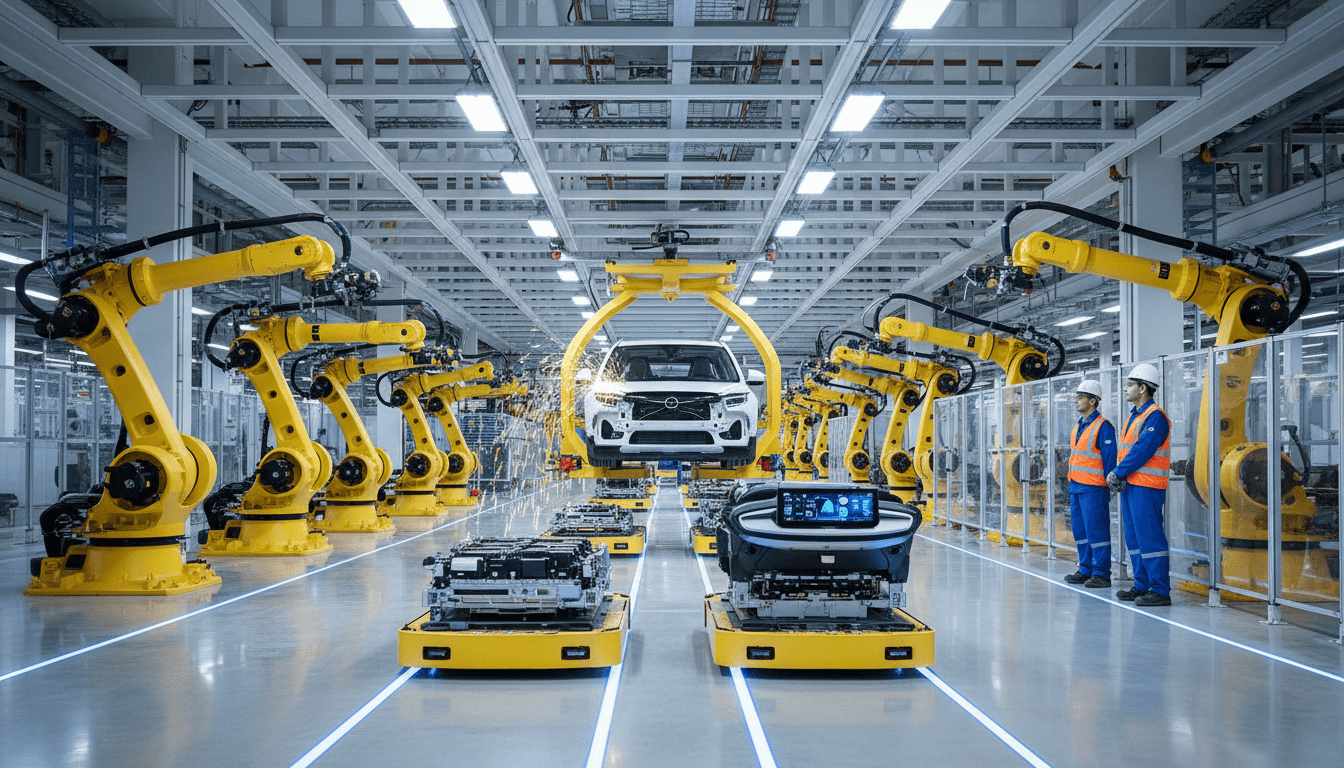
AI Robots Power Hyundai’s Metaplant EV Factory
A modern EV factory doesn’t win by hiring the most people—it wins by eliminating the most waiting.
Hyundai Motor Group’s $7.6 billion Metaplant near Savannah, Georgia is built around that idea. At full ramp, it’s designed for 500,000 EVs per year across Hyundai, Kia, and Genesis. Yet during early production, Hyundai was pushing vehicles down the line with roughly 1,340–1,400 workers, surrounded by a much larger workforce of machines: about 850 robots plus around 300 automated guided vehicles (AGVs) that handle material movement and “just in time” delivery.
For our AI in Robotics & Automation series, this plant is a useful reality check. The conversation about “smart factories” often gets stuck at buzzwords. The Metaplant shows what actually matters: AI-driven logistics, machine vision quality control, collaborative robotics, and flexible automation that can survive demand swings—including the very real 2025 headwinds of slower EV adoption and shifting U.S. incentives.
The real AI story: flow, not flashy robots
The fastest way to improve output in manufacturing is to reduce variation and delay. The Metaplant’s most important “AI” isn’t a humanoid on the line—it’s the system that keeps every station fed with the right part at the right time.
Hyundai’s approach pairs automation on the physical side (AGVs, robotic unloaders, robotic sleds) with software that behaves like a factory-wide nervous system. If you’re evaluating industrial AI for your own operation, here’s the key point:
AI in manufacturing pays back when it manages constraints—material availability, sequence timing, and quality escapes—not when it merely replaces a human motion.
In practical terms, Metaplant automation reduces the two costliest factory failures:
- Starving the line (a station waits because parts aren’t there)
- Blocking the line (a station can’t pass work forward due to downstream delay)
Once you stop those, the plant’s “automation level” stops being a vanity metric and starts being a throughput strategy.
AGVs as the factory’s circulatory system
AGVs at the Metaplant don’t follow tracks; they navigate with sensors and onboard intelligence, slow or stop near people, and even provide spoken warnings. Their job isn’t glamorous, but it’s foundational: remove the decision burden from humans for routine material moves.
Hyundai’s assembly leadership describes it plainly: the AGVs deliver the right part to the right station at the right time so workers aren’t making thousands of micro-decisions that inevitably create mistakes, delays, and rework.
If you run operations, this is the part to copy first. Not the humanoid. Not the “fully lights-out” dream. Start with material flow automation because it:
- Improves uptime without touching the process itself
- Produces clear data exhaust for analytics (delivery times, dwell times, bottlenecks)
- Reduces hidden labor (expediting, searching, staging, and “parts firefighting”)
Robots do repetition; humans do craftsmanship (when it’s designed right)
A lot of plants say “humans do the skilled work.” Few design the line so that’s actually true.
At Metaplant, the pattern is clearer: robots handle heavy, repetitive, high-precision tasks; people do the work that still benefits from human perception and dexterity. You see it in the welding hall—hundreds of robots forming car bodies with consistent speed and safety—and you also see it in final assembly, where tactile alignment, nuanced inspection, and nuanced fit-and-finish still matter.
One quote from Hyundai’s assembly management captures the design intent: pay people for what humans do well, and remove the tedious tasks.
Collaborative robots where they make economic sense
One of the best examples is door installation. Hanging doors is deceptively hard: heavy parts, tight tolerances, and paint you can’t scratch. A collaborative robot can do this “perfectly” and repeatedly, provided the cell is engineered correctly with sensing, force control, and safety-rated systems.
This is an important stance for anyone planning an AI robotics rollout:
Collaborative robots aren’t a philosophy; they’re a cost model. Use them where consistency prevents expensive defects.
If your defect costs are high (paint, sealing, water leaks, NVH issues), a cobot that eliminates variation can pay for itself faster than a faster robot elsewhere.
Flexibility beats maximum automation
Hyundai emphasizes adaptability: lines that can adjust to changing production mixes and future models. That matters more in late 2025 than it did a few years ago.
EV demand isn’t a straight line. Incentives change. Tariffs change. Supply chains wobble. A plant that can’t change model mix quickly becomes a stranded asset.
So the strategic takeaway is simple:
- Build automation that can be reprogrammed (software-defined behaviors)
- Prefer modular cells over giant, monolithic systems
- Keep manual fallback stations so maintenance doesn’t stop the whole line
This “automation with escape hatches” is what separates reliable plants from impressive tours.
AI-driven quality: machine vision, sensing, and mobile inspection
The Metaplant highlights a shift that’s becoming standard across advanced manufacturing: quality isn’t only checked at the end. It’s measured continuously.
In body assembly, robots use machine vision and laser measurement to ensure correct alignment and fit of panels (like doors), and to validate torque specs for bolts. That’s not just about reducing scrap; it reduces the most expensive form of waste: shipping defects.
Why a robot dog belongs in a car factory
Hyundai-owned Boston Dynamics’ Spot is used to inspect body welds for potential defects. The point isn’t novelty—it’s mobility.
Fixed camera systems are great, until the inspection target moves, lighting shifts, or a new model changes the geometry. A mobile platform can:
- Inspect multiple stations without duplicating hardware
- Re-run checks after maintenance events
- Reach awkward angles humans hate to inspect repeatedly
Spot also represents a larger trend: robots as data collectors. The value isn’t the walking—it’s the structured inspection data you can attach to VIN, shift, and tooling conditions.
Humanoids: useful, but only if they earn their floor space
Hyundai is experimenting with humanoid robots (Atlas) for tasks like welding. People tend to fixate on humanoids as a symbol of “the future factory.” I’m more skeptical.
Humanoids make sense when you have three conditions:
- The task environment is built for humans (stairs, ladders, tight access)
- The task mix changes often (high mix, low volume)
- Tooling cost for dedicated automation is too high
In high-volume welding lines—where conventional industrial robots are already dominant—the question is whether humanoids reduce integration time or increase flexibility enough to offset complexity.
The Metaplant is a good reminder to stay pragmatic: humanoids are a strategy for flexibility, not a badge of technological superiority.
Scaling EV production in the U.S. means automating the boring parts
Hyundai’s Georgia build is also an onshoring story: a major investment supported by $2.1 billion in state subsidies, paired with a growing U.S. manufacturing footprint (including a battery JV with LG Energy Solution planned to produce lithium-ion cells in 2026).
But it’s happening in a choppy policy and demand environment:
- EV adoption has slowed compared to earlier forecasts
- The U.S. clean-car tax credit that helped drive sales is being phased out
- Trade tensions and enforcement actions can disrupt staffing and timelines
In that reality, automation is less about “the factory of the future” and more about survivability.
The throughput math is changing
Legacy auto history was built on massive labor pools—think of the River Rouge era. Plants like Metaplant reflect a different equation:
- Higher automation density
- Smaller direct headcount
- Higher wages for the remaining roles (Hyundai cited average pay around $58,100, roughly 35% higher than the local county average)
For operations leaders, this is the strategic pivot:
The goal isn’t replacing people. It’s building a line where each person’s work is high-value, supported by robots that remove fatigue, risk, and variation.
If you’re selling into manufacturing (robotics integrator, AI platform, sensors, MES, safety systems), that’s also your messaging: you’re not “automating jobs,” you’re stabilizing throughput and quality.
What automation leaders can copy from Hyundai’s playbook
If you want actionable steps—not a factory tour—here are patterns worth stealing.
1) Start with “just in time” material intelligence
AGVs are only half the story. The real win comes from the rules engine behind them: priority queues, route optimization, station consumption rates, and exception handling.
A practical first project often looks like:
- Instrument high-runner parts with better traceability
- Add dynamic replenishment triggers (not fixed schedules)
- Use simulation to stress-test peak conditions before deployment
2) Put machine vision where defects get expensive
Don’t blanket the factory with cameras. Place vision where it prevents:
- Paint and panel damage
- Sealing and water-leak failures
- Torque and fastening errors on safety-critical assemblies
Then tie it to a closed-loop response: stop, rework, or auto-adjust tooling.
3) Design cobots around ergonomics and defect prevention
The best cobot tasks share a theme: they either protect people’s bodies (heavy lifting, awkward postures) or protect the product (repeatability, delicate handling). Door install is a perfect example.
4) Build manual “bypass” stations on purpose
Hyundai’s inclusion of backup stations for operations like battery fasteners is an underappreciated reliability pattern. If one automated cell goes down, you don’t want the entire line to stop.
If you’re planning a smart factory roadmap, treat bypass capacity as insurance.
5) Treat mobile robots as quality and maintenance multipliers
Mobile inspection robots can expand coverage without duplicating fixed sensors everywhere. They also create a repeatable inspection routine that doesn’t depend on shift-to-shift human variation.
Where this is heading in 2026: software-defined factories
The Metaplant already points to the next phase of AI in robotics and automation: factories that behave more like software products.
As battery plants come online and EV platforms iterate, the winners will be the manufacturers that can:
- Rebalance lines quickly for different models
- Update robot behaviors safely and frequently
- Use quality data to predict failures before they show up as warranty claims
That requires more than robots—it requires an AI-ready data architecture: standardized event logs, consistent part traceability, and governance that lets operations teams trust the numbers.
For readers following this series, Hyundai’s Metaplant is a real-world marker: AI in manufacturing has moved from pilot projects to production-critical infrastructure.
If you’re planning your next automation investment, here’s the question I’d ask before buying another robot: Which constraint in my plant is truly limiting output—and can AI remove that constraint without adding new fragility?